

The World Model Remembers, the Actor Forgets: Dream Rehearsal for Continual Model-Based RL
Paper • 2607.19749 • Published • 1



When a reinforcement-learning agent "catastrophically forgets" a skill, we measured which part actually forgot. The answer: none of the memory. The world model retains everything — reward structure, values, dynamics. Only the behavior decays. And a lost skill can be restored by having the agent imitate its own graded dreams, with zero new environment interaction.
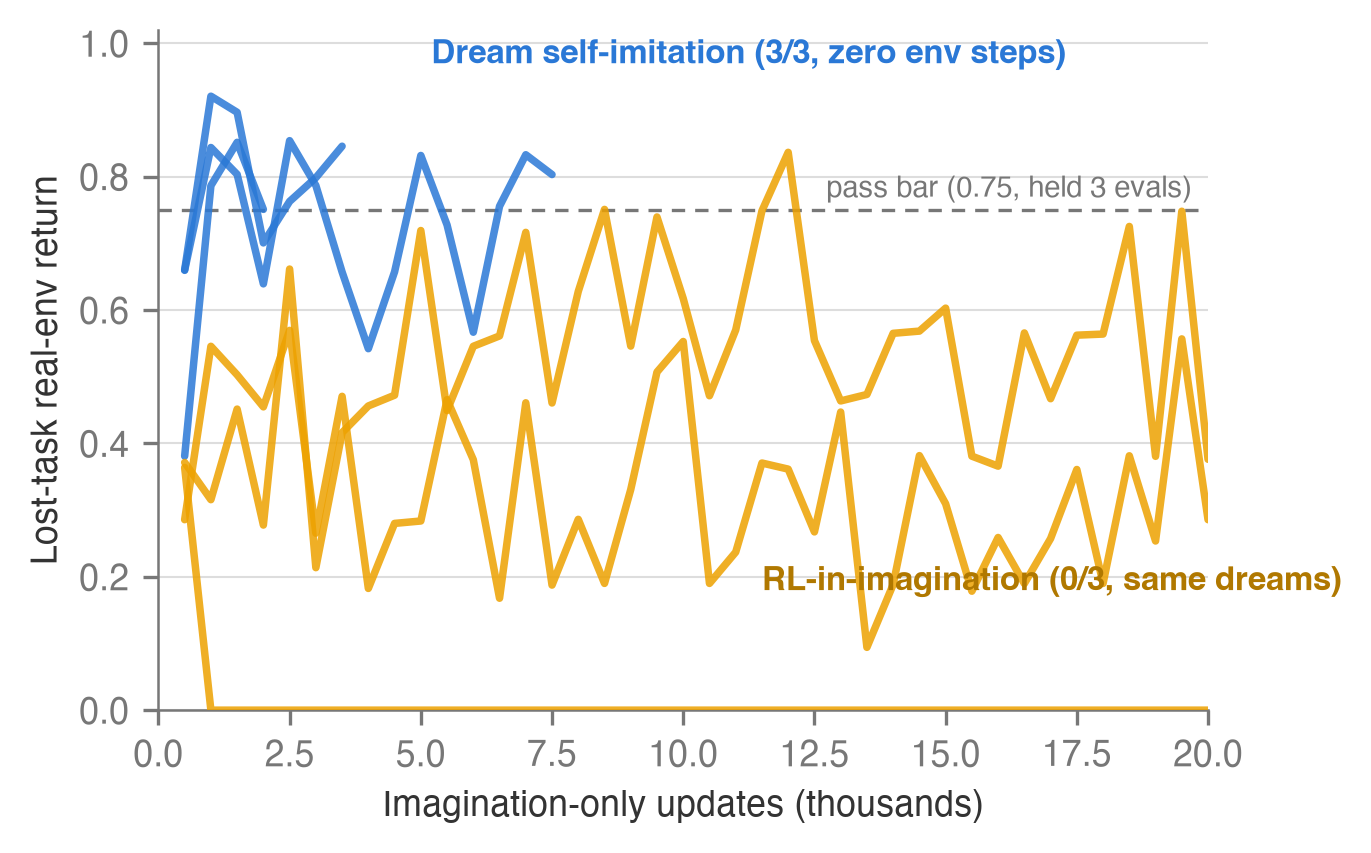
The recovery race. Same frozen world model, same imagined data, two teachers.
Reinforcement learning in imagination (orange) fails on 3/3 seeds. Supervised imitation of
the model's own graded dreams (blue) recovers the lost skill on 3/3 — without touching the
environment. The learning channel is what's broken, not the memory.
Four-task chains (DoorKey-5x5 → SimpleCrossing → LavaGap → MultiRoom), n=3 seeds:
| Plain replay | Frozen heads + router | Dream rehearsal | |
|---|---|---|---|
| Chains retained (all 4 tasks ≥ 0.6) | 0 / 3 | 3 / 5 | 3 / 3 |
| Hardest-task retention | 0.37 | 0.62 ± 0.13 | 0.82 |
| Task labels needed | no | no | no |
| Extra parameters | none | +1 policy per task | none |
Eight-task chains — same recipe, same constants, double the length. All three seeds retain all eight tasks (pass bar 0.6 on every task; per-seed final retention):
| Seed | DoorKey5 | SimpleX | LavaGap | MultiRoom | LavaCross | DistShift | DoorKey6 | Unlock |
|---|---|---|---|---|---|---|---|---|
| 1 | 0.964 | 0.943 | 0.947 | 0.759 | 0.861 | 0.960 | 0.915 | 0.861 |
| 2 | 0.963 | 0.919 | 0.943 | 0.746 | 0.865 | 0.929 | 0.962 | 0.888 |
| 3 | 0.901 | 0.876 | 0.942 | 0.754 | 0.794 | 0.959 | 0.962 | 0.740 |
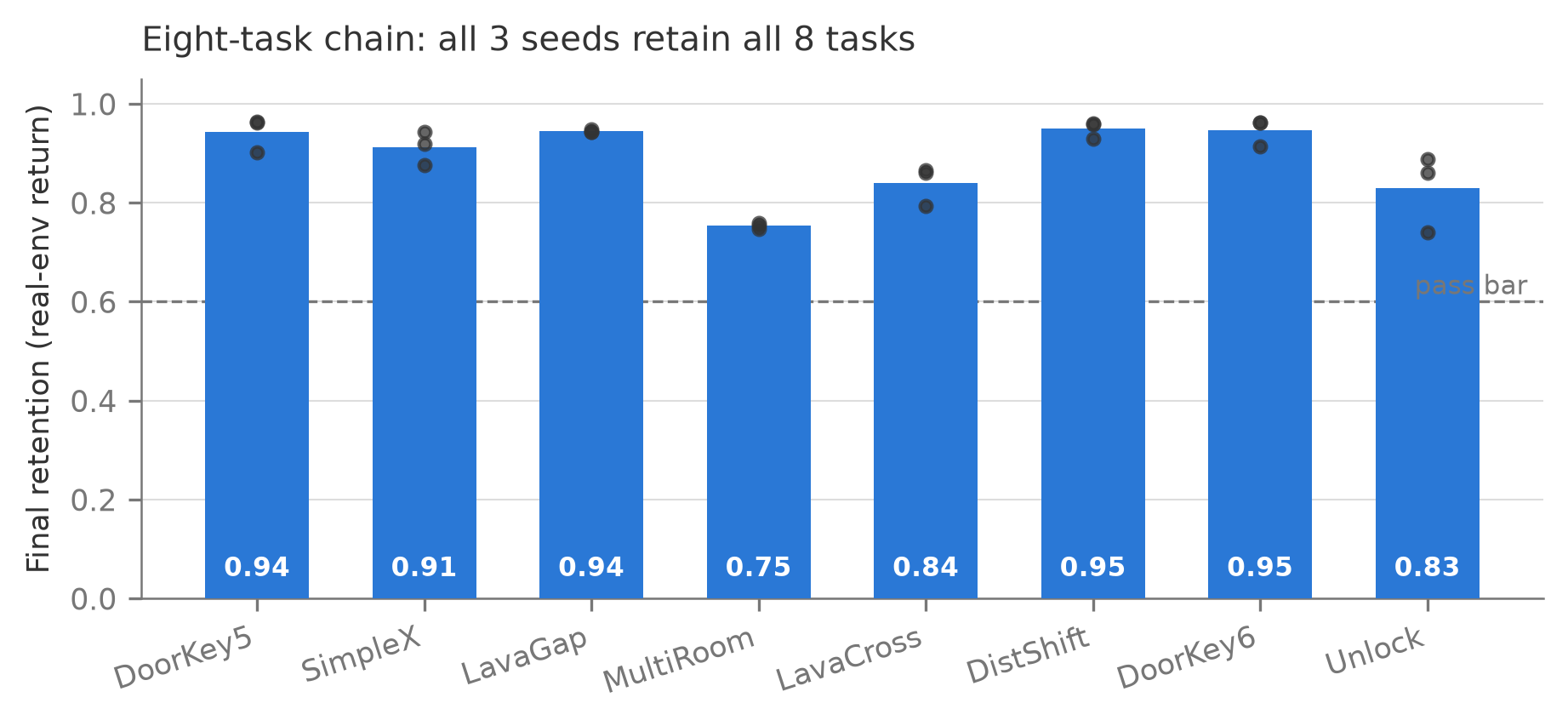
Eight-task chain: bar = cross-seed mean, dots = individual seeds, dashed line = pass
bar. No baseline arm is shown because none was run at this length — plain replay already
fails at four tasks. Generated directly from the released summaries in
results/ by
make_fig3_eight.py.
By the final phase the agent runs 350 dream-imitation updates per 2,000-step chunk across
seven prior tasks — still one actor, still no task labels, still no added parameters. The
baselines were not run at eight tasks: plain replay already fails at four, so the comparison
was made where it is informative (raw per-run data for every run above is in
results/).
Dream rehearsal also outperforms matched real-episode cloning (paired difference +0.13, bootstrap 95% CI [0.07, 0.24], every dream seed above every cloning seed) — §6.2 of the paper gives the pre-registered comparison, including the bug we caught in our own favour and killed before reading any verdict.
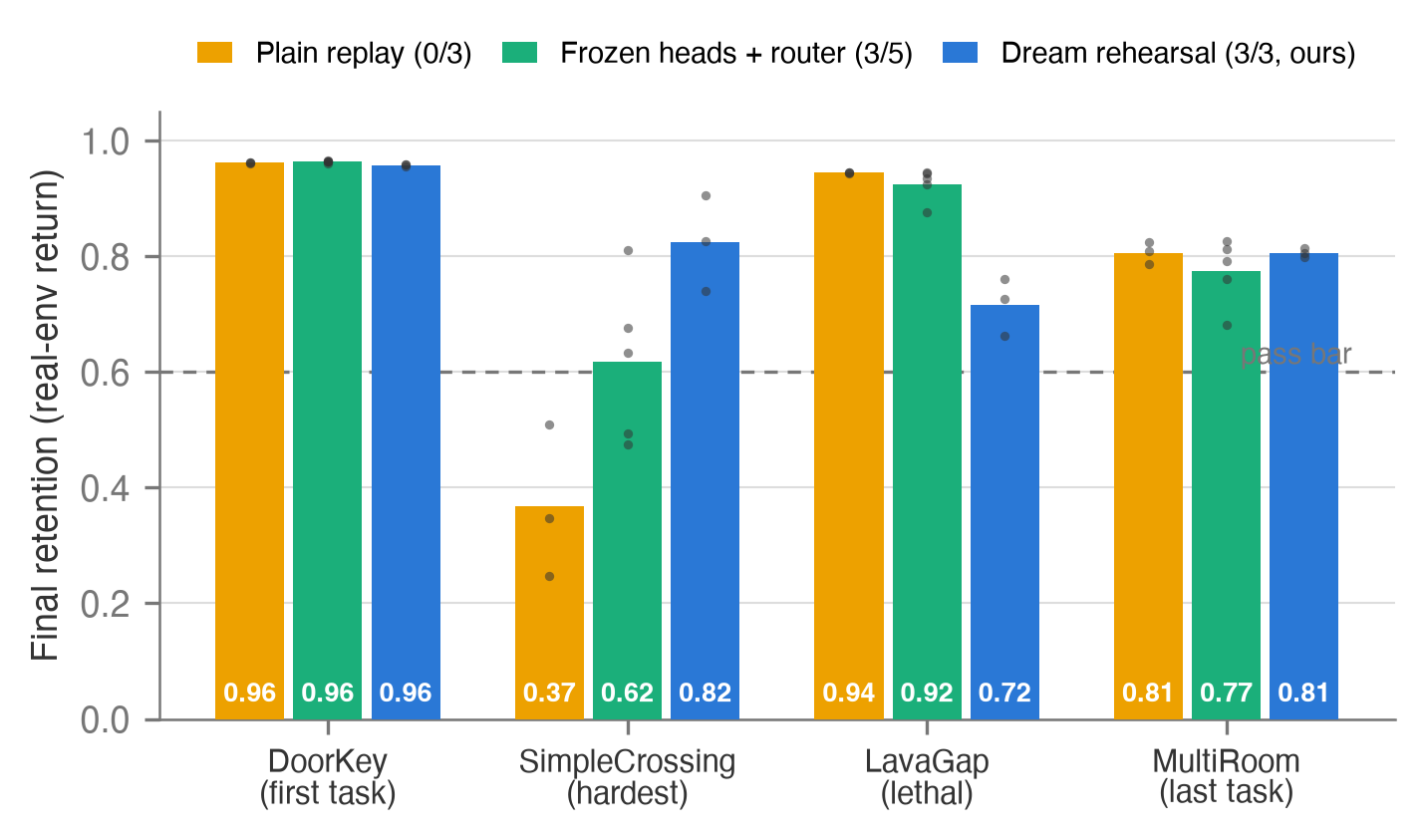
Final retention across the four-task chain; per-seed points over bar means.
Every 2,000 environment steps, while learning a new task, the agent:
One actor throughout. No task labels at any point, no stored policies, no router, no parameter growth, ~15% compute overhead. The grading step is where the difficulty lives — get it wrong and the agent imitates walking into lava (§7 characterizes two ways that happens, and ships the offline gauge that catches them before they cost training time).
paper/ |
The paper (PDF + LaTeX source) and figures |
src/ |
Orchestrators, probes, the offline selection gauge, sweep scripts |
prereg/ |
The full pre-registration trail — every protocol, bar, and interpretation matrix, committed before its experiment ran, including refuted hypotheses and both scoring bugs |
results/ |
31 runs — per-run summaries and complete evaluation traces for every experiment in the paper (see results/README.md for the run-to-section map) |
substrate/ |
Environment wrapper + setup notes |
Every experiment was pre-registered before it ran. Bars, arms, and interpretation matrices were committed to version control first; refuted hypotheses appear in the main text, not in a footnote. Total compute: one NVIDIA GB10 workstation, roughly three weeks.
Runs on NM512/dreamerv3-torch — see
substrate/SETUP.md for the three-step install, then:
python orchestrator_chain_nm512.py \
  --tasks minigrid_DoorKey-5x5,minigrid_SimpleCrossingS9N1,minigrid_LavaGapS5,minigrid_MultiRoom-N2-S4 \
  --tunnel_rehearsal --cont_grading --rehearsal_updates 50 \
  --eval_every 2000 --phase_max_steps 150000 --logdir ./tunl4b_s1 --seed 1
@article{nijjer2026dreamrehearsal,
  title={The World Model Remembers, the Actor Forgets: Dream Rehearsal for Continual Model-Based RL},
  author={Nijjer, Gurp},
  year={2026},
  eprint={2607.19749},
  archivePrefix={arXiv},
  primaryClass={cs.LG},
  doi={10.5281/zenodo.21462836},
  note={https://github.com/gurpnijjer/dream-rehearsal}
}
Gurp Nijjer — Quantegra Research · Apache-2.0 · paper · archive