

The dataset viewer is not available for this split.
Error code:   FeaturesError
Exception:    ArrowInvalid
Message:      JSON parse error: Invalid value. in row 0
Traceback:    Traceback (most recent call last):
                File "/usr/local/lib/python3.14/site-packages/datasets/packaged_modules/json/json.py", line 324, in _generate_tables
                  df = pandas_read_json(f)
                File "/usr/local/lib/python3.14/site-packages/datasets/packaged_modules/json/json.py", line 38, in pandas_read_json
                  return pd.read_json(path_or_buf, **kwargs)
                         ~~~~~~~~~~~~^^^^^^^^^^^^^^^^^^^^^^^
                File "/usr/local/lib/python3.14/site-packages/pandas/io/json/_json.py", line 791, in read_json
                  json_reader = JsonReader(
                      path_or_buf,
                  ...<16 lines>...
                      engine=engine,
                  )
                File "/usr/local/lib/python3.14/site-packages/pandas/io/json/_json.py", line 905, in __init__
                  self.data = self._preprocess_data(data)
                              ~~~~~~~~~~~~~~~~~~~~~^^^^^^
                File "/usr/local/lib/python3.14/site-packages/pandas/io/json/_json.py", line 917, in _preprocess_data
                  data = data.read()
                File "/usr/local/lib/python3.14/site-packages/datasets/utils/file_utils.py", line 844, in read_with_retries
                  out = read(*args, **kwargs)
                File "<frozen codecs>", line 325, in decode
              UnicodeDecodeError: 'utf-8' codec can't decode byte 0x89 in position 0: invalid start byte

              During handling of the above exception, another exception occurred:

              Traceback (most recent call last):
                File "/src/services/worker/src/worker/job_runners/split/first_rows.py", line 243, in compute_first_rows_from_streaming_response
                  iterable_dataset = iterable_dataset._resolve_features()
                File "/usr/local/lib/python3.14/site-packages/datasets/iterable_dataset.py", line 4379, in _resolve_features
                  features = _infer_features_from_batch(self.with_format(None)._head())
                                                        ~~~~~~~~~~~~~~~~~~~~~~~~~~~~^^
                File "/usr/local/lib/python3.14/site-packages/datasets/iterable_dataset.py", line 2661, in _head
                  return next(iter(self.iter(batch_size=n)))
                File "/usr/local/lib/python3.14/site-packages/datasets/iterable_dataset.py", line 2839, in iter
                  for key, pa_table in ex_iterable.iter_arrow():
                                       ~~~~~~~~~~~~~~~~~~~~~~^^
                File "/usr/local/lib/python3.14/site-packages/datasets/iterable_dataset.py", line 2377, in _iter_arrow
                  yield from self.ex_iterable._iter_arrow()
                File "/usr/local/lib/python3.14/site-packages/datasets/iterable_dataset.py", line 536, in _iter_arrow
                  for key, pa_table in iterator:
                                       ^^^^^^^^
                File "/usr/local/lib/python3.14/site-packages/datasets/iterable_dataset.py", line 419, in _iter_arrow
                  for key, pa_table in self.generate_tables_fn(**gen_kwags):
                                       ~~~~~~~~~~~~~~~~~~~~~~~^^^^^^^^^^^^^
                File "/usr/local/lib/python3.14/site-packages/datasets/packaged_modules/json/json.py", line 327, in _generate_tables
                  raise e
                File "/usr/local/lib/python3.14/site-packages/datasets/packaged_modules/json/json.py", line 290, in _generate_tables
                  pa_table = paj.read_json(
                      io.BytesIO(batch), read_options=paj.ReadOptions(block_size=block_size)
                  )
                File "pyarrow/_json.pyx", line 342, in pyarrow._json.read_json
                File "pyarrow/error.pxi", line 155, in pyarrow.lib.pyarrow_internal_check_status
                  return check_status(status)
                File "pyarrow/error.pxi", line 92, in pyarrow.lib.check_status
                  raise convert_status(status)
              pyarrow.lib.ArrowInvalid: JSON parse error: Invalid value. in row 0
Need help to make the dataset viewer work? Make sure to review how to configure the dataset viewer, and open a discussion for direct support.
RDDAC — Real Deep Drawing and Cutting Dataset






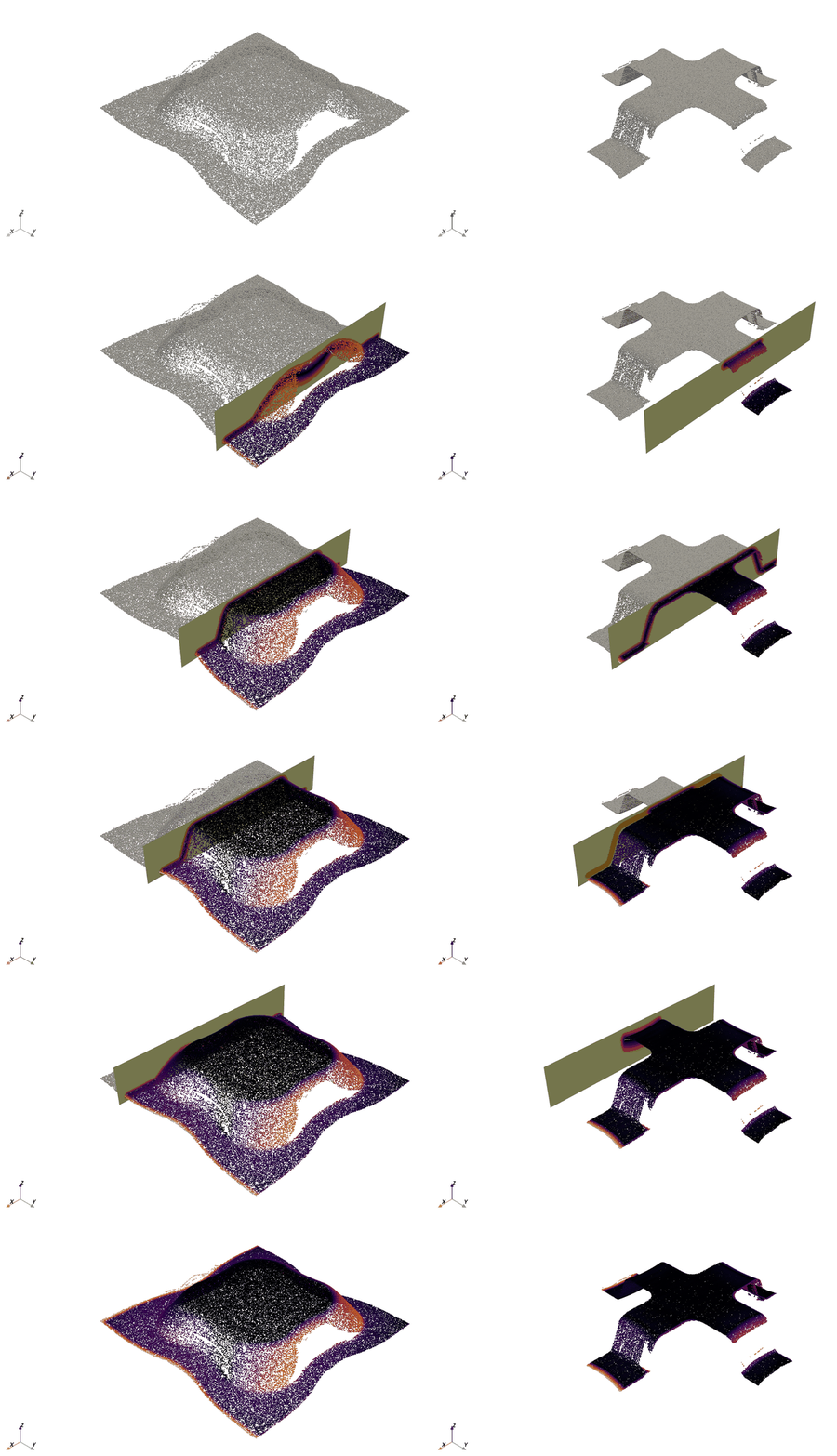
Measured point clouds of one experiment after deep drawing (OP10, left) and cutting (OP20, right), colored by the deviation from the matching DDACS simulation.
A large-scale experimental dataset of 9,000 physical deep-drawing and cutting experiments — the real-world counterpart to the DDACS FEM simulations. Each experiment forms a modified quadratic cup from DP600 dual-phase steel (deep drawing in OP10, cutting in OP20) and records press force signals, sheet-thickness and oil-film traverses, and high-resolution 3D laser scans of the part after each operation. Use it to quantify the simulation-to-reality gap, train models on real process data, or validate DDACS-trained surrogates against physical measurements.
| Experiments | 9,000 |
| Total size | ~87 GB (HDF5, lossless) |
| Process steps per experiment | 2 (OP10 deep drawing, OP20 cutting) |
| Parameter space | 2 geometries x 3 blankholder forces x 3 oil types (18 categories) |
| Repetitions | up to 500 per category |
| Train / val / test | 7,200 / 900 / 900 (predefined, seed 42) |
| Matching simulations | DDACS rddac.zip (~9 GB), fetched by rddac download |
Documentation · Dataset DOI · Paper
About this sample
This is a ~174 MB teaser of RDDAC — 18 experiments (one per category) plus the Croissant 1.1 manifest, the complete process-parameter table, and the six tutorial notebooks — so you can explore the schema and run every tutorial in seconds before committing to the full download.
data/
  metadata.json             Croissant 1.1 manifest (the dataset schema)
  process_parameters.csv    parameters + splits for all 9,000 experiments
  h5/sample.zip             18 experiments, one per category (all modalities)
rddac_documentation.pdf     dataset documentation
notebooks/                  six end-to-end tutorials (see notebooks/README.md)
Croissant manifest. data/metadata.json is the
Croissant 1.1 manifest — the machine-readable
schema (every HDF5 field and CSV column) that rddac.load() and any
Croissant-aware tool consume. It is the same manifest published with the full
dataset on DaRUS (doi:10.18419/DARUS-5589).
Installation
pip install rddac # add the PyTorch adapter with: pip install 'rddac[torch]'
Basic usage
rddac.open_h5 opens a single experiment in memory and returns an h5py.File;
the visualization helpers plot the raw modalities directly.
import rddac

# Open one bundled experiment. Four raw modalities per file.
with rddac.open_h5(0, data_dir="data") as f:
    force = f["force/data"][:]                 # (n, 8): time, load cells, temp, position, total force
    z     = f["pointcloud/op10/z"][:]          # (6400000,) flat laser-scan buffer
    lumi  = f["pointcloud/op10/luminescence"][:]

# The OP10 scan as a 3D point cloud.
points = rddac.scan_to_pointcloud(z, lumi, stride=4)
rddac.plot_point_cloud(points, point_size=0.4)
PyTorch integration
RDDACDataset is a torch.utils.data.IterableDataset over a Croissant view. It
auto-shards across DataLoader workers and DDP ranks, and silently skips
experiments whose zip is missing — so partial downloads (like this teaser) stream
cleanly.
from rddac.pytorch import RDDACDataset
from torch.utils.data import DataLoader

ds = RDDACDataset(view="force-curve", data_dir="data")
for batch in DataLoader(ds, batch_size=1, num_workers=0):
    force = batch["force_data"]
    break
Tutorials
Six end-to-end notebooks ship in notebooks/ and are published on
Read the Docs:
- Getting started — install, inspect one experiment, 3D point cloud plot.
- Build your own view —
rddac.add_view, manifest inspection, custom RecordSets. - PyTorch training —
RDDACDataset, filters, train/val/test splits. - Visualization — scans, point clouds, force curves, traverses.
- Loose HDF5 recipe — pandas +
h5pyafter--extract --remove-zip. - Streaming & numpy export —
iter_view,export_to_numpy.
Relationship to DDACS
RDDAC is the experimental counterpart to the DDACS
simulation dataset: same cup geometry, same DP600 steel, same two-stage OP10/OP20
process. The matching FEM simulations are published in the DDACS dataset as
rddac.zip (~9 GB); rddac download fetches them alongside the measurements. The
rddac package API mirrors ddacs one to one, so analysis code moves between
simulation and experiment by swapping the import.
⬇️ Get the full dataset
This sample contains 18 of 9,000 experiments. The complete RDDAC dataset — 9,000 experiments, ~87 GB of lossless HDF5, with the predefined 7,200 / 900 / 900 train/val/test split — is hosted on DaRUS with a citable DOI:
➡️ https://doi.org/10.18419/DARUS-5589
Everything you ran here scales to the full release unchanged — just point the same code at the full download, or let the package fetch it:
pip install rddac
rddac download            # full release  (rddac download --small for this sample)
Citation
If you use this dataset or code in your research, please cite both the dataset and the paper:
@dataset{baum2026rddac,
  title={Real Deep Drawing and Cutting Dataset},
  author={Baum, Sebastian and Heinzelmann, Pascal},
  year={2026},
  publisher={DaRUS},
  doi={10.18419/DARUS-5589}
}

@article{baum2026deviation,
  title={Statistical Analysis of Simulation to Reality Deviation in Deep Drawing with a Benchmark Dataset},
  author={Baum, Sebastian and Heinzelmann, Pascal and Clau{\ss}, P. and others},
  journal={Transactions of the Indian Institute of Metals},
  volume={79},
  pages={176},
  year={2026},
  doi={10.1007/s12666-026-03870-5}
}
License
Data: CC BY 4.0. Package code: MIT.
- Downloads last month
- -