
YAML Metadata Warning:empty or missing yaml metadata in repo card
Check out the documentation for more information.
dexgarmentlab-folding-lifting-state-est-gps-chamfer
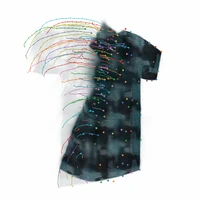
GPSStateEstModel — graph-based (GNN + Transformer) state estimation for
variable-vertex cloth meshes. Reconstructs the full cloth mesh state from a
partial point cloud observation via DDPM diffusion, conditioned on each
cloth's own rest state and topology (no global template).
- Task data: DexGarmentLab mixed-garment fold + lift-place demos (
dexgarmentlab_folding_lifting_meshes.h5, Cloth-splatters/dexgarmentlab-folding-lifting-meshes) - Formulation: DDPM diffusion + Chamfer auxiliary loss (variant C)
- Rest-position centering:
self - Cross-attention mode: parallel
- Max vertices per mesh: 2048
- Best validation loss: 0.002651358715426657 (checkpoint in
model/ischeckpoint-best) - Training run:
dexgarment_ddpm_chamferC_2026-08-03_10-50-21_7138061(full config inconfig.yml)
⚠️ Superseded — not recommended (note added 2026-08-24)
The Chamfer auxiliary loss (variant C) won the fold-unfold-lift ablation but does not transfer to DexGarmentLab: at weight 0.5 it diverges on this dataset for both schedulers, and the no-chamfer baselines were already 3–5× better on validation before that happened. This checkpoint is kept for provenance; it should not be used as a state estimator.
Use instead, both trained with the current recipe (EMA + heavy occlusion/outlier augmentation, and — for the flow model — a ×3 coordinate scale):
| use case | repo |
|---|---|
| DDPM (default) | Cloth-splatters/dexgarmentlab-folding-lifting-state-est-gps |
| flow matching | Cloth-splatters/dexgarmentlab-folding-lifting-state-est-gps-flow |
For reference, on held-out demonstrations the current DDPM standard reaches 2.4e-4 m² validation MSE and identifies 7/8 test garments end-to-end through the particle filter; ramp the Chamfer weight in or lower the learning rate if you want to revisit this variant on a new dataset.
Chamfer auxiliary loss (variant C)
Trained with an auxiliary Chamfer distance loss between the denoised mesh prediction and the observed point cloud (weight 0.5, applied only at low noise levels — variant C from the fold-unfold-lift chamfer ablation). The extra loss term is why this checkpoint's recorded best validation loss is not directly comparable to the no-chamfer variants.
Rest-position centering: self
This checkpoint was trained with the self rest-position centering convention:
the per-cloth rest (template) positions fed to the model are centered by
subtracting the rest mesh's own (valid-vertex) mean, independent of the
observed point cloud.
Implications:
- The model is translation-invariant in rest space, which makes it suitable for real-world inference: the canonical template can live in any coordinate frame relative to the camera point cloud.
- At inference, the rest positions must be self-centered the same way. Pipelines
in the training repo read
model.config.rest_pos_centering(recorded as"self"in this checkpoint'sconfig.json) and do this automatically. - Not interchangeable with checkpoints trained with the legacy
pcdconvention (all state-estimation checkpoints in this org trained on or before 2026-05-10).
- Downloads last month
- -