
YAML Metadata Warning:empty or missing yaml metadata in repo card
Check out the documentation for more information.
dexgarmentlab-folding-lifting-state-est-gps-flow
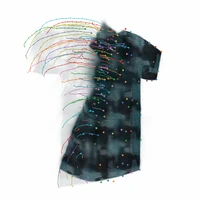
GPSStateEstModel — graph-based (GNN + Transformer) state estimation for
variable-vertex cloth meshes. Reconstructs the full cloth mesh state from a
partial point cloud observation via flow matching, conditioned on each
cloth's own rest state and topology (no global template).
- Task data: DexGarmentLab mixed-garment fold + lift-place demos, point-cloud-cleaned (
dexgarmentlab_folding_lifting_meshes_clean.h5, Cloth-splatters/dexgarmentlab-folding-lifting-meshes-clean) - Formulation: flow matching
- Rest-position centering:
self - Cross-attention mode: parallel
- Max vertices per mesh: 2048
- Best validation loss: 0.00019553977641302415 (checkpoint in
model/ischeckpoint-best) - Training run:
dexgarment_flow_clean_2026-08-05_14-28-22_475354(full config inconfig.yml)
Retrained on cleaned point clouds (2026-08-06)
This revision supersedes the 2026-08-04 upload, which was trained on
dexgarmentlab_folding_lifting_meshes.h5 before the point-cloud audit. Roughly
half of those observations carried scene geometry (floor / fixture returns) mixed
into the cloth points; the cleaned dataset removes it and trims the affected
frames. The previous revision is still reachable by commit hash.
Validation losses are not comparable across that change — the split itself changed, so the 0.000114 recorded on the pre-clean revision does not sit on the same scale as the number above, and is not evidence that the older checkpoint is better.
Rest-position centering: self
This checkpoint was trained with the self rest-position centering convention:
the per-cloth rest (template) positions fed to the model are centered by
subtracting the rest mesh's own (valid-vertex) mean, independent of the
observed point cloud.
Implications:
- The model is translation-invariant in rest space, which makes it suitable for real-world inference: the canonical template can live in any coordinate frame relative to the camera point cloud.
- At inference, the rest positions must be self-centered the same way. Pipelines
in the training repo read
model.config.rest_pos_centering(recorded as"self"in this checkpoint'sconfig.json) and do this automatically. - Not interchangeable with checkpoints trained with the legacy
pcdconvention (all state-estimation checkpoints in this org trained on or before 2026-05-10).
v2 (2026-08-20) — this revision
Retrained with the v2 recipe: EMA weights (shipped in model/), heavy
occlusion/outlier augmentation (fold-unfold-lift set, scale 0.8-1.25, no yaw) and coord_scale 3.
Best validation MSE 2.81e-4 m² (previous release: 8.55e-4); held-out first-frame
reconstruction better on 7/8 test cloths, and the TNLC_Jacket001_0 hard start
improves from rank 136 to rank 3 in the 239-mesh identification probe.
Sequential cross-attention, 200k steps. The previous release remains available at
revision 500dc4fe0f492b833fbd5bdeb0a4b852f67e80e0.
- Downloads last month
- -