
The dataset viewer is not available for this subset.
Exception:    SplitsNotFoundError
Message:      The split names could not be parsed from the dataset config.
Traceback:    Traceback (most recent call last):
                File "/usr/local/lib/python3.14/site-packages/datasets/inspect.py", line 286, in get_dataset_config_info
                  for split_generator in builder._split_generators(
                                         ~~~~~~~~~~~~~~~~~~~~~~~~~^
                      StreamingDownloadManager(base_path=builder.base_path, download_config=download_config)
                      ^^^^^^^^^^^^^^^^^^^^^^^^^^^^^^^^^^^^^^^^^^^^^^^^^^^^^^^^^^^^^^^^^^^^^^^^^^^^^^^^^^^^^^
                  )
                  ^
                File "/usr/local/lib/python3.14/site-packages/datasets/packaged_modules/hdf5/hdf5.py", line 49, in _split_generators
                  import h5py
              ModuleNotFoundError: No module named 'h5py'

              The above exception was the direct cause of the following exception:

              Traceback (most recent call last):
                File "/src/services/worker/src/worker/job_runners/config/split_names.py", line 71, in compute_split_names_from_streaming_response
                  for split in get_dataset_split_names(
                               ~~~~~~~~~~~~~~~~~~~~~~~^
                      path=dataset,
                      ^^^^^^^^^^^^^
                      config_name=config,
                      ^^^^^^^^^^^^^^^^^^^
                      token=hf_token,
                      ^^^^^^^^^^^^^^^
                  )
                  ^
                File "/usr/local/lib/python3.14/site-packages/datasets/inspect.py", line 340, in get_dataset_split_names
                  info = get_dataset_config_info(
                      path,
                  ...<6 lines>...
                      **config_kwargs,
                  )
                File "/usr/local/lib/python3.14/site-packages/datasets/inspect.py", line 291, in get_dataset_config_info
                  raise SplitsNotFoundError("The split names could not be parsed from the dataset config.") from err
              datasets.inspect.SplitsNotFoundError: The split names could not be parsed from the dataset config.
Need help to make the dataset viewer work? Make sure to review how to configure the dataset viewer, and open a discussion for direct support.
dexgarmentlab-folding-lifting-meshes
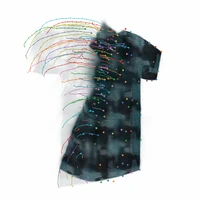
Simulated garment-manipulation demonstrations recorded with DexGarmentLab assets, for training cloth state-estimation and dynamics models on variable-vertex meshes.
Contents
dexgarmentlab_folding_lifting_meshes.h5 (~1.4 GB):
- 239 garments, mixed categories (tops, jackets, pants, dresses, shirts, suits, vests, sweaters), each with its own topology: 1,637–2,048 vertices, ≤6,051 unidirectional edges (≤12,102 bidirectional), ≤4,000 faces.
- 894 trajectories / 28,673 steps (12–59 steps each), two task types: short in-place folding-style manipulations (
54%) and lift-and-place motions (46%). - Single gripper, single camera with 2,048-point clouds per step.
- Metric scale, z-up, cloth resting on a table plane at z≈0.
Layout
training/<garment>/
  rest_positions          (V, 3) float32
  edges                   (E, 2) int32    unidirectional
  faces                   (F, 3) int32
  trajectory_<N>/
    actuated_vertices     (V, 1) float64  binary grasp mask
    step_<XXXX>/
      positions           (V, 3) float32  ground-truth mesh state
      gripper_pos         (3,)   float32
      pointclouds/cam_0   (2048, 3) float32
Only a training split is present; downstream loaders partition trajectories into train/val.
Usage
Consumed by the UniClothDiff training stack (ClothStateEstVariableDataset, ClothDynamicsVariableDataset) with max_num_nodes: 2048, max_num_edges: 12288. Configs train_state_est_gps_dexgarment.yaml and train_dynamics_gps_dexgarment.yaml auto-download this file via src/hub.py when it is not found locally.
- Downloads last month
- -