

Arm Playground: PPO policies for a 4-joint robot arm
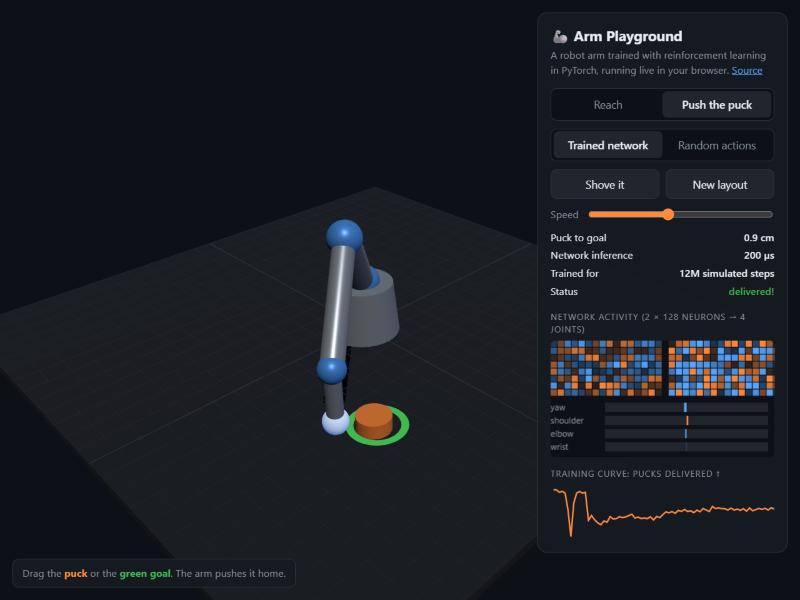
Two small neural-network controllers for a simulated 4-joint robot arm (base yaw, shoulder, elbow, wrist), trained with reinforcement learning in PyTorch:
reachmoves the hand to a 3D target and re-chases it when the target moves.pushgets behind a puck and shoves it onto a goal spot on the table without overshooting.
Every 20 ms the policy reads the arm's state and outputs four joint velocity commands. Nothing else is scripted: no inverse kinematics, no path planner.
▶ Live demo in the browser · Hugging Face Space · Source code on GitHub
Files
| File | What it is |
|---|---|
reach.safetensors, push.safetensors |
PyTorch weights plus observation normalization buffers (obs_mean, obs_std) |
reach.onnx, push.onnx |
The same policies as ONNX (opset 17). Input obs [batch, obs_dim], output action [batch, 4], float32 |
config.json |
Per task: obs/action sizes, hidden sizes, activation, a name for every observation and action component, joint limits, velocity scales, 20 ms control period |
Both formats are drop-in policies: they take the raw observation and do the
normalization, the MLP and the output clipping themselves, exactly like the browser demo
(clip((obs - mean) / std, -5, 5) → Linear 128 → tanh → Linear 128 → tanh → Linear 4 →
clip(-1, 1)). They were rebuilt from the JSON weights the demo runs, and the export
script checks that PyTorch, ONNX Runtime and the demo's forward pass agree to within
1e-5 (in practice about 1e-6) on the repo's parity trajectories and on thousands of
random observations.
Observation and action spaces
Joint angles q = [yaw, shoulder, elbow, wrist] (radians; pitch joints chained from
the horizontal), joint velocities qd, positions in metres with the arm base at the
origin, z up.
| Task | obs_dim | Observation (in order) |
|---|---|---|
| Reach | 21 | sin(q) (4), cos(q) (4), qd / vmax (4), hand xyz (3), target xyz (3), target − hand (3) |
| Push | 25 | sin(q) (4), cos(q) (4), qd / vmax (4), hand xyz (3), puck xy (2), puck velocity xy (2), goal xy (2), puck − hand xy (2), goal − puck (2) |
Action (both tasks): 4 numbers in [-1, 1], one target velocity per joint, scaled
by vmax = [2.0, 2.0, 2.5, 3.0] rad/s. The motors follow the command through a
first-order lag (τ = 80 ms) and stop at hard joint limits. Control runs at 50 Hz.
config.json names every component.
Training
All training ran on CPU with a compact PPO implementation (no RL library), with 1024 simulated arms in parallel, observation normalization, GAE and dense progress rewards.
| Task | How it was trained |
|---|---|
| Reach | PPO from scratch, 20M simulated steps. Targets jump to new spots during episodes so the policy learns to re-chase. |
| Push | Imitation of a scripted pusher (DAgger, 1.8M steps), then PPO refinement (10M steps). From scratch, PPO got stuck hovering near the puck; the scripted expert is only used in training. |
Results
Evaluated on 2000 fresh random layouts in the training simulator:
| Task | Result |
|---|---|
| Reach | 94% within 3 cm · median 0.68 s · median error 1.1 cm |
| Push | 99.5% delivered · 97.5% still on goal at the end · median 1.1 s |
The Push policy ends up better than the scripted controller it imitated: that controller delivers 95% of pucks, and imitation alone reached 96.7% in 1.84 s.
Limitations
- Custom simulator, not a real robot. The physics (kinematics, motor lag, joint
limits, a sliding puck with simple contact) is a small hand-written simulator
(
arm/sim.py). The policies have only ever seen that simulator. - No sim-to-real. There is no domain randomization, no sensor noise model and no real-hardware testing. Do not drive a physical arm with these weights.
- The observation includes exact simulator state (hand, puck and goal positions), which a real system would have to estimate.
- Results are for the task distributions used in training (targets and pucks within the arm's reach on a 1.3 m table); behaviour outside them is untested.
Usage
The policy only needs the observation vector. To roll it out you need the simulator from
the GitHub repo (arm/sim.py in PyTorch, or web/sim.js in JavaScript).
ONNX Runtime
# pip install onnxruntime numpy huggingface_hub
import numpy as np
import onnxruntime as ort
from huggingface_hub import hf_hub_download

path = hf_hub_download("zerochance1907/arm-playground", "reach.onnx")
policy = ort.InferenceSession(path)

obs = np.zeros((1, 21), dtype=np.float32)     # raw observation, layout in config.json
action = policy.run(["action"], {"obs": obs})[0]
print(action)                                  # [[yaw, shoulder, elbow, wrist]] in [-1, 1]
safetensors + PyTorch
# pip install torch safetensors huggingface_hub
import torch
from huggingface_hub import hf_hub_download
from safetensors.torch import load_file


class ArmPolicy(torch.nn.Module):
    def __init__(self, obs_dim, hidden=(128, 128), action_dim=4):
        super().__init__()
        self.register_buffer("obs_mean", torch.zeros(obs_dim))
        self.register_buffer("obs_std", torch.ones(obs_dim))
        sizes = (obs_dim, *hidden, action_dim)
        self.layers = torch.nn.ModuleList(torch.nn.Linear(a, b) for a, b in zip(sizes[:-1], sizes[1:]))

    def forward(self, obs):
        x = ((obs - self.obs_mean) / self.obs_std).clamp(-5, 5)
        for i, layer in enumerate(self.layers):
            x = layer(x)
            if i < len(self.layers) - 1:
                x = torch.tanh(x)
        return x.clamp(-1, 1)


policy = ArmPolicy(obs_dim=25)                 # "push"; use 21 for "reach"
policy.load_state_dict(load_file(hf_hub_download("zerochance1907/arm-playground", "push.safetensors")))
policy.eval()

with torch.no_grad():
    action = policy(torch.zeros(1, 25))        # raw observation, layout in config.json
To run a full episode, step the simulator from the repo with this action every 20 ms
(arm.sim.arm_step, and arm.sim.puck_step for Push).
Citation
@software{arm_playground_2026,
  title  = {Arm Playground: a PyTorch-trained robot arm that runs live in the browser},
  author = {zerochance1907},
  year   = {2026},
  url    = {https://github.com/zerochance1907/arm-playground},
  license = {MIT}
}
- Downloads last month
- -
Space using zerochance1907/arm-playground 1
Evaluation results
- within 3 cm (%) on Arm Playground Reach (2000 fresh random layouts)self-reported94.000
- median (s) on Arm Playground Reach (2000 fresh random layouts)self-reported0.680
- median error (cm) on Arm Playground Reach (2000 fresh random layouts)self-reported1.100
- delivered (%) on Arm Playground Push (2000 fresh random layouts)self-reported99.500
- still on goal at the end (%) on Arm Playground Push (2000 fresh random layouts)self-reported97.500
- median (s) on Arm Playground Push (2000 fresh random layouts)self-reported1.100