

t0 model family
Collection
Pretrained t0 forecasting models from The Forecasting Company, and the runtime artifacts to serve them. • 7 items • Updated • 5

This is a first-party INT8-weight, FP32-compute ONNX export of
t0-beta, the second public iteration of the probabilistic
time-series forecasting foundation model from The Forecasting Company.
It runs with ONNX Runtime, including ONNX Runtime Web's WASM and WebGPU providers.
It supports grouped univariate and multivariate targets, known-future covariates, and dynamic context lengths and forecast horizons.
Model family: t0-beta (PyTorch/MLX) · ONNX INT8 · ONNX FP16
You can also use t0 on Retrocast, our platform
for forecasting on your own data and comparing open-weight models.
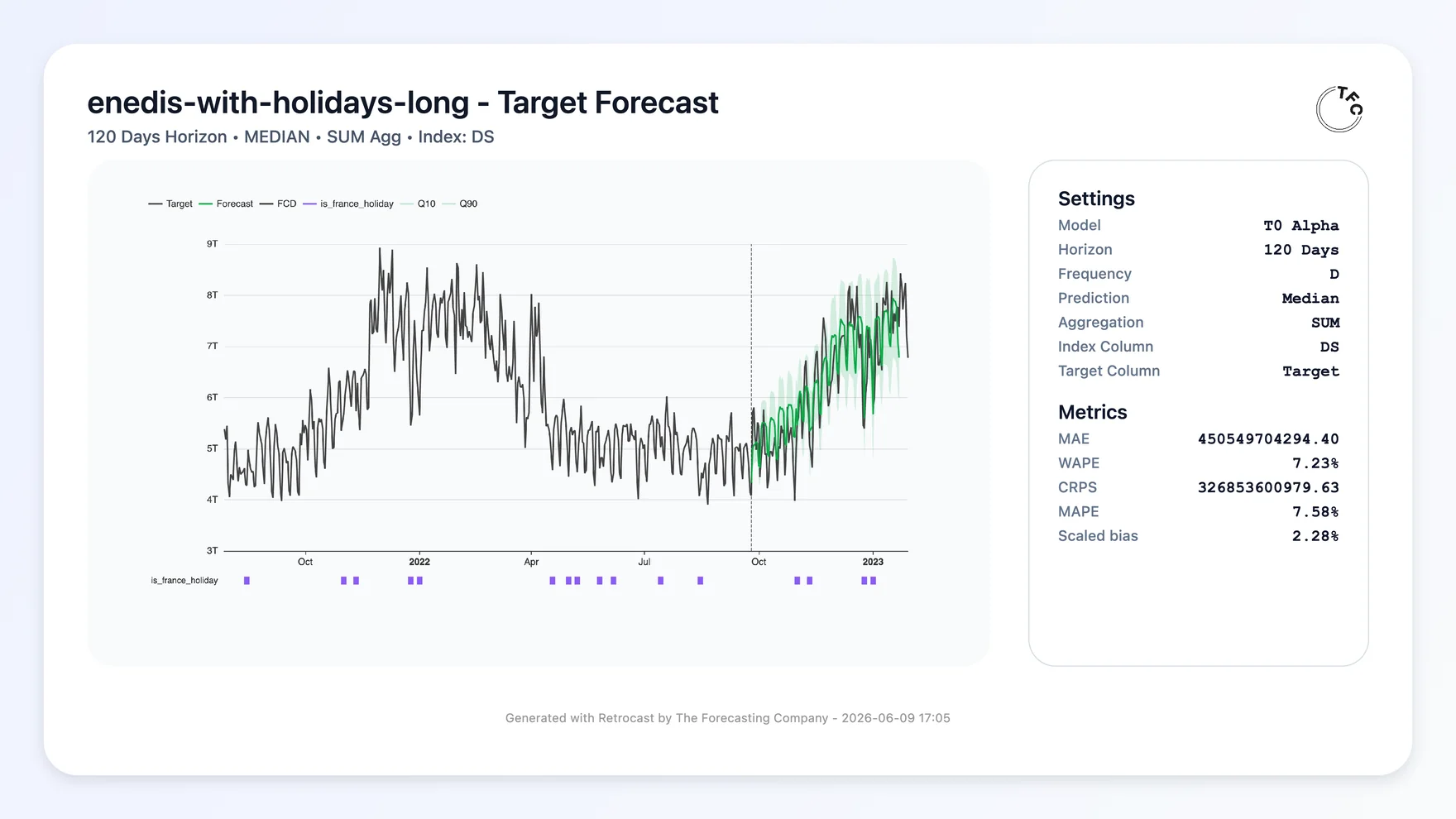
An illustration of t0 in Retrocast, from the source model card. Data: Enedis open data.
| Field | Value |
|---|---|
| Base model | t0-beta |
| Architecture | Decoder-style patch transformer, approximately 256M parameters |
| Layers / embedding size | 24 / 1024 |
| Patch size | 32 observations |
| Native quantiles | 21 levels, from 0.01 to 0.99 |
| Weight storage / computation | INT8 / FP32 |
| Interface | Grouped targets and known-future covariates |
| ONNX opset | 20 |
| License | Apache-2.0 |
The 96 transformer projection matrices use per-channel signed INT8 weights. Six input/output projection matrices remain FP32 to preserve the extreme quantiles. Compact weights reduce download size; expanded runtime weights and calculations use FP32, so this is not a proportional reduction in runtime memory.
Beta returns 21 native quantiles instead of five. The median is index 10, not alpha's index 2. The ordered levels are:
0.01, 0.05, 0.10, 0.15, 0.20, 0.25, 0.30, 0.35, 0.40, 0.45, 0.50,
0.55, 0.60, 0.65, 0.70, 0.75, 0.80, 0.85, 0.90, 0.95, 0.99
The graph includes beta's normalization: scaler_eps=0.01 and
scaler_eps_mode=std_clamp. Pass raw observations; do not apply alpha's
normalization outside the graph. All native quantiles are returned; arbitrary
quantile interpolation and autoregressive rollout are not included in this export.
This derivative is intended for local probabilistic forecasting in browsers, on CPUs and with the tested WebGPU configuration, including known-future covariates. It has been validated for numerical consistency and browser execution. Evaluate forecast accuracy and calibration on your own historical backtests and validate execution on the hardware you plan to use.
For the full forecasting API, including quantile interpolation, longer-horizon
rollout and fine-tuning, use t0-beta with
tfc-t0>=0.5.0. The source repository also supports MLX inference. These
ONNX files do not require PyTorch or tfc-t0 at inference time. Forecasts are probabilistic estimates.
| Artifact | Download size | Purpose |
|---|---|---|
t0-beta-grouped-int8.onnx |
269.1 MB | INT8 weights, FP32 compute |
Exported from the pinned beta checkpoint revision.
Artifact SHA-256: 2c517869aac22518c1e04a35386a739d2656490574a40ea9a31187f4f115ac9b.
File hashes are recorded in manifest.json.
| Input/output | Type | Shape | Notes |
|---|---|---|---|
target_context |
float32 |
[target_rows, context] |
NaN marks missing observations |
target_group_ids |
int32 |
[target_rows] |
Rows with the same id attend jointly |
future_covariate_context |
float32 |
[covariate_rows, context] |
Historical portion of known-future covariates |
future_covariate_future |
float32 |
[covariate_rows, compute_horizon] |
Values available over the forecast horizon |
future_covariate_group_ids |
int32 |
[covariate_rows] |
Associates covariates with target groups |
quantiles |
float32 |
[target_rows, compute_horizon, 21] |
Native quantile forecasts |
Group ids need not be contiguous. Give target and covariate rows the same id when they belong to the same multivariate series; different groups remain independent. Historical-only covariates can be supplied as additional target rows in the same group; the graph also forecasts those rows.
With no known-future covariates, pass arrays with zero covariate rows. Keep the
second dimension of future_covariate_future: it still selects the horizon.
The graph accepts contexts within its exported 1–8192 observation range and
left-pads them internally to the 32-step patch grid. Use NaN for missing
observations. It has no separate public padding-mask input.
The compute horizon is selected by the width of
future_covariate_future and must be a positive multiple of 32, up to 1024.
For a 50-step forecast, pass width 64 and retain the first 50 outputs.
Quantile outputs are float32 for both storage precisions.
pip install numpy "onnxruntime==1.29.0" huggingface_hub
hf auth login  # authenticate with an authorized account for private repositories
The example downloads this repository's artifact and runs on CPU:
import math

import numpy as np
import onnxruntime as ort
from huggingface_hub import hf_hub_download

model_path = hf_hub_download(
    repo_id="theforecastingcompany/t0-beta-onnx-int8",
    filename="t0-beta-grouped-int8.onnx",
)
session = ort.InferenceSession(model_path, providers=["CPUExecutionProvider"])

horizon = 50
compute_horizon = math.ceil(horizon / 32) * 32  # 64
history = (10 + np.sin(np.arange(97) / 6)).astype(np.float32)
target_context = history[None, :]
feeds = {
    "target_context": target_context,
    "target_group_ids": np.array([0], dtype=np.int32),
    "future_covariate_context": np.empty((0, history.size), dtype=np.float32),
    "future_covariate_future": np.empty((0, compute_horizon), dtype=np.float32),
    "future_covariate_group_ids": np.empty((0,), dtype=np.int32),
}
quantiles = session.run(["quantiles"], feeds)[0]
forecast = quantiles[:, :horizon, :]  # [1, 50, 21]
median = forecast[..., 10]           # [1, 50]
print(forecast.shape, median.shape)
The following continues the example above. Two target rows share a group, so they are forecast jointly. A calendar covariate belongs to that same group and is supplied over both history and the full compute horizon.
targets = np.concatenate([target_context, target_context * 1.2], axis=0)
calendar = np.sin(2 * np.pi * np.arange(history.size + compute_horizon) / 7)
calendar = calendar.astype(np.float32)[None, :]
with_covariates = {
    "target_context": targets,
    "target_group_ids": np.array([7, 7], dtype=np.int32),
    "future_covariate_context": calendar[:, :history.size],
    "future_covariate_future": calendar[:, history.size:],
    "future_covariate_group_ids": np.array([7], dtype=np.int32),
}
forecast_with_covariates = session.run(["quantiles"], with_covariates)[0][:, :horizon, :]
print(forecast_with_covariates.shape)  # [2, 50, 21]
Only use covariates available at the forecast origin, such as calendar
features, planned promotions or weather forecasts. Unknown entries may be
marked with NaN; do not substitute later observed target values.
Use ONNX Runtime Web 1.29.0 and this repository's
webgpu-options.js. Download the model and helper, then
serve both through your application. The helper is specific to this artifact:
it places affected mask operations on WASM and allows constant weight expansion
to be folded, while matrix operations run on WebGPU.
import * as ort from "onnxruntime-web/webgpu";
import { webgpuOptions } from "./webgpu-options.js";

ort.env.wasm.numThreads = 1;
const response = await fetch("./t0-beta-grouped-int8.onnx");
if (!response.ok) throw new Error(`Model download failed: ${response.status}`);
const modelBytes = await response.arrayBuffer();
const session = await ort.InferenceSession.create(modelBytes, webgpuOptions);
Feed tensors using the names, dtypes and shapes in the graph contract above.
For WASM-only execution, create the session with
{ executionProviders: ["wasm"] }. Use WASM when WebGPU is unavailable.
The pinned t0-beta model card reports the following results for the original checkpoint:
| Benchmark | Metric | t0-beta |
|---|---|---|
| GIFT-Eval | CRPS ↓ | 0.4738 |
| GIFT-Eval | MASE ↓ | 0.6865 |
| fev-bench | Skill score ↑ | 46.37 |
These are source-model results. GIFT-Eval and fev-bench have not been run on this ONNX derivative; its conversion checks below measure numerical drift.
Native validation passed 54 synthetic series/context/horizon cases against unmodified PyTorch, with finite, ordered outputs. Across these cases, the worst per-series mean drift was 0.2271% and the worst point drift was 9.393%. Drift is absolute error divided by the reference series' full forecast range across the horizon and all quantiles, not relative error on an individual prediction. The gates were 2% mean and 10% point drift.
Browser validation passed 12 cases for this exact
artifact: six fixtures each on single-thread WASM and WebGPU, with ONNX Runtime
Web 1.29.0, Chromium 152 and Apple Metal 3. Fixtures cover contexts 1, 33, 97,
512 and 8192 and horizons 32, 64 and 1024. Browser outputs matched native CPU
outputs at rtol=0.001, atol=0.001, with no non-finite values or quantile
crossings. Other hardware has not been validated. Recorded timings include
first-use compilation and are not warm-inference benchmarks.
INT8 can introduce more drift in extreme quantiles. The FP16 sibling provides a closer numerical match in these checks.
t0-beta continues the t0-alpha model family.
The underlying model builds on ideas from Toto,
Chronos-2 and
TiRex. Thanks also to
Siddharth7113/tsfm-onnx for the
Apache-2.0 ONNX export work that informed parts of this pipeline.
See NOTICE for code-level attributions.
@misc{tfc-t0,
  title  = {t0: A time-series forecasting foundation model},
  author = {The Forecasting Company},
  year   = {2026},
  url    = {https://huggingface.co/theforecastingcompany/t0-beta},
}
Apache-2.0. See LICENSE and NOTICE.
For issues and bug reports, use the
tfc-t0 issue tracker.
Base model
theforecastingcompany/t0-beta