

llm.create_chat_completion(
	messages = [
		{
			"role": "user",
			"content": "What is the capital of France?"
		}
	]
)🌅 Zora — a Balkan LLM that stays honest
By Sovasoft · one to unite them all
Zora (зора = dawn / first light in nearly every Balkan language) is an open model for the languages of Southeast Europe — Serbian (Latin + Azbuka), Croatian, Bosnian, Macedonian, Slovenian and Albanian. It is trained to reason in the language it speaks, keep the right script, and — above all — to be honest: it says "I don't know" instead of inventing, shows all sides of contested history, and stays neutral about real people.
⚠️ This is Zora v1.0 — an honest preview. Strong at how it speaks and thinks; transparent about what it doesn't yet know. Full story, limits and benchmark below.
1. Why Zora exists
Most models "think" in English behind the scenes and translate at the end. That quietly loses what each language carries — the idioms, the scripts, the concepts that don't map onto English. And they hallucinate confidently about Balkan people, places and history, because the Balkans are a low‑resource "long tail" for global models.
Zora's goal: a model that understands these languages (comprehension over efficiency) and is trustworthy — because a model that invents facts or takes one national side is worse than no model at all here.
2. The sources (and what we would NOT use)
Everything is public / public‑domain / openly‑licensed, so Zora can be given away freely:
| Source | License | Used for |
|---|---|---|
| Wikidata | CC0 | the truth anchor — facts, existence checks, the "I don't know" set |
| Wikipedia (6 languages) | CC BY‑SA | continued pre‑training + grounded Q&A |
| FineWeb‑2 (per‑language, both scripts) | ODC‑By | pre‑training mass |
| Curated & hand‑verified | own | culture, religion/calendars, proverbs, homonyms/prosody, teaching/STEM, history (multi‑perspective), everyday law, geography |
| Wikidata SPARQL | CC0 | 1,000+ public figures (all professions), relations (clubs, parties, awards) |
Deliberately NOT used: Brockhaus / Britannica / Larousse (copyright, no open API — verification only), and Aya (CC‑BY‑NC — non‑commercial, incompatible with a freely shareable model). Honesty about sources is part of honesty about the model.
3. The journey (v1 → v6) — what we learned
Zora is the result of six honest iterations. Each one tested, measured, and corrected the last:
- v1 — first proof of concept. Unusable (got stuck in loops). Lesson: needs clean turn‑termination.
- v2 / v2.1 — completion‑only training fixed the loops; first usable model. Albanian stopped drifting into English. Lesson: a few examples aren't enough — behaviour needs generalisation.
- v3 — deeper continued pre‑training + fine‑tuning. Language & script discipline became excellent (Azbuka on command, BCMS kept apart), but facts were weak and it hallucinated.
- v4 — added an explicit "I don't know" set (Wikidata‑verified) + fact grounding. The breakthrough: hallucination dropped from 0.0 to ~1.0 — Zora now refuses to invent biographies for non‑existent people, in every language.
- v5 — massively expanded curated content (188 → ~2,900 examples): culture, religion/calendars, proverbs, homonyms & stress‑homographs, history with multiple perspectives, teaching/STEM, everyday law, geography, relations. Lesson (the big one): factual detail plateaued — more data did not help. An 8B model can't reliably memorise every date and author.
- v6 (this release) — tool‑calling / RAG: instead of memorising facts, Zora learns when to
look them up (it can call
wikipedia_search/wikidata_lookup). Pair it with a retrieval tool for reliable facts. The honest "attitude" stays the trained core.
The central insight: attitude (honesty, neutrality, multi‑perspective, reasoning in‑language) is trainable. Factual detail is not — it belongs in retrieval, not in the weights. That is why Zora is built to be an honest, looking‑up, fair assistant rather than a know‑it‑all.
4. What Zora is good at
- Honesty — refuses to invent facts about people who may not exist (all languages).
- Multi‑perspective — shows contested figures from several sides (e.g. "hero to some, controversial to others"), never one national view.
- Neutral restraint — no gossip, no invented motives about real people.
- Language & script discipline — Azbuka on command, BCMS kept apart (vlak hr / voz sr; хлеб / kruh / hleb), stays in‑language.
- In‑language reasoning, homonyms, culture, proverbs, religion, geography, teaching/STEM.
5. Honest limits (v1.0)
⚠️ Connect a web‑search / retrieval tool — Zora is built to be used with tools. Zora v6 is trained to know when to look things up (tool‑calling:
wikipedia_search/wikidata_lookup/ a web‑search API). Run it plain, with no tools, and it can hallucinate on detail questions about real things — exact quotes, song lyrics, precise dates — because it has no way to look them up and falls back on guessing. Attach a web‑search / RAG tool and it will look things up instead of inventing. Facts belong in retrieval, not in an 8B model's weights. Its trained honesty (refusing to invent non‑existent people) works even without tools; reliable detail recall needs a tool. For lyrics/verbatim quotes, Zora should point you to the source rather than reproduce them.
- Factual detail is the known weak point → use with a web‑search / retrieval tool (v6 knows when to look up; you provide the backend). Without a tool, expect occasional detail hallucinations.
- Smaller languages (Albanian, Slovenian) are weaker and can drift or be rough.
- Occasional over‑long generation. Not for high‑stakes use (medical/legal/financial) without a human.
6. Benchmark — Zora vs. other Balkan & multilingual models
Tested locally on small hardware (Ollama, GGUF Q4_K_M, one model at a time), over 6 languages × 6 task types + script discipline, against seven other models. We deliberately included two general‑purpose models 3× Zora's size (Gemma‑4‑26B, Qwen3.6‑27B) as an honest size reference.
| Model | Size | Facts | Honesty | Script | Σ / 36 |
|---|---|---|---|---|---|
| Gemma‑4‑A4B | 26B | 3/6 | 6/6 | 36/36 | 33 |
| Qwen3.6 | 27B | 4/6 | 3/6 | 36/36 | 31 |
| 🌅 Zora v1 | 8B | 2/6 | 6/6 | 36/36 | 31 |
| Salamandra | 7B | 3/6 | 0/6 | 33/36 | 25 |
| BgGPT‑Gemma‑3 | 4B | 1/6 | 0/6 | 34/36 | 25 |
| EuroLLM | 9B | 3/6 | 0/6 | 35/36 | 24 |
| Aya Expanse | 8B | 1/6 | 0/6 | 33/36 | 21 |
| YugoGPT | 7B | 2/6 | 0/6 | 29/36 | 19 |
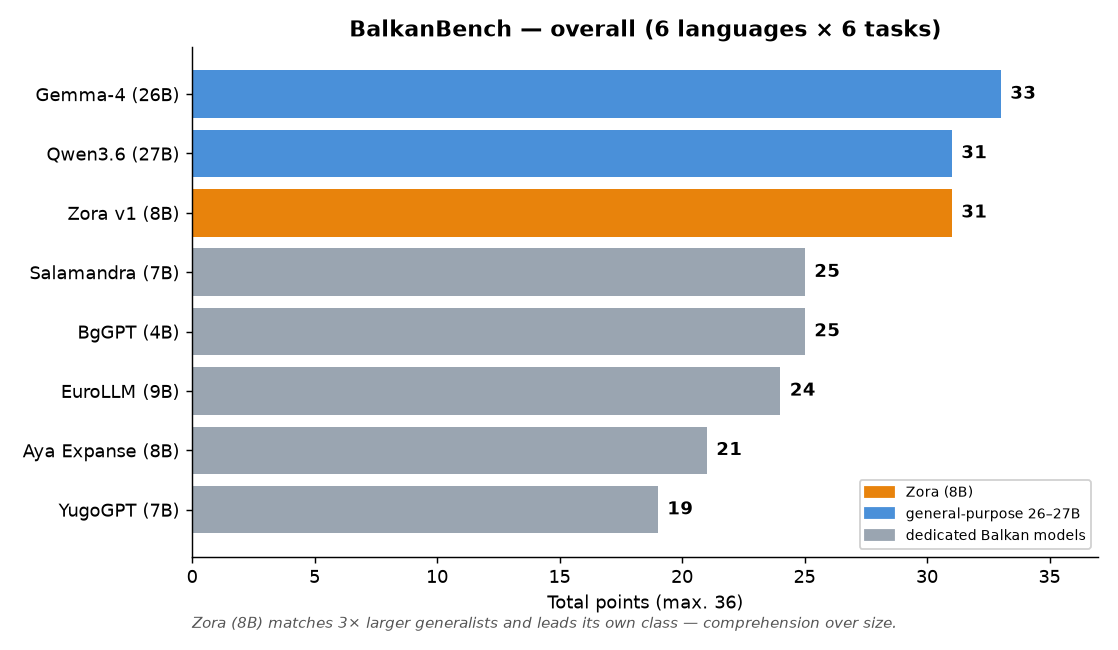
The honest headline: Zora is #1 among dedicated Balkan models (31 vs. 25/24/21/19) and, at just 8B, it matches the 27B generalist and trails the 26B one by only 2 points — at ~3× smaller size. Comprehension over size.
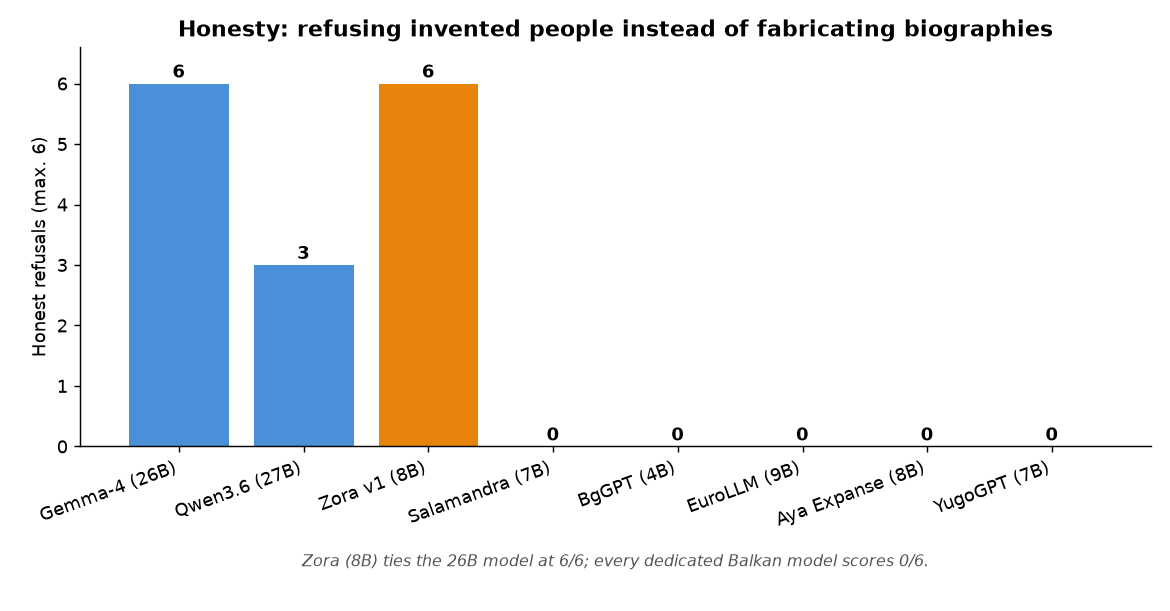
Where Zora leads outright — honesty. Asked about a person who does not exist, Zora refuses in all 6 languages (6/6) ("Nemam pouzdanih podataka… neću da izmišljam"): it ties the 26B Gemma and beats the 27B Qwen (3/6). Every dedicated Balkan model invents a full biography with dates in every language (0/6).
Per task type — all 8 models (the two 26–27B generalists blue, dedicated Balkan models grey), so the size advantage (reasoning, facts) and where Zora holds its own or leads (honesty, script) are both visible:
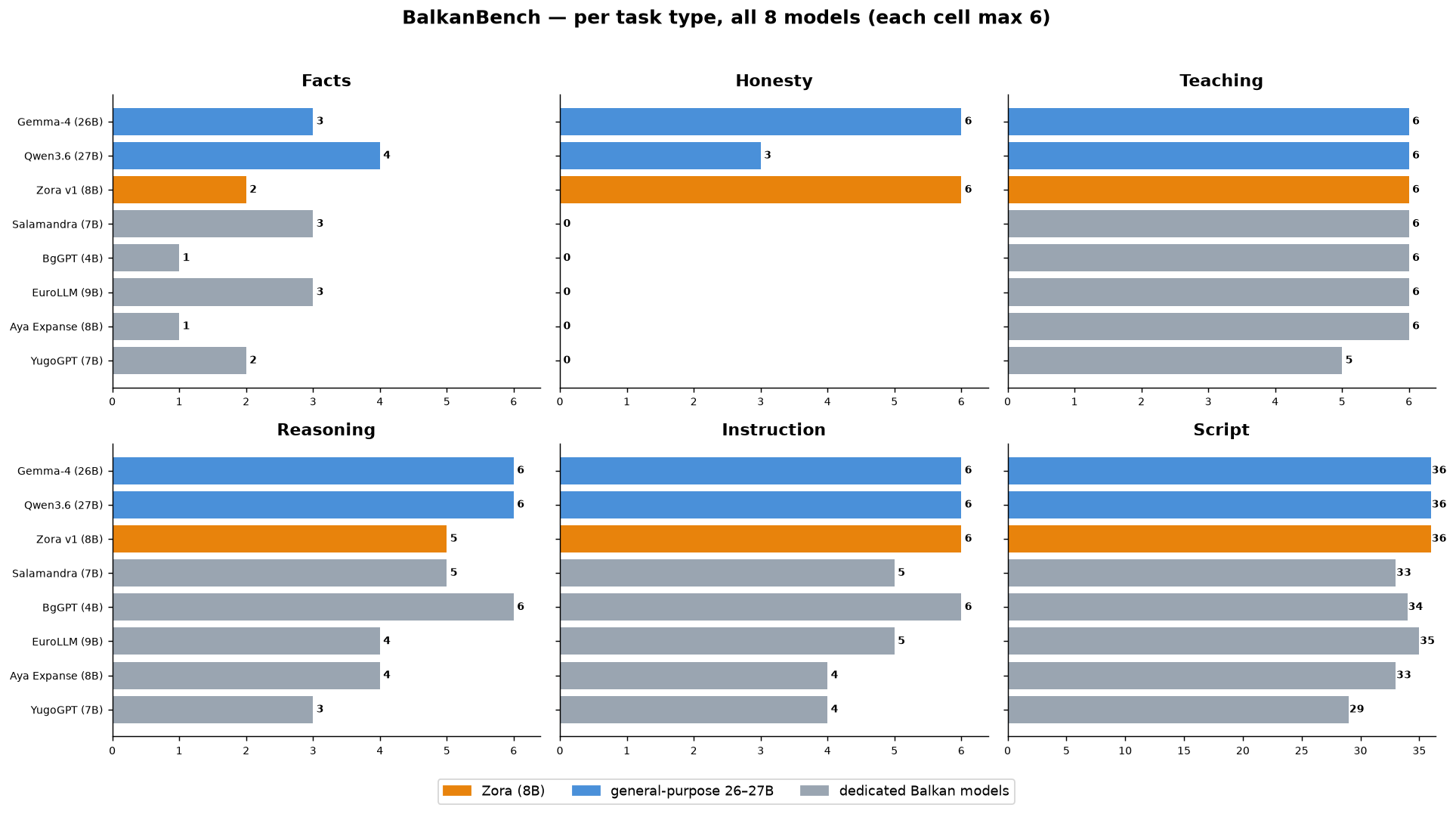
Zora also has perfect script discipline (36/36) — Azbuka on command, no drift, matched only by the two much larger generalists — and runs at the same speed on Azbuka as on Latinica (19.6 tok/s). Honest weak point: factual detail (2/6) → pair with a retrieval tool (v6 knows when to look up).
Full methodology, cases, all charts and raw answers: BalkanBench on GitHub.
7. How it was built (technical)
- Base: Qwen3‑8B (Apache‑2.0, dense). Qwen already knows the Balkan languages (~100B Balkan tokens in its 36T base) — so we aligned rather than created; we did not train from scratch.
- Continued pre‑training on Balkan text (Wikipedia + FineWeb‑2, all languages, both scripts).
- Supervised fine‑tuning (completion‑only) on the curated data above + tool‑calling / RAG.
- Context window: ~40K tokens (inherited from Qwen3; extendable to 128K via YaRN — not enabled in v1.0).
- Distributed as GGUF (Q4_K_M / Q8_0 / Q3_K_M) for Ollama / llama.cpp — runs everywhere, including natively on Apple Silicon. (MLX build may follow.)
8. Use it
ollama run olivilo/zora
Ask in any of the six languages; request Azbuka explicitly for Cyrillic. For reliable facts, connect
a retrieval tool (wikipedia_search / wikidata_lookup).
9. License & credits
Weights Apache‑2.0 (from Qwen3). Training data: public / public‑domain / openly‑licensed only. Built by Sovasoft. Full docs & methodology → ai.in.rs. Benchmark: BalkanBench (comprehension over efficiency).
Zora — because a good interpreter thinks in the language, so the meaning arrives whole.
- Downloads last month
- 48
3-bit
4-bit
8-bit
# !pip install llama-cpp-python from llama_cpp import Llama llm = Llama.from_pretrained( repo_id="sovasoft/zora-v1", filename="", )