
Instructions to use moonshotai/Kimi-K3 with libraries, inference providers, notebooks, and local apps. Follow these links to get started.
- Libraries
- Transformers
How to use moonshotai/Kimi-K3 with Transformers:
# Use a pipeline as a high-level helper from transformers import pipeline pipe = pipeline("image-text-to-text", model="moonshotai/Kimi-K3", trust_remote_code=True) messages = [ { "role": "user", "content": [ {"type": "image", "url": "https://huggingface.co/datasets/huggingface/documentation-images/resolve/main/p-blog/candy.JPG"}, {"type": "text", "text": "What animal is on the candy?"} ] }, ] pipe(text=messages)# Load model directly from transformers import AutoModel model = AutoModel.from_pretrained("moonshotai/Kimi-K3", trust_remote_code=True, device_map="auto") - Inference
- HuggingChat
- Notebooks
- Google Colab
- Kaggle
- Local Apps Settings
- vLLM
How to use moonshotai/Kimi-K3 with vLLM:
Install from pip and serve model
# Install vLLM from pip: pip install vllm # Start the vLLM server: vllm serve "moonshotai/Kimi-K3" # Call the server using curl (OpenAI-compatible API): curl -X POST "http://localhost:8000/v1/chat/completions" \ -H "Content-Type: application/json" \ --data '{ "model": "moonshotai/Kimi-K3", "messages": [ { "role": "user", "content": [ { "type": "text", "text": "Describe this image in one sentence." }, { "type": "image_url", "image_url": { "url": "https://cdn.britannica.com/61/93061-050-99147DCE/Statue-of-Liberty-Island-New-York-Bay.jpg" } } ] } ] }'Use Docker
docker model run hf.co/moonshotai/Kimi-K3
- SGLang
How to use moonshotai/Kimi-K3 with SGLang:
Install from pip and serve model
# Install SGLang from pip: pip install sglang # Start the SGLang server: python3 -m sglang.launch_server \ --model-path "moonshotai/Kimi-K3" \ --host 0.0.0.0 \ --port 30000 # Call the server using curl (OpenAI-compatible API): curl -X POST "http://localhost:30000/v1/chat/completions" \ -H "Content-Type: application/json" \ --data '{ "model": "moonshotai/Kimi-K3", "messages": [ { "role": "user", "content": [ { "type": "text", "text": "Describe this image in one sentence." }, { "type": "image_url", "image_url": { "url": "https://cdn.britannica.com/61/93061-050-99147DCE/Statue-of-Liberty-Island-New-York-Bay.jpg" } } ] } ] }'Use Docker images
docker run --gpus all \ --shm-size 32g \ -p 30000:30000 \ -v ~/.cache/huggingface:/root/.cache/huggingface \ --env "HF_TOKEN=<secret>" \ --ipc=host \ lmsysorg/sglang:latest \ python3 -m sglang.launch_server \ --model-path "moonshotai/Kimi-K3" \ --host 0.0.0.0 \ --port 30000 # Call the server using curl (OpenAI-compatible API): curl -X POST "http://localhost:30000/v1/chat/completions" \ -H "Content-Type: application/json" \ --data '{ "model": "moonshotai/Kimi-K3", "messages": [ { "role": "user", "content": [ { "type": "text", "text": "Describe this image in one sentence." }, { "type": "image_url", "image_url": { "url": "https://cdn.britannica.com/61/93061-050-99147DCE/Statue-of-Liberty-Island-New-York-Bay.jpg" } } ] } ] }' - Docker Model Runner
How to use moonshotai/Kimi-K3 with Docker Model Runner:
docker model run hf.co/moonshotai/Kimi-K3
Kimi K3 (2.78T) running on a 128 GB MacBook Pro at ~1 tok/s, experts streamed from four SSDs
Not a quant release, just a data point for anyone wondering whether K3 runs on a laptop at all.
Machine: MacBook Pro M5 Max, 128 GB. The trunk stays in memory and the routed experts (1.44 TB at 4-bit) are streamed from NVMe: the internal SSD plus up to three Thunderbolt 5 enclosures, each holding a byte-identical replica, with every expert read split across the drives. Output is identical at every rung.
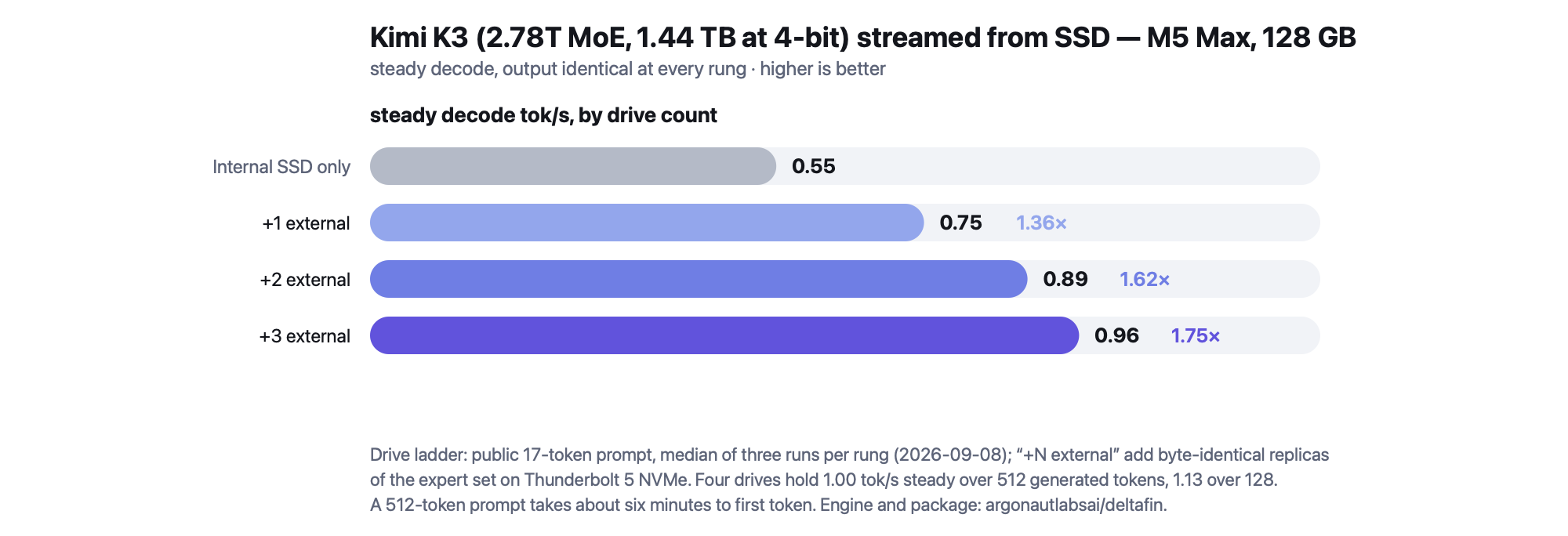
- one drive: 0.55 tok/s
- +1 enclosure: 0.75
- +2: 0.89
- +3: 0.96 (1.75×), and 1.00 steady over 512 generated tokens, 1.13 over 128
Engine (a llama.cpp-derived fork), manifests and every run: https://github.com/argonautlabsai/deltafin (k3-public-bench). The storage layout and instruments are in argonautlabsai/argodrive.
why would u do this to ur self... 1 token / s is torture...
Fair, it's not a chat speed. The point was the existence proof and the curve: a 2.78T model on a laptop, same output as a resident run, and every SSD you add buys a measurable step.
In practice it runs a batch of document jobs overnight.
assuming it gets 2x faster per SSD, it takes u need another 6 drives to get a useable speed... not to mention, the processor can still bottle neck...
