
OpenDecider
Collection
Open decision models (System One): typed choice/score/yes-no questions, calibrated probabilities. pip install opendecider • 7 items • Updated

Open, calibrated System 1 decision model for decisions it has never seen. Give it a state (text, email, ticket
or JSON) and typed questions (choice, score, noul); it returns a calibrated probability for every option:
40 ms on an NVIDIA L40S, and it runs on a 16 GB Mac mini (tested). A 4B LoRA adapter on Qwen3-4B-Instruct-2507, Apache-2.0.
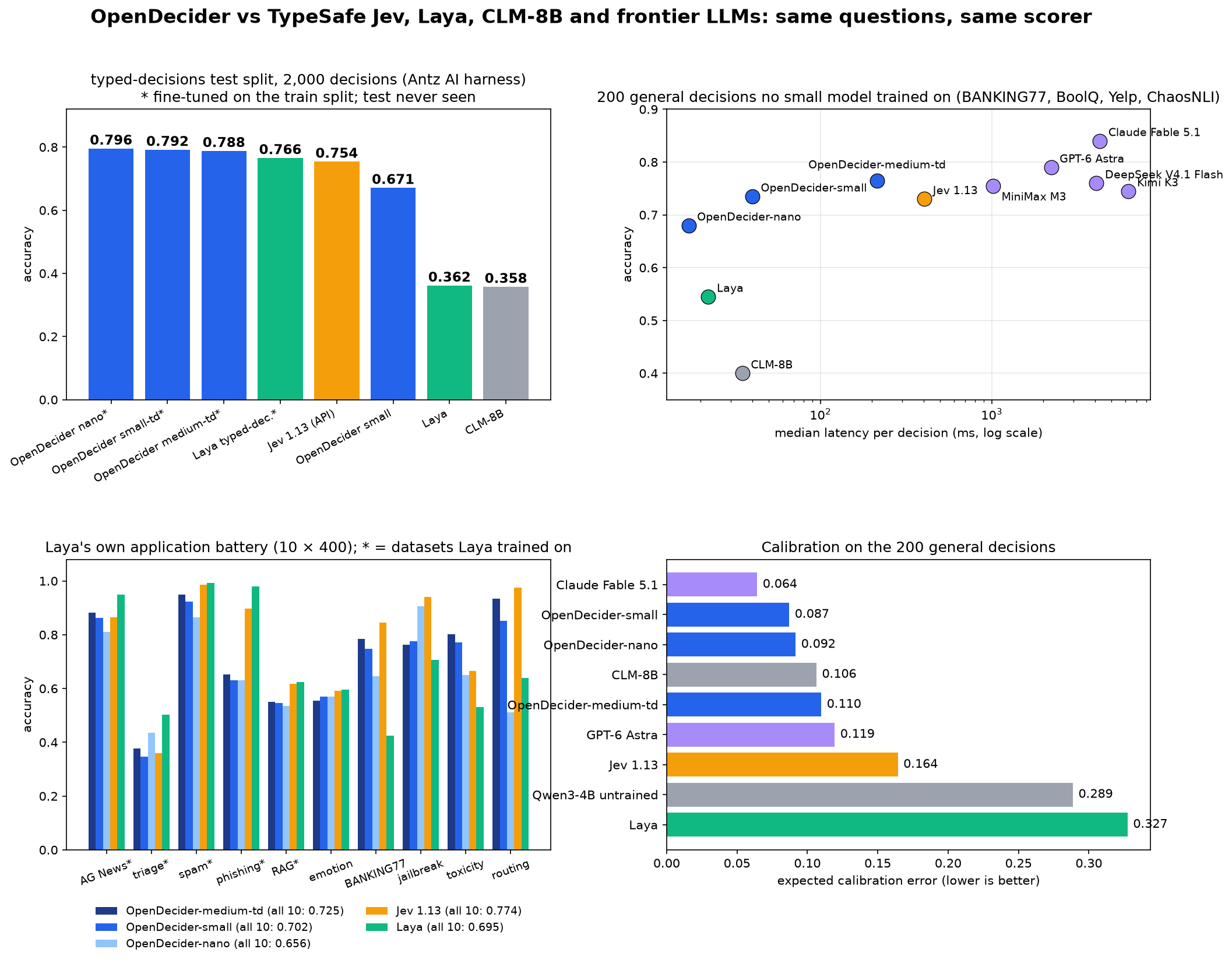
Zero-shot, it beats TypeSafe Jev and Laya on general decisions (0.735 vs 0.730 and 0.545) and ties Laya's best checkpoint on Laya's own application battery (0.702 vs 0.702), winning the five tasks Laya was not trained on by 13–16 points. Best-calibrated model you can run yourself (ECE 0.087; Jev 0.164, Laya 0.327).
pip install "opendecider[small]"
Python 3.10 or newer; Linux, Windows or macOS; NVIDIA (CUDA) or Apple Silicon (MPS) recommended. Downloads Qwen3-4B-Instruct-2507 (8 GB) plus this adapter (126 MB) on first use. Platform notes are in the GitHub README.
from opendecider import load, Choice, Noul

model = load("manjunathshiva/opendecider-small")

r = model.system_one(
    {"message": "I took out cash abroad and the exchange rate is wrong."},
    {"intent": Choice("Which banking intent is this?",
                      ["wrong_exchange_rate_for_cash_withdrawal", "card_payment_fee_charged",
                       "cash_withdrawal_charge", "declined_cash_withdrawal"]),
     "complaint": Noul("Is the customer complaining?")})
print(r["answers"]["intent"]["choice"], r["answers"]["intent"]["probabilities"])
print(r["answers"]["complaint"]["noul"])   # probability the answer is yes
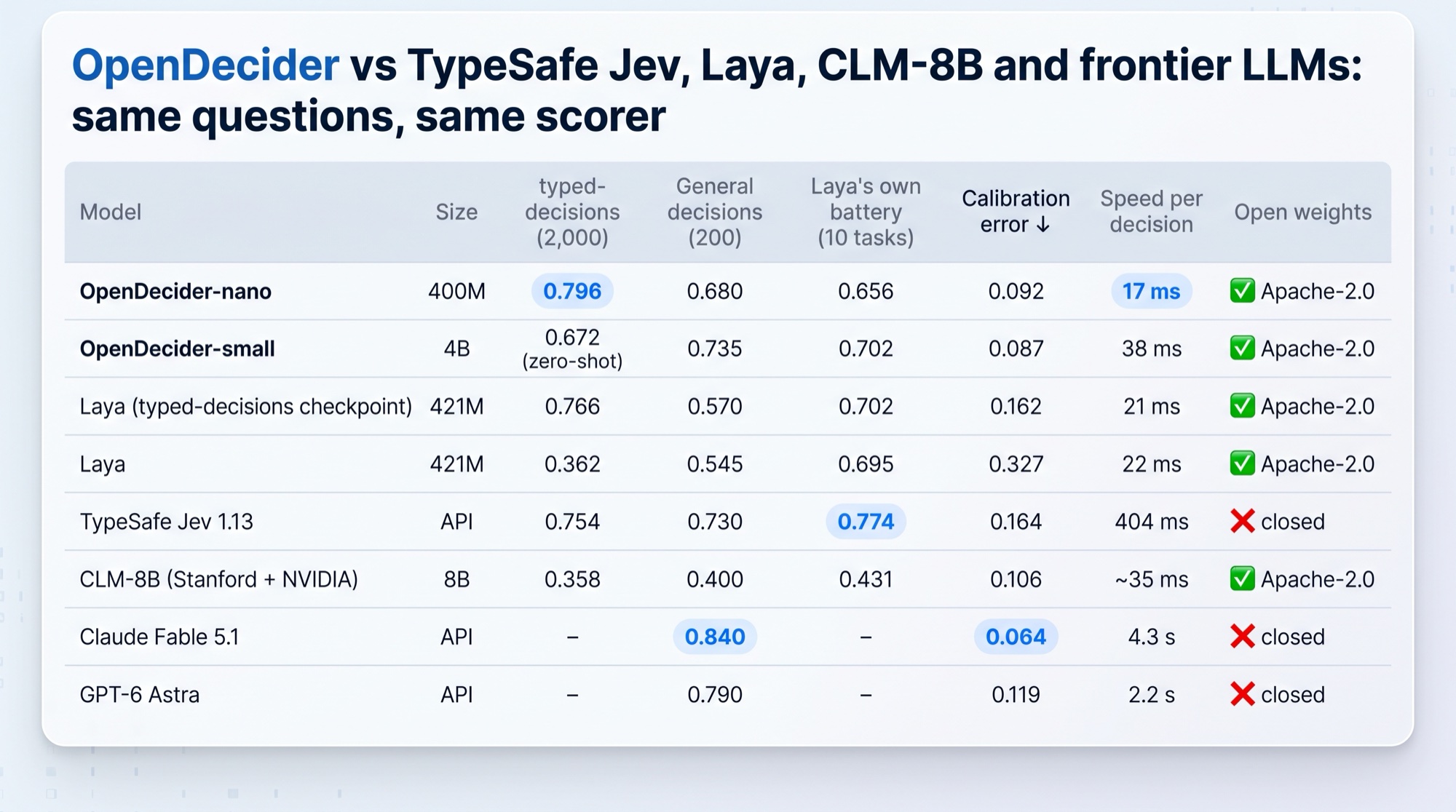
Highlighted: best in each column. typed-decisions scored with the Antz AI harness; OpenDecider-nano and Laya's typed-decisions checkpoint were fine-tuned on the train split, and the test split was never seen. Speeds: OpenDecider on an NVIDIA L40S, Laya on Apple Silicon, APIs include the network. Every number: COMPARISON.md.
| Hardware | Memory used | Latency, one question | Tested |
|---|---|---|---|
| Mac mini M4, 16 GB | 8.9 GiB of the 11.8 GiB GPU budget | 280 ms | ✅ |
| MacBook Pro M4 Max, 64 GB | 8.9 GiB | 141 ms | ✅ |
| NVIDIA L40S (Linux) | ~9 GB (bf16) | 38 ms | ✅ |
| CPU only (fp32) | ~17 GB of RAM | slow | not recommended |
A 16 GB Mac is enough (tested on an M4 Mac mini with ~3 GiB to spare). NVIDIA: a GPU with 12 GB or more. Answers are identical across these machines to four decimals.
Distillation from calibrated teachers. Two openly licensed teachers, Qwen3-235B-A22B-Instruct-2507 (Apache-2.0) and DeepSeek V4.1 Flash (MIT), scored every training question through token log-probabilities, each temperature-scaled on held-out gold labels before averaging; datasets with gold labels only use label-smoothed gold. This model never saw typed-decisions or any other benchmark dataset below (or its family), and every training pool was checked for text overlap with all test sets (0 overlaps). No outputs of Claude or GPT models were used.
Every model answered the same questions and was scored by the same code; TypeSafe Jev was measured through TypeSafe's own API. Full tables: COMPARISON.md.
| questions per call | NVIDIA L40S | Apple M4 Max |
|---|---|---|
| 1 | 37.6 ms | 141 ms |
| 5 | 190.1 ms (38.0 ms/q) | 680 ms (136 ms/q) |
| 10 | 388.2 ms (38.8 ms/q) | 1.37 s (137 ms/q) |
| 50 | 1.94 s (38.7 ms/q) | 6.86 s (137 ms/q) |
Memory: 8.9 GiB (bf16), tested on a 16 GB Mac mini (M4). TypeSafe Jev: 404 ms median per question through its API.
| Benchmark / metric | TypeSafe Jev 1.13 | Laya | Laya typed-decisions | OpenDecider-small |
|---|---|---|---|---|
| 200 general decisions (BANKING77, BoolQ, Yelp, ChaosNLI) | 0.730 | 0.545 | 0.570 | 0.735 |
| Laya's application battery, 10 tasks | 0.774 | 0.695 | 0.702 | 0.702 |
| Laya's battery, the 5 tasks Laya was not trained on | 0.803 | 0.579 | 0.609 | 0.743 |
| BANKING77, 77 labels (Laya's battery) | 0.845 | 0.425 | 0.492 | 0.748 |
| typed-decisions, 2,000 decisions | 0.754 | 0.362 | 0.766 (fine-tuned) | 0.672 (zero-shot) |
| Calibration error (ECE), general decisions | 0.164 | 0.327 | 0.162 | 0.087 |
| Distance from the human label spread (ChaosNLI JSD) | 0.148 | 0.174 | 0.111 | 0.040 |
| Median latency, 1 question | 404 ms (API) | 22 ms | 21 ms | 40 ms (L40S) |
| Model | accuracy | ECE | median latency | $ / 1,000 decisions |
|---|---|---|---|---|
| Claude Fable 5.1 | 0.840 | 0.064 | 4.27 s | $11.81 |
| GPT-6 Astra | 0.790 | 0.119 | 2.22 s | $6.96 |
| DeepSeek V4.1 Flash | 0.760 | 0.138 | 4.08 s | $0.158 |
| OpenDecider-small | 0.735 | 0.087 | 40 ms | self-hosted |
| TypeSafe Jev 1.13 | 0.730 | 0.164 | 404 ms | $0.025 |
| Qwen3-4B-Instruct-2507, untrained (this model's base) | 0.700 | 0.289 | – | – |
Distillation moved the base model from 0.700 to 0.735 and cut its calibration error from 0.289 to 0.087.
Apache 2.0 · Base model Qwen3-4B-Instruct-2507 (Apache-2.0) · Manjunath Janardhan