Instructions to use jkim96/DeepSeek-R1-Distill-Qwen-32B-DASHQ-INT2-g32 with libraries, inference providers, notebooks, and local apps. Follow these links to get started.
- Libraries
- Transformers
How to use jkim96/DeepSeek-R1-Distill-Qwen-32B-DASHQ-INT2-g32 with Transformers:
# Use a pipeline as a high-level helper from transformers import pipeline pipe = pipeline("text-generation", model="jkim96/DeepSeek-R1-Distill-Qwen-32B-DASHQ-INT2-g32", trust_remote_code=True) messages = [ {"role": "user", "content": "Who are you?"}, ] pipe(messages)# Load model directly from transformers import AutoTokenizer, AutoModelForCausalLM tokenizer = AutoTokenizer.from_pretrained("jkim96/DeepSeek-R1-Distill-Qwen-32B-DASHQ-INT2-g32", trust_remote_code=True) model = AutoModelForCausalLM.from_pretrained("jkim96/DeepSeek-R1-Distill-Qwen-32B-DASHQ-INT2-g32", trust_remote_code=True, device_map="auto") messages = [ {"role": "user", "content": "Who are you?"}, ] inputs = tokenizer.apply_chat_template( messages, add_generation_prompt=True, tokenize=True, return_dict=True, return_tensors="pt", ).to(model.device) outputs = model.generate(**inputs, max_new_tokens=40) print(tokenizer.decode(outputs[0][inputs["input_ids"].shape[-1]:])) - Notebooks
- Google Colab
- Kaggle
- Local Apps Settings
- vLLM
How to use jkim96/DeepSeek-R1-Distill-Qwen-32B-DASHQ-INT2-g32 with vLLM:
Install from pip and serve model
# Install vLLM from pip: pip install vllm # Start the vLLM server: vllm serve "jkim96/DeepSeek-R1-Distill-Qwen-32B-DASHQ-INT2-g32" # Call the server using curl (OpenAI-compatible API): curl -X POST "http://localhost:8000/v1/chat/completions" \ -H "Content-Type: application/json" \ --data '{ "model": "jkim96/DeepSeek-R1-Distill-Qwen-32B-DASHQ-INT2-g32", "messages": [ { "role": "user", "content": "What is the capital of France?" } ] }'Use Docker
docker model run hf.co/jkim96/DeepSeek-R1-Distill-Qwen-32B-DASHQ-INT2-g32
- SGLang
How to use jkim96/DeepSeek-R1-Distill-Qwen-32B-DASHQ-INT2-g32 with SGLang:
Install from pip and serve model
# Install SGLang from pip: pip install sglang # Start the SGLang server: python3 -m sglang.launch_server \ --model-path "jkim96/DeepSeek-R1-Distill-Qwen-32B-DASHQ-INT2-g32" \ --host 0.0.0.0 \ --port 30000 # Call the server using curl (OpenAI-compatible API): curl -X POST "http://localhost:30000/v1/chat/completions" \ -H "Content-Type: application/json" \ --data '{ "model": "jkim96/DeepSeek-R1-Distill-Qwen-32B-DASHQ-INT2-g32", "messages": [ { "role": "user", "content": "What is the capital of France?" } ] }'Use Docker images
docker run --gpus all \ --shm-size 32g \ -p 30000:30000 \ -v ~/.cache/huggingface:/root/.cache/huggingface \ --env "HF_TOKEN=<secret>" \ --ipc=host \ lmsysorg/sglang:latest \ python3 -m sglang.launch_server \ --model-path "jkim96/DeepSeek-R1-Distill-Qwen-32B-DASHQ-INT2-g32" \ --host 0.0.0.0 \ --port 30000 # Call the server using curl (OpenAI-compatible API): curl -X POST "http://localhost:30000/v1/chat/completions" \ -H "Content-Type: application/json" \ --data '{ "model": "jkim96/DeepSeek-R1-Distill-Qwen-32B-DASHQ-INT2-g32", "messages": [ { "role": "user", "content": "What is the capital of France?" } ] }' - Docker Model Runner
How to use jkim96/DeepSeek-R1-Distill-Qwen-32B-DASHQ-INT2-g32 with Docker Model Runner:
docker model run hf.co/jkim96/DeepSeek-R1-Distill-Qwen-32B-DASHQ-INT2-g32
DeepSeek-R1-Distill-Qwen-32B-DASHQ-INT2-g32
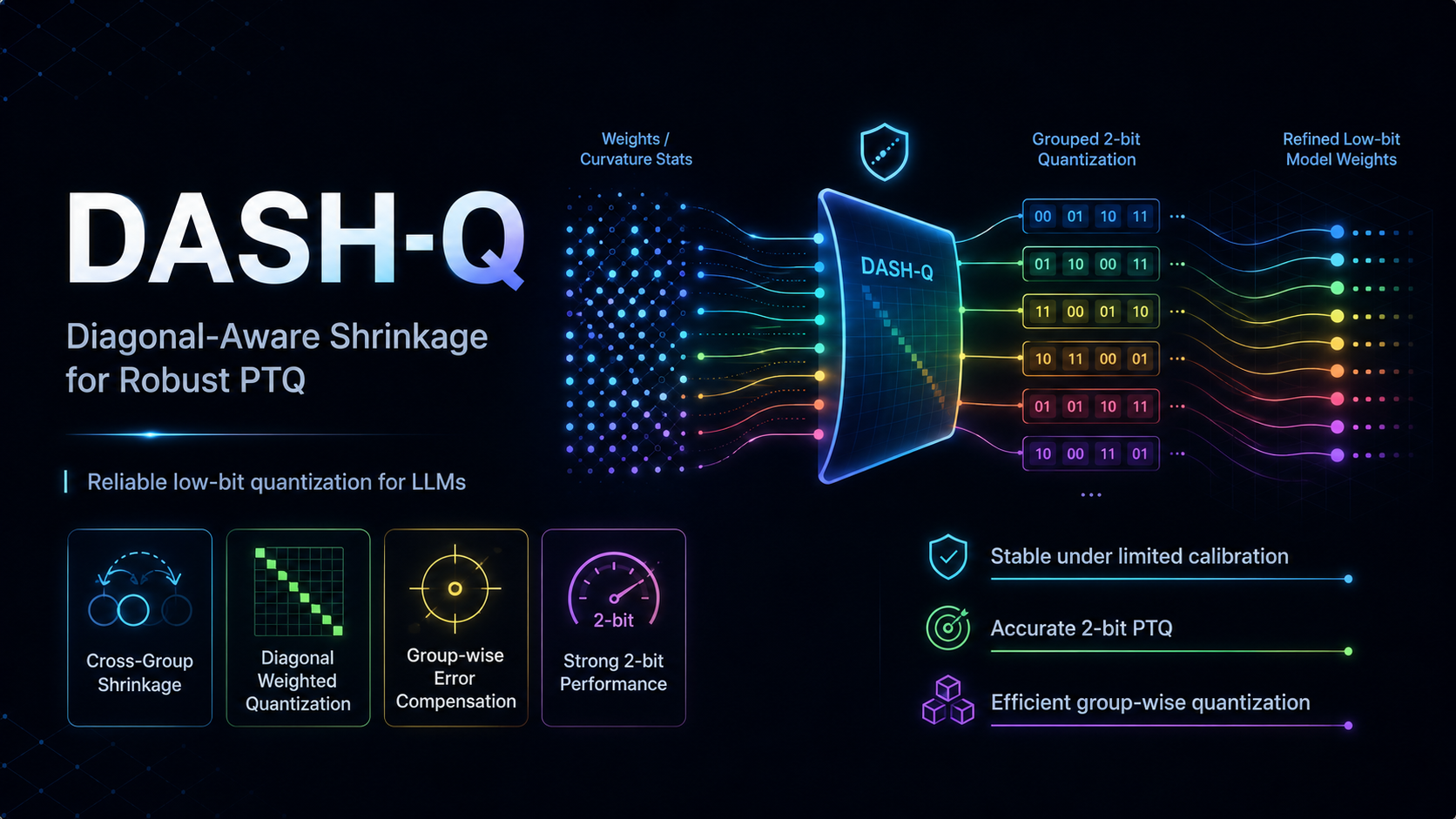
DASH-Q — Diagonal-Aware Shrinkage for Robust PTQ.
INT2· group size 32 · 14.8188 GB (from 65.5278 GB — 4.4x smaller)
Usage
from transformers import AutoModelForCausalLM, AutoTokenizer
model = AutoModelForCausalLM.from_pretrained(
"jkim96/DeepSeek-R1-Distill-Qwen-32B-DASHQ-INT2-g32", trust_remote_code=True, device_map="cuda", dtype="auto"
)
tokenizer = AutoTokenizer.from_pretrained("jkim96/DeepSeek-R1-Distill-Qwen-32B-DASHQ-INT2-g32")
messages = [{"role": "user", "content": "Explain 2-bit quantization in one sentence."}]
text = tokenizer.apply_chat_template(messages, add_generation_prompt=True, tokenize=False)
inputs = tokenizer(text, return_tensors="pt").to(model.device)
print(tokenizer.decode(model.generate(**inputs, max_new_tokens=256)[0]))
trust_remote_code=True is required: the checkpoint ships its quantized-layer
implementation (modeling_dashq.py) and Triton kernels (dashq_kernel.py).
Without Triton, or on CPU, it falls back to dequantize-and-matmul in PyTorch.
Requirements
| Package | Minimum | Verified with |
|---|---|---|
torch |
2.4 | 2.12.1+cu130 |
transformers |
5.8 | 5.9.0 |
triton |
3.0 (Linux; bundled with CUDA builds of PyTorch) | 3.7.1 |
huggingface_hub |
1.5 (pulled in by transformers) | 1.15.0 |
Quantization
| Field | Value |
|---|---|
| Base model | deepseek-ai/DeepSeek-R1-Distill-Qwen-32B |
| Precision | INT2, group size 32 |
| Scale / zero dtype | float16 |
| Calibration | wikitext2, 128 samples x 2048 |
| Size | 14.8188 GB · original 65.5278 GB · 4.4x compression |
Benchmarks
Full zero-shot / few-shot results for every DASH-Q checkpoint: github.com/JaeminK/dashq#benchmarks
Evaluation
| Metric | Value |
|---|---|
wikitext2_ppl |
8.4454 |
zero-shot accuracy avg |
66.4855 |
arc_challenge |
49.2321 |
arc_easy |
75.5892 |
commonsense_qa |
81.9820 |
hellaswag |
74.7262 |
lambada_openai |
70.4056 |
openbookqa |
41.8000 |
piqa |
77.5843 |
truthfulqa_mc2 |
53.4112 |
winogrande |
73.6385 |
- Downloads last month
- 10
Model tree for jkim96/DeepSeek-R1-Distill-Qwen-32B-DASHQ-INT2-g32
Base model
deepseek-ai/DeepSeek-R1-Distill-Qwen-32B