
Datasets:

Access MM-Dia
Access is provided for non-commercial research and educational use after manual review of the signed MM-Dia EULA.
Please review the MM-Dia EULA, submit this access request, and email the signed EULA to jinzeyu23@mails.tsinghua.edu.cn. Access will be granted after manual review.
Log in or Sign Up to review the conditions and access this dataset content.
MM-Dia





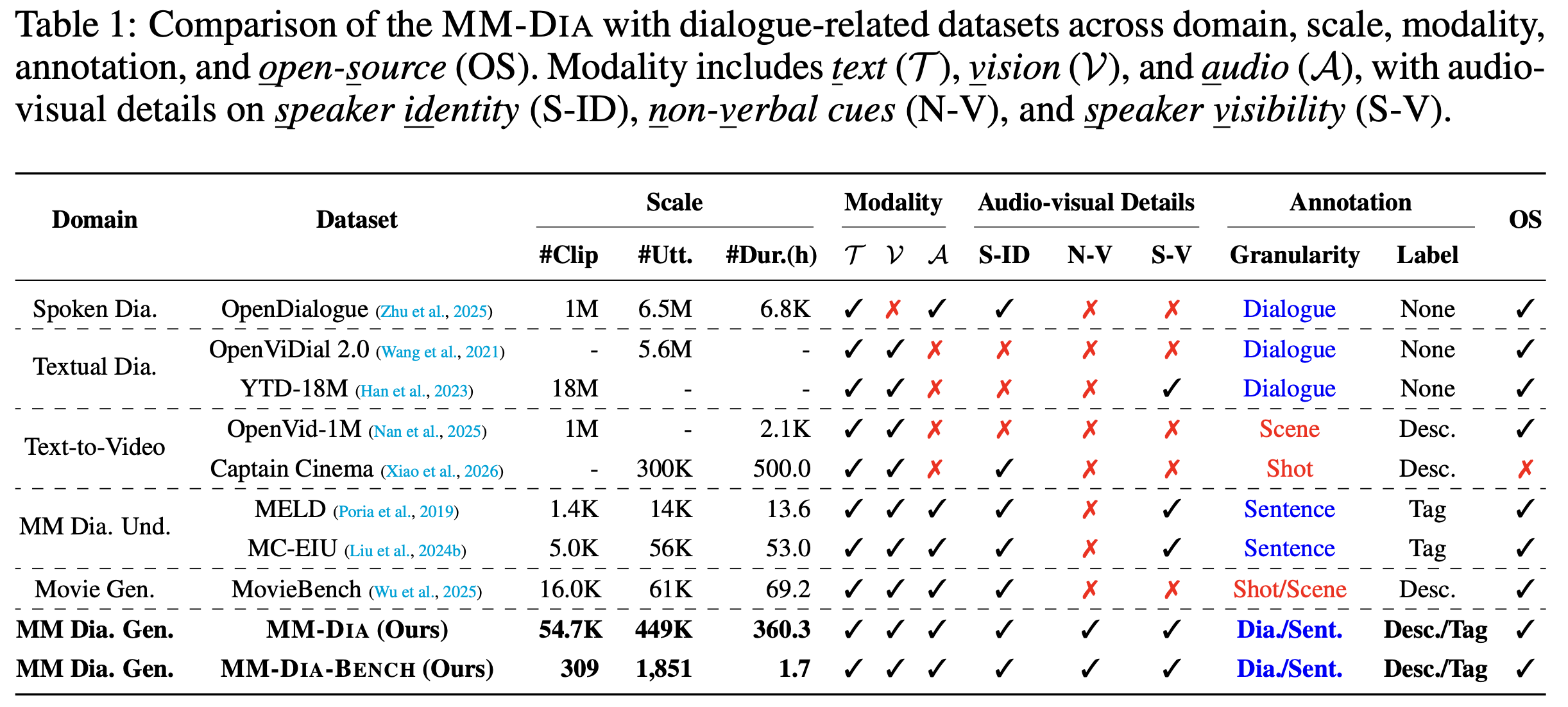
MM-Dia is a dataset for expressive multimodal dialogue generation introduced in the ICLR 2026 paper “From Natural Alignment to Conditional Controllability in Multimodal Dialogue”. Curated from movies and TV series, it is the first dataset centered on dialogue-level expressiveness across modalities, with synchronized text, speech, visual context, and hierarchical style annotations.
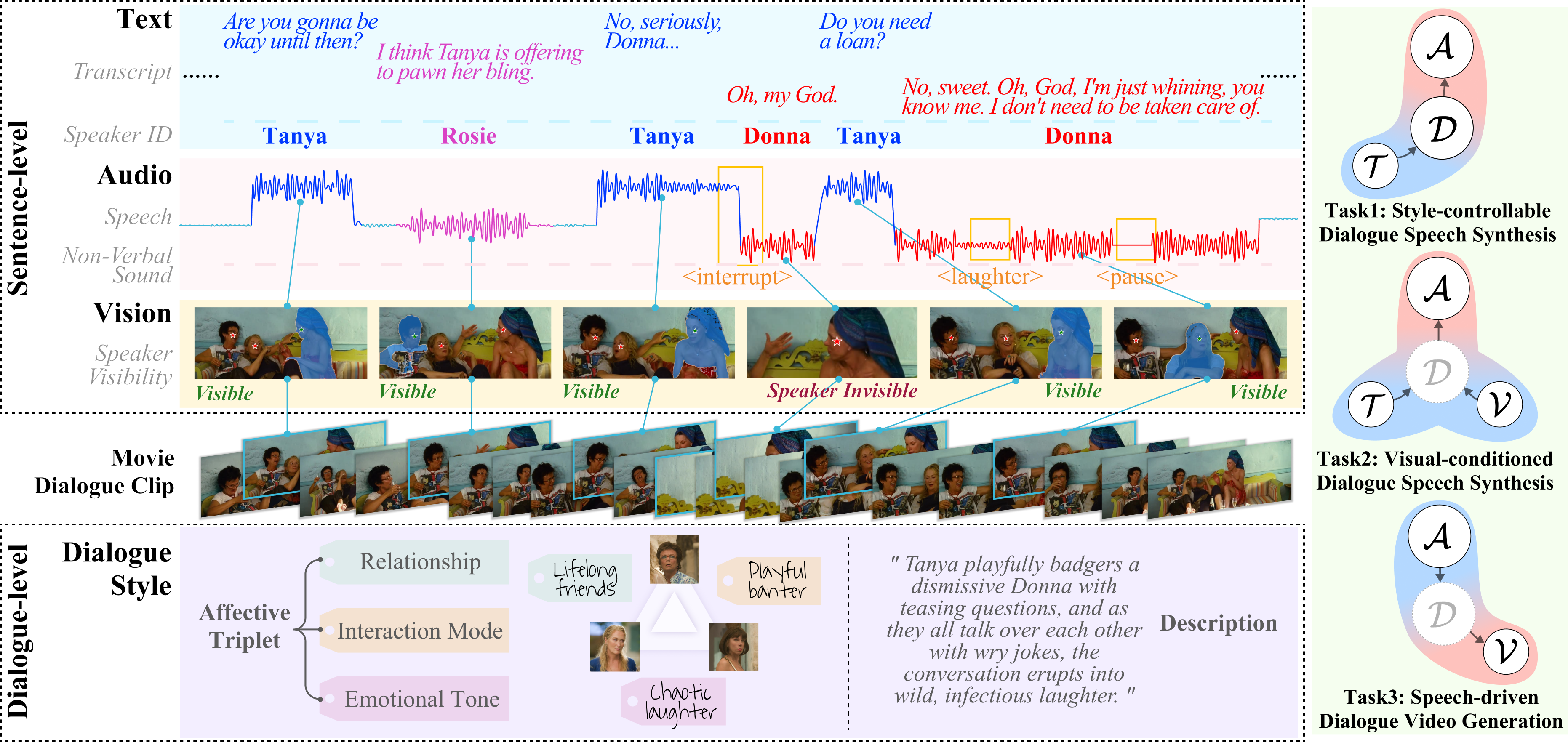
In our paper, we explore three representative applications of MM-Dia: 1. style-controllable dialogue speech synthesis, 2. vision-conditioned dialogue speech synthesis, and 3. speech-driven dialogue video generation. The dataset may also support broader research in multimodal dialogue modeling, conversational speech, affective computing, and audio-visual learning.
|
|
Dataset at a Glance
| Statistic | MM-Dia |
|---|---|
| Dialogues | 54,700 |
| Speaking turns | 449,138 |
| Total duration | 360.26 hours |
| Average speakers per dialogue | 2.29 |
| Average duration per dialogue | 23.71 seconds |
| Average turns per dialogue | 8.21 |
| Speaker visibility | Partial |
Released Content
Due to copyright restrictions on the source movies and TV series, the MM-Dia release contains:
- JSON annotations: transcripts, timestamps, speaker information, style descriptions, Affective Triplets, expressiveness scores, and visual alignment metadata.
- DAC-encoded audio: dialogue audio encoded at 44.1 kHz for local reconstruction as WAV.
- Reconstruction tools: code for aligning and extracting dialogue video clips from legally obtained source media.
Original movie and TV video files are not distributed with MM-Dia. Researchers requiring visual clips must obtain legal copies of the corresponding source media and reconstruct the clips locally. The provided pipeline can also be used to extract and annotate dialogue clips from users' own new video and subtitle sources.
File Structure
MM-Dia/
├── json/
│   └── <batch>/
│       └── <movie_or_episode>.json
├── audio_enc/
│   └── <batch>/
│       └── <movie_or_episode>/
│           └── <clip>/
│               ├── <clip>.dac             # Denoised audio encoded at 24 kHz
│               ├── <clip>_44k.dac         # Denoised audio encoded at 44.1 kHz
│               ├── <clip>_no_vocals.dac   # Encoded non-vocal track with background music and ambient sounds
│               └── <clip>_orig.dac        # Encoded original audio with volume normalization
└── character/
    ├── movie_character/
    └── TV_character/
        └── <series_name>/
            └── <character_name>.<jpg|png>
After local reconstruction, decoded audio and extracted video follow the same hierarchy:
audio/<batch>/<movie_or_episode>/<clip>/*.wav
video/<batch>/<movie_or_episode>/<clip>.mp4
Corresponding JSON, audio, and reconstructed video entries refer to the same dialogue segment.
Character Image Gallery
The character/ directory is a reference image gallery for recurring movie and TV characters. It supports character recognition and speaker attribution in the MM-Dia curation pipeline. Movie entries are organized by IMDb ID and include a cast index, while TV entries are grouped by series.
Annotations
MM-Dia provides utterance-level and dialogue-level information, including:
- utterance text, timestamps, and speaker identity;
- dialogue style descriptions;
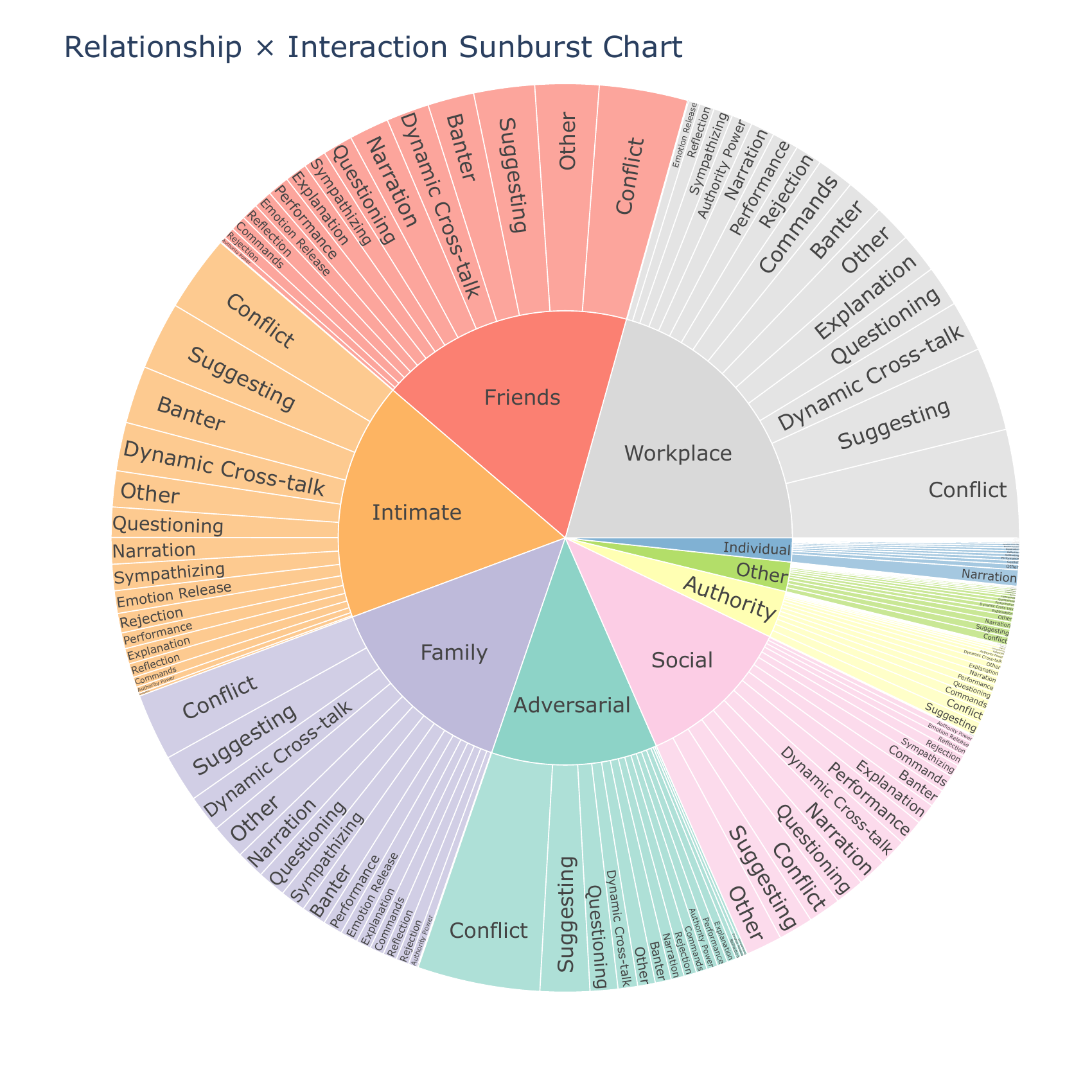
- Affective Triplets: relationship, interaction mode, and emotional tone;
- emotion intensity and emotion-flow volatility;
- speaker visibility and visual alignment metadata.
Representative JSON fields include utterances, affective_triplet, description, emotion_intensity, emotion_volatility, and speaker_visibility.
What to Download
| Research goal | JSON | Encoded audio | Source media required | Additional preparation |
|---|---|---|---|---|
| Conversational speech modeling | ✓ | ✓ | — | Decode DAC audio to WAV |
| Speech and affect understanding | ✓ | ✓ | — | Decode DAC audio to WAV |
| Audio-visual dialogue modeling | ✓ | ✓ | ✓ | Decode audio and reconstruct video |
| Speech-driven dialogue video generation | ✓ | ✓ | ✓ | Decode audio and reconstruct video |
For direct benchmark evaluation with distributed WAV and video files, see MM-Dia-Bench.
Access and EULA
MM-Dia is gated and uses manual approval. It is available for non-commercial research and educational use under the MM-Dia EULA.
To request access:
- Read and sign
MM-DIA_EULA.pdf. - Submit the access request on this Hugging Face page using the same identity and email address.
- Email the signed EULA to jinzeyu23@mails.tsinghua.edu.cn.
- Access will be granted after the submitted information and signed agreement are reviewed.
Please do not redistribute the dataset or use it for commercial purposes. Users are responsible for obtaining lawful access to any source media used for video reconstruction.
Download
After approval, authenticate with Hugging Face and download the repository:
hf auth login
hf download jessyjin/MM-Dia \
  --repo-type dataset \
  --local-dir MM-Dia
The processing and reconstruction tools are maintained in the GitHub repository:
git clone https://github.com/jessyjinzy/MM-Dia.git
cd MM-Dia
pip install -r requirements.txt
Extract the Packaged Audio
The encoded audio is distributed as a Zstandard-compressed tar archive split into multiple parts. Install zstd, then run the following command from the downloaded dataset directory:
tar -xf MM_DIA-json.tar
tar -xf MM_DIA-character.tar

cat MM_DIA-audio_enc.tar.zst.part-* \
  | zstd -d -c \
  | tar -xf -
This streams the ordered parts directly into tar and extracts the audio_enc/ directory without creating an additional full-size archive. Keep all parts in the same directory and ensure that the destination has sufficient free space before extraction.
Decode the Audio
python utils/audio_codec_utils.py decode \
  --batch_input_dir /path/to/MM-Dia/audio_enc/movie \
  --batch_output_dir /path/to/output/audio/movie
The decoder supports batch processing and produces WAV files for training, evaluation, or listening.
Reconstruct Video
Original video is not included. After obtaining legal source media, reconstruct aligned dialogue clips with:
python av_align_and_extract.py \
  --batch_json_dir /path/to/MM-Dia/json/movie \
  --batch_audio_dir /path/to/output/audio/movie \
  --source_dir /path/to/legal/source/media \
  --batch_output_dir /path/to/output/video/movie
See the GitHub documentation for setup details and troubleshooting.
Limitations and Responsible Use
Copyright in the underlying movies and TV series remains with their respective rights holders. We do not claim ownership of the source media. If you are a rights holder and believe that any released material should be removed, please contact jinzeyu23@mails.tsinghua.edu.cn with the relevant details. We will review the request and remove the affected content where appropriate.
The dataset must not be used for identity impersonation, deceptive media generation, surveillance, harassment, or other harmful applications.
Citation
@inproceedings{jin2026mmdia,
  title     = {From Natural Alignment to Conditional Controllability in Multimodal Dialogue},
  author    = {Jin, Zeyu and Zhou, Songtao and Wang, Haoyu and Tian, Minghao and Yun, Kaifeng and Chen, Zhuo and Qin, Xiaoyu and Jia, Jia},
  booktitle = {The International Conference on Learning Representations (ICLR)},
  year      = {2026}
}
- Downloads last month
- 27