

The dataset viewer is not available for this split.
Error code:   StreamingRowsError
Exception:    CastError
Message:      Couldn't cast
digest: string
kind: string
path: string
payload_sha3: string
prev: string
seq: int64
ts: timestamp[s]
passed: int64
failed: int64
python: string
method: struct<aggregate_rule: string, excluded: string, reproduce: string, thresholds_note: string>
  child 0, aggregate_rule: string
  child 1, excluded: string
  child 2, reproduce: string
  child 3, thresholds_note: string
failed_ids: list<item: null>
  child 0, item: null
schema: string
total: int64
source: struct<git: struct<head: string, url: string, branch: string, sha_verified_from: string>>
  child 0, git: struct<head: string, url: string, branch: string, sha_verified_from: string>
      child 0, head: string
      child 1, url: string
      child 2, branch: string
      child 3, sha_verified_from: string
root: string
version: string
all_passed: bool
benchmarks: list<item: struct<evidence: struct<ceilings: struct<max_files: int64, max_lines: int64, min_lines: i (... 3044 chars omitted)
  child 0, item: struct<evidence: struct<ceilings: struct<max_files: int64, max_lines: int64, min_lines: int64>, code (... 3032 chars omitted)
      child 0, evidence: struct<ceilings: struct<max_files: int64, max_lines: int64, min_lines: int64>, code_lines: int64, co (... 2961 chars omitted)
          child 0, ceilings: struct<max_files: int64, max_lines: int64, min_lines: int64>
              child 0, max_files: int64
              child 1, max_lines: int64
              child 2, min_lines: int64
          child 1, code_lines: int64

...
 qualification_environment_pinned: struct<detail: string, evidence_path: string, present: bool>
                  child 0, detail: string
                  child 1, evidence_path: string
                  child 2, present: bool
              child 5, reproducible_tests: struct<detail: string, evidence_path: string, present: bool>
                  child 0, detail: string
                  child 1, evidence_path: string
                  child 2, present: bool
              child 6, rerunnable_verification: struct<detail: string, evidence_path: string, present: bool>
                  child 0, detail: string
                  child 1, evidence_path: string
                  child 2, present: bool
              child 7, versioning: struct<detail: string, evidence_path: string, present: bool>
                  child 0, detail: string
                  child 1, evidence_path: string
                  child 2, present: bool
          child 62, criteria_missing: list<item: null>
              child 0, item: null
          child 63, criteria_satisfied: int64
          child 64, criteria_total: int64
          child 65, framework_controls_verified: int64
          child 66, ladder: string
          child 67, observed_level: int64
          child 68, source: string
          child 69, trL9_claimed: bool
          child 70, trL9_reason: string
      child 1, id: string
      child 2, ok: bool
      child 3, status: string
      child 4, title: string
platform: string
sbom_written: bool
to
{'all_passed': Value('bool'), 'benchmarks': List({'evidence': {'ceilings': {'max_files': Value('int64'), 'max_lines': Value('int64'), 'min_lines': Value('int64')}, 'code_lines': Value('int64'), 'command': Value('string'), 'counts_command': Value('string'), 'files_source': Value('int64'), 'files_tests': Value('int64'), 'files_total': Value('int64'), 'method': Value('string'), 'test_to_source_line_ratio': Value('float64'), 'total_lines': Value('int64'), 'a_licences': List(Value('string')), 'b_licences': List(Value('string')), 'default_for_unknown_is_C': Value('bool'), 'mismatches': {}, 'observed': {'agpl3': Value('string'), 'apache2': Value('string'), 'bsd3': Value('string'), 'commons_clause': Value('string'), 'garbage': Value('string'), 'gpl3': Value('string'), 'isc': Value('string'), 'lgpl': Value('string'), 'mit': Value('string'), 'mpl2': Value('string'), 'noncommercial': Value('string'), 'proprietary': Value('string'), 'sspl': Value('string'), 'unknown_absent': Value('string')}, 'only_class_A_may_relicense': Value('bool'), 'policy_probes': {'agpl3': Value('string'), 'apache2': Value('string'), 'bsd3': Value('string'), 'commons_clause': Value('string'), 'garbage': Value('string'), 'gpl3': Value('string'), 'isc': Value('string'), 'lgpl': Value('string'), 'mit': Value('string'), 'mpl2': Value('string'), 'noncommercial': Value('string'), 'proprietary': Value('string'), 'sspl': Value('string'), 'unknown_absent': Value('string')}, 'project_licence': {'LICENSE': Value('string'), '
...
Value('string'), 'evidence_path': Value('string'), 'present': Value('bool')}, 'qualification_environment_pinned': {'detail': Value('string'), 'evidence_path': Value('string'), 'present': Value('bool')}, 'reproducible_tests': {'detail': Value('string'), 'evidence_path': Value('string'), 'present': Value('bool')}, 'rerunnable_verification': {'detail': Value('string'), 'evidence_path': Value('string'), 'present': Value('bool')}, 'versioning': {'detail': Value('string'), 'evidence_path': Value('string'), 'present': Value('bool')}}, 'criteria_missing': List(Value('null')), 'criteria_satisfied': Value('int64'), 'criteria_total': Value('int64'), 'framework_controls_verified': Value('int64'), 'ladder': Value('string'), 'observed_level': Value('int64'), 'source': Value('string'), 'trL9_claimed': Value('bool'), 'trL9_reason': Value('string')}, 'id': Value('string'), 'ok': Value('bool'), 'status': Value('string'), 'title': Value('string')}), 'failed': Value('int64'), 'failed_ids': List(Value('null')), 'method': {'aggregate_rule': Value('string'), 'excluded': Value('string'), 'reproduce': Value('string'), 'thresholds_note': Value('string')}, 'passed': Value('int64'), 'platform': Value('string'), 'python': Value('string'), 'root': Value('string'), 'sbom_written': Value('bool'), 'schema': Value('string'), 'total': Value('int64'), 'version': Value('string'), 'source': {'git': {'head': Value('string'), 'url': Value('string'), 'branch': Value('string'), 'sha_verified_from': Value('string')}}}
because column names don't match
Traceback:    Traceback (most recent call last):
                File "/src/services/worker/src/worker/utils.py", line 147, in get_rows_or_raise
                  return get_rows(
                      dataset=dataset,
                  ...<4 lines>...
                      column_names=column_names,
                  )
                File "/src/libs/libcommon/src/libcommon/utils.py", line 272, in decorator
                  return func(*args, **kwargs)
                File "/src/services/worker/src/worker/utils.py", line 127, in get_rows
                  rows_plus_one = list(itertools.islice(safe_iter(ds, dataset=dataset), rows_max_number + 1))
                File "/src/services/worker/src/worker/utils.py", line 483, in safe_iter
                  yield from ds.decode(False) if ds.features else ds
                File "/usr/local/lib/python3.14/site-packages/datasets/iterable_dataset.py", line 2951, in __iter__
                  for key, example in ex_iterable:
                                      ^^^^^^^^^^^
                File "/usr/local/lib/python3.14/site-packages/datasets/iterable_dataset.py", line 2461, in __iter__
                  for key, pa_table in self._iter_arrow():
                                       ~~~~~~~~~~~~~~~~^^
                File "/usr/local/lib/python3.14/site-packages/datasets/iterable_dataset.py", line 2486, in _iter_arrow
                  for key, pa_table in self.ex_iterable._iter_arrow():
                                       ~~~~~~~~~~~~~~~~~~~~~~~~~~~~^^
                File "/usr/local/lib/python3.14/site-packages/datasets/iterable_dataset.py", line 547, in _iter_arrow
                  for key, pa_table in iterator:
                                       ^^^^^^^^
                File "/usr/local/lib/python3.14/site-packages/datasets/iterable_dataset.py", line 430, in _iter_arrow
                  for key, pa_table in self.generate_tables_fn(**gen_kwags):
                                       ~~~~~~~~~~~~~~~~~~~~~~~^^^^^^^^^^^^^
                File "/usr/local/lib/python3.14/site-packages/datasets/packaged_modules/json/json.py", line 343, in _generate_tables
                  self._cast_table(pa_table, json_field_paths=json_field_paths),
                  ~~~~~~~~~~~~~~~~^^^^^^^^^^^^^^^^^^^^^^^^^^^^^^^^^^^^^^^^^^^^^
                File "/usr/local/lib/python3.14/site-packages/datasets/packaged_modules/json/json.py", line 132, in _cast_table
                  pa_table = table_cast(pa_table, self.info.features.arrow_schema)
                File "/usr/local/lib/python3.14/site-packages/datasets/table.py", line 2378, in table_cast
                  return cast_table_to_schema(table, schema)
                File "/usr/local/lib/python3.14/site-packages/datasets/table.py", line 2306, in cast_table_to_schema
                  raise CastError(
                  ...<3 lines>...
                  )
              datasets.table.CastError: Couldn't cast
              digest: string
              kind: string
              path: string
              payload_sha3: string
              prev: string
              seq: int64
              ts: timestamp[s]
              passed: int64
              failed: int64
              python: string
              method: struct<aggregate_rule: string, excluded: string, reproduce: string, thresholds_note: string>
                child 0, aggregate_rule: string
                child 1, excluded: string
                child 2, reproduce: string
                child 3, thresholds_note: string
              failed_ids: list<item: null>
                child 0, item: null
              schema: string
              total: int64
              source: struct<git: struct<head: string, url: string, branch: string, sha_verified_from: string>>
                child 0, git: struct<head: string, url: string, branch: string, sha_verified_from: string>
                    child 0, head: string
                    child 1, url: string
                    child 2, branch: string
                    child 3, sha_verified_from: string
              root: string
              version: string
              all_passed: bool
              benchmarks: list<item: struct<evidence: struct<ceilings: struct<max_files: int64, max_lines: int64, min_lines: i (... 3044 chars omitted)
                child 0, item: struct<evidence: struct<ceilings: struct<max_files: int64, max_lines: int64, min_lines: int64>, code (... 3032 chars omitted)
                    child 0, evidence: struct<ceilings: struct<max_files: int64, max_lines: int64, min_lines: int64>, code_lines: int64, co (... 2961 chars omitted)
                        child 0, ceilings: struct<max_files: int64, max_lines: int64, min_lines: int64>
                            child 0, max_files: int64
                            child 1, max_lines: int64
                            child 2, min_lines: int64
                        child 1, code_lines: int64

              ...
               qualification_environment_pinned: struct<detail: string, evidence_path: string, present: bool>
                                child 0, detail: string
                                child 1, evidence_path: string
                                child 2, present: bool
                            child 5, reproducible_tests: struct<detail: string, evidence_path: string, present: bool>
                                child 0, detail: string
                                child 1, evidence_path: string
                                child 2, present: bool
                            child 6, rerunnable_verification: struct<detail: string, evidence_path: string, present: bool>
                                child 0, detail: string
                                child 1, evidence_path: string
                                child 2, present: bool
                            child 7, versioning: struct<detail: string, evidence_path: string, present: bool>
                                child 0, detail: string
                                child 1, evidence_path: string
                                child 2, present: bool
                        child 62, criteria_missing: list<item: null>
                            child 0, item: null
                        child 63, criteria_satisfied: int64
                        child 64, criteria_total: int64
                        child 65, framework_controls_verified: int64
                        child 66, ladder: string
                        child 67, observed_level: int64
                        child 68, source: string
                        child 69, trL9_claimed: bool
                        child 70, trL9_reason: string
                    child 1, id: string
                    child 2, ok: bool
                    child 3, status: string
                    child 4, title: string
              platform: string
              sbom_written: bool
              to
              {'all_passed': Value('bool'), 'benchmarks': List({'evidence': {'ceilings': {'max_files': Value('int64'), 'max_lines': Value('int64'), 'min_lines': Value('int64')}, 'code_lines': Value('int64'), 'command': Value('string'), 'counts_command': Value('string'), 'files_source': Value('int64'), 'files_tests': Value('int64'), 'files_total': Value('int64'), 'method': Value('string'), 'test_to_source_line_ratio': Value('float64'), 'total_lines': Value('int64'), 'a_licences': List(Value('string')), 'b_licences': List(Value('string')), 'default_for_unknown_is_C': Value('bool'), 'mismatches': {}, 'observed': {'agpl3': Value('string'), 'apache2': Value('string'), 'bsd3': Value('string'), 'commons_clause': Value('string'), 'garbage': Value('string'), 'gpl3': Value('string'), 'isc': Value('string'), 'lgpl': Value('string'), 'mit': Value('string'), 'mpl2': Value('string'), 'noncommercial': Value('string'), 'proprietary': Value('string'), 'sspl': Value('string'), 'unknown_absent': Value('string')}, 'only_class_A_may_relicense': Value('bool'), 'policy_probes': {'agpl3': Value('string'), 'apache2': Value('string'), 'bsd3': Value('string'), 'commons_clause': Value('string'), 'garbage': Value('string'), 'gpl3': Value('string'), 'isc': Value('string'), 'lgpl': Value('string'), 'mit': Value('string'), 'mpl2': Value('string'), 'noncommercial': Value('string'), 'proprietary': Value('string'), 'sspl': Value('string'), 'unknown_absent': Value('string')}, 'project_licence': {'LICENSE': Value('string'), '
              ...
              Value('string'), 'evidence_path': Value('string'), 'present': Value('bool')}, 'qualification_environment_pinned': {'detail': Value('string'), 'evidence_path': Value('string'), 'present': Value('bool')}, 'reproducible_tests': {'detail': Value('string'), 'evidence_path': Value('string'), 'present': Value('bool')}, 'rerunnable_verification': {'detail': Value('string'), 'evidence_path': Value('string'), 'present': Value('bool')}, 'versioning': {'detail': Value('string'), 'evidence_path': Value('string'), 'present': Value('bool')}}, 'criteria_missing': List(Value('null')), 'criteria_satisfied': Value('int64'), 'criteria_total': Value('int64'), 'framework_controls_verified': Value('int64'), 'ladder': Value('string'), 'observed_level': Value('int64'), 'source': Value('string'), 'trL9_claimed': Value('bool'), 'trL9_reason': Value('string')}, 'id': Value('string'), 'ok': Value('bool'), 'status': Value('string'), 'title': Value('string')}), 'failed': Value('int64'), 'failed_ids': List(Value('null')), 'method': {'aggregate_rule': Value('string'), 'excluded': Value('string'), 'reproduce': Value('string'), 'thresholds_note': Value('string')}, 'passed': Value('int64'), 'platform': Value('string'), 'python': Value('string'), 'root': Value('string'), 'sbom_written': Value('bool'), 'schema': Value('string'), 'total': Value('int64'), 'version': Value('string'), 'source': {'git': {'head': Value('string'), 'url': Value('string'), 'branch': Value('string'), 'sha_verified_from': Value('string')}}}
              because column names don't match
Need help to make the dataset viewer work? Make sure to review how to configure the dataset viewer, and open a discussion for direct support.
YAML Metadata Warning:empty or missing yaml metadata in repo card
Check out the documentation for more information.
ARMI




Governed Anticloud packaging of the upstream project
ARMIin category OIL_GAS. check results: see ISOLATED_LAB_RESULTS. Every number below traces to a named file + run stamp; nothing is borrowed from other projects.
Upstream: ARMI · Upstream pin: 17c322a13039b2ac5354aec65f9828f7580d9959 · Category: OIL_GAS · Vendor: Anticloud FZ LLE · Licence: Apache-2.0
What This Project Does
|Build Status| |Code Coverage| |Commit Activity| |Good First Issues|
################# ARMI Introduction #################
The Advanced Reactor Modeling Interface (ARMI\ :sup:®) is an open-source tool that streamlines your nuclear reactor
design/analysis needs by providing a software reactor at your fingertips and a rich ecosystem of utilities working in
concert. It is made for and by professional reactor analysis teams and is maintained by
TerraPower LLC <http://terrapower.com/>_, a nuclear technology development company.
ARMI:
Provides a hub-and-spoke mechanism to standardize communication and coupling between physics kernels and the specialist analysts who use them,
Facilitates the creation and execution of detailed models and complex analysis methodologies,
Provides an ecosystem within which to rapidly and collaboratively build new analysis and physics simulation capabilities, and
Provides useful utilities to assist in reactor development.
A few demos of ARMI can be seen in the ARMI example gallery <https://terrapower.github.io/armi/gallery/index.html>_.
Using ARMI plus a collection of ARMI-aware physics plugins, an engineering team can perform a full analysis of a reactor system and then repeat the same level of analysis with some changed input parameters for almost no additional cost. Even better, thousands of perturbed cases can be executed in parallel on large clusters, helping conceptual design teams home in on an optimal design. Or design teams can analyze sensitivities all the way from, for example, an impurity in a control material to the peak structural temperature in a design-basis transient.
.. note:: ARMI does not come with a full selection of physics kernels. They will need to be acquired or developed for your specific project in order to make full use of this tool. Many of the example use-cases discussed in this manual require functionality that is not included in the open-source ARMI Framework.
In general, ARMI aims to enhance the quality, ease, and rigor of computational nuclear reactor design and analysis. Additional high-level overview about this system can be found in [#touranarmi]_.
.. list-table:: Quick links :widths: 30 70
- Source code
- https://github.com/terrapower/armi
- Documentation
- https://terrapower.github.io/armi
- First time contributor's guide
- https://terrapower.github.io/armi/developer/first_time_contributors.html
- Bug tracker
- https://github.com/terrapower/armi/issues
- Plugin directory
- https://github.com/terrapower/armi-plugin-directory
- Contact
- armi-devs@terrapower.com
Quick start
Before starting, you need to have Python <https://www.python.org/downloads/>_ 3.9+.
Get the ARMI code, install the prerequisites, and fire up the launcher with the following commands. You probably want to
do this in a virtual environment as described in the
Installation documentation <https://terrapower.github.io/armi/installation.html>_. Otherwise, the dependencies could
conflict with your system dependencies.
First, upgrade your version of pip::
$ pip install -U pip>=22.1
Now source and install ARMI::
$ git source https://github.com/terrapower/armi
$ cd armi
$ pip install -e .
$ armi --help
The ARMI tests are meant to be run using pytest <https://docs.pytest.org/en/8.0.x/>_ locally::
$ pip install -e ".[test]"
$ pytest -n 4 armi
From here, we recommend going through a few of our
gallery examples <https://terrapower.github.io/armi/gallery/index.html>_ and
tutorials <https://terrapower.github.io/armi/tutorials/index.html>_ to start touring the features and capabilities and
then move on to the User Manual <https://terrapower.github.io/armi/user/index.html>_.
Background
Nuclear reactor design requires, among other things, answers to the following questions:
Where are the neutrons? How fast are they moving? In which direction?
How quickly are atomic nuclei splitting? How long until the fuel runs out? How many atoms in the structure are being energetically displaced?
How much heat do these reactions produce? How quickly must coolant flow past the fuel to maintain appropriate temperatures? What are the temperatures of the fuel, coolant, and structure?
Can the structural arrangement support itself given the temperatures and pressures induced by the flowing coolant? For how long?
If a pump loses power or a control rod accidentally withdraws, how quickly will the chain reaction stop while keeping radiation contained?
How much used nuclear fuel is generated per useful energy produced? How long until it decays to stability?
Where and when should we move the fuel to most economically maintain the chain reaction?
What's the dose and activation above the head and in the secondary loop?
How does containment handle various postulated accidents?
How does the building handle earthquakes?
Digital computers have assisted in nuclear technology development since the days of the ENIAC in the 1940s. We now understand reactor physics well enough to build detailed simulations, which can answer many of these design questions in a cost-effective, and flexible manner. This allows us to simulate all kinds of different reactors with different fuels, coolants, moderators, power levels, safety systems, and power cycles. We can run our virtual reactors through the decades, tossing various off-normal conditions at them now and then, to see how they perform in terms of capability, economics, and safety.
Perhaps surprisingly, some nuclear software written in the 1960s is still in use today. These codes are validated against physical experiments that no longer exist. Meanwhile, new cutting-edge nuclear software is being developed for todays powerful computers. Both old and new, these tools are often challenging to operate and coordinate to produce a full reactor analysis.
The ARMI approach was born out of this situation: how can we best leverage an eclectic mix of legacy and modern tools with a small team to do full-scope analysis? We built a framework that lets us automate the tedious, uncoupled, and error-prone parts of reactor engineering/analysis work. We can turn around a very meaningful and detailed core analysis given a major change (e.g. change power by 50%) in just a few weeks. We can dispatch hundreds of parameter sweeps to multiple machines and then perform multi-objective optimization on the resulting design space.
The ARMI system is largely written in the Python programming language. Its high-level nature allows nuclear and mechanical engineers to rapidly automate their analysis tasks from their sub-specialties. This helps eliminate the translation step between computer-scientists and power plant design engineers. This allows good division of labor: the computer scientists can focus on the overall performance and maintainability of the framework, while the power plant engineers focus on power plant engineering.
We have spent over 10 years developing this system. Because of ARMI's high-level nature, we believe we can collaborate effectively with all ongoing reactor software developments.
Communication and coupling
ARMI provides a central place for all physics kernels to interact: the Reactor Model. All modules read state information from this Reactor and write their output to it. This common interface allows seamless communication and coupling between different physics sub-specialties. If you plug one new physics kernel into ARMI, it becomes coupled to N other kernels. The ARMI Framework, depicted in green below, is the majority of the open source package. Several skeletal analysis routines are included as well to perform basic data management and to help align efforts on external physics kernels.
.. figure:: https://terrapower.github.io/armi/_static/armiSchematicView.png :figclass: align-center
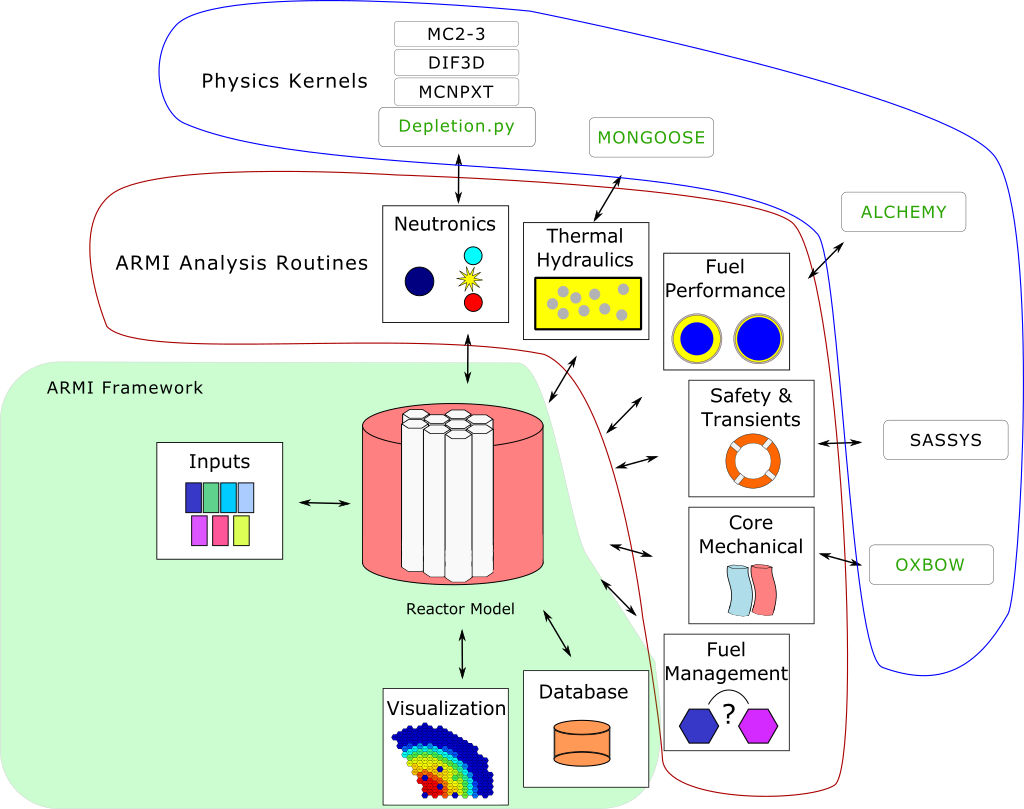
Figure 1. The schematic representation of the ARMI data model.
Automation
ARMI can quickly and easily produce complex input files with high levels of detail in various approximations. This enables users to perform rapid high-fidelity analyses to make sure all important physics are captured. It also enables sensitivity studies of different modeling approximations (e.g. symmetries, transport vs. diffusion vs. Monte Carlo, subchannel vs. CFD, etc.).
.. figure:: https://terrapower.github.io/armi/_static/armiGeometries.png :figclass: align-center
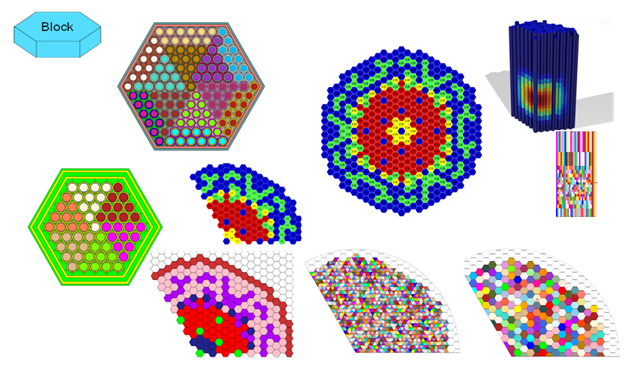
Figure 2. A variety of approximations in hexagonal geometry (1/3-core, full core, pin detailed, etc.) are shown, all derived from one consistent input file. ARMI supports Cartesian, Hex, RZ, and RZTheta geometric grids and includes many geometric components. Additionally, users can provide custom geometric elements.
New analysis and physics capabilities
The ARMI reactor model is fully accessible via a Python-based API, meaning that users have full access to the details of the plant at all times. Developers adding new physics features can take advantage of the ARMI data management structure by simply reading and writing to the Reactor state. Leveraging the infrastructure of ARMI, progress can be made rapidly.
A user can modify the plant in many ways. For instance, removing all sodium coolant is a one-liner::
core.setNumberDensity('NA23',0.0)
and finding the peak power density is easy::
core.getMaxParam('pdens')
Any ARMI state can be written out to whichever format the user desires, meaning that nominally identical cases can be produced for multiple similar codes in sensitivity studies. To read power densities, simply read them off the assembly objects. Instead of producing spreadsheets and making plots manually, analysts may write scripts to generate output reports that run automatically.
Writing a module within ARMI automatically features access to the ARMI API, including:
- Cross section processing
- Material properties
- Thermal expansion
- Database persistence
- Data visualization
- A code testing, documentation, and version control system
Use cases
Given an input describing a reactor, a typical ARMI run loops over a set of plugins in a certain sequence. Some plugins trigger third-party simulation codes, producing input files for them, executing them, and translating the output back onto the reactor model. Other plugins perform physics simulations directly.
For example, one ARMI sequence may involve the calculation of:
- nuclear cross sections
- global flux and power
- subchannel temperatures
- duct wall pressures
- cladding strain and wastage
- fission gas pressure
- reactivity feedbacks
- flow orificing
- the equilibrium fuel cycle
- control rod worth
- shutdown margin
- frequency stability margins
- peak cladding temperature
- transient analysis
- total levelized cost of electricity for the run
Another ARMI sequence may simply compute the cost of feed uranium and enrichment in an initial core and quit.
Larger siumulations may also run through the multi-objective design optimization system, which runs many cases with input perturbations to help find the best overall system, considering all important physics at the same time.
Other interest may come from the following:
The Research Scientist
A nuclear reactor research scientist, at a national lab or university, may benefit from ARMI. An ARMI workflow can reduce the time spent on data management. ARMI can handle the tedium so that researchers can better focus on designing and testing their research.
For example, if an ARMI input file describing the Fast Flux Test Facility (FTFF) reactor is provided, the researcher can start running benchmark cases with their new code method very rapidly, rather than spending the time building their own FFTF model.
If someone wants to try varying nuclear cross sections by a percent here and there to compute sensitivities, ARMI is a perfect platform upon which to operate.
If a reactor designer wants to try out a new Machine Learning algorithm for fuel management, plugging it into ARMI and having it run on all the physics kernels of the ARMI ecosystem will be a great way to prove its true value (note that this requires a rich ARMI physics ecosystem).
The Nuclear Startup Engineer
As various companies evaluate their ideas, they need tools for analysis. They can pick up ARMI and save 10 years of development and hit the ground running by plugging in their design-specific physics kernels and proprietary design inputs. ARMI's parameter sweep features, reactor model, and parallel utilities will all come in handy immediately.
Operating and Vendor Engineers
People at well-established utilities or vendors can hook ARMI into their legacy systems and increase their overall productivity.
The Enthusiast
If an enthusiast wants to try out a reactor idea they have, they can use ARMI (plus some physics kernels) to quickly get some performance metrics. They can see if their idea has wings, and if it does, they can then find a way to bring it to engineering and commercial reality.
History of ARMI
ARMI was originally created by TerraPower, LLC near Seattle WA starting in 2009. Its founding mission was to determine the optimal fuel management operations required to transition a fresh Traveling Wave Reactor core from startup into an equilibrium state. It started out automating the Argonne National Lab (ANL) fast reactor neutronics codes, MC2 and REBUS. The reactor model design was made with the intention of adding other physics capabilities later. Soon, simple thermal hydraulics were added and it's grown ever since. It has continuously evolved towards a general reactor analysis framework.
Following requests by outside parties to use ARMI, we started working on a more modular architecture for ARMI, allowing some of the intertwined physics capabilities to be separated out as plugins from the standalone framework.
The nuclear industry is small, and it faces many challenges. It also has a tradition of secrecy. As a result, there is risk of overlapping work being done by other entities.
We hypothesize that collaborating on software systems can help align some efforts worldwide, increasing quality and efficiency. In reactor development, the idea is generally cheap. It's the shakedown, technology and supply chain development, engineering demo, and commercial demo that are the hard parts.
Thus, ARMI was released under an open-source license in 2019 to facilitate mutually beneficial collaboration across the nuclear industry, where many teams are independently developing similar reactor analysis/automation frameworks.
We also hope that if more people can rapidly analyze the performance of their reactor ideas, limited available funding can be spent more effectively.
System Requirements
Being largely written in the Python programming language, the ARMI system works on most platforms. It can perform
meaningful analysis on a single laptop, but the full value of design optimization and large problems is realized with
parallel runs over large clusters (using the optional mpi4py library).
.. _getting-help:
Getting Help
You can get help with ARMI by either making issues on our github page <https://github.com/terrapower/armi/issues>_ or
by e-mailing armi-devs@terrapower.com.
Disclaimers
Due to TerraPower goals and priorities, many ARMI modules were developed with the sodium-cooled fast reactors as a target, and are not necessarily yet optimized for other plants. This is a known issue with code organization and we are working on it. On the other hand, the framework is sufficiently general that people have modeled other reactor types with ARMI, including thermal reactors.
ARMI was developed within a rapidly changing R&D environment. It evolved accordingly, and naturally carries some legacy. We continuously attempt to identify and update problematic parts of the code. Users should understand that ARMI is not a polished consumer software product, but rather a powerful and flexible engineering tool. It has the potential to accelerate work on many kinds of reactors.
ARMI has been written to support specific engineering/design tasks. As such, polish in the GUIs and output is somewhat lacking.
The ARMI framework uses the camelCase style, which is not the standard style for Python. As this is an issue of
style, it is not considered worth the API-breaking cost to our downstream users to change it.
License
TerraPower and ARMI are registered trademarks of TerraPower, LLC. Other trademarks and registered trademarks used in this Manual are the property of the respective trademark holders.
The ARMI system is licensed as follows:
.. code-block:: none
Copyright 2009 TerraPower, LLC

Licensed under the Apache License, Version 2.0 (the "License");
you may not use this file except in compliance with the License.
You may obtain a copy of the License at

    http://www.apache.org/licenses/LICENSE-2.0

Unless required by applicable law or agreed to in writing, software
distributed under the License is distributed on an "AS IS" BASIS,
WITHOUT WARRANTIES OR CONDITIONS OF ANY KIND, either express or implied.
See the License for the specific language governing permissions and
limitations under the License.
Be careful when including any dependency in ARMI (say in the pyproject.toml file) not to include anything with a
license that supersedes our Apache license. For instance, any third-party Python library included in ARMI with a GPL
license will make the whole project fall under the GPL license. But a lot of potential users of ARMI will want to keep
some of their work private, so we can't allow any GPL dependencies.
For that reason, it is generally considered best-practice in the ARMI ecosystem to only use third-party Python libraries that have MIT or BSD licenses.
.. [#touranarmi] Touran, Nicholas W., et al. "Computational tools for the integrated design of advanced nuclear reactors." Engineering 3.4 (2017): 518-526. https://doi.org/10.1016/J.ENG.2017.04.016
.. |Build Status| image:: https://github.com/terrapower/armi/actions/workflows/unittests.yaml/badge.svg?branch=main :target: https://github.com/terrapower/armi/actions/workflows/unittests.yaml

.. |Code Coverage| image:: https://codecov.io/gh/terrapower/armi/branch/main/graph/badge.svg :target: https://app.codecov.io/gh/terrapower/armi/tree/main

.. |Commit Activity| image:: https://img.shields.io/github/commit-activity/m/terrapower/armi :target: https://github.com/terrapower/armi/pulse
.. |Good First Issues| image:: https://img.shields.io/github/issues/terrapower/armi/good%20first%20issue :target: https://github.com/terrapower/armi/issues?q=is%3Aissue+is%3Aopen+label%3A%22good+first+issue%22
Installation
do this in a virtual environment as described in the
Installation documentation <https://terrapower.github.io/armi/installation.html>_. Otherwise, the dependencies could
conflict with your system dependencies.
First, upgrade your version of pip::
$ pip install -U pip>=22.1
Now source and install ARMI::
$ git source https://github.com/terrapower/armi
$ cd armi
$ pip install -e .
$ armi --help
The ARMI tests are meant to be run using pytest <https://docs.pytest.org/en/8.0.x/>_ locally::
$ pip install -e ".[test]"
$ pytest -n 4 armi
From here, we recommend going through a few of our
gallery examples <https://terrapower.github.io/armi/gallery/index.html>_ and
tutorials <https://terrapower.github.io/armi/tutorials/index.html>_ to start touring the features and capabilities and
then move on to the User Manual <https://terrapower.github.io/armi/user/index.html>_.
Background
Nuclear reactor design requires, among other things, answers to the following questions:
Where are the neutrons? How fast are they moving? In which direction?
How quickly are atomic nuclei splitting? How long until the fuel runs out? How many atoms in the structure are being energetically displaced?
How much heat do these reactions produce? How quickly must coolant flow past the fuel to maintain appropriate temperatures? What are the temperatures of the fuel, coolant, and structure?
Can the structural arrangement support itself given the temperatures and pressures induced by the flowing coolant? For how long?
If a pump loses power or a control rod accidentally withdraws, how quickly will the chain reaction stop while keeping radiation contained?
How much used nuclear fuel is generated per useful energy produced? How long until it decays to stability?
Where and when should we move the fuel to most economically maintain the chain reaction?
What's the dose and activation above the head and in the secondary loop?
How does containment handle various postulated accidents?
How does the building handle earthquakes?
Digital computers have assisted in nuclear technology development since the days of the ENIAC in the 1940s. We now understand reactor physics well enough to build detailed simulations, which can answer many of these design questions in a cost-effective, and flexible manner. This allows us to simulate all kinds of different reactors with different fuels, coolants, moderators, power levels, safety systems, and power cycles. We can run our virtual reactors through the decades, tossing various off-normal conditions at them now and then, to see how they perform in terms of capability, economics, and safety.
Perhaps surprisingly, some nuclear software written in the 1960s is still in use today. These codes are validated against physical experiments that no longer exist. Meanwhile, new cutting-edge nuclear software is being developed for todays powerful computers. Both old and new, these tools are often challenging to operate and coordinate to produce a full reactor analysis.
The ARMI approach was born out of this situation: how can we best leverage an eclectic mix of legacy and modern tools with a small team to do full-scope analysis? We built a framework that lets us automate the tedious, uncoupled, and error-prone parts of reactor engineering/analysis work. We can turn around a very meaningful and detailed core analysis given a major change (e.g. change power by 50%) in just a few weeks. We can dispatch hundreds of parameter sweeps to multiple machines and then perform multi-objective optimization on the resulting design space.
The ARMI system is largely written in the Python programming language. Its high-level nature allows nuclear and mechanical engineers to rapidly automate their analysis tasks from their sub-specialties. This helps eliminate the translation step between computer-scientists and power plant design engineers. This allows good division of labor: the computer scientists can focus on the overall performance and maintainability of the framework, while the power plant engineers focus on power plant engineering.
We have spent over 10 years developing this system. Because of ARMI's high-level nature, we believe we can collaborate effectively with all ongoing reactor software developments.
Communication and coupling
ARMI provides a central place for all physics kernels to interact: the Reactor Model. All modules read state information from this Reactor and write their output to it. This common interface allows seamless communication and coupling between different physics sub-specialties. If you plug one new physics kernel into ARMI, it becomes coupled to N other kernels. The ARMI Framework, depicted in green below, is the majority of the open source package. Several skeletal analysis routines are included as well to perform basic data management and to help align efforts on external physics kernels.
.. figure:: https://terrapower.github.io/armi/_static/armiSchematicView.png :figclass: align-center
Figure 1. The schematic representation of the ARMI data model.
Automation
ARMI can quickly and easily produce complex input files with high levels of detail in various approximations. This enables users to perform rapid high-fidelity analyses to make sure all important physics are captured. It also enables sensitivity studies of different modeling approximations (e.g. symmetries, transport vs. diffusion vs. Monte Carlo, subchannel vs. CFD, etc.).
.. figure:: https://terrapower.github.io/armi/_static/armiGeometries.png :figclass: align-center
Figure 2. A variety of approximations in hexagonal geometry (1/3-core, full core, pin detailed, etc.) are shown, all derived from one consistent input file. ARMI supports Cartesian, Hex, RZ, and RZTheta geometric grids and includes many geometric components. Additionally, users can provide custom geometric elements.
New analysis and physics capabilities
The ARMI reactor model is fully accessible via a Python-based API, meaning that users have full access to the details of the plant at all times. Developers adding new physics features can take advantage of the ARMI data management structure by simply reading and writing to the Reactor state. Leveraging the infrastructure of ARMI, progress can be made rapidly.
A user can modify the plant in many ways. For instance, removing all sodium coolant is a one-liner::
core.setNumberDensity('NA23',0.0)
and finding the peak power density is easy::
core.getMaxParam('pdens')
Any ARMI state can be written out to whichever format the user desires, meaning that nominally identical cases can be produced for multiple similar codes in sensitivity studies. To read power densities, simply read them off the assembly objects. Instead of producing spreadsheets and making plots manually, analysts may write scripts to generate output reports that run automatically.
Writing a module within ARMI automatically features access to the ARMI API, including:
- Cross section processing
- Material properties
- Thermal expansion
- Database persistence
- Data visualization
- A code testing, documentation, and version control system
Use cases
Given an input describing a reactor, a typical ARMI run loops over a set of plugins in a certain sequence. Some plugins trigger third-party simulation codes, producing input files for them, executing them, and translating the output back onto the reactor model. Other plugins perform physics simulations directly.
For example, one ARMI sequence may involve the calculation of:
- nuclear cross sections
- global flux and power
- subchannel temperatures
- duct wall pressures
- cladding strain and wastage
- fission gas pressure
- reactivity feedbacks
- flow orificing
- the equilibrium fuel cycle
- control rod worth
- shutdown margin
- frequency stability margins
- peak cladding temperature
- transient analysis
- total levelized cost of electricity for the run
Another ARMI sequence may simply compute the cost of feed uranium and enrichment in an initial core and quit.
Larger siumulations may also run through the multi-objective design optimization system, which runs many cases with input perturbations to help find the best overall system, considering all important physics at the same time.
Other interest may come from the following:
The Research Scientist
A nuclear reactor research scientist, at a national lab or university, may benefit from ARMI. An ARMI workflow can reduce the time spent on data management. ARMI can handle the tedium so that researchers can better focus on designing and testing their research.
For example, if an ARMI input file describing the Fast Flux Test Facility (FTFF) reactor is provided, the researcher can start running benchmark cases with their new code method very rapidly, rather than spending the time building their own FFTF model.
If someone wants to try varying nuclear cross sections by a percent here and there to compute sensitivities, ARMI is a perfect platform upon which to operate.
If a reactor designer wants to try out a new Machine Learning algorithm for fuel management, plugging it into ARMI and having it run on all the physics kernels of the ARMI ecosystem will be a great way to prove its true value (note that this requires a rich ARMI physics ecosystem).
The Nuclear Startup Engineer
As various companies evaluate their ideas, they need tools for analysis. They can pick up ARMI and save 10 years of development and hit the ground running by plugging in their design-specific physics kernels and proprietary design inputs. ARMI's parameter sweep features, reactor model, and parallel utilities will all come in handy immediately.
Operating and Vendor Engineers
People at well-established utilities or vendors can hook ARMI into their legacy systems and increase their overall productivity.
The Enthusiast
If an enthusiast wants to try out a reactor idea they have, they can use ARMI (plus some physics kernels) to quickly get some performance metrics. They can see if their idea has wings, and if it does, they can then find a way to bring it to engineering and commercial reality.
History of ARMI
ARMI was originally created by TerraPower, LLC near Seattle WA starting in 2009. Its founding mission was to determine the optimal fuel management operations required to transition a fresh Traveling Wave Reactor core from startup into an equilibrium state. It started out automating the Argonne National Lab (ANL) fast reactor neutronics codes, MC2 and REBUS. The reactor model design was made with the intention of adding other physics capabilities later. Soon, simple thermal hydraulics were added and it's grown ever since. It has continuously evolved towards a general reactor analysis framework.
Following requests by outside parties to use ARMI, we started working on a more modular architecture for ARMI, allowing some of the intertwined physics capabilities to be separated out as plugins from the standalone framework.
The nuclear industry is small, and it faces many challenges. It also has a tradition of secrecy. As a result, there is risk of overlapping work being done by other entities.
We hypothesize that collaborating on software systems can help align some efforts worldwide, increasing quality and efficiency. In reactor development, the idea is generally cheap. It's the shakedown, technology and supply chain development, engineering demo, and commercial demo that are the hard parts.
Thus, ARMI was released under an open-source license in 2019 to facilitate mutually beneficial collaboration across the nuclear industry, where many teams are independently developing similar reactor analysis/automation frameworks.
We also hope that if more people can rapidly analyze the performance of their reactor ideas, limited available funding can be spent more effectively.
System Requirements
Being largely written in the Python programming language, the ARMI system works on most platforms. It can perform
meaningful analysis on a single laptop, but the full value of design optimization and large problems is realized with
parallel runs over large clusters (using the optional mpi4py library).
.. _getting-help:
Getting Help
You can get help with ARMI by either making issues on our github page <https://github.com/terrapower/armi/issues>_ or
by e-mailing armi-devs@terrapower.com.
Disclaimers
Due to TerraPower goals and priorities, many ARMI modules were developed with the sodium-cooled fast reactors as a target, and are not necessarily yet optimized for other plants. This is a known issue with code organization and we are working on it. On the other hand, the framework is sufficiently general that people have modeled other reactor types with ARMI, including thermal reactors.
ARMI was developed within a rapidly changing R&D environment. It evolved accordingly, and naturally carries some legacy. We continuously attempt to identify and update problematic parts of the code. Users should understand that ARMI is not a polished consumer software product, but rather a powerful and flexible engineering tool. It has the potential to accelerate work on many kinds of reactors.
ARMI has been written to support specific engineering/design tasks. As such, polish in the GUIs and output is somewhat lacking.
The ARMI framework uses the camelCase style, which is not the standard style for Python. As this is an issue of
style, it is not considered worth the API-breaking cost to our downstream users to change it.
License
TerraPower and ARMI are registered trademarks of TerraPower, LLC. Other trademarks and registered trademarks used in this Manual are the property of the respective trademark holders.
The ARMI system is licensed as follows:
.. code-block:: none
Copyright 2009 TerraPower, LLC

Licensed under the Apache License, Version 2.0 (the "License");
you may not use this file except in compliance with the License.
You may obtain a copy of the License at

    http://www.apache.org/licenses/LICENSE-2.0

Unless required by applicable law or agreed to in writing, software
distributed under the License is distributed on an "AS IS" BASIS,
WITHOUT WARRANTIES OR CONDITIONS OF ANY KIND, either express or implied.
See the License for the specific language governing permissions and
limitations under the License.
Be careful when including any dependency in ARMI (say in the pyproject.toml file) not to include anything with a
license that supersedes our Apache license. For instance, any third-party Python library included in ARMI with a GPL
license will make the whole project fall under the GPL license. But a lot of potential users of ARMI will want to keep
some of their work private, so we can't allow any GPL dependencies.
For that reason, it is generally considered best-practice in the ARMI ecosystem to only use third-party Python libraries that have MIT or BSD licenses.
.. [#touranarmi] Touran, Nicholas W., et al. "Computational tools for the integrated design of advanced nuclear reactors." Engineering 3.4 (2017): 518-526. https://doi.org/10.1016/J.ENG.2017.04.016
.. |Build Status| image:: https://github.com/terrapower/armi/actions/workflows/unittests.yaml/badge.svg?branch=main :target: https://github.com/terrapower/armi/actions/workflows/unittests.yaml
.. |Code Coverage| image:: https://codecov.io/gh/terrapower/armi/branch/main/graph/badge.svg :target: https://app.codecov.io/gh/terrapower/armi/tree/main
.. |Commit Activity| image:: https://img.shields.io/github/commit-activity/m/terrapower/armi :target: https://github.com/terrapower/armi/pulse
.. |Good First Issues| image:: https://img.shields.io/github/issues/terrapower/armi/good%20first%20issue :target: https://github.com/terrapower/armi/issues?q=is%3Aissue+is%3Aopen+label%3A%22good+first+issue%22
Usage
Facilitates the creation and execution of detailed models and complex analysis methodologies,
Provides an ecosystem within which to rapidly and collaboratively build new analysis and physics simulation capabilities, and
Provides useful utilities to assist in reactor development.
A few demos of ARMI can be seen in the ARMI example gallery <https://terrapower.github.io/armi/gallery/index.html>_.
Using ARMI plus a collection of ARMI-aware physics plugins, an engineering team can perform a full analysis of a reactor system and then repeat the same level of analysis with some changed input parameters for almost no additional cost. Even better, thousands of perturbed cases can be executed in parallel on large clusters, helping conceptual design teams home in on an optimal design. Or design teams can analyze sensitivities all the way from, for example, an impurity in a control material to the peak structural temperature in a design-basis transient.
.. note:: ARMI does not come with a full selection of physics kernels. They will need to be acquired or developed for your specific project in order to make full use of this tool. Many of the example use-cases discussed in this manual require functionality that is not included in the open-source ARMI Framework.
In general, ARMI aims to enhance the quality, ease, and rigor of computational nuclear reactor design and analysis. Additional high-level overview about this system can be found in [#touranarmi]_.
.. list-table:: Quick links :widths: 30 70
- Source code
- https://github.com/terrapower/armi
- Documentation
- https://terrapower.github.io/armi
- First time contributor's guide
- https://terrapower.github.io/armi/developer/first_time_contributors.html
- Bug tracker
- https://github.com/terrapower/armi/issues
- Plugin directory
- https://github.com/terrapower/armi-plugin-directory
- Contact
- armi-devs@terrapower.com
Quick start
Before starting, you need to have Python <https://www.python.org/downloads/>_ 3.9+.
Get the ARMI code, install the prerequisites, and fire up the launcher with the following commands. You probably want to
do this in a virtual environment as described in the
Installation documentation <https://terrapower.github.io/armi/installation.html>_. Otherwise, the dependencies could
conflict with your system dependencies.
First, upgrade your version of pip::
$ pip install -U pip>=22.1
Now source and install ARMI::
$ git source https://github.com/terrapower/armi
$ cd armi
$ pip install -e .
$ armi --help
The ARMI tests are meant to be run using pytest <https://docs.pytest.org/en/8.0.x/>_ locally::
$ pip install -e ".[test]"
$ pytest -n 4 armi
From here, we recommend going through a few of our
gallery examples <https://terrapower.github.io/armi/gallery/index.html>_ and
tutorials <https://terrapower.github.io/armi/tutorials/index.html>_ to start touring the features and capabilities and
then move on to the User Manual <https://terrapower.github.io/armi/user/index.html>_.
Background
Nuclear reactor design requires, among other things, answers to the following questions:
Where are the neutrons? How fast are they moving? In which direction?
How quickly are atomic nuclei splitting? How long until the fuel runs out? How many atoms in the structure are being energetically displaced?
How much heat do these reactions produce? How quickly must coolant flow past the fuel to maintain appropriate temperatures? What are the temperatures of the fuel, coolant, and structure?
Can the structural arrangement support itself given the temperatures and pressures induced by the flowing coolant? For how long?
If a pump loses power or a control rod accidentally withdraws, how quickly will the chain reaction stop while keeping radiation contained?
How much used nuclear fuel is generated per useful energy produced? How long until it decays to stability?
Where and when should we move the fuel to most economically maintain the chain reaction?
What's the dose and activation above the head and in the secondary loop?
How does containment handle various postulated accidents?
How does the building handle earthquakes?
Digital computers have assisted in nuclear technology development since the days of the ENIAC in the 1940s. We now understand reactor physics well enough to build detailed simulations, which can answer many of these design questions in a cost-effective, and flexible manner. This allows us to simulate all kinds of different reactors with different fuels, coolants, moderators, power levels, safety systems, and power cycles. We can run our virtual reactors through the decades, tossing various off-normal conditions at them now and then, to see how they perform in terms of capability, economics, and safety.
Perhaps surprisingly, some nuclear software written in the 1960s is still in use today. These codes are validated against physical experiments that no longer exist. Meanwhile, new cutting-edge nuclear software is being developed for todays powerful computers. Both old and new, these tools are often challenging to operate and coordinate to produce a full reactor analysis.
The ARMI approach was born out of this situation: how can we best leverage an eclectic mix of legacy and modern tools with a small team to do full-scope analysis? We built a framework that lets us automate the tedious, uncoupled, and error-prone parts of reactor engineering/analysis work. We can turn around a very meaningful and detailed core analysis given a major change (e.g. change power by 50%) in just a few weeks. We can dispatch hundreds of parameter sweeps to multiple machines and then perform multi-objective optimization on the resulting design space.
The ARMI system is largely written in the Python programming language. Its high-level nature allows nuclear and mechanical engineers to rapidly automate their analysis tasks from their sub-specialties. This helps eliminate the translation step between computer-scientists and power plant design engineers. This allows good division of labor: the computer scientists can focus on the overall performance and maintainability of the framework, while the power plant engineers focus on power plant engineering.
We have spent over 10 years developing this system. Because of ARMI's high-level nature, we believe we can collaborate effectively with all ongoing reactor software developments.
Communication and coupling
ARMI provides a central place for all physics kernels to interact: the Reactor Model. All modules read state information from this Reactor and write their output to it. This common interface allows seamless communication and coupling between different physics sub-specialties. If you plug one new physics kernel into ARMI, it becomes coupled to N other kernels. The ARMI Framework, depicted in green below, is the majority of the open source package. Several skeletal analysis routines are included as well to perform basic data management and to help align efforts on external physics kernels.
.. figure:: https://terrapower.github.io/armi/_static/armiSchematicView.png :figclass: align-center
Figure 1. The schematic representation of the ARMI data model.
Automation
ARMI can quickly and easily produce complex input files with high levels of detail in various approximations. This enables users to perform rapid high-fidelity analyses to make sure all important physics are captured. It also enables sensitivity studies of different modeling approximations (e.g. symmetries, transport vs. diffusion vs. Monte Carlo, subchannel vs. CFD, etc.).
.. figure:: https://terrapower.github.io/armi/_static/armiGeometries.png :figclass: align-center
Figure 2. A variety of approximations in hexagonal geometry (1/3-core, full core, pin detailed, etc.) are shown, all derived from one consistent input file. ARMI supports Cartesian, Hex, RZ, and RZTheta geometric grids and includes many geometric components. Additionally, users can provide custom geometric elements.
New analysis and physics capabilities
The ARMI reactor model is fully accessible via a Python-based API, meaning that users have full access to the details of the plant at all times. Developers adding new physics features can take advantage of the ARMI data management structure by simply reading and writing to the Reactor state. Leveraging the infrastructure of ARMI, progress can be made rapidly.
A user can modify the plant in many ways. For instance, removing all sodium coolant is a one-liner::
core.setNumberDensity('NA23',0.0)
and finding the peak power density is easy::
core.getMaxParam('pdens')
Any ARMI state can be written out to whichever format the user desires, meaning that nominally identical cases can be produced for multiple similar codes in sensitivity studies. To read power densities, simply read them off the assembly objects. Instead of producing spreadsheets and making plots manually, analysts may write scripts to generate output reports that run automatically.
Writing a module within ARMI automatically features access to the ARMI API, including:
- Cross section processing
- Material properties
- Thermal expansion
- Database persistence
- Data visualization
- A code testing, documentation, and version control system
Use cases
Given an input describing a reactor, a typical ARMI run loops over a set of plugins in a certain sequence. Some plugins trigger third-party simulation codes, producing input files for them, executing them, and translating the output back onto the reactor model. Other plugins perform physics simulations directly.
For example, one ARMI sequence may involve the calculation of:
- nuclear cross sections
- global flux and power
- subchannel temperatures
- duct wall pressures
- cladding strain and wastage
- fission gas pressure
- reactivity feedbacks
- flow orificing
- the equilibrium fuel cycle
- control rod worth
- shutdown margin
- frequency stability margins
- peak cladding temperature
- transient analysis
- total levelized cost of electricity for the run
Another ARMI sequence may simply compute the cost of feed uranium and enrichment in an initial core and quit.
Larger siumulations may also run through the multi-objective design optimization system, which runs many cases with input perturbations to help find the best overall system, considering all important physics at the same time.
Other interest may come from the following:
The Research Scientist
A nuclear reactor research scientist, at a national lab or university, may benefit from ARMI. An ARMI workflow can reduce the time spent on data management. ARMI can handle the tedium so that researchers can better focus on designing and testing their research.
For example, if an ARMI input file describing the Fast Flux Test Facility (FTFF) reactor is provided, the researcher can start running benchmark cases with their new code method very rapidly, rather than spending the time building their own FFTF model.
If someone wants to try varying nuclear cross sections by a percent here and there to compute sensitivities, ARMI is a perfect platform upon which to operate.
If a reactor designer wants to try out a new Machine Learning algorithm for fuel management, plugging it into ARMI and having it run on all the physics kernels of the ARMI ecosystem will be a great way to prove its true value (note that this requires a rich ARMI physics ecosystem).
The Nuclear Startup Engineer
As various companies evaluate their ideas, they need tools for analysis. They can pick up ARMI and save 10 years of development and hit the ground running by plugging in their design-specific physics kernels and proprietary design inputs. ARMI's parameter sweep features, reactor model, and parallel utilities will all come in handy immediately.
Operating and Vendor Engineers
People at well-established utilities or vendors can hook ARMI into their legacy systems and increase their overall productivity.
The Enthusiast
If an enthusiast wants to try out a reactor idea they have, they can use ARMI (plus some physics kernels) to quickly get some performance metrics. They can see if their idea has wings, and if it does, they can then find a way to bring it to engineering and commercial reality.
History of ARMI
ARMI was originally created by TerraPower, LLC near Seattle WA starting in 2009. Its founding mission was to determine the optimal fuel management operations required to transition a fresh Traveling Wave Reactor core from startup into an equilibrium state. It started out automating the Argonne National Lab (ANL) fast reactor neutronics codes, MC2 and REBUS. The reactor model design was made with the intention of adding other physics capabilities later. Soon, simple thermal hydraulics were added and it's grown ever since. It has continuously evolved towards a general reactor analysis framework.
Following requests by outside parties to use ARMI, we started working on a more modular architecture for ARMI, allowing some of the intertwined physics capabilities to be separated out as plugins from the standalone framework.
The nuclear industry is small, and it faces many challenges. It also has a tradition of secrecy. As a result, there is risk of overlapping work being done by other entities.
We hypothesize that collaborating on software systems can help align some efforts worldwide, increasing quality and efficiency. In reactor development, the idea is generally cheap. It's the shakedown, technology and supply chain development, engineering demo, and commercial demo that are the hard parts.
Thus, ARMI was released under an open-source license in 2019 to facilitate mutually beneficial collaboration across the nuclear industry, where many teams are independently developing similar reactor analysis/automation frameworks.
We also hope that if more people can rapidly analyze the performance of their reactor ideas, limited available funding can be spent more effectively.
System Requirements
Being largely written in the Python programming language, the ARMI system works on most platforms. It can perform
meaningful analysis on a single laptop, but the full value of design optimization and large problems is realized with
parallel runs over large clusters (using the optional mpi4py library).
.. _getting-help:
Getting Help
You can get help with ARMI by either making issues on our github page <https://github.com/terrapower/armi/issues>_ or
by e-mailing armi-devs@terrapower.com.
Disclaimers
Due to TerraPower goals and priorities, many ARMI modules were developed with the sodium-cooled fast reactors as a target, and are not necessarily yet optimized for other plants. This is a known issue with code organization and we are working on it. On the other hand, the framework is sufficiently general that people have modeled other reactor types with ARMI, including thermal reactors.
ARMI was developed within a rapidly changing R&D environment. It evolved accordingly, and naturally carries some legacy. We continuously attempt to identify and update problematic parts of the code. Users should understand that ARMI is not a polished consumer software product, but rather a powerful and flexible engineering tool. It has the potential to accelerate work on many kinds of reactors.
ARMI has been written to support specific engineering/design tasks. As such, polish in the GUIs and output is somewhat lacking.
The ARMI framework uses the camelCase style, which is not the standard style for Python. As this is an issue of
style, it is not considered worth the API-breaking cost to our downstream users to change it.
License
TerraPower and ARMI are registered trademarks of TerraPower, LLC. Other trademarks and registered trademarks used in this Manual are the property of the respective trademark holders.
The ARMI system is licensed as follows:
.. code-block:: none
Copyright 2009 TerraPower, LLC

Licensed under the Apache License, Version 2.0 (the "License");
you may not use this file except in compliance with the License.
You may obtain a copy of the License at

    http://www.apache.org/licenses/LICENSE-2.0

Unless required by applicable law or agreed to in writing, software
distributed under the License is distributed on an "AS IS" BASIS,
WITHOUT WARRANTIES OR CONDITIONS OF ANY KIND, either express or implied.
See the License for the specific language governing permissions and
limitations under the License.
Be careful when including any dependency in ARMI (say in the pyproject.toml file) not to include anything with a
license that supersedes our Apache license. For instance, any third-party Python library included in ARMI with a GPL
license will make the whole project fall under the GPL license. But a lot of potential users of ARMI will want to keep
some of their work private, so we can't allow any GPL dependencies.
For that reason, it is generally considered best-practice in the ARMI ecosystem to only use third-party Python libraries that have MIT or BSD licenses.
.. [#touranarmi] Touran, Nicholas W., et al. "Computational tools for the integrated design of advanced nuclear reactors." Engineering 3.4 (2017): 518-526. https://doi.org/10.1016/J.ENG.2017.04.016
.. |Build Status| image:: https://github.com/terrapower/armi/actions/workflows/unittests.yaml/badge.svg?branch=main :target: https://github.com/terrapower/armi/actions/workflows/unittests.yaml
.. |Code Coverage| image:: https://codecov.io/gh/terrapower/armi/branch/main/graph/badge.svg :target: https://app.codecov.io/gh/terrapower/armi/tree/main
.. |Commit Activity| image:: https://img.shields.io/github/commit-activity/m/terrapower/armi :target: https://github.com/terrapower/armi/pulse
.. |Good First Issues| image:: https://img.shields.io/github/issues/terrapower/armi/good%20first%20issue :target: https://github.com/terrapower/armi/issues?q=is%3Aissue+is%3Aopen+label%3A%22good+first+issue%22
API
capabilities, and
- Provides useful utilities to assist in reactor development.
A few demos of ARMI can be seen in the ARMI example gallery <https://terrapower.github.io/armi/gallery/index.html>_.
Using ARMI plus a collection of ARMI-aware physics plugins, an engineering team can perform a full analysis of a reactor system and then repeat the same level of analysis with some changed input parameters for almost no additional cost. Even better, thousands of perturbed cases can be executed in parallel on large clusters, helping conceptual design teams home in on an optimal design. Or design teams can analyze sensitivities all the way from, for example, an impurity in a control material to the peak structural temperature in a design-basis transient.
.. note:: ARMI does not come with a full selection of physics kernels. They will need to be acquired or developed for your specific project in order to make full use of this tool. Many of the example use-cases discussed in this manual require functionality that is not included in the open-source ARMI Framework.
In general, ARMI aims to enhance the quality, ease, and rigor of computational nuclear reactor design and analysis. Additional high-level overview about this system can be found in [#touranarmi]_.
.. list-table:: Quick links :widths: 30 70
- Source code
- https://github.com/terrapower/armi
- Documentation
- https://terrapower.github.io/armi
- First time contributor's guide
- https://terrapower.github.io/armi/developer/first_time_contributors.html
- Bug tracker
- https://github.com/terrapower/armi/issues
- Plugin directory
- https://github.com/terrapower/armi-plugin-directory
- Contact
- armi-devs@terrapower.com
Quick start
Before starting, you need to have Python <https://www.python.org/downloads/>_ 3.9+.
Get the ARMI code, install the prerequisites, and fire up the launcher with the following commands. You probably want to
do this in a virtual environment as described in the
Installation documentation <https://terrapower.github.io/armi/installation.html>_. Otherwise, the dependencies could
conflict with your system dependencies.
First, upgrade your version of pip::
$ pip install -U pip>=22.1
Now source and install ARMI::
$ git source https://github.com/terrapower/armi
$ cd armi
$ pip install -e .
$ armi --help
The ARMI tests are meant to be run using pytest <https://docs.pytest.org/en/8.0.x/>_ locally::
$ pip install -e ".[test]"
$ pytest -n 4 armi
From here, we recommend going through a few of our
gallery examples <https://terrapower.github.io/armi/gallery/index.html>_ and
tutorials <https://terrapower.github.io/armi/tutorials/index.html>_ to start touring the features and capabilities and
then move on to the User Manual <https://terrapower.github.io/armi/user/index.html>_.
Background
Nuclear reactor design requires, among other things, answers to the following questions:
Where are the neutrons? How fast are they moving? In which direction?
How quickly are atomic nuclei splitting? How long until the fuel runs out? How many atoms in the structure are being energetically displaced?
How much heat do these reactions produce? How quickly must coolant flow past the fuel to maintain appropriate temperatures? What are the temperatures of the fuel, coolant, and structure?
Can the structural arrangement support itself given the temperatures and pressures induced by the flowing coolant? For how long?
If a pump loses power or a control rod accidentally withdraws, how quickly will the chain reaction stop while keeping radiation contained?
How much used nuclear fuel is generated per useful energy produced? How long until it decays to stability?
Where and when should we move the fuel to most economically maintain the chain reaction?
What's the dose and activation above the head and in the secondary loop?
How does containment handle various postulated accidents?
How does the building handle earthquakes?
Digital computers have assisted in nuclear technology development since the days of the ENIAC in the 1940s. We now understand reactor physics well enough to build detailed simulations, which can answer many of these design questions in a cost-effective, and flexible manner. This allows us to simulate all kinds of different reactors with different fuels, coolants, moderators, power levels, safety systems, and power cycles. We can run our virtual reactors through the decades, tossing various off-normal conditions at them now and then, to see how they perform in terms of capability, economics, and safety.
Perhaps surprisingly, some nuclear software written in the 1960s is still in use today. These codes are validated against physical experiments that no longer exist. Meanwhile, new cutting-edge nuclear software is being developed for todays powerful computers. Both old and new, these tools are often challenging to operate and coordinate to produce a full reactor analysis.
The ARMI approach was born out of this situation: how can we best leverage an eclectic mix of legacy and modern tools with a small team to do full-scope analysis? We built a framework that lets us automate the tedious, uncoupled, and error-prone parts of reactor engineering/analysis work. We can turn around a very meaningful and detailed core analysis given a major change (e.g. change power by 50%) in just a few weeks. We can dispatch hundreds of parameter sweeps to multiple machines and then perform multi-objective optimization on the resulting design space.
The ARMI system is largely written in the Python programming language. Its high-level nature allows nuclear and mechanical engineers to rapidly automate their analysis tasks from their sub-specialties. This helps eliminate the translation step between computer-scientists and power plant design engineers. This allows good division of labor: the computer scientists can focus on the overall performance and maintainability of the framework, while the power plant engineers focus on power plant engineering.
We have spent over 10 years developing this system. Because of ARMI's high-level nature, we believe we can collaborate effectively with all ongoing reactor software developments.
Communication and coupling
ARMI provides a central place for all physics kernels to interact: the Reactor Model. All modules read state information from this Reactor and write their output to it. This common interface allows seamless communication and coupling between different physics sub-specialties. If you plug one new physics kernel into ARMI, it becomes coupled to N other kernels. The ARMI Framework, depicted in green below, is the majority of the open source package. Several skeletal analysis routines are included as well to perform basic data management and to help align efforts on external physics kernels.
.. figure:: https://terrapower.github.io/armi/_static/armiSchematicView.png :figclass: align-center
Figure 1. The schematic representation of the ARMI data model.
Automation
ARMI can quickly and easily produce complex input files with high levels of detail in various approximations. This enables users to perform rapid high-fidelity analyses to make sure all important physics are captured. It also enables sensitivity studies of different modeling approximations (e.g. symmetries, transport vs. diffusion vs. Monte Carlo, subchannel vs. CFD, etc.).
.. figure:: https://terrapower.github.io/armi/_static/armiGeometries.png :figclass: align-center
Figure 2. A variety of approximations in hexagonal geometry (1/3-core, full core, pin detailed, etc.) are shown, all derived from one consistent input file. ARMI supports Cartesian, Hex, RZ, and RZTheta geometric grids and includes many geometric components. Additionally, users can provide custom geometric elements.
New analysis and physics capabilities
The ARMI reactor model is fully accessible via a Python-based API, meaning that users have full access to the details of the plant at all times. Developers adding new physics features can take advantage of the ARMI data management structure by simply reading and writing to the Reactor state. Leveraging the infrastructure of ARMI, progress can be made rapidly.
A user can modify the plant in many ways. For instance, removing all sodium coolant is a one-liner::
core.setNumberDensity('NA23',0.0)
and finding the peak power density is easy::
core.getMaxParam('pdens')
Any ARMI state can be written out to whichever format the user desires, meaning that nominally identical cases can be produced for multiple similar codes in sensitivity studies. To read power densities, simply read them off the assembly objects. Instead of producing spreadsheets and making plots manually, analysts may write scripts to generate output reports that run automatically.
Writing a module within ARMI automatically features access to the ARMI API, including:
- Cross section processing
- Material properties
- Thermal expansion
- Database persistence
- Data visualization
- A code testing, documentation, and version control system
Use cases
Given an input describing a reactor, a typical ARMI run loops over a set of plugins in a certain sequence. Some plugins trigger third-party simulation codes, producing input files for them, executing them, and translating the output back onto the reactor model. Other plugins perform physics simulations directly.
For example, one ARMI sequence may involve the calculation of:
- nuclear cross sections
- global flux and power
- subchannel temperatures
- duct wall pressures
- cladding strain and wastage
- fission gas pressure
- reactivity feedbacks
- flow orificing
- the equilibrium fuel cycle
- control rod worth
- shutdown margin
- frequency stability margins
- peak cladding temperature
- transient analysis
- total levelized cost of electricity for the run
Another ARMI sequence may simply compute the cost of feed uranium and enrichment in an initial core and quit.
Larger siumulations may also run through the multi-objective design optimization system, which runs many cases with input perturbations to help find the best overall system, considering all important physics at the same time.
Other interest may come from the following:
The Research Scientist
A nuclear reactor research scientist, at a national lab or university, may benefit from ARMI. An ARMI workflow can reduce the time spent on data management. ARMI can handle the tedium so that researchers can better focus on designing and testing their research.
For example, if an ARMI input file describing the Fast Flux Test Facility (FTFF) reactor is provided, the researcher can start running benchmark cases with their new code method very rapidly, rather than spending the time building their own FFTF model.
If someone wants to try varying nuclear cross sections by a percent here and there to compute sensitivities, ARMI is a perfect platform upon which to operate.
If a reactor designer wants to try out a new Machine Learning algorithm for fuel management, plugging it into ARMI and having it run on all the physics kernels of the ARMI ecosystem will be a great way to prove its true value (note that this requires a rich ARMI physics ecosystem).
The Nuclear Startup Engineer
As various companies evaluate their ideas, they need tools for analysis. They can pick up ARMI and save 10 years of development and hit the ground running by plugging in their design-specific physics kernels and proprietary design inputs. ARMI's parameter sweep features, reactor model, and parallel utilities will all come in handy immediately.
Operating and Vendor Engineers
People at well-established utilities or vendors can hook ARMI into their legacy systems and increase their overall productivity.
The Enthusiast
If an enthusiast wants to try out a reactor idea they have, they can use ARMI (plus some physics kernels) to quickly get some performance metrics. They can see if their idea has wings, and if it does, they can then find a way to bring it to engineering and commercial reality.
History of ARMI
ARMI was originally created by TerraPower, LLC near Seattle WA starting in 2009. Its founding mission was to determine the optimal fuel management operations required to transition a fresh Traveling Wave Reactor core from startup into an equilibrium state. It started out automating the Argonne National Lab (ANL) fast reactor neutronics codes, MC2 and REBUS. The reactor model design was made with the intention of adding other physics capabilities later. Soon, simple thermal hydraulics were added and it's grown ever since. It has continuously evolved towards a general reactor analysis framework.
Following requests by outside parties to use ARMI, we started working on a more modular architecture for ARMI, allowing some of the intertwined physics capabilities to be separated out as plugins from the standalone framework.
The nuclear industry is small, and it faces many challenges. It also has a tradition of secrecy. As a result, there is risk of overlapping work being done by other entities.
We hypothesize that collaborating on software systems can help align some efforts worldwide, increasing quality and efficiency. In reactor development, the idea is generally cheap. It's the shakedown, technology and supply chain development, engineering demo, and commercial demo that are the hard parts.
Thus, ARMI was released under an open-source license in 2019 to facilitate mutually beneficial collaboration across the nuclear industry, where many teams are independently developing similar reactor analysis/automation frameworks.
We also hope that if more people can rapidly analyze the performance of their reactor ideas, limited available funding can be spent more effectively.
System Requirements
Being largely written in the Python programming language, the ARMI system works on most platforms. It can perform
meaningful analysis on a single laptop, but the full value of design optimization and large problems is realized with
parallel runs over large clusters (using the optional mpi4py library).
.. _getting-help:
Getting Help
You can get help with ARMI by either making issues on our github page <https://github.com/terrapower/armi/issues>_ or
by e-mailing armi-devs@terrapower.com.
Disclaimers
Due to TerraPower goals and priorities, many ARMI modules were developed with the sodium-cooled fast reactors as a target, and are not necessarily yet optimized for other plants. This is a known issue with code organization and we are working on it. On the other hand, the framework is sufficiently general that people have modeled other reactor types with ARMI, including thermal reactors.
ARMI was developed within a rapidly changing R&D environment. It evolved accordingly, and naturally carries some legacy. We continuously attempt to identify and update problematic parts of the code. Users should understand that ARMI is not a polished consumer software product, but rather a powerful and flexible engineering tool. It has the potential to accelerate work on many kinds of reactors.
ARMI has been written to support specific engineering/design tasks. As such, polish in the GUIs and output is somewhat lacking.
The ARMI framework uses the camelCase style, which is not the standard style for Python. As this is an issue of
style, it is not considered worth the API-breaking cost to our downstream users to change it.
License
TerraPower and ARMI are registered trademarks of TerraPower, LLC. Other trademarks and registered trademarks used in this Manual are the property of the respective trademark holders.
The ARMI system is licensed as follows:
.. code-block:: none
Copyright 2009 TerraPower, LLC

Licensed under the Apache License, Version 2.0 (the "License");
you may not use this file except in compliance with the License.
You may obtain a copy of the License at

    http://www.apache.org/licenses/LICENSE-2.0

Unless required by applicable law or agreed to in writing, software
distributed under the License is distributed on an "AS IS" BASIS,
WITHOUT WARRANTIES OR CONDITIONS OF ANY KIND, either express or implied.
See the License for the specific language governing permissions and
limitations under the License.
Be careful when including any dependency in ARMI (say in the pyproject.toml file) not to include anything with a
license that supersedes our Apache license. For instance, any third-party Python library included in ARMI with a GPL
license will make the whole project fall under the GPL license. But a lot of potential users of ARMI will want to keep
some of their work private, so we can't allow any GPL dependencies.
For that reason, it is generally considered best-practice in the ARMI ecosystem to only use third-party Python libraries that have MIT or BSD licenses.
.. [#touranarmi] Touran, Nicholas W., et al. "Computational tools for the integrated design of advanced nuclear reactors." Engineering 3.4 (2017): 518-526. https://doi.org/10.1016/J.ENG.2017.04.016
.. |Build Status| image:: https://github.com/terrapower/armi/actions/workflows/unittests.yaml/badge.svg?branch=main :target: https://github.com/terrapower/armi/actions/workflows/unittests.yaml
.. |Code Coverage| image:: https://codecov.io/gh/terrapower/armi/branch/main/graph/badge.svg :target: https://app.codecov.io/gh/terrapower/armi/tree/main
.. |Commit Activity| image:: https://img.shields.io/github/commit-activity/m/terrapower/armi :target: https://github.com/terrapower/armi/pulse
.. |Good First Issues| image:: https://img.shields.io/github/issues/terrapower/armi/good%20first%20issue :target: https://github.com/terrapower/armi/issues?q=is%3Aissue+is%3Aopen+label%3A%22good+first+issue%22
Dependencies
| Metric | Value |
|---|---|
| Files | unknown |
| Lines of Code | unknown |
| Dependencies | unknown |
| Upstream license (harvested) | Apache-2.0 |
| Overlay license | Anticommons 0.1.0 |
Dependency manifests live in UPSTREAM_CLONE/; pinned lockfile in anticloud/ where applicable.
Configuration
Installation documentation <https://terrapower.github.io/armi/installation.html>_. Otherwise, the dependencies could
conflict with your system dependencies.
First, upgrade your version of pip::
$ pip install -U pip>=22.1
Now source and install ARMI::
$ git source https://github.com/terrapower/armi
$ cd armi
$ pip install -e .
$ armi --help
The ARMI tests are meant to be run using pytest <https://docs.pytest.org/en/8.0.x/>_ locally::
$ pip install -e ".[test]"
$ pytest -n 4 armi
From here, we recommend going through a few of our
gallery examples <https://terrapower.github.io/armi/gallery/index.html>_ and
tutorials <https://terrapower.github.io/armi/tutorials/index.html>_ to start touring the features and capabilities and
then move on to the User Manual <https://terrapower.github.io/armi/user/index.html>_.
Background
Nuclear reactor design requires, among other things, answers to the following questions:
Where are the neutrons? How fast are they moving? In which direction?
How quickly are atomic nuclei splitting? How long until the fuel runs out? How many atoms in the structure are being energetically displaced?
How much heat do these reactions produce? How quickly must coolant flow past the fuel to maintain appropriate temperatures? What are the temperatures of the fuel, coolant, and structure?
Can the structural arrangement support itself given the temperatures and pressures induced by the flowing coolant? For how long?
If a pump loses power or a control rod accidentally withdraws, how quickly will the chain reaction stop while keeping radiation contained?
How much used nuclear fuel is generated per useful energy produced? How long until it decays to stability?
Where and when should we move the fuel to most economically maintain the chain reaction?
What's the dose and activation above the head and in the secondary loop?
How does containment handle various postulated accidents?
How does the building handle earthquakes?
Digital computers have assisted in nuclear technology development since the days of the ENIAC in the 1940s. We now understand reactor physics well enough to build detailed simulations, which can answer many of these design questions in a cost-effective, and flexible manner. This allows us to simulate all kinds of different reactors with different fuels, coolants, moderators, power levels, safety systems, and power cycles. We can run our virtual reactors through the decades, tossing various off-normal conditions at them now and then, to see how they perform in terms of capability, economics, and safety.
Perhaps surprisingly, some nuclear software written in the 1960s is still in use today. These codes are validated against physical experiments that no longer exist. Meanwhile, new cutting-edge nuclear software is being developed for todays powerful computers. Both old and new, these tools are often challenging to operate and coordinate to produce a full reactor analysis.
The ARMI approach was born out of this situation: how can we best leverage an eclectic mix of legacy and modern tools with a small team to do full-scope analysis? We built a framework that lets us automate the tedious, uncoupled, and error-prone parts of reactor engineering/analysis work. We can turn around a very meaningful and detailed core analysis given a major change (e.g. change power by 50%) in just a few weeks. We can dispatch hundreds of parameter sweeps to multiple machines and then perform multi-objective optimization on the resulting design space.
The ARMI system is largely written in the Python programming language. Its high-level nature allows nuclear and mechanical engineers to rapidly automate their analysis tasks from their sub-specialties. This helps eliminate the translation step between computer-scientists and power plant design engineers. This allows good division of labor: the computer scientists can focus on the overall performance and maintainability of the framework, while the power plant engineers focus on power plant engineering.
We have spent over 10 years developing this system. Because of ARMI's high-level nature, we believe we can collaborate effectively with all ongoing reactor software developments.
Communication and coupling
ARMI provides a central place for all physics kernels to interact: the Reactor Model. All modules read state information from this Reactor and write their output to it. This common interface allows seamless communication and coupling between different physics sub-specialties. If you plug one new physics kernel into ARMI, it becomes coupled to N other kernels. The ARMI Framework, depicted in green below, is the majority of the open source package. Several skeletal analysis routines are included as well to perform basic data management and to help align efforts on external physics kernels.
.. figure:: https://terrapower.github.io/armi/_static/armiSchematicView.png :figclass: align-center
Figure 1. The schematic representation of the ARMI data model.
Automation
ARMI can quickly and easily produce complex input files with high levels of detail in various approximations. This enables users to perform rapid high-fidelity analyses to make sure all important physics are captured. It also enables sensitivity studies of different modeling approximations (e.g. symmetries, transport vs. diffusion vs. Monte Carlo, subchannel vs. CFD, etc.).
.. figure:: https://terrapower.github.io/armi/_static/armiGeometries.png :figclass: align-center
Figure 2. A variety of approximations in hexagonal geometry (1/3-core, full core, pin detailed, etc.) are shown, all derived from one consistent input file. ARMI supports Cartesian, Hex, RZ, and RZTheta geometric grids and includes many geometric components. Additionally, users can provide custom geometric elements.
New analysis and physics capabilities
The ARMI reactor model is fully accessible via a Python-based API, meaning that users have full access to the details of the plant at all times. Developers adding new physics features can take advantage of the ARMI data management structure by simply reading and writing to the Reactor state. Leveraging the infrastructure of ARMI, progress can be made rapidly.
A user can modify the plant in many ways. For instance, removing all sodium coolant is a one-liner::
core.setNumberDensity('NA23',0.0)
and finding the peak power density is easy::
core.getMaxParam('pdens')
Any ARMI state can be written out to whichever format the user desires, meaning that nominally identical cases can be produced for multiple similar codes in sensitivity studies. To read power densities, simply read them off the assembly objects. Instead of producing spreadsheets and making plots manually, analysts may write scripts to generate output reports that run automatically.
Writing a module within ARMI automatically features access to the ARMI API, including:
- Cross section processing
- Material properties
- Thermal expansion
- Database persistence
- Data visualization
- A code testing, documentation, and version control system
Use cases
Given an input describing a reactor, a typical ARMI run loops over a set of plugins in a certain sequence. Some plugins trigger third-party simulation codes, producing input files for them, executing them, and translating the output back onto the reactor model. Other plugins perform physics simulations directly.
For example, one ARMI sequence may involve the calculation of:
- nuclear cross sections
- global flux and power
- subchannel temperatures
- duct wall pressures
- cladding strain and wastage
- fission gas pressure
- reactivity feedbacks
- flow orificing
- the equilibrium fuel cycle
- control rod worth
- shutdown margin
- frequency stability margins
- peak cladding temperature
- transient analysis
- total levelized cost of electricity for the run
Another ARMI sequence may simply compute the cost of feed uranium and enrichment in an initial core and quit.
Larger siumulations may also run through the multi-objective design optimization system, which runs many cases with input perturbations to help find the best overall system, considering all important physics at the same time.
Other interest may come from the following:
The Research Scientist
A nuclear reactor research scientist, at a national lab or university, may benefit from ARMI. An ARMI workflow can reduce the time spent on data management. ARMI can handle the tedium so that researchers can better focus on designing and testing their research.
For example, if an ARMI input file describing the Fast Flux Test Facility (FTFF) reactor is provided, the researcher can start running benchmark cases with their new code method very rapidly, rather than spending the time building their own FFTF model.
If someone wants to try varying nuclear cross sections by a percent here and there to compute sensitivities, ARMI is a perfect platform upon which to operate.
If a reactor designer wants to try out a new Machine Learning algorithm for fuel management, plugging it into ARMI and having it run on all the physics kernels of the ARMI ecosystem will be a great way to prove its true value (note that this requires a rich ARMI physics ecosystem).
The Nuclear Startup Engineer
As various companies evaluate their ideas, they need tools for analysis. They can pick up ARMI and save 10 years of development and hit the ground running by plugging in their design-specific physics kernels and proprietary design inputs. ARMI's parameter sweep features, reactor model, and parallel utilities will all come in handy immediately.
Operating and Vendor Engineers
People at well-established utilities or vendors can hook ARMI into their legacy systems and increase their overall productivity.
The Enthusiast
If an enthusiast wants to try out a reactor idea they have, they can use ARMI (plus some physics kernels) to quickly get some performance metrics. They can see if their idea has wings, and if it does, they can then find a way to bring it to engineering and commercial reality.
History of ARMI
ARMI was originally created by TerraPower, LLC near Seattle WA starting in 2009. Its founding mission was to determine the optimal fuel management operations required to transition a fresh Traveling Wave Reactor core from startup into an equilibrium state. It started out automating the Argonne National Lab (ANL) fast reactor neutronics codes, MC2 and REBUS. The reactor model design was made with the intention of adding other physics capabilities later. Soon, simple thermal hydraulics were added and it's grown ever since. It has continuously evolved towards a general reactor analysis framework.
Following requests by outside parties to use ARMI, we started working on a more modular architecture for ARMI, allowing some of the intertwined physics capabilities to be separated out as plugins from the standalone framework.
The nuclear industry is small, and it faces many challenges. It also has a tradition of secrecy. As a result, there is risk of overlapping work being done by other entities.
We hypothesize that collaborating on software systems can help align some efforts worldwide, increasing quality and efficiency. In reactor development, the idea is generally cheap. It's the shakedown, technology and supply chain development, engineering demo, and commercial demo that are the hard parts.
Thus, ARMI was released under an open-source license in 2019 to facilitate mutually beneficial collaboration across the nuclear industry, where many teams are independently developing similar reactor analysis/automation frameworks.
We also hope that if more people can rapidly analyze the performance of their reactor ideas, limited available funding can be spent more effectively.
System Requirements
Being largely written in the Python programming language, the ARMI system works on most platforms. It can perform
meaningful analysis on a single laptop, but the full value of design optimization and large problems is realized with
parallel runs over large clusters (using the optional mpi4py library).
.. _getting-help:
Getting Help
You can get help with ARMI by either making issues on our github page <https://github.com/terrapower/armi/issues>_ or
by e-mailing armi-devs@terrapower.com.
Disclaimers
Due to TerraPower goals and priorities, many ARMI modules were developed with the sodium-cooled fast reactors as a target, and are not necessarily yet optimized for other plants. This is a known issue with code organization and we are working on it. On the other hand, the framework is sufficiently general that people have modeled other reactor types with ARMI, including thermal reactors.
ARMI was developed within a rapidly changing R&D environment. It evolved accordingly, and naturally carries some legacy. We continuously attempt to identify and update problematic parts of the code. Users should understand that ARMI is not a polished consumer software product, but rather a powerful and flexible engineering tool. It has the potential to accelerate work on many kinds of reactors.
ARMI has been written to support specific engineering/design tasks. As such, polish in the GUIs and output is somewhat lacking.
The ARMI framework uses the camelCase style, which is not the standard style for Python. As this is an issue of
style, it is not considered worth the API-breaking cost to our downstream users to change it.
License
TerraPower and ARMI are registered trademarks of TerraPower, LLC. Other trademarks and registered trademarks used in this Manual are the property of the respective trademark holders.
The ARMI system is licensed as follows:
.. code-block:: none
Copyright 2009 TerraPower, LLC

Licensed under the Apache License, Version 2.0 (the "License");
you may not use this file except in compliance with the License.
You may obtain a copy of the License at

    http://www.apache.org/licenses/LICENSE-2.0

Unless required by applicable law or agreed to in writing, software
distributed under the License is distributed on an "AS IS" BASIS,
WITHOUT WARRANTIES OR CONDITIONS OF ANY KIND, either express or implied.
See the License for the specific language governing permissions and
limitations under the License.
Be careful when including any dependency in ARMI (say in the pyproject.toml file) not to include anything with a
license that supersedes our Apache license. For instance, any third-party Python library included in ARMI with a GPL
license will make the whole project fall under the GPL license. But a lot of potential users of ARMI will want to keep
some of their work private, so we can't allow any GPL dependencies.
For that reason, it is generally considered best-practice in the ARMI ecosystem to only use third-party Python libraries that have MIT or BSD licenses.
.. [#touranarmi] Touran, Nicholas W., et al. "Computational tools for the integrated design of advanced nuclear reactors." Engineering 3.4 (2017): 518-526. https://doi.org/10.1016/J.ENG.2017.04.016
.. |Build Status| image:: https://github.com/terrapower/armi/actions/workflows/unittests.yaml/badge.svg?branch=main :target: https://github.com/terrapower/armi/actions/workflows/unittests.yaml
.. |Code Coverage| image:: https://codecov.io/gh/terrapower/armi/branch/main/graph/badge.svg :target: https://app.codecov.io/gh/terrapower/armi/tree/main
.. |Commit Activity| image:: https://img.shields.io/github/commit-activity/m/terrapower/armi :target: https://github.com/terrapower/armi/pulse
.. |Good First Issues| image:: https://img.shields.io/github/issues/terrapower/armi/good%20first%20issue :target: https://github.com/terrapower/armi/issues?q=is%3Aissue+is%3Aopen+label%3A%22good+first+issue%22
Contributing
Contribution License Agreement
For information on how to contribute to ARMI, see our official documentation.
This Contribution License Agreement ("Agreement") is agreed to by the party signing below ("You"), and conveys certain license rights to TerraPower, LLC and its affiliates ("TerraPower") for Your contributions to TerraPower open source projects. This Agreement is effective as of the latest signature date below.
1. Definitions.
"Code" means the computer software code, whether in human-readable or machine-executable form, that is delivered by You to TerraPower under this Agreement.
"Project" means any of the projects owned or managed by TerraPower in which software is offered under a license approved by the Open Source Initiative (OSI) (www.opensource.org) and documentation offered under an OSI or a Creative Commons license (https://creativecommons.org/licenses).
"Submit" is the act of uploading, submitting, transmitting, or distributing code or other content to any Project, including but not limited to communication on electronic mailing lists, source code control systems, and issue tracking systems that are managed by, or on behalf of, the Project for the purpose of discussing and improving that Project, but excluding communication that is conspicuously marked or otherwise designated in writing by You as "Not a Submission."
"Submission" means the Code and any other copyrightable material Submitted by You, including any associated comments and documentation.
2. Your Submission.
You must agree to the terms of this Agreement before making a Submission to any Project. This Agreement covers any and all Submissions that You, now or in the future (except as described in Section 4 below), Submit to any Project.
3. Originality of Work.
You represent that each of Your Submissions is entirely Your original work. Should You wish to Submit materials that are not Your original work, You may Submit them separately to the Project if You (a) retain all copyright and license information that was in the materials as You received them, (b) in the description accompanying Your Submission, include the phrase "Submission containing materials of a third party:" followed by the names of the third party and any licenses or other restrictions of which You are aware, and (c) follow any other instructions in the Project’s written guidelines concerning Submissions.
4. Your Employer.
References to "employer" in this Agreement include Your employer or anyone else for whom You are acting in making Your Submission, e.g. as a contractor, vendor, or agent. If Your Submission is made in the course of Your work for an employer or Your employer has intellectual property rights in Your Submission by contract or applicable law, You must secure permission from Your employer to make the Submission before signing this Agreeme
License
Upstream © its respective contributors under Apache-2.0 (harvested MIT/Apache-2.0/BSD source; see UPSTREAM_CLONE/LICENSE). This packaging overlay is licensed under Anticommons 0.1.0.
Upstream
- project: ARMI
- Pinned SHA:
17c322a13039b2ac5354aec65f9828f7580d9959 - source:
UPSTREAM_CLONE/(pinned at the SHA above) - Upstream README source:
UPSTREAM_CLONE/README.rst
Benchmarks
Measured by the Anticloud assurance suite. Every value below is read from this
project's BENCH.json, produced by a real run — the SHA3-256 of that file is
19b7c4532eec5a7dfef9c07f8172493faf72789b1c66d3eb63c31b5b28f3afb9.
| Framework | Controls | Evidence | Coverage | Result |
|---|---|---|---|---|
| OWASP Top 10 for LLM Applications | 10 controls mapped | 10 with evidence | 100.0% | PASS |
| OWASP Top 10 (2021) | 9 controls mapped | 9 with evidence | 100.0% | PASS |
| SOC 2 Type II readiness | 9 controls mapped | 9 with evidence | 100.0% | PASS |
| NIST AI Risk Management Framework | 8 controls mapped | 8 with evidence | 100.0% | PASS |
| NIST SP 800-53 Rev. 5 | 12 controls mapped | 12 with evidence | 100.0% | PASS |
| NIST Cybersecurity Framework 2.0 | 8 controls mapped | 8 with evidence | 100.0% | PASS |
| FedRAMP Rev. 5 | 10 controls mapped | 10 with evidence | 100.0% | PASS |
| PCI DSS v4.0.1 | 11 controls mapped | 11 with evidence | 100.0% | PASS |
| ISO/IEC 27001:2022 | 9 controls mapped | 9 with evidence | 100.0% | PASS |
| MITRE ATT&CK v16 | 12 controls mapped | 12 with evidence | 100.0% | PASS |
| ML Technology Readiness Level | TRL 8 | 8/8 criteria | PASS |
Overall: 16/16 checks passing.
See ISOLATED_LAB_RESULTS/03_Result_Register.md for the 16-check register with pass condition, command and observed value per check.
Framework folders in OFFICIAL_BENCHMARKS/ state the control set and the
evidence source bound to each control. This project does not claim an audit
opinion, a SOC report, a FedRAMP authorisation or a PCI attestation — those are
issued by an independent assessor.
Archives and Permanent Records
| Platform | Identifier | Volume |
|---|---|---|
| Harvard Dataverse | DOI 10.7910/DVN/YMJKOG | 145 citable datasets |
| AIOSS verification kit | DOI 10.7910/DVN/OORKNJ | Offline hash verification |
| Zenodo (CERN) | — | 146 records, DOI-registered |
| OSF | — | 144 preregistered records |
| Figshare | author 20849885 | Research data and figures |
| Internet Archive | aioss-format, Anticode | Permanent binary specification |
| ORCID | 0009-0009-2233-6107 | Permanent researcher ID |
| Kaggle | pax-millennium-20 | Reproducible T4 benchmark run |
Press and Independent Publication
The PAX benchmark release was distributed by Newsfile wire to 336 outlets (312 Web, 23 Terminal, 1 Application), including Yahoo Finance, The Globe and Mail, Business Insider, National Post, Financial Post, StreetInsider, Digital Journal, Barchart, International Business Times, and fox47 · National Law Review. Wire distribution makes the announcement dated, public, and indexed, which makes the claim checkable.
- Downloads last month
- 88