

ED-Former


Official PyTorch implementation of “ED-Former: Efficient Dehazing Transformer with Attention-Adaptive Feed-Forward Network”, published in Signal Processing: Image Communication (2026).
[Paper] [ScienceDirect]
Jinrong Chen, Yulin He, Xin Wang, Zhongyuan Guo, Jingtong Chen, Zhe Rao, and Yi Xiang, “ED-Former: Efficient dehazing transformer with Attention-Adaptive Feed-Forward Network,” Signal Processing: Image Communication, vol. 148, article 117634, 2026.
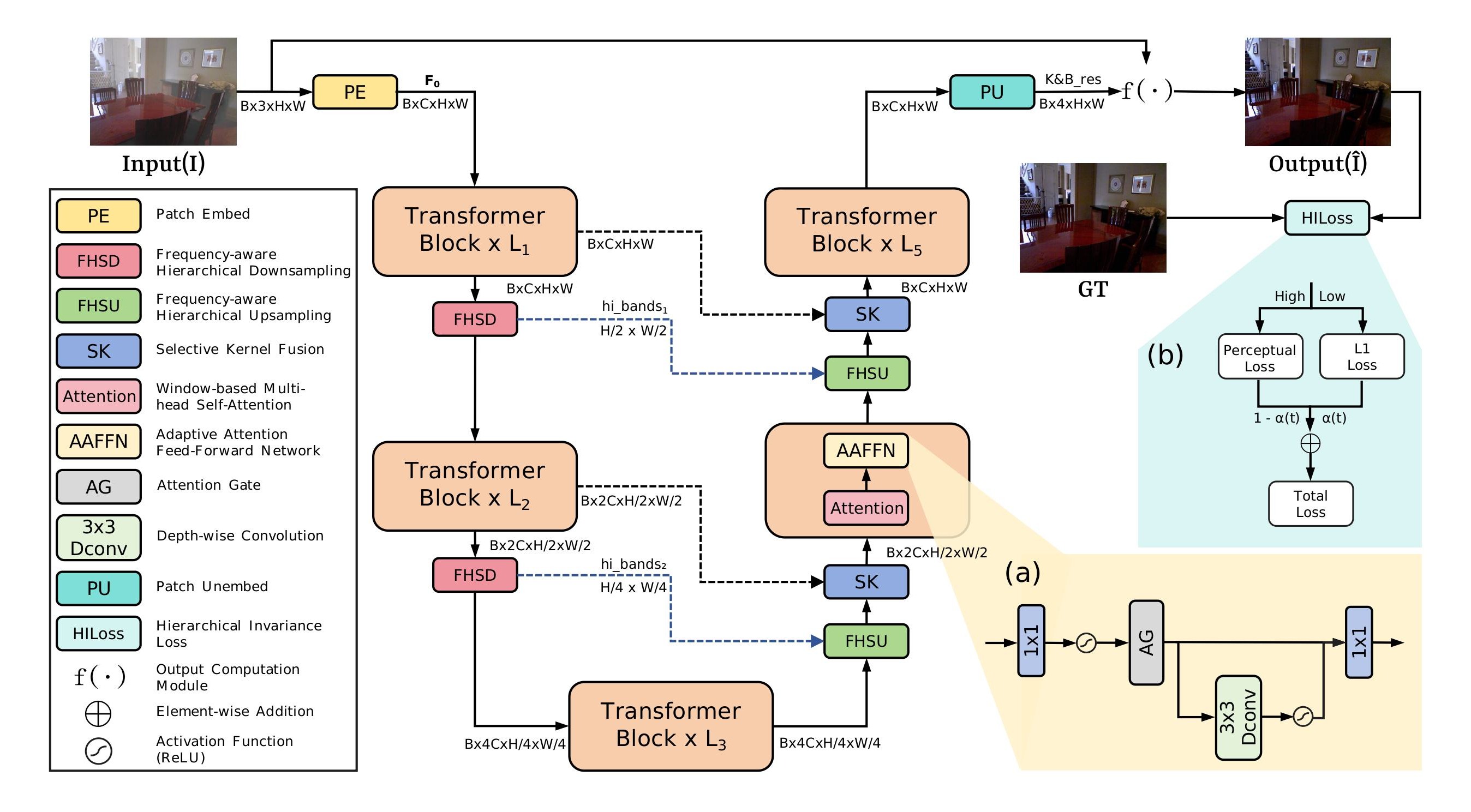
ED-Former is an extremely lightweight Transformer for single-image dehazing. It combines a Frequency-aware Hierarchical Sampler (FHS), an Attention-Adaptive Feed-Forward Network (AAFFN), and Hierarchical Invariance Loss (HILoss) to preserve high-frequency details while keeping the model below one million parameters.
Highlights
- Extremely lightweight: 0.866 M parameters and 7.36 G MACs for a 256 × 256 input.
- Frequency-aware Hierarchical Sampler (FHS): uses wavelet-based decomposition and reconstruction to reduce information loss during feature resizing.
- Attention-Adaptive Feed-Forward Network (AAFFN): dynamically refines detail-rich features through a lightweight attention gate.
- Hierarchical Invariance Loss (HILoss): uses cosine scheduling to shift the training objective from perceptual structure toward pixel-wise fidelity.
- Real-time inference: 75.2 FPS at 256 × 256 on a single NVIDIA RTX 4060 Ti, as reported in the paper.
Network architecture
Quantitative comparison
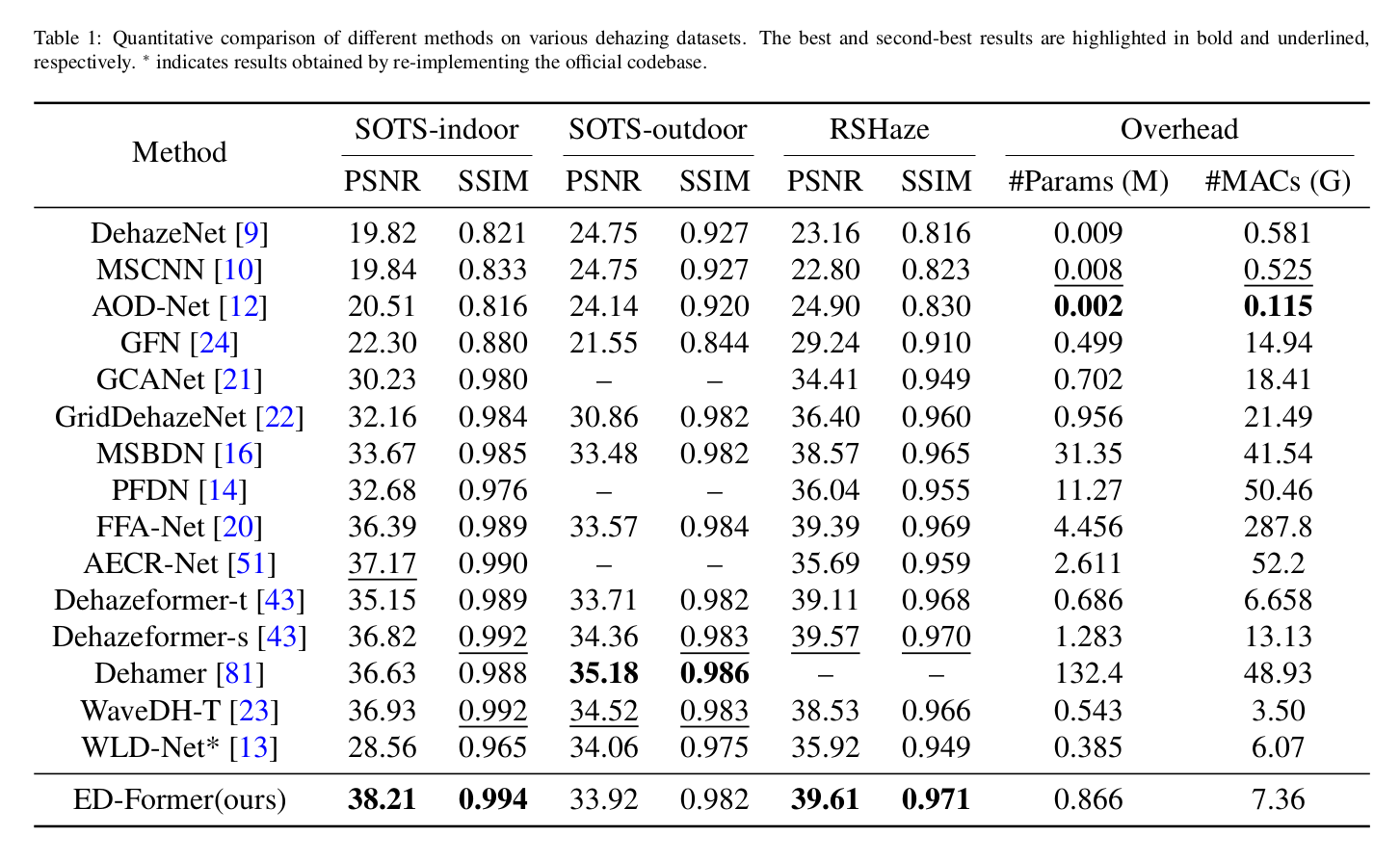
| Dataset | PSNR | SSIM |
|---|---|---|
| SOTS-indoor (RESIDE-IN) | 38.21 | 0.9942 |
| SOTS-outdoor (RESIDE-OUT) | 33.92 | 0.9827 |
| RS-Haze | 39.61 | 0.9715 |
| O-HAZE (zero-shot) | 15.78 | 0.702 |
The model has 0.866 M parameters and requires 7.36 G MACs for a 256 × 256 input.
Qualitative comparison
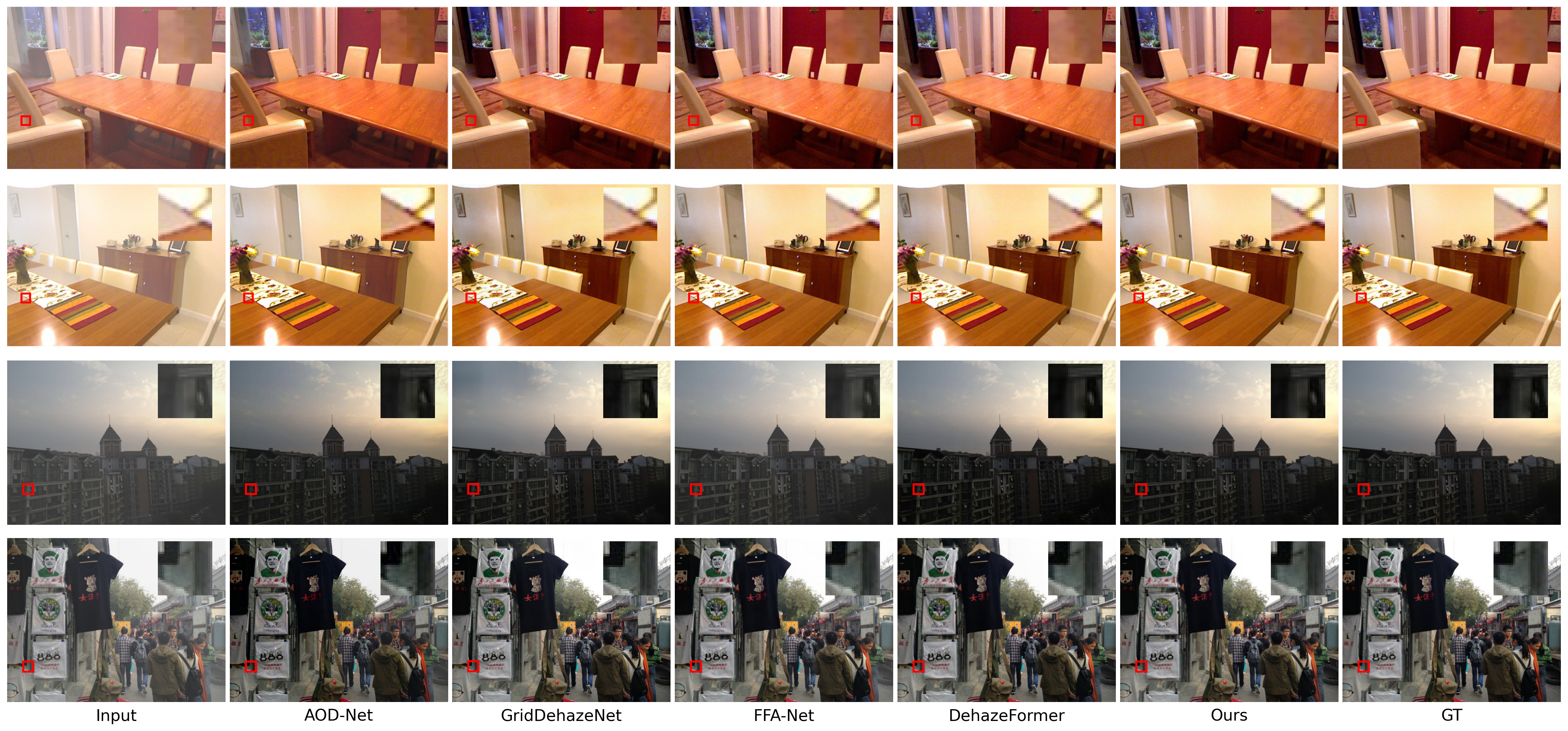
Qualitative comparisons with state-of-the-art dehazing methods on indoor, outdoor, and real-world hazy images.
Results
The benchmark summaries are included directly in this repository:
| Benchmark | Metric file | Dehazed images |
|---|---|---|
| SOTS-indoor | results/RESIDE-IN/ed-former/38.21 | 0.9942.csv |
results/RESIDE-IN/ed-former/imgs/ |
| SOTS-outdoor | results/RESIDE-OUT/ed-former/33.92 | 0.9827.csv |
results/RESIDE-OUT/ed-former/imgs/ |
| RS-Haze | results/RSHaze/ed-former/39.61 | 0.9715.csv |
results/RSHaze/ed-former/imgs/ |
To keep the Git repository lightweight, the complete per-image outputs for all three benchmarks are packaged as ED-Former-complete-results.tar.gz in the latest GitHub Release. After running test.py, newly generated dehazed images and per-image metrics are saved under results/<DATASET>/ed-former/ using the same layout.
Runtime and complexity
Runtime was measured in the paper on a single NVIDIA RTX 4060 Ti with a 256 × 256 input.
| Method | Latency (ms) ↓ | FPS ↑ | Params (M) ↓ | MACs (G) ↓ |
|---|---|---|---|---|
| GridDehazeNet | 15.3 | 65.2 | 0.956 | 21.49 |
| MSBDN | 19.9 | 50.2 | 31.35 | 41.54 |
| FFA-Net | 93.5 | 10.7 | 4.456 | 287.8 |
| DehazeFormer-s | 18.7 | 53.5 | 1.283 | 13.13 |
| Dehamer | 19.0 | 52.7 | 132.4 | 48.93 |
| ED-Former | 13.3 | 75.2 | 0.866 | 7.36 |
Generalization to real-world haze
For O-HAZE, the checkpoint trained on RESIDE-OUT is evaluated directly without fine-tuning. ED-Former obtains 15.78 dB PSNR and 0.702 SSIM, demonstrating transfer from synthetic training data to real-world haze.
Installation
The code is written in Python 3.7 and requires PyTorch. A CUDA-enabled GPU is required by the current testing script.
git clone https://github.com/2697166190a-beep/ED-Former.git
cd ED-Former

conda create -n edformer python=3.7 -y
conda activate edformer
pip install -r requirements.txt

PyTorch and CUDA versions depend on the local driver/toolkit. Install a Python 3.7-compatible PyTorch build that matches your CUDA environment by following the official PyTorch installation guide, then install the remaining packages from requirements.txt. You can record the resolved environment for reproducibility with pip freeze > environment-lock.txt.

## Data preparation
Download the datasets from their official/project sources:

RESIDE (ITS, OTS, and SOTS)

RS-Haze (provided by the DehazeFormer project)

O-HAZE

Please follow the licenses and terms of the respective datasets. Arrange paired hazy and ground-truth images as follows. A hazy image and its ground truth must have the same filename.

code
Text
data/
├── RESIDE-IN/
│   ├── train/
│   │   ├── hazy/
│   │   └── GT/
│   └── test/
│       ├── hazy/
│       └── GT/
├── RESIDE-OUT/
│   ├── train/
│   │   ├── hazy/
│   │   └── GT/
│   └── test/
│       ├── hazy/
│       └── GT/
└── RSHaze/
    ├── train/
    │   ├── hazy/
    │   └── GT/
    └── test/
        ├── hazy/
        └── GT/
## Pretrained models
The pretrained checkpoints are available at:

Training set	Checkpoint	SHA-256
RESIDE-ITS	saved_models/indoor/ed-former.pth	98681f33d71031c1ef5a1db74da54e4d0a09b2a2f7a31867ebfe9b963cd570e5
RESIDE-OTS	saved_models/outdoor/ed-former.pth	ea7d7e3988ec98daea7b23f216bca7597fa987675c4ac7df5c001116459aef3a
RS-Haze	saved_models/rshaze/ed-former.pth	43c4abab6cf5405da3fd01a5fa1424c0976ed1765371f8924b1a200efc60c07e
Verify a downloaded checkpoint with sha256sum saved_models/<experiment>/ed-former.pth.

## Testing
Run the command for the desired benchmark:

Bash
# SOTS-indoor
python test.py --model ed-former --dataset RESIDE-IN --exp indoor

# SOTS-outdoor
python test.py --model ed-former --dataset RESIDE-OUT --exp outdoor

# RS-Haze
python test.py --model ed-former --dataset RSHaze --exp rshaze
Dehazed images and a CSV file containing per-image PSNR/SSIM values are written to results/<DATASET>/ed-former/.

## Training
The experiment settings are stored in configs/indoor/ed-former.json, configs/outdoor/ed-former.json, and configs/rshaze/ed-former.json.

The paper reports training with a single NVIDIA A800 GPU, an Intel Xeon E-2436 CPU, and 64 GB RAM. All experiments use 256 × 256 patches, batch size 32, AdamW, an initial learning rate of 4e-4, and cosine annealing.

## Experiment	Training set	Epochs	L1 schedule (start → end)
indoor	RESIDE-ITS	300	0.1 → 1.0
outdoor	RESIDE-OTS	30	0.5 → 0.9
rshaze	RS-Haze	150	0.1 → 1.0
Bash
# RESIDE indoor
python train.py --model ed-former --dataset RESIDE-IN --exp indoor \
  --lambda_l1_start 0.1 --lambda_l1_end 1.0

# RESIDE outdoor
python train.py --model ed-former --dataset RESIDE-OUT --exp outdoor \
  --lambda_l1_start 0.5 --lambda_l1_end 0.9

# RS-Haze
python train.py --model ed-former --dataset RSHaze --exp rshaze \
  --lambda_l1_start 0.1 --lambda_l1_end 1.0
These commands are also collected in run.sh.

## Repository structure

Text
ED-Former/
├── configs/                    # Training configurations
├── figs/                       # Architecture and comparison figures
├── results/                    # Benchmark metric CSV files
├── saved_models/               # Pretrained checkpoints
├── ED_Former.py                # Network definition
├── HierarchicalInvarianceLoss.py
├── loader.py                   # Paired image data loader
├── train.py
├── test.py
├── run.sh                      # Example training/testing commands
└── requirements.txt
## Citation
If this work is useful for your research, please cite:

Bibtex
@article{chen2026edformer,
  title   = {ED-Former: Efficient dehazing transformer with Attention-Adaptive Feed-Forward Network},
  author  = {Chen, Jinrong and He, Yulin and Wang, Xin and Guo, Zhongyuan and Chen, Jingtong and Rao, Zhe and Xiang, Yi},
  journal = {Signal Processing: Image Communication},
  volume  = {148},
  pages   = {117634},
  year    = {2026},
  doi     = {10.1016/j.image.2026.117634}
}
Acknowledgements
Parts of this codebase are based on the DehazeFormer implementation. We sincerely thank Yuda Song, Zhuqing He, Hui Qian, and Xin Du for making their work publicly available. We also thank the authors and maintainers of the public datasets and other open-source projects used in this work.

## Contact
For technical questions, please open a GitHub issue.