

ProMo3D: Probing Motion Cues in Frozen 3D Foundation Models
NeurIPS 2026 | Paper | Project page
Xiaoang Zhang, Mert Kiray, Yordanka Velikova, Manoj Biswanath, Benjamin Busam
Technical University of Munich (TUM) | Munich Center for Machine Learning (MCML) | Obsphera
Release Status
This release contains the original-paper rank-8 PMD probes for all six backbones, trained without safeguard or forced token-0 export. Native backbone preprocessing is preserved. Upstream backbone weights are obtained from their official sources.
Training/validation RGB images and binary motion masks are released separately in ProMo3D-data, with agreement to the upstream research-use terms required for downloads. Backbone weights are obtained from their official sources.
Checkpoint Layout
Each backbone has its own directory. Rank-8 low-rank probes are supplied for all available trained block groups, including the groups used for dense PMD masks. Every block directory contains the original, byte-identical weights-only best_probe.pt and a portable config.json; manifest.json records file checksums and the original checkpoint/configuration hashes. Training logs, optimizer states, source image data, and machine-specific paths are excluded.
pi3x/rank_8/pair_lowrank_quadratic/<group>/<block>/
pi3/rank_8/pair_lowrank_quadratic/<group>/<block>/
vggt/rank_8/pair_lowrank_quadratic/<group>/<block>/
da3/rank_8/pair_lowrank_quadratic/<group>/<block>/
mapanything/rank_8/pair_lowrank_quadratic/<group>/<block>/
dust3r/rank_8/pair_lowrank_quadratic/<group>/<block>/
Use the original backbone/checkpoint configuration, not a replacement model variant. Official sources: Pi3X and Pi3, VGGT, Depth Anything 3, MapAnything, and DUSt3R. The paper uses DA3-GIANT-1.1, the original non-commercial VGGT-1B, and the non-commercial MapAnything weights. Their upstream licenses apply.
Method
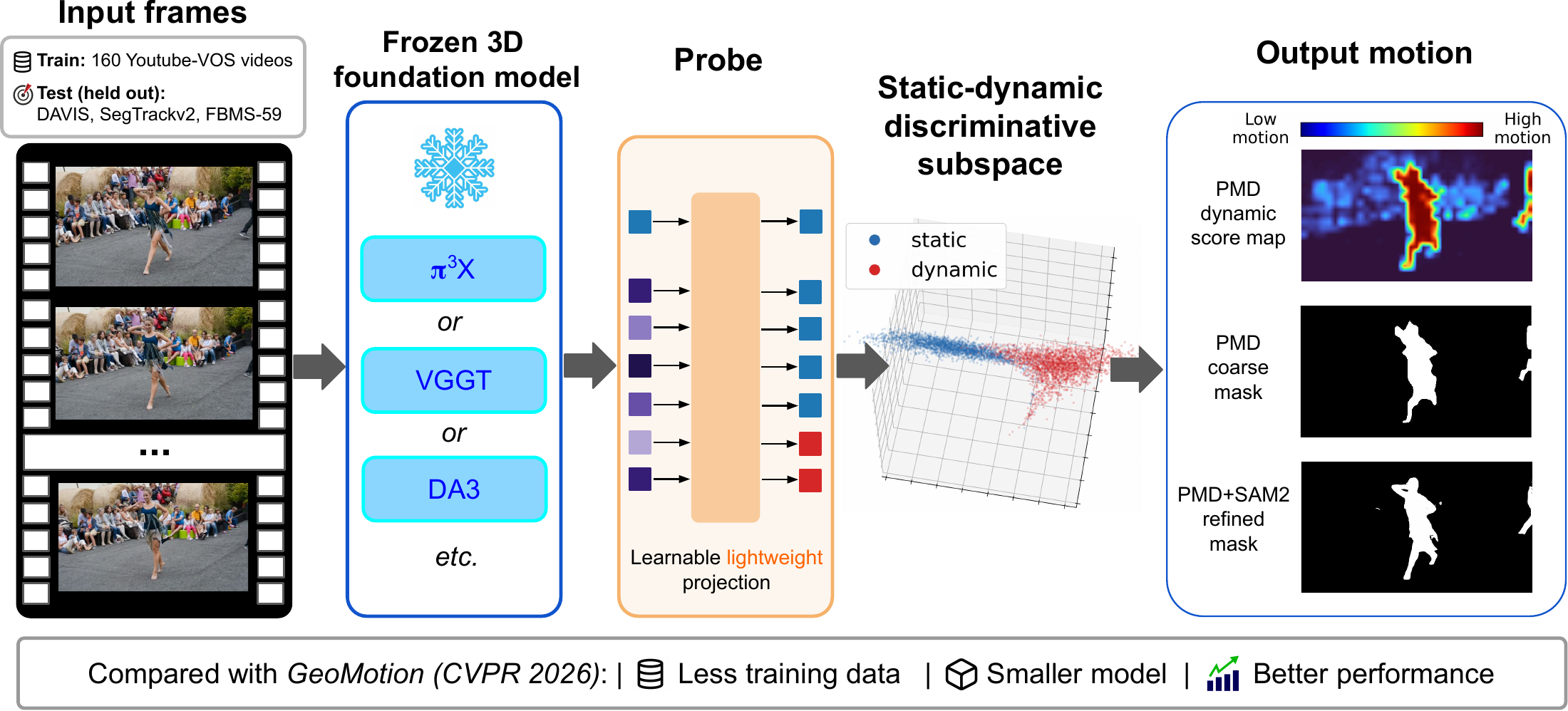
Probing-based Motion Distillation (PMD) recovers motion-relevant information from frozen 3D foundation-model tokens with a low-rank quadratic probe trained on 160 YouTube-VOS videos. A probe predicts whether two tokens from the same target frame share the same motion state. At inference, the fixed anchor token h_a and the token h_i being scored are ordinary spatial tokens with different roles, not attention query/key projections.
For the padded Pi3X configuration, anchor index a = 0 is static by construction. Compatibility with that anchor gives the static score, and its complement gives the dynamic score. Scores are averaged over the fixed selected block group, bilinearly upsampled, and binarized. SAM2 is optional external refinement; coarse and refined results are reported separately.
Supported release configurations are Pi3X, Pi3, VGGT, DA3, MapAnything, and DUSt3R. The paper uses native backbone preprocessing: Pi3X/Pi3/VGGT include their native padding; the other three use native preprocessing without the additional aspect-padding experiment. The Pi3X rank-8 probe has 294,930 trained parameters across its 18 aggregated blocks. Frozen backbone parameters are not included in that count.
These are the original paper probes trained from the original sampled-token exports, without forced token-0 export or safeguard training. Native padding in Pi3X/Pi3/VGGT is retained and must not be confused with those later ablations. Released checkpoints are matched against the archived paper metrics before packaging.
Coarse Results
Each cell reports J-Mean / J-Recall (%), without SAM2. PMD uses no target-benchmark training or fine-tuning.
| Backbone | DAVIS2017 | SegTrackv2 | FBMS-59 |
|---|---|---|---|
| Pi3X | 73.7 / 91.0 | 72.9 / 94.0 | 73.5 / 88.8 |
| Pi3 | 72.7 / 89.9 | 72.9 / 92.9 | 72.6 / 83.4 |
| VGGT | 72.6 / 89.9 | 70.8 / 84.7 | 73.5 / 85.9 |
| DA3 | 69.6 / 85.8 | 66.3 / 80.3 | 69.8 / 81.4 |
| MapAnything | 69.2 / 86.0 | 62.3 / 75.7 | 69.1 / 79.9 |
| DUSt3R | 62.2 / 70.0 | 58.6 / 77.3 | 64.0 / 74.5 |
Source: camera-ready main/additional-backbone tables. J-Recall counts frames with Jaccard score above 0.5; it is not pixel recall. Metrics are sequence-macro averages and FBMS-59 uses only annotated frames.
Direct Mask Inference and Evaluation
The reproduction repository provides scripts/download_huggingface.sh and scripts/evaluate.sh. These download the PMD probes and run existing dense inference, qualitative-output writing, and evaluation without training or token export. The selected backbone environment/checkpoint is still required. A Pi3X example is:
bash scripts/download_huggingface.sh --assets models --models pi3x

bash scripts/evaluate.sh pi3x \
  --probe-root outputs/pretrained/pi3x/rank_8/pair_lowrank_quadratic \
  --davis-root /path/to/DAVIS \
  --segtrack-root /path/to/SegTrackv2 \
  --fbms-root /path/to/FBMS-59 \
  --output-dir outputs/predictions/pi3x_native
Add --sam2 to generate refined masks and evaluate coarse/refined outputs separately. Add --dry-run to inspect commands. Outputs include input images, score heatmaps, masks, overlays, evaluation JSONs, and a combined J-Mean/J-Recall CSV. Different inference settings require a new output directory. The fixed image-inference context is 3 frames with stride 2.
Sampled training/validation token exports are not full spatial grids and are not a substitute for dense image inference.
Intended Use and Limitations
PMD is a research method for supervised motion decodability and benchmark motion-mask prediction. Compactness refers to the supervised probe-induced representation. Semantic leakage can occur, and annotation-defined foreground targets need not equal instantaneous physical motion. The fixed-reference assumption is not guaranteed for every native non-padded configuration. Fully uniform same-state scenes do not establish absolute physical motion from pairwise compatibility alone.
The method does not estimate object identities, velocities, or trajectories. Deployment for monitoring people should respect consent, privacy, and applicable dataset restrictions. It is not validated as a safety-critical perception system.
Licensing
Licenses for the trained probes and training/validation assets will be stated with those artifacts. Third-party backbones, checkpoints, and datasets retain their original licenses. This page does not grant redistribution rights to those third-party assets.