

VLAct
Collection
Beyond Data Scaling: Representation-Centric Continued Pre-training for Vision-Language-Action Models • 10 items • Updated
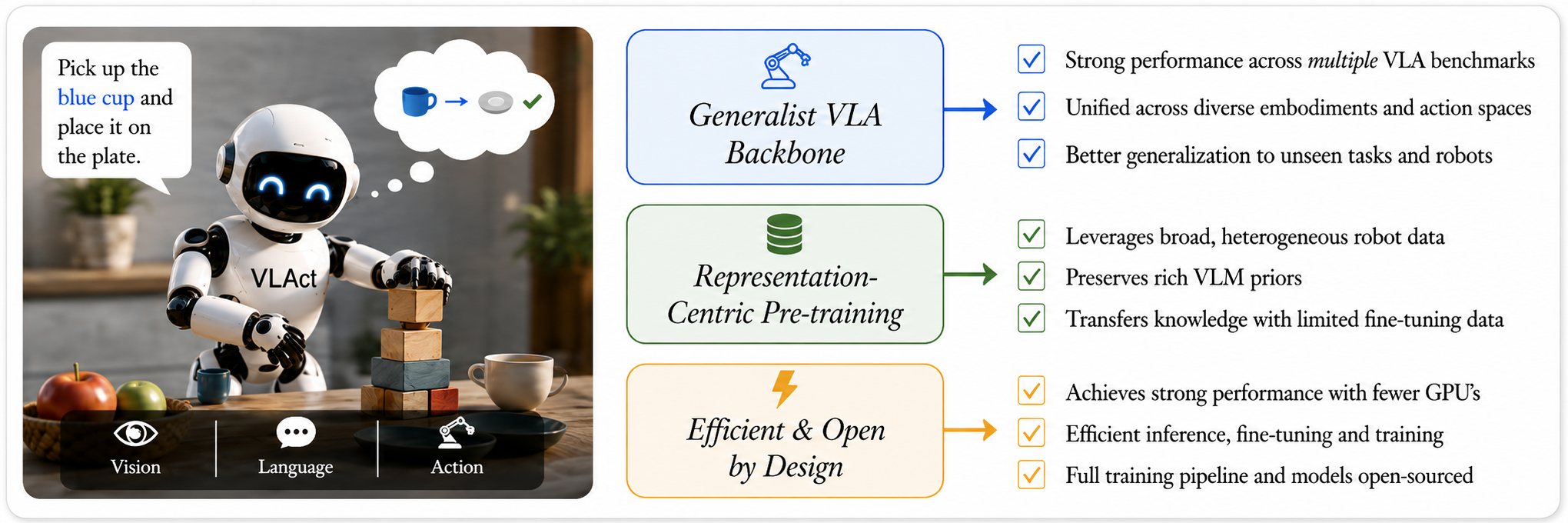



This repository contains the 100K-step VLAct continued-pretraining checkpoint introduced in Beyond Data Scaling: Representation-Centric Continued Pre-training for Vision-Language-Action Models. It is the recommended VLAct starting point for adapting Qwen3-VL-4B to a new robot, dataset, benchmark, or continuous action head.
This is a training checkpoint and reusable VLM/action backbone, not a directly deployable robot policy and not a standard
transformers.AutoModelpackage. A downstream policy must define its camera, state, action, normalization, and control contracts, then be fine-tuned for the target embodiment. For a new or incompatible action space, initialize the downstream action head from scratch and transfer the shared VLAct backbone.
VLAct asks how a fixed amount of robot data can teach a backbone more transferable visual-action knowledge. Its continued-pretraining recipe combines three ideas:
During downstream fine-tuning, the pretraining heads can be discarded. The complete method, ablations, and evaluation protocols are documented in the paper and code repository.
| Item | Value |
|---|---|
| Framework | StarVLA QwenHybrid_xrobot_padding |
| Base VLM | StarVLA/Qwen3-VL-4B-Instruct-Action |
| Pretraining heads | OFT + GR00T + PI, equal loss weights (1:1:1) |
| Action representation | Continuous, partially unified cross-embodiment padded layout |
| Action / state dimensions | 20-D padded action / 14-D state |
| Action horizon | 50 steps (future_action_window_size: 49) |
| Frozen modules | Vision encoder and language-model layers 0–17 |
| Training step | 100,000 |
| Training hardware | 16 GPUs |
| Per-GPU VLA batch size | 16 |
| Optimizer | AdamW, 5K-step warmup, cosine schedule |
| Learning rates | Qwen-VL interface 1e-5; action/base modules 1e-4 |
| Seed | 42 |
The checkpoint packages all three pretraining heads because they formed the co-supervision objective. Their presence does not mean a downstream policy must use any particular head.
The VLA mixture combines heterogeneous AgileX/ALOHA and Franka data from five open dataset groups:
The run also mixes image-text supervision from ShareGPT4V-COCO and LLaVA-ReCap CC3M. Dataset
sampling is balanced across embodiments, inactive action dimensions are masked, and single-arm and
dual-arm loss weights are 8.0 and 1.0, respectively.
See the data-preparation and continued-pretraining guide for the expected LeRobot layout, preprocessing commands, and launch configuration.
git clone https://github.com/starVLA/VLAct.git
cd VLAct

conda create -n vlact python=3.10 -y
conda activate vlact

# Install a CUDA-compatible PyTorch build first.
python -m pip install -r requirements.txt
python -m pip install flash-attn==2.7.4.post1 --no-build-isolation
python -m pip install -e .
Run from the VLAct repository root:
hf download StarVLA/VLAct_Qwen3_Pretrain \
  --local-dir playground/Pretrained_models/VLAct-Qwen3VL4B-Pretrained
The checkpoint path is then:
playground/Pretrained_models/VLAct-Qwen3VL4B-Pretrained/checkpoints/steps_100000_pytorch_model.pt
Keep the downloaded directory structure unchanged. StarVLA resolves config.yaml and
dataset_statistics.json from the run directory two levels above the checkpoint file.
Set the launcher's pretrained_ckpt to the path above and retain these transfer settings:
--trainer.pretrained_checkpoint ${pretrained_ckpt} \
--trainer.random_init_action_model True \
--trainer.reset_steps True
random_init_action_model=True skips the checkpoint's pretraining action module while loading the
shared backbone into the downstream framework. This is the recommended setting when the target head,
action dimension, or embodiment differs from pretraining.
The repository includes launchers for RoboTwin 2.0, LIBERO-Plus, VLA-Arena, and DOMINO. For example:
bash scripts/run_scripts/RoboTwin/train_robotwin_qwen3oft.sh
bash scripts/run_scripts/LIBERO/train_libero_qwen3pi.sh
bash scripts/run_scripts/VLA-Arena/train_vla_arena_qwen3pi.sh
bash scripts/run_scripts/DOMINO/train_domino_qwen3oft.sh
Review each launcher's marked configuration block before training, especially base_vlm, dataset
paths, run_root_dir, pretrained_ckpt, action horizon, and image-size settings.
The full checkpoint can be reconstructed only with the matching StarVLA framework and the packaged configuration. This mode is useful for inspecting the three-head model or continuing model training with the same architecture. It is generally not the right path for a new embodiment.
The .pt file contains model parameters only; it does not package optimizer or scheduler state.
Loading it therefore does not reproduce a bit-for-bit training resume.
VLAct-Qwen3VL4B-Pretrained/
├── README.md
├── config.yaml
├── training_config.original.yaml
├── dataset_statistics.json
├── summary.jsonl
└── checkpoints/
    └── steps_100000_pytorch_model.pt
| File | Purpose |
|---|---|
checkpoints/steps_100000_pytorch_model.pt |
Full PyTorch state dict for the three-head model |
config.yaml |
Portable resolved configuration using the public base-model ID |
training_config.original.yaml |
Original resolved run configuration and local base-model path |
dataset_statistics.json |
Dataset statistics used by StarVLA normalization utilities |
summary.jsonl |
Saved-checkpoint step history |
Checkpoint SHA-256:
5da4b96f9c923eabf35b7ac4c8928bef847266a044dbb8a239e3696aa305095d
The following numbers come from downstream policies fine-tuned from VLAct; they are not zero-shot scores of this raw checkpoint. Controlled comparisons keep the downstream action head, initialization, data, optimizer, and fine-tuning budget fixed while changing the backbone weights.
| Benchmark | VLAct | Matched Qwen3-VL-OFT baseline |
|---|---|---|
| LIBERO-Plus | 82.6% | 75.0% |
| VLA-Arena | 54.8% | 33.4% |
| RoboTwin 2.0 Base, Clean | 80.5% | 61.7% |
| RoboTwin 2.0 Data Scaling, Clean / Random | 92.5% / 90.8% | 88.2% / 88.3% |
| DOMINO, SR / MS | 18.50 / 34.20 | 10.86 / 30.49 |
VLAct also reaches 49.5% on RoboCasa-GR1 with only 20% of the downstream trajectories and ranks 6th of 35 policies by success rate in the paper's August 24, 2026 RoboDojo leaderboard snapshot.
The packaged files preserve several source-run details worth noting:
training_config.original.yaml records a VLM auxiliary-loss scale of 0.2; the paper defines the
reported caption objective with weight 0.5.agilex_franka_5data_manualvel_balance33_66_50; the public launcher uses
agilex_franka_5data_manualvel_balance_50.Use the packaged configuration to inspect or reproduce this specific artifact, and use the paper for the reported experimental protocol and results.
This checkpoint is intended for research on VLA representation learning, action-head transfer, multi-embodiment pretraining, and downstream robot-policy adaptation.
@misc{yang2026vlact,
  title   = {Beyond Data Scaling: Representation-Centric Continued Pre-training
             for Vision-Language-Action Models},
  author  = {Yang, Senqiao and Wang, Chengyao and Chen, Yuxin and Wang, Zixuan and
             Tang, Longxiang and Gui, Haokun and Ye, Jinhui and Lu, Changsheng and
             Wu, Xiaoyang and Zhu, Mingkang and Chen, Pengguang and Liu, Shu and
             Tian, Zhuotao and Zhao, Hengshuang and Yu, Bei and Jia, Jiaya},
  year    = {2026},
  month   = aug,
  note    = {Preprint},
  url     = {https://starvla.github.io/VLAct/}
}
The checkpoint is released under the Apache License 2.0. The VLAct code repository is released separately under the MIT License. Users must also comply with the licenses and terms of the base model and training datasets.
VLAct builds on StarVLA, LeRobot, GR00T, and Qwen3-VL.
For questions, email yangsenqiao.ai@gmail.com or open an issue in the VLAct repository.