

BA-T: An Iterative Transformer for Two-View Bundle Adjustment
Paper • 2606.03287 • Published • 1

Ganlin Zhang1,2 · Weirong Chen1,2 · Daniel Cremers1,2 · Xi Wang1,2,3
1 TU Munich, 2 MCML, 3 ETH Zurich
arXiv | Project Page | Code
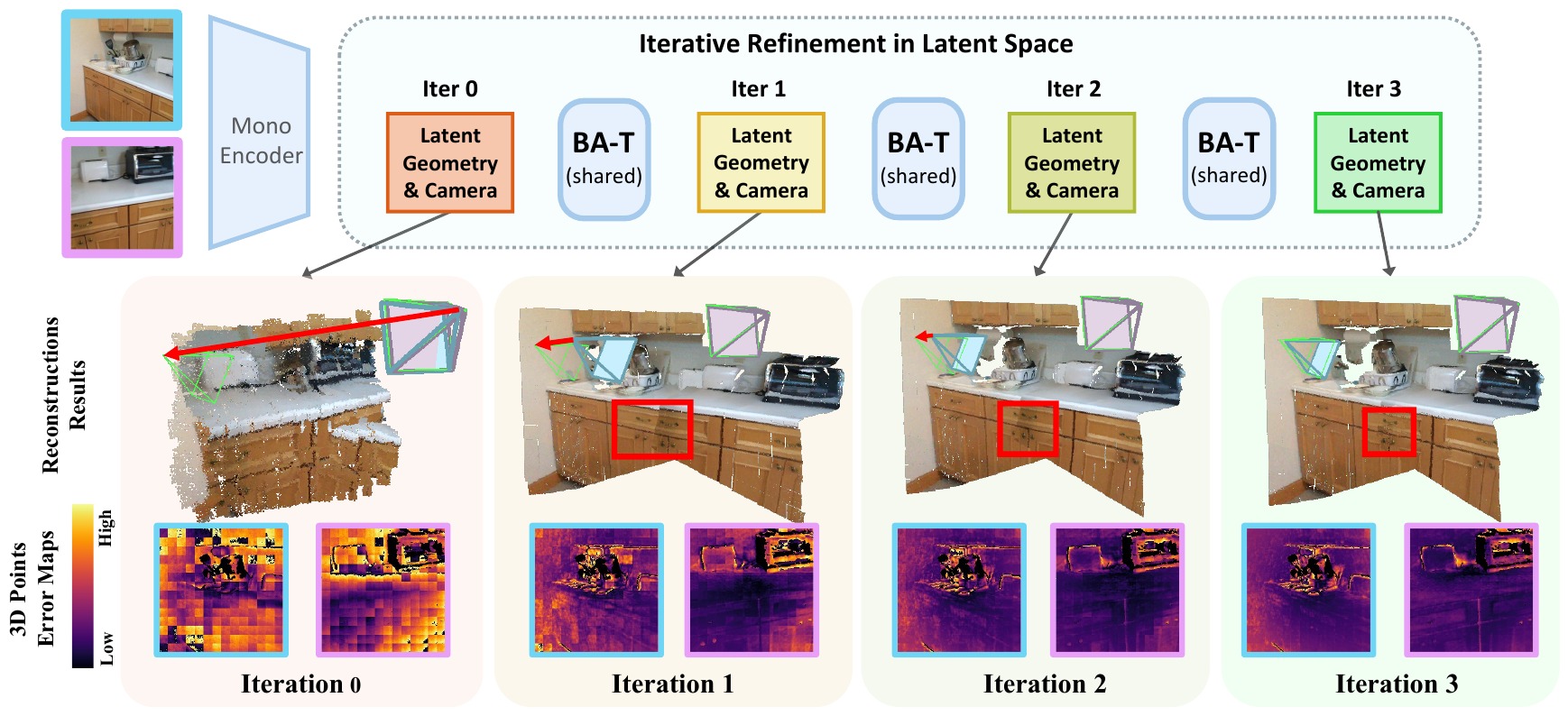
TL;DR: BA-T is a repeatable, compact Transformer layer that refines camera pose and local geometry in latent space, inspired by bundle adjustment.
Given an image pair (A, B), BA-T predicts:
Both images are encoded by a shared ViT-L encoder (patch size 16, RoPE, 224x224 input).
A single shared BA-T layer then refines the image tokens and a relative camera token
recursively, K times; K is chosen at test time (default 8, useful range roughly 4 to 24).
The refinement is causal, so the prediction after iteration k equals a run with K=k.
The same weights also refine more than two views jointly on a view graph: every view cross-attends to its neighbours and every edge has its own relative camera token. The inference code builds the graph automatically from encoder-feature similarity and recovers global camera poses with confidence-weighted pose graph optimization.
| file | description |
|---|---|
bat.pth |
Default. The paper model, further fine-tuned with more refinement iterations and on multi-view graphs (2 to 8 views). |
bat_paper.pth |
The checkpoint used for the results in the paper (two-view). |
Both are plain PyTorch state_dicts (about 1.4 GB each) with the same architecture,
and work with all scripts in the code repository.
Install the code following the GitHub README, then
download a checkpoint into pretrains/:
git clone https://github.com/zhangganlin/BA-T.git && cd BA-T
# install torch, then: pip install -r requirements.txt
hf download zhangganlin/BA-T bat.pth --local-dir pretrains
Two views:
python demo.py --images path/to/A.jpg path/to/B.jpg --output outputs/demo
from ba_t.data import load_views
from ba_t.inference import load_model, run_pairs

model = load_model('pretrains/bat.pth', device='cuda')
view_a, view_b = load_views(['A.jpg', 'B.jpg'])
out = run_pairs(model, view_a, [view_b], num_refine_iter=8)

T_b_a = out['a'][0]['relative_pose']   # (1,4,4) camera A -> camera B
pts_a = out['a'][0]['pts3d']           # (1,224,224,3) in the camera frame of A
pts_b = out['b'][0]['pts3d']           # (1,224,224,3) in the camera frame of B
Multiple views:
python demo_multiview.py --images path/to/folder --output outputs/demo_mv
from ba_t.inference import run_multiview

out = run_multiview(model, load_views('path/to/folder'))
out['cam_to_world']   # (V,4,4) camera poses, view 0's camera is the world frame
out['pts3d']          # (V,224,224,3) point maps, each in its own camera frame
relative_pose of A is T_B<-A = inv(c2w_B) @ c2w_A, mapping camera-A points into camera B.With the optional curope kernel and xformers on an RTX 4070 at K=8: one pair takes about
50 ms and 1.3 GB of GPU memory; 8 views take 0.4 s and 1.6 GB, 64 views 3 s and 3.3 GB.
The code builds on ViSTA-SLAM and DUSt3R.
@inproceedings{zhang2026bat,
  title     = {{BA-T}: An Iterative Transformer for Two-View Bundle Adjustment},
  author    = {Zhang, Ganlin and Chen, Weirong and Cremers, Daniel and Wang, Xi},
  booktitle = {Advances in Neural Information Processing Systems (NeurIPS)},
  year      = {2026}
}