

Access LVL-1
This repository is publicly accessible, but you have to accept the conditions to access its files and content.
By requesting access, you agree to share your Hugging Face username and email address with Vitrus and to use LVL-1 only under the Creative Commons Attribution-NonCommercial 4.0 International license (CC BY-NC 4.0).
Log in or Sign Up to review the conditions and access this model content.
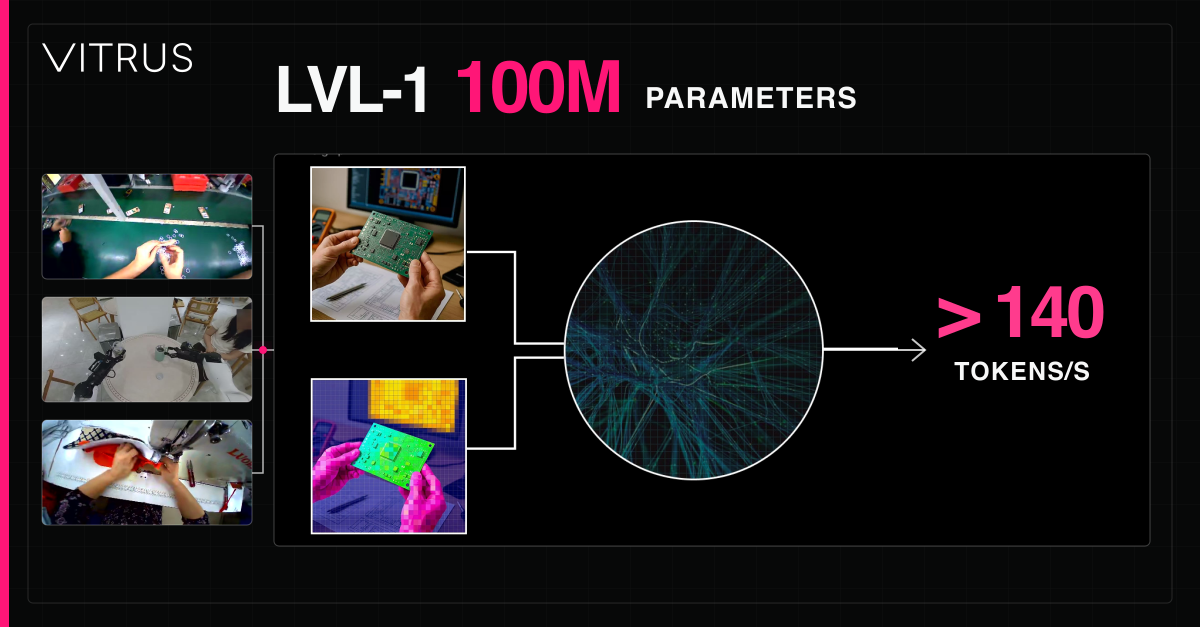
LVL-1 ("Leãozinho" Vision Language)
A compact vision-language model for extracting spatial knowledge at the edge.
0.1B trainable core · 0.218B complete VLM · scene description + 2D grounding
What is LVL-1?
LVL-1 asks a focused question: how much useful spatial knowledge can a very small language core preserve from strong visual encoders?
Rather than asking one compact network to learn vision from scratch, LVL-1 combines two frozen visual specialists:
- SigLIP 2 Base contributes language-aligned semantics and localization.
- DINOv2 Small contributes dense structure, shape, parts, texture, and layout.
- ARC-Text 100M receives their compressed evidence as a learned 131-token visual prefix and expresses it as concise English or 2D boxes.
The result is a small, inspectable research model built for physical scenes: workbenches, objects, people, manipulation, and robotics environments. It is intentionally narrower than a general-purpose VLM.
Architecture
                         ┌─ SigLIP 2 Base ─ semantic localization ─┐
image ─ preprocessing ──┤                                          ├─ learned 131-token prefix ─ ARC-Text 100M ─ text
                         └─ DINOv2 Small ─ dense visual structure ─┘
| Component | Parameters | Role |
|---|---|---|
| ARC-Text decoder | 100,823,552 | Compact language core |
| Dual visual connector | 2,237,184 | Pools and projects visual evidence |
| LVL-1 trainable core | 103,060,736 | Decoder + connector |
| SigLIP 2 vision encoder | 92,930,304 | Frozen semantic stream |
| DINOv2 Small vision encoder | 22,056,576 | Frozen structural stream |
| Total deployed VLM | 218,047,616 | Complete inference graph |
“100M” refers to the compact trainable core. The complete deployed VLM is 218M parameters when both frozen visual encoders are included.
Prompt contract
LVL-1 was trained with explicit task tokens. Use them exactly as shown:
| Task | Input text | Expected output |
|---|---|---|
| Scene description | <DESCRIBE/> |
A concise English description grounded in the image |
| 2D grounding | <2D_BBOX/> |
Object labels and image-space boxes |
<DESCRIBE/>
<2D_BBOX/>
The current checkpoint is strongest on concise description. The 2D-box path is experimental and can regress to oversized or full-frame boxes.
Training objective
The two tasks share the same visual bottleneck but demand different evidence:
<DESCRIBE/>teaches the model to retain visible objects, activity, spatial relations, and scene context.<2D_BBOX/>asks it to preserve explicit image-space localization.- No-image and wrong-image counterfactuals discourage the decoder from reproducing familiar prose without consulting the current image.
- Text replay helps preserve the language core while visual grounding is learned.
This repository contains the pinned joint checkpoint at training step 6000. Training images, episodes, teacher traces, and cached visual features are not included.
Measured edge performance
The following numbers are runtime measurements, not caption-quality scores.
| Device and runtime | Protocol | Decode | Generation | End-to-end | Memory |
|---|---|---|---|---|---|
| Apple M4 Mac mini, 16 GB unified memory; MLX FP32 decoder + MPS FP32 vision | Median of 100 images: 50 held-out real + 50 synthetic; <DESCRIBE/>; 32-token cap |
142.997 tok/s | 135.470 tok/s | 284.552 ms | 441.1 MiB MPS allocated |
| Raspberry Pi 5, 8 GB; ORT CPU with INT8 decoder | Median of 5 warm runs on one RH20T image; 22 generated tokens | 31.807 tok/s | 22.772 tok/s | 2.236 s | 958.1 MiB RSS |
The Mac and Raspberry Pi rows use different protocols and should not be treated as a controlled hardware comparison. On the 50 held-out real images alone—AgiBot, DROID, RH20T, and Open Images source families represented during training—the Mac runtime measured 143.122 decode tok/s and 284.641 ms median end-to-end latency. Synthetic and out-of-distribution stress images were excluded from that slice.
Repository contents
language_model.safetensors— joint step-6000 ARC-Text language state.vision_projector.safetensors— joint step-6000 dual-vision connector.lvl1_config.json— complete architecture and inference contract.vision_assets.json— pinned upstream vision models and revisions.release_manifest.json— hashes and checkpoint provenance.tokenizer/— tokenizer files, including the LVL-1 task tokens.
The core weights in this repository are FP32 safetensors. Frozen SigLIP 2 and DINOv2 weights are resolved from the exact upstream revisions recorded in vision_assets.json.
For portable component graphs and the validated decoder-only INT8 research profile, see vitrus/LVL-1-ONNX.
Intended use
LVL-1 is intended for:
- noncommercial research on compact multimodal models;
- edge-inference experiments;
- scene-description and visual-grounding evaluation;
- studying visual-token compression and specialist-teacher architectures.
Limitations and safety
LVL-1 is a research checkpoint, not a perception authority.
- It may hallucinate plausible objects or relations.
- It may repeat objects or phrases during longer generations.
- Fine details and small objects can be lost in the visual bottleneck.
- Performance degrades outside the training distribution.
- Current 2D boxes can collapse to oversized or full-frame predictions.
- English is the only documented output language.
Do not use LVL-1 for robot control, safety decisions, geometric measurement, surveillance, or autonomous actions. Outputs require independent verification.
License
LVL-1 is released under the Creative Commons Attribution-NonCommercial 4.0 International license. You may share and adapt the released materials for noncommercial purposes with attribution. Commercial use requires separate permission from Vitrus.
SigLIP 2 and DINOv2 remain subject to their upstream licenses; their exact revisions are recorded in vision_assets.json.
Citation
If LVL-1 is useful in your research, cite the model repository:
@misc{vitrus2026lvl1,
  title        = {Leaozinho VL-1 (LVL-1)},
  author       = {{Vitrus}},
  year         = {2026},
  howpublished = {\url{https://huggingface.co/vitrus/LVL-1}},
  note         = {Research-only compact vision-language model}
}
For commercial licensing or collaboration, contact Vitrus through vitrus.com.