

YAML Metadata Warning:empty or missing yaml metadata in repo card
Check out the documentation for more information.
AI-ML-Project-Embryo-Analysis-to-Improve-Success-Rate-of-IVF
This project is a recreation of the STORK repository Github Link to STORK used for embryo classification.
📖 Table of Contents
Table of Contents
✏️ About The Project
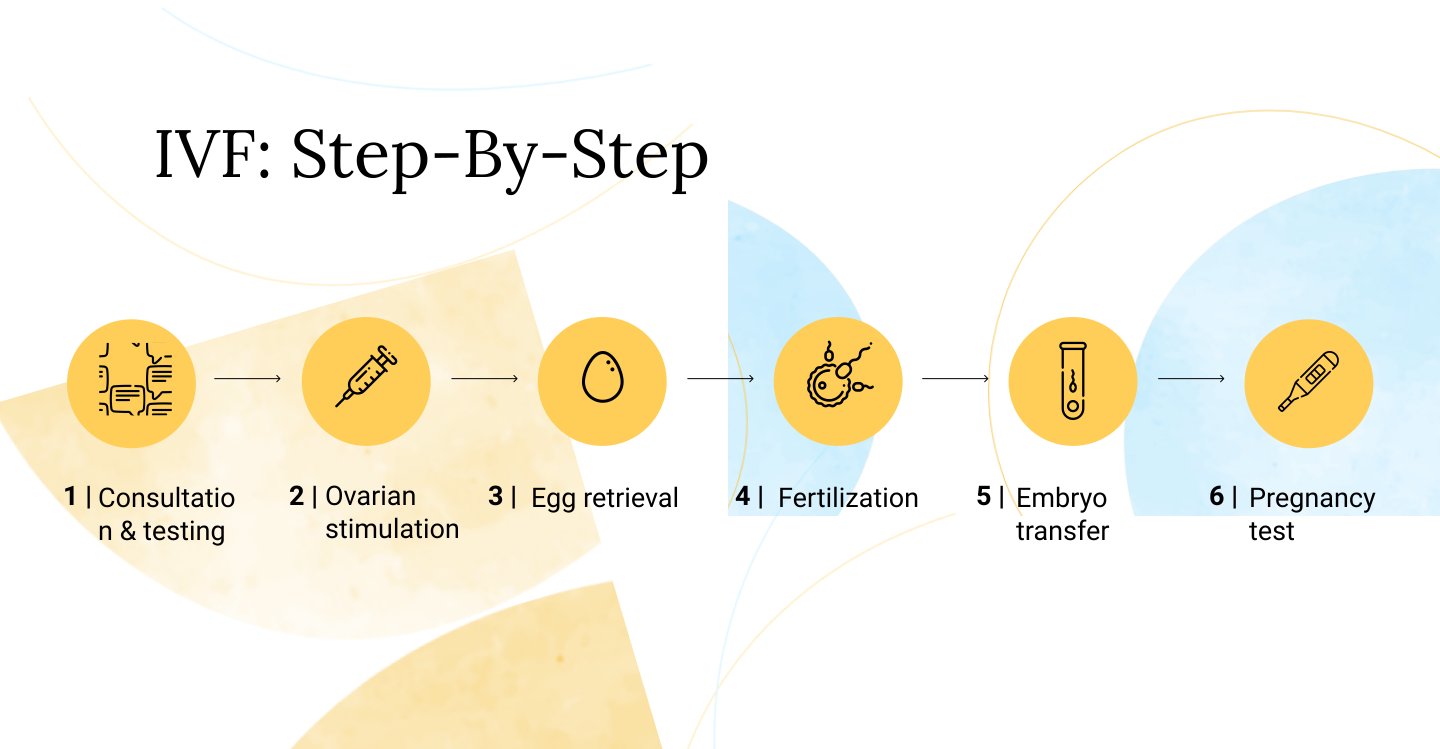
Infertility is a clinical condition characterized by an inability to conceive after one year or longer of unprotected sex. In vitro fertilization (IVF) is a type of assistive reproductive technology (ART) for infertility treatment and surrogacy.
This project aims to use machine learning to classify embryos as "good" or "poor" based on their quality, improving IVF success rates and reducing human error in embryo selection.
🍴 Prerequisites
This project requires Python and Conda for setting up the environment.
Installation Steps:
Clone the repository:
git clone https://huggingface.co/saikAIML/ivf
cd ivf
Install Conda (if not already installed).
Follow the instructions at Miniconda Installation.Create and activate the Conda environment:
conda create -n embryo-env python=3.7
conda init
conda activate embryo-env
Install required dependencies:
pip install -r requirements.txt
▶️ Steps to Follow
Training the Model (Optional):
The model is already trained on Inception-V1 with the dataset and the weights are available at scripts/slim/result this is if you want use a different model
- Download pre-trained Inception-V1 models from TensorFlow Pretrained Models.
- Create the process directory :
python convert.py ../Images/train process/ 0 - Modify
load_inception_v1.shto set correct paths. - Run the script:
OR use Python:./run/load_inception_v1.shpython train_image_classifier.py --train_dir=scripts/result --dataset_name=embryo --dataset_split_name=train --dataset_dir=scripts/process --model_name=inception_v1 --checkpoint_path=run/checkpoint/inception_v1.ckpt --checkpoint_exclude_scopes=InceptionV1/Logits --max_number_of_steps=5000 --batch_size=32 --learning_rate=0.01 --save_interval_secs=100 --save_summaries_secs=100 --log_every_n_steps=300 --optimizer=rmsprop --weight_decay=0.00004 --clone_on_cpu=True
Testing the Model:
Navigate to the
slimdirectory:cd scripts/slimRun the test script:
python tst.pyTo test different images, modify
tst.py:- Open
tst.pyin a text editor. - Locate the line with
predict_image_label. - Change the file path to a different embryo image.
Example:
from pred import predict_image_label print("**************", predict_image_label("result", "../../Images/test/good_23765483_-15_3AA.jpg", "v1"), "**************")- Save the file and rerun:
python tst.py
- Open
📂 Dataset
- Source: STORK Framework
- Training Images: 42 Good, 42 Poor
- Test Images: 14
- Total Images: 98 (JPG format)

🎯 Data Pipeline

📜 Methodology
We use a Deep Neural Network (DNN) for embryo image analysis based on Google’s Inception-V1 architecture. The pre-trained STORK framework helps classify embryos into good or poor categories.
The dataset is divided as follows:
- 85% (84 images) for training
- 15% (14 images) for testing
🔍 Results and Discussion
- The model achieved 100% accuracy on the test set (14 images).
- Using this model could reduce IVF cycles and costs by selecting the best embryo.
- A web interface allows users to upload an embryo image and check its quality.
📚 References
- Muhammad et al. (2020) - NIH Article
- Kirillova et al. (2020) - "Should we transfer poor quality embryos?"
- PFCLA - IVF Overview
- STORK GitHub - STORK Framework
✍️ Contributors
👩🎓 Anjana Padikkal Veetil
📧 AP202@myscc.ca | GitHub
👩🎓 Nobin Ann Mathew
📧 NM91@myscc.ca | GitHub
👨🎓 Santosh Kumar Kantimahanti Lakshmi
📧 SK602@myscc.ca | GitHub
👨🎓 Amal Mathew
📧 AM252@myscc.ca | GitHub
🎯 Final Notes:
- The model is pre-trained, so only testing is required unless you want to retrain it.
- Modify
tst.pyto test with different images.
💡 This project was developed as part of the Data Analytics for Business (May 2021) course at St. Clair College.