

SPot-the-Difference Self-Supervised Pre-training for Anomaly Detection and Segmentation
Paper • 2207.14315 • Published
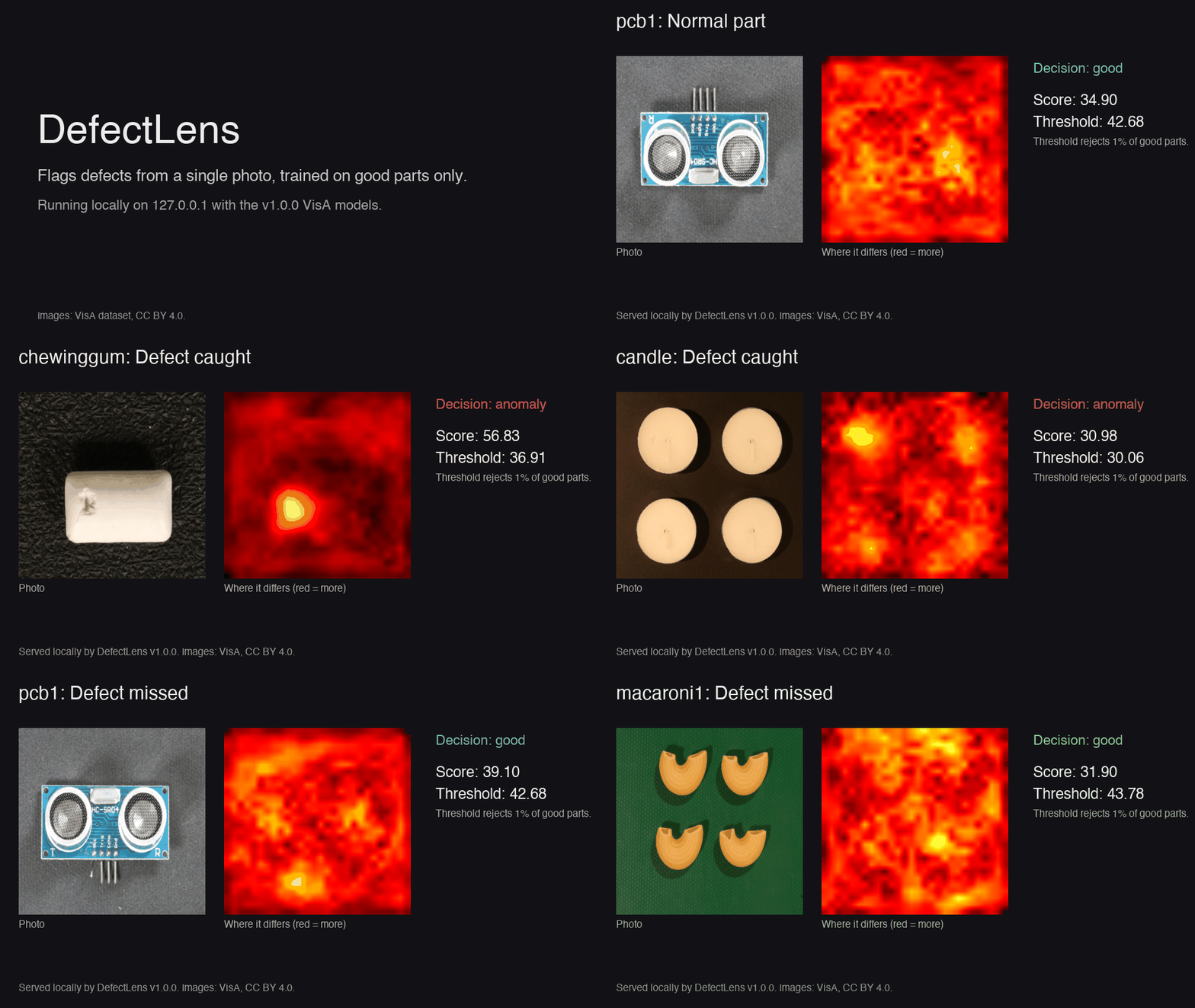
Demo recorded from the local service with these weights. Source and video: https://github.com/pavan-dangeti/DefectLens.
Per-category PatchCore models that flag defects on manufactured parts. Each model is trained only on images of good parts; no defective examples are used, in fitting or in calibration.
Source code: https://github.com/pavan-dangeti/DefectLens (release v1.0.0).
good or anomaly, from
a per-category threshold.configs/coreset.yaml).torch.save dictionary with the coreset, the threshold and the configuration,
loaded with weights_only=True. Each file has a SHA-256 sidecar that the service checks before loading.The VisA dataset from Amazon Science (github.com/amazon-science/spot-diff), 12 categories, released
under CC BY 4.0 (verified on the dataset's official page, 2026-10-30). The weights use the good
images of the training split. They contain feature vectors computed from those images, not the images
themselves. The 80% of good images used for fitting and the 10% used for calibration are drawn with
seed 0.
These weights are derived from VisA and carry the same licence. Credit VisA when you reuse them, with this citation, as given on the dataset's official page:
Zou, Yang and Jeong, Jongheon and Pemula, Latha and Zhang, Dongqing and Dabeer, Onkar. SPot-the-Difference Self-Supervised Pre-training for Anomaly Detection and Segmentation. arXiv:2207.14315, 2022 (ECCV 2022).
No weights fitted on MVTec AD are included. MVTec AD is licensed CC BY-NC-SA 4.0 (non-commercial only, verified on its official page). It is used here only as a research benchmark, and the benchmark numbers in this card are not weights. This card and its weights are CC BY 4.0.
The feature extractor is timm's wide_resnet50_2, loaded with pretrained=True. timm's default weights
for this architecture are the racm_in1k tag (timm/wide_resnet50_2.racm_in1k on the Hugging Face Hub),
not the torchvision weights. Its licence is Apache-2.0. It was trained on ImageNet-1k with the
timm "RACM" recipe from ResNet Strikes Back (arXiv:2110.00476), on the Wide Residual Network architecture
(arXiv:1605.07146). This release does not redistribute the backbone weights: they are downloaded from the
Hub when the service starts.
ImageNet-1k is a dataset with its own terms, which as commonly stated restrict it to non-commercial research use. The ImageNet terms were not re-fetched for this card. Whether those terms apply to weights trained on it is not settled here. Confirm it before any commercial use of the service.
Three seeds (0, 1, 2) per category. Each seed re-draws the 80 / 10 / 10 split of the good training images. The test set is the benchmark's own test split. Intervals are 95% Student-t intervals across seeds.
| Dataset | Categories | Image AUROC | Pixel AUROC | AUPRO | Escape rate at 1% FRR |
|---|---|---|---|---|---|
| VisA | 12 | 0.891 ± 0.017 | 0.954 ± 0.025 | 0.736 ± 0.078 | 0.446 ± 0.069 |
Per-category results are in the repository's results/evaluation/tables.md. The spread is wide: the
weakest VisA categories are capsules (image AUROC 0.676 ± 0.028) and macaroni2 (0.679 ± 0.051).
These numbers are above the 0.5 chance level but below the published VisA PatchCore reference (Real-IAD paper, Table 2: image AUROC 0.951, AUPRO 0.912, reproduced with Anomalib). The protocol differs in the coreset ratio, the fit split and the AUPRO integration; see the repository README.
The escape rate is high for several categories. At a 1% false-reject target, macaroni2 lets 0.91 of
its defects through and macaroni1 0.79. A decision from these models is not a substitute for human
inspection where a missed defect is costly.
uv sync
uv run defectlens data download visa
uv run defectlens fit --root data/visa --category <name> --out <registry-dir>
uv run python results/evaluation/run.py --dataset visa --seeds 0 1 2