

YOLOX: Exceeding YOLO Series in 2021
Paper • 2107.08430 • Published



Megvii released YOLOvX in July 2021. The release represented an inflection point in the family of YOLO models, with major architectural changes such as Decoupled Head as well as Anchor-Free detection. The average precision (AP) achieved by these models surpassed the previous generations of YOLOv3–YOLOv5 models, while maintaining real-time speed for a variety of applications.
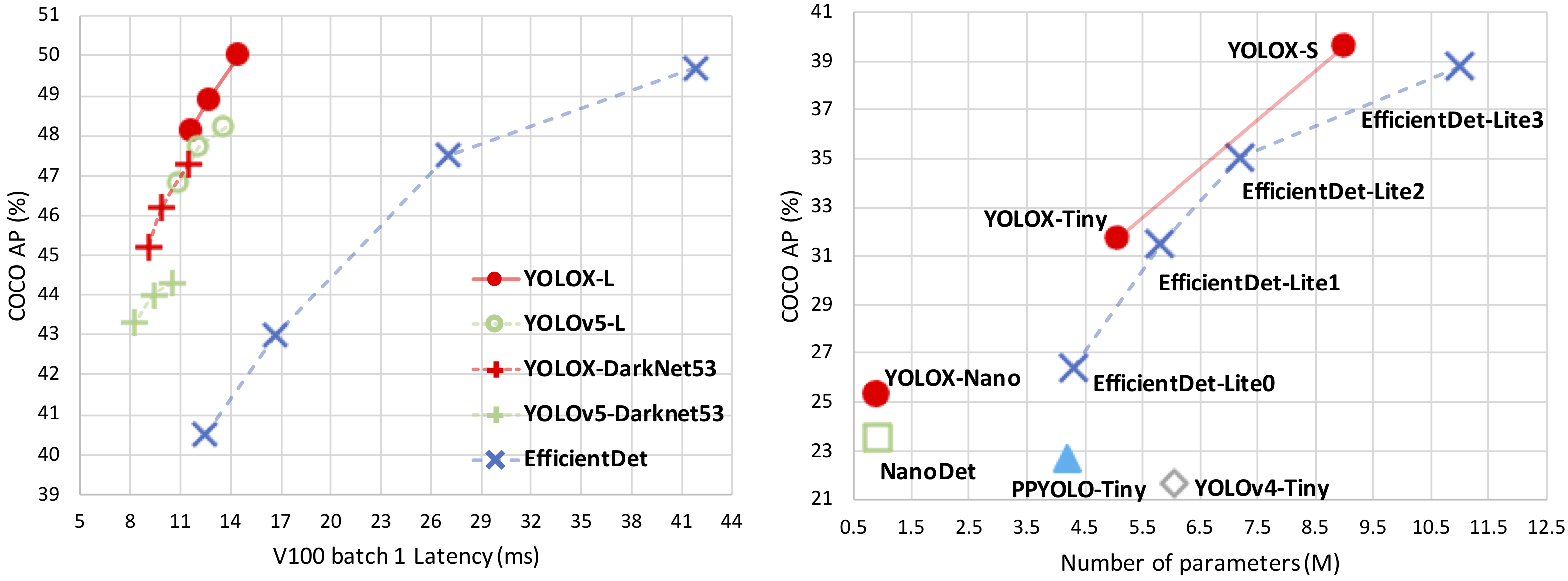
YOLOX model comparison on V100: accuracy (mAP), latency and number of parameters across different model sizes. Source: Megvii-BaseDetection/YOLOX
This is a repository that contains a set of quantized and compiled versions of YOLOX models optimized for Ara240 DNPU.
This model is a derivative work with the following changes from the original:
Original model available at: Megvii
| Model | size (pixels) |
FP32 mAPval 50-95 |
INT8 mAPval 50-95 |
Latency Ara240 (ms) |
Performance Ara240 (inferences/s) |
params (M) |
|---|---|---|---|---|---|---|
| YOLOX-Tiny | 416 | 32.8 | 30.57 | 2.48 | 402.98 | 5.06 |
| YOLOX-s | 640 | 40.5 | 38.34 | 6.52 | 153.25 | 9.0 |
| YOLOX-m | 640 | 46.9 | 44.13 | 15.89 | 62.89 | 25.3 |
| YOLOX-l | 640 | 49.7 | 47.04 | 31.51 | 31.72 | 54.2 |
| YOLOX-x | 640 | 51.1 | 48.43 | 59.69 | 16.75 | 99.1 |
This model is released under the Apache-2.0 License, the same license as the original Megvii-BaseDetection/YOLOX model.
If you use this model, please cite both this work and the original model:
@article{DBLP:journals/corr/abs-2107-08430,
  author       = {Zheng Ge and
                  Songtao Liu and
                  Feng Wang and
                  Zeming Li and
                  Jian Sun},
  title        = {{YOLOX:} Exceeding {YOLO} Series in 2021},
  journal      = {CoRR},
  volume       = {abs/2107.08430},
  year         = {2021},
  url          = {https://arxiv.org/abs/2107.08430},
  eprinttype   = {arXiv},
  eprint       = {2107.08430},
  timestamp    = {Tue, 05 Apr 2022 14:09:44 +0200},
  biburl       = {https://dblp.org/rec/journals/corr/abs-2107-08430.bib},
  bibsource    = {dblp computer science bibliography, https://dblp.org}
}