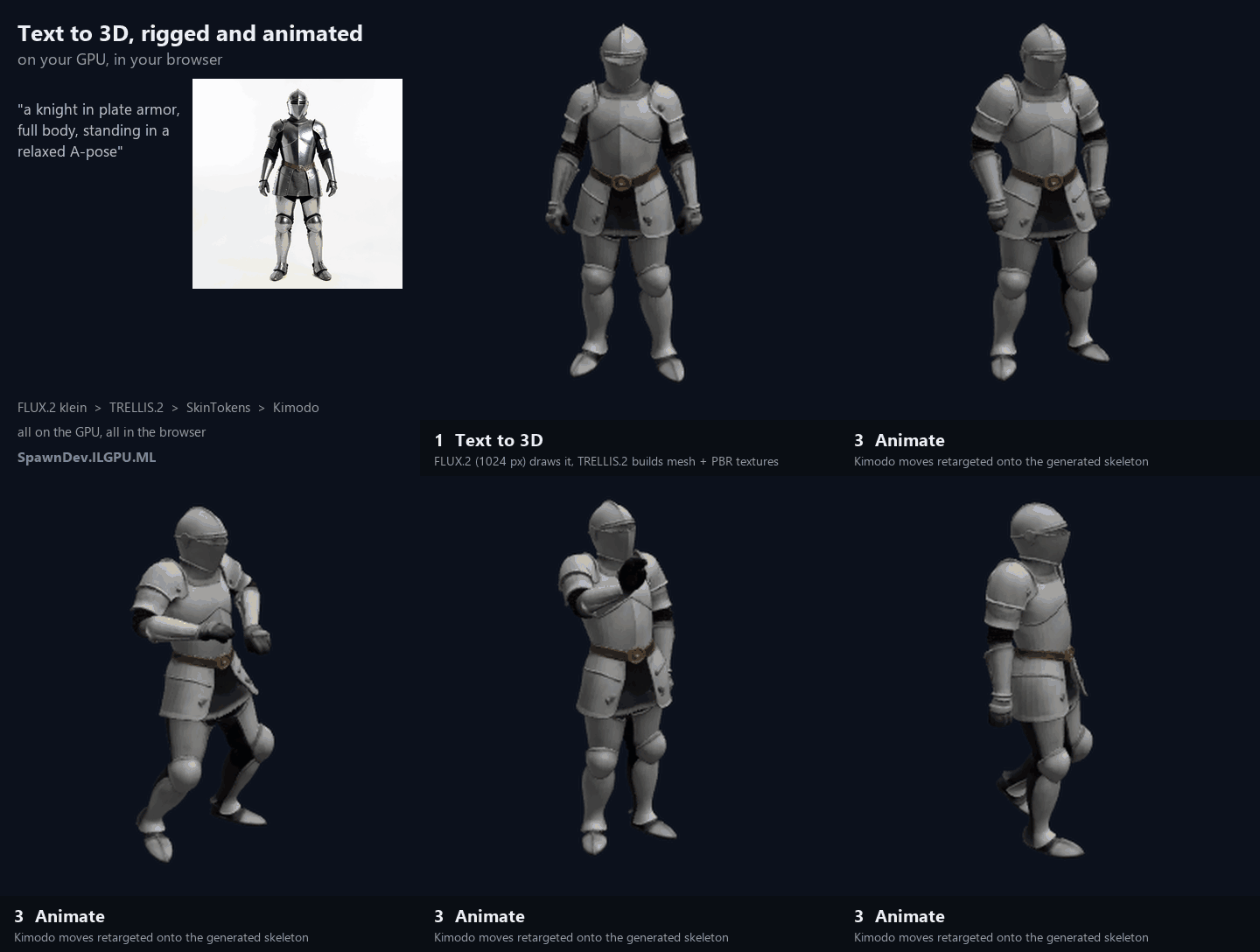
Running TRELLIS.2-4B 100% client-side in the browser via WebGPU (with auto-rigging & animation)

Hey everyone! Huge thanks to Microsoft for releasing TRELLIS.2-4B under the MIT license.
I wanted to share a project we just pushed live that might interest the community: we ported the full TRELLIS.2-4B pipeline to run 100% client-side in the browser via WebGPU using SpawnDev.ILGPU.ML (our open-source C# GPU compute and ML engine).
No Python backend, no server-side GPU cluster, and no API wrappers. Everything executes directly on local consumer hardware.
To take it a step further, we also chained SkinTokens (for neural auto-rigging and learned skin weights) and Kimodo SOMA (for skeletal motion retargeting and animation) into the same client-side browser pipeline.
You can drop a text prompt or an image, generate the 3D PBR mesh, rig it, and animate it—entirely locally in your browser tab.
Live Demo & Docs: https://lostbeard.github.io/SpawnDev.ILGPU.ML/text-to-3d
Would love to hear thoughts from anyone else experimenting with browser-native 3D generation!