


ExplorationBench: Measuring AI Systems' Exploration in Verifiable Alien Worlds
Paper • 2609.30199 • Published • 32
id stringclasses 5
values | key stringclasses 5
values | name stringclasses 5
values | manual_says stringclasses 5
values | actual stringclasses 5
values | unchanged_red_herring bool 2
classes | ground_truth_sexpr stringclasses 5
values |
|---|---|---|---|---|---|---|
R01 | int_offset | Integer offset | Integers pass through unchanged | Integer literal n -> n + 7 | false | (+ n 7) |
R02 | under_le | UNDER is non-strict | UNDER(a,b) = (a < b) | UNDER(a,b) = (a <= b) | false | (<= a b) |
R03 | pluck_next | PLUCK reads one further | PLUCK(seq, i) -> seq[i] | PLUCK(seq, i) -> seq[i + 1] | false | (get seq (+ i 1)) |
R04 | strand_identity | STRAND unchanged | STRAND(a,b,c) = [a,b,c] | STRAND(a,b,c) = [a,b,c] (same as manual) | true | IDENTITY |
R05 | gauge_double | GAUGE doubles | GAUGE(seq) = length | GAUGE(seq) = 2 * length | false | (* (len seq) 2) |






📄 Paper | 💻 Code | 🖥️ Website & Leaderboard | 📝 Blog
This dataset holds the two public demo worlds of ExplorationBench. They are built with the same procedure as the evaluation worlds and use the same language, manual, proof format, protocol and task families, but their rules are new and differ from every rule of the evaluation worlds. The evaluation worlds themselves are kept private, because a world whose rules are public measures recall instead of exploration. The evaluation code, which runs these demo worlds end to end, is on GitHub.
| Config | File | Rows | Content |
|---|---|---|---|
aliencode_heldout_tasks |
aliencode/heldout_tasks.jsonl |
5 | Held-out tasks with expected outputs and reference solutions |
aliencode_worked_examples |
aliencode/worked_examples.jsonl |
4 | The fixed worked examples a system reads first, with their real outputs and what the manual predicts |
aliencode_discovery_targets |
aliencode/discovery_targets.jsonl |
5 | The hidden rule changes: what the manual says, what actually happens, and the S-expression answer key |
alienlogic_heldout_theorems |
alienlogic/heldout_theorems.jsonl |
5 | Held-out theorems, including an unprovable one, with reference proofs and the standard-calculus proofs this world refuses |
alienlogic_worked_examples |
alienlogic/worked_examples.jsonl |
5 | The fixed worked proofs, accepted and refused, with the proof checker's verdicts |
alienlogic_side_conditions |
alienlogic/side_conditions.jsonl |
3 | The patched side conditions of the demo proof system |
aliencode/manual.md is the flawed manual a system starts from, and examples/ shows both demo worlds as a system sees them. The answer keys (discovery_targets, reference solutions and proofs, side conditions) are for checking results and are never shown to a system during evaluation. Task prompts are in Chinese, the language of the evaluation prompts.
To evaluate a model on the demo worlds, use the harness in the GitHub repository. Demo-world scores are for development only and are not comparable to the leaderboard. To have a model evaluated on the private evaluation worlds, see Evaluate Your Model.
Scientific discovery begins where known problems end. There, AI systems must explore: frame hypotheses, design experiments, and iterate on the results. ExplorationBench measures this ability in verifiable Alien Worlds. Their rules are executable, so every answer is checked exactly, and they conflict with familiar knowledge, so recall alone cannot solve the tasks.
A system starts from a flawed manual and a fixed set of worked examples. Over four rounds it probes the world through a single tool, and the world answers with deterministic feedback and no explanation. After every round, a copy of the conversation with tools disabled reports the rules it believes hold and answers every held-out task three times. The copy is then discarded, so test items never leak into exploration.
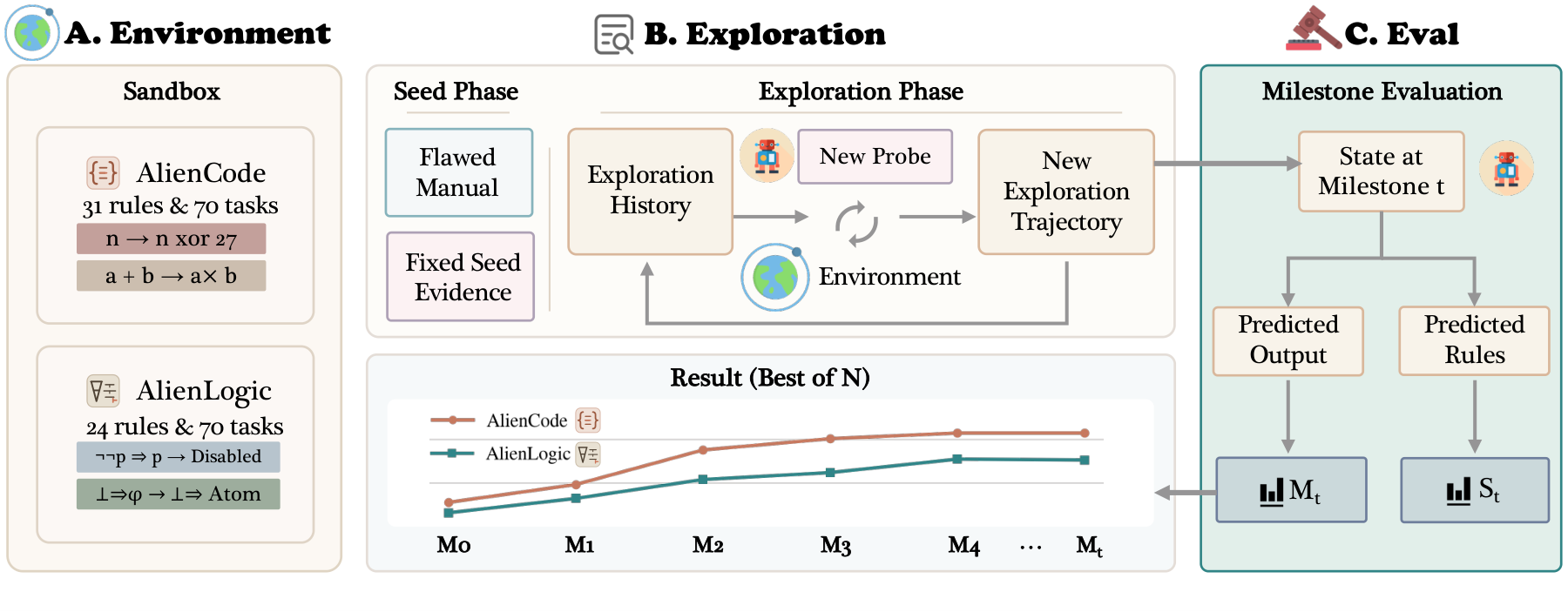
The evaluation protocol. Every system starts from the same flawed manual and the same fixed worked examples and chooses its own probes over four rounds. At every milestone Mt, a tool-disabled copy reports the rules it believes hold and answers the held-out tasks.
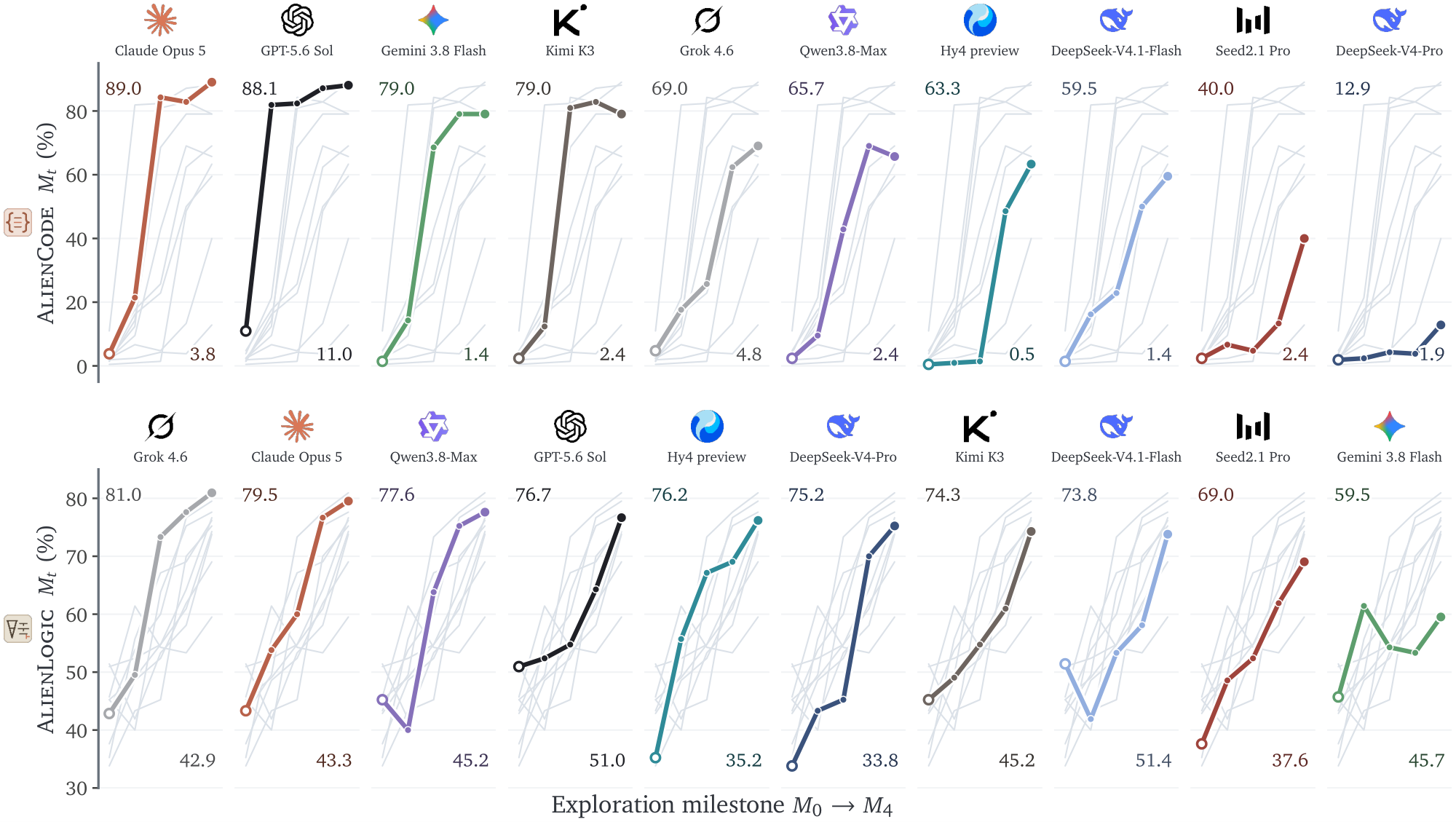
Held-out accuracy over autonomous exploration. Top: AlienCode; bottom: AlienLogic. Each cell highlights one system's M0–M4 curve; the other nine are grey. Each curve is the system's Best@3 trajectory, and each milestone is the mean of three answers per held-out task.
Stats: 2 sandboxes · 55 discovery targets · 140 held-out tasks · 10 frontier systems · 3 independent trajectories per system and sandbox · every verdict from an interpreter or a proof checker, with no LLM judge
Sandboxes:
SHATTER multiplies, EMIT(100) prints 127, and no primitive adds. 31 discovery targets and 70 held-out tasks; each program is graded by an interpreter on five private inputs.Held-out accuracy (%) after four rounds of autonomous exploration (M4). Best@3 is the best of three independent trajectories and Mean@3 their mean; M0 is the Best@3 trajectory's accuracy after the worked examples alone. Every score is the mean of three answers per task, and every system runs at its highest reasoning setting. More columns, the control conditions, and interactive trajectories are on the website.
AlienCode
| Rank | System | M0 | Best@3 | Mean@3 |
|---|---|---|---|---|
| 1 | Claude Opus 5 | 3.8 | 89.0 | 73.5 |
| 2 | GPT-5.6 Sol | 11.0 | 88.1 | 79.5 |
| 3 | Gemini 3.8 Flash | 1.4 | 79.0 | 39.7 |
| 4 | Kimi K3 | 2.4 | 79.0 | 38.7 |
| 5 | Grok 4.6 | 4.8 | 69.0 | 53.2 |
| 6 | Qwen3.8-Max | 2.4 | 65.7 | 64.0 |
| 7 | Hy4 preview | 0.5 | 63.3 | 30.2 |
| 8 | DeepSeek-V4.1-Flash | 1.4 | 59.5 | 46.3 |
| 9 | Seed2.1 Pro | 2.4 | 40.0 | 24.8 |
| 10 | DeepSeek-V4-Pro | 1.9 | 12.9 | 7.3 |
AlienLogic
| Rank | System | M0 | Best@3 | Mean@3 |
|---|---|---|---|---|
| 1 | Grok 4.6 | 42.9 | 81.0 | 72.1 |
| 2 | Claude Opus 5 | 43.3 | 79.5 | 75.9 |
| 3 | Qwen3.8-Max | 45.2 | 77.6 | 74.3 |
| 4 | GPT-5.6 Sol | 51.0 | 76.7 | 75.1 |
| 5 | Hy4 preview | 35.2 | 76.2 | 69.2 |
| 6 | DeepSeek-V4-Pro | 33.8 | 75.2 | 66.3 |
| 7 | Kimi K3 | 45.2 | 74.3 | 69.4 |
| 8 | DeepSeek-V4.1-Flash | 51.4 | 73.8 | 60.6 |
| 9 | Seed2.1 Pro | 37.6 | 69.0 | 59.8 |
| 10 | Gemini 3.8 Flash | 45.7 | 59.5 | 59.0 |
The data and code are licensed under the Apache-2.0 License.
@article{zhang2026explorationbench,
  title   = {ExplorationBench: Measuring AI Systems' Exploration
             in Verifiable Alien Worlds},
  author  = {Zhang, Ming and Xiang, Zhenghao and
             Gao, Peizhong and Shen, Yujiong and Wang, Yuhui and
             Yue, Zhonghan and Dou, Shihan and Yin, Zhangyue and
             Ye, Junjie and Liu, Shichun and Zheng, Weihuang and
             Chen, Jiahao and Chen, Jiayi and Liu, Hongzhang and
             Shao, Jiaqi and Gui, Tao and Zhang, Qi and
             Huang, Xuanjing and Zheng, Suncong and Pan, Maxm},
  journal = {arXiv preprint arXiv:2609.30199},
  year    = {2026}
}
Synced from GitHub commit 8892fd0.