

question stringlengths 37 4.33k | thinking stringlengths 2.12k 2.4k | answer stringlengths 1 179 | id int64 309 93.7k | content stringlengths 2.13k 2.58k | id_ stringlengths 4 6 | __index_level_0__ int64 0 472 |
|---|---|---|---|---|---|---|
Solve the following system of equations:
$$
\begin{aligned}
& \cos x+\cos y=\cos (x+y) \\
& \sin x+\sin y=\sin (x+y)
\end{aligned}
$$ | <think>I. solution. Let us introduce the notations $u=\frac{x+y}{2}$ and $v=\frac{x-y}{2}$. With these, $x=u+v, y=u-v$, and our system of equations transforms into:
$$
\begin{aligned}
& 2 \cos u \cos v=2 \cos ^{2} u-1 \\
& 2 \sin u \cos v=2 \sin u \cos u
\end{aligned}
$$
From (1), $\cos u \neq \cos v$, since $2 \cos ... | \begin{aligned}&\\frac{\pi}{3}+2(k+)\pi,\\&\\frac{\pi}{3}+2\pi\end{aligned} | 53,153 | <think>I. solution. Let us introduce the notations $u=\frac{x+y}{2}$ and $v=\frac{x-y}{2}$. With these, $x=u+v, y=u-v$, and our system of equations transforms into:
$$
\begin{aligned}
& 2 \cos u \cos v=2 \cos ^{2} u-1 \\
& 2 \sin u \cos v=2 \sin u \cos u
\end{aligned}
$$
From (1), $\cos u \neq \cos v$, since $2 \cos ... | 1_21 | 0 |
In the coordinate plane, find the area of the region bounded by the curve $ C: y\equal{}\frac{x\plus{}1}{x^2\plus{}1}$ and the line $ L: y\equal{}1$. | <think>1. **Define the function and the line:**
The curve \( C \) is given by the function \( f(x) = \frac{x+1}{x^2+1} \) and the line \( L \) is given by \( y = 1 \).
2. **Find the intersection points:**
To find the points where the curve intersects the line \( y = 1 \), we solve the equation:
\[
\frac{x+... | 1 - \frac{\pi}{4} - \frac{\ln(2)}{2} | 51,004 | <think>1. **Define the function and the line:**
The curve \( C \) is given by the function \( f(x) = \frac{x+1}{x^2+1} \) and the line \( L \) is given by \( y = 1 \).
2. **Find the intersection points:**
To find the points where the curve intersects the line \( y = 1 \), we solve the equation:
\[
\frac{x+... | 1_29 | 1 |
5. Given three positive real numbers $o, \rho, v$, construct a triangle $A B C$ with perimeter equal to $o$, the radius of its $A$-excircle equal to $\rho$, and the length of its $A$ altitude equal to $v$. Determine the number of solutions (non-congruent triangles) in terms of the given lengths.
(Patrik Bak)
| <think>
Solution. Let $P$ be a point on the ray opposite to $B C$ such that $B P=B A$ and, similarly, let $Q$ be a point on the ray opposite to $C B$ such that $C Q=C A$. Then $P Q=o$.
Let $I_{a}$ be the $A$-excenter of $\triangle A B C$ (Fig. 4). Since $I_{a} B$ is the bisector of angle $A B P$ and the triangle $A B ... | \begin{pmatrix}\sqrt{\rho^{2}+\frac{1}{4}^{2}}>\rho+v:&\ldots2\text{solutions,}\\\sqrt{\rho^{2}+\frac{1}{4}^{2}}=\rho+v:&\ldots1\text{solution,}\\\sqrt{\rho^{2}+\frac{1}{4}^{2}}<\ | 7,441 | <think>
Solution. Let $P$ be a point on the ray opposite to $B C$ such that $B P=B A$ and, similarly, let $Q$ be a point on the ray opposite to $C B$ such that $C Q=C A$. Then $P Q=o$.
Let $I_{a}$ be the $A$-excenter of $\triangle A B C$ (Fig. 4). Since $I_{a} B$ is the bisector of angle $A B P$ and the triangle $A B ... | 1_34 | 2 |
## Task 4 - 340714
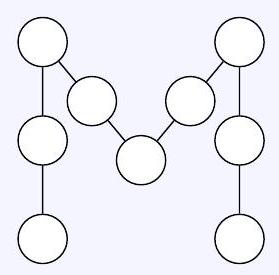
The numbers 1, 2, 3, 4, 5, 6, 7, 8, 9 are to be entered into the circles of the drawing. The following condition must be met: In each of the four groups of three, which... | <think>For each required entry of the numbers 1, 2, 3, 4, 5, 6, 7, 8, 9:
If one adds the four sums mentioned in the problem text (which are equal to each other), then the numbers \(a, b, c\) (see figure) are each used twice, and the other numbers are used once as summands. Therefore, we have
\[
4s = 1 + 2 + \ldots + ... | 13,17,15 | 48,300 | <think>For each required entry of the numbers 1, 2, 3, 4, 5, 6, 7, 8, 9:
If one adds the four sums mentioned in the problem text (which are equal to each other), then the numbers \(a, b, c\) (see figure) are each used twice, and the other numbers are used once as summands. Therefore, we have
\[
4s = 1 + 2 + \ldots + ... | 1_47 | 3 |
Kubarev A.M.
From a chessboard of 8x8, 10 cells have been cut out. It is known that among the cut-out cells, there are both black and white cells. What is the maximum number of two-cell rectangles that can be guaranteed to be cut out from this board after this?
# | <think>Each two-cell rectangle contains a black and a white cell, so if 9 white cells are cut out, it is impossible to cut out more than $32-n$ dominoes.
Fig. 1

Fig. 1
 A magician performs a magic trick: letting an audience member write any two numbers on a blackboard. Starting from the third number, each subsequent number is the sum of the two preceding numbers. When enough numbers are written (more than 10), the audience member tells the magician the last number, ... | <think>Three, let the number said by the audience be $x$, the magician only needs to calculate $\frac{1+\sqrt{5}}{2} x$, and the integer obtained by rounding to the nearest whole number is the next number.
In fact, by $a_{n}=a_{n-1}+a_{n-2}$, we know that $\left\{a_{n}\right\}$ is an increasing sequence of integers.
L... | \frac{1+\sqrt{5}}{2} x | 28,593 | <think>Three, let the number said by the audience be $x$, the magician only needs to calculate $\frac{1+\sqrt{5}}{2} x$, and the integer obtained by rounding to the nearest whole number is the next number.
In fact, by $a_{n}=a_{n-1}+a_{n-2}$, we know that $\left\{a_{n}\right\}$ is an increasing sequence of integers.
L... | 1_51 | 5 |
3.13. Given the imaginary part $v(x, y)=3^{x} \sin (y \ln 3)$ of the analytic function $f(z)$. Find $f(z)$. | <think>Solution.
Since the function $f(z)$ is analytic, the Cauchy-Riemann conditions are satisfied, i.e.,
$$
\frac{\partial u(x, y)}{\partial x}=\frac{\partial v(x, y)}{\partial y}, \quad \frac{\partial u(x, y)}{\partial y}=-\frac{\partial v(x, y)}{\partial x}
$$
For our problem, these conditions can be rewritten a... | 3^{z}+C | 69,622 | <think>Solution.
Since the function $f(z)$ is analytic, the Cauchy-Riemann conditions are satisfied, i.e.,
$$
\frac{\partial u(x, y)}{\partial x}=\frac{\partial v(x, y)}{\partial y}, \quad \frac{\partial u(x, y)}{\partial y}=-\frac{\partial v(x, y)}{\partial x}
$$
For our problem, these conditions can be rewritten a... | 1_52 | 6 |
6. The number 1 is written on the board. If the number a is written on the board, it can be replaced by any number of the form a+d, where $d$ is coprime with a and $10 \leq d \leq 20$. Is it possible to obtain the number $18!=1 \cdot 2 \cdot 3 \cdot \ldots \cdot 18$ on the board after several such operations? (I. Ruban... | <think>First solution. Note that the number 18!-19 ends with 1. We will add 10 to the number on the board. Each time, we will get a number ending in 1, and thus coprime with the number 10, so the operation is possible. Eventually, the number 18!-19 will appear on the board. We will add 19 to it and get 18!.
Second sol... | 18! | 24,932 | <think>First solution. Note that the number 18!-19 ends with 1. We will add 10 to the number on the board. Each time, we will get a number ending in 1, and thus coprime with the number 10, so the operation is possible. Eventually, the number 18!-19 will appear on the board. We will add 19 to it and get 18!.
Second sol... | 1_63 | 7 |
In a fish shop with 28 kinds of fish, there are 28 fish sellers. In every seller, there exists only one type of each fish kind, depending on where it comes, Mediterranean or Black Sea. Each of the $k$ people gets exactly one fish from each seller and exactly one fish of each kind. For any two people, there exists a fis... | <think>1. **Restate the problem in terms of binary strings:**
We are given an \( n \times n \) board where each cell contains either a 0 or a 1. We need to choose exactly \( n \) cells such that all the chosen cells are in different rows and different columns. For each row, we append the value of the chosen cell to ... | 2^n - n | 80,949 | <think>1. **Restate the problem in terms of binary strings:**
We are given an \( n \times n \) board where each cell contains either a 0 or a 1. We need to choose exactly \( n \) cells such that all the chosen cells are in different rows and different columns. For each row, we append the value of the chosen cell to ... | 1_73 | 8 |
Example 2. Using the Runge-Kutta method, find the solution to the Cauchy problem for the equation $y^{\prime}=3 x+y, y(0)=-1, x \in[0,1]$, taking $h=0.1$. | <think>Solution. As in the previous example, using formulas (14.7) - (14.9), we find the values of $y_{1}, y_{2}, y_{3}, y_{4}, y_{5}$ (see Table 14.4).
Table 14.4
| i | $x_{i}$ | $y_{i}$ | $3 x_{i}$ | $3 x_{i}+y_{i}$ | $k_{j}$ | $p_{j}$ | $S=$ $=\sum_{j=1}^{4} p_{j} k_{j}$ | $\Delta y_{i}=$ $=\frac{1}{6} s$ |
| :-... | 2e^{x}-3x-3 | 52,607 | <think>Solution. As in the previous example, using formulas (14.7) - (14.9), we find the values of $y_{1}, y_{2}, y_{3}, y_{4}, y_{5}$ (see Table 14.4).
Table 14.4
| i | $x_{i}$ | $y_{i}$ | $3 x_{i}$ | $3 x_{i}+y_{i}$ | $k_{j}$ | $p_{j}$ | $S=$ $=\sum_{j=1}^{4} p_{j} k_{j}$ | $\Delta y_{i}=$ $=\frac{1}{6} s$ |
| :-... | 1_74 | 9 |
Determine all strictly increasing functions $f:\mathbb{N}_0\to\mathbb{N}_0$ which satisfy \[f(x)\cdot f(y)\mid (1+2x)\cdot f(y)+(1+2y)\cdot f(x)\]for all non-negative integers $x{}$ and $y{}$. | <think>1. **Given Condition:**
We need to find all strictly increasing functions \( f: \mathbb{N}_0 \to \mathbb{N}_0 \) such that:
\[
f(x) \cdot f(y) \mid (1 + 2x) \cdot f(y) + (1 + 2y) \cdot f(x)
\]
for all non-negative integers \( x \) and \( y \).
2. **Substitute \( x = 0 \):**
Let \( x = 0 \):
... | f(x) = 2x + 1 | 19,741 | <think>1. **Given Condition:**
We need to find all strictly increasing functions \( f: \mathbb{N}_0 \to \mathbb{N}_0 \) such that:
\[
f(x) \cdot f(y) \mid (1 + 2x) \cdot f(y) + (1 + 2y) \cdot f(x)
\]
for all non-negative integers \( x \) and \( y \).
2. **Substitute \( x = 0 \):**
Let \( x = 0 \):
... | 1_83 | 10 |
For which numbers $n$ is it possible to put marks on a stick such that all distances $1$ cm, $2$ cm, . . . , $n$ cm each appear exactly once as the distance between two of the marks, and no other distance appears as such a distance?
| <think>To determine for which numbers \( n \) it is possible to place marks on a stick such that all distances \( 1 \) cm, \( 2 \) cm, \ldots, \( n \) cm each appear exactly once as the distance between two of the marks, and no other distance appears, we proceed as follows:
1. **Understanding the Problem:**
We need... | n = 3 | 20,745 | <think>To determine for which numbers \( n \) it is possible to place marks on a stick such that all distances \( 1 \) cm, \( 2 \) cm, \ldots, \( n \) cm each appear exactly once as the distance between two of the marks, and no other distance appears, we proceed as follows:
1. **Understanding the Problem:**
We need... | 1_85 | 11 |
Find all triplets $ (x,y,z) $ of real numbers such that
\[ 2x^3 + 1 = 3zx \]\[ 2y^3 + 1 = 3xy \]\[ 2z^3 + 1 = 3yz \] | <think>We are given the system of equations:
\[ 2x^3 + 1 = 3zx \]
\[ 2y^3 + 1 = 3xy \]
\[ 2z^3 + 1 = 3yz \]
We need to find all triplets \((x, y, z)\) of real numbers that satisfy these equations. We will consider different cases based on the signs of \(x\), \(y\), and \(z\).
### Case 1: \(x, y, z \ge 0\)
Using the A... | (1, 1, 1) | 28,998 | <think>We are given the system of equations:
\[ 2x^3 + 1 = 3zx \]
\[ 2y^3 + 1 = 3xy \]
\[ 2z^3 + 1 = 3yz \]
We need to find all triplets \((x, y, z)\) of real numbers that satisfy these equations. We will consider different cases based on the signs of \(x\), \(y\), and \(z\).
### Case 1: \(x, y, z \ge 0\)
Using the A... | 1_87 | 12 |
Task 4. Let $n \geq 3$ be an integer and consider an $n \times n$ board, divided into $n^{2}$ unit squares. We have for every $m \geq 1$ arbitrarily many $1 \times m$ rectangles (type I) and arbitrarily many $m \times 1$ rectangles (type II) available. We cover the board with $N$ of these rectangles, which do not overl... | <think>Solution. We prove that the minimal value $N=2n-1$. We first construct an example by induction.
Base case. For $n=3$, $N=5$ is possible, by placing a $1 \times 1$ rectangle in the middle field and covering the remaining fields with four $2 \times 1$ and $1 \times 2$ rectangles. There are then three rectangles w... | 2n-1 | 29,114 | <think>Solution. We prove that the minimal value $N=2n-1$. We first construct an example by induction.
Base case. For $n=3$, $N=5$ is possible, by placing a $1 \times 1$ rectangle in the middle field and covering the remaining fields with four $2 \times 1$ and $1 \times 2$ rectangles. There are then three rectangles w... | 1_88 | 13 |
Let $G{}$ be an arbitrary finite group, and let $t_n(G)$ be the number of functions of the form \[f:G^n\to G,\quad f(x_1,x_2,\ldots,x_n)=a_0x_1a_1\cdots x_na_n\quad(a_0,\ldots,a_n\in G).\]Determine the limit of $t_n(G)^{1/n}$ as $n{}$ tends to infinity. | <think>1. **Define the problem and the function count**: We are given a finite group \( G \) and need to determine the limit of \( t_n(G)^{1/n} \) as \( n \) tends to infinity, where \( t_n(G) \) is the number of functions of the form:
\[
f: G^n \to G, \quad f(x_1, x_2, \ldots, x_n) = a_0 x_1 a_1 \cdots x_n a_n \... | \frac{|G|}{|Z(G)|} | 46,773 | <think>1. **Define the problem and the function count**: We are given a finite group \( G \) and need to determine the limit of \( t_n(G)^{1/n} \) as \( n \) tends to infinity, where \( t_n(G) \) is the number of functions of the form:
\[
f: G^n \to G, \quad f(x_1, x_2, \ldots, x_n) = a_0 x_1 a_1 \cdots x_n a_n \... | 1_95 | 14 |
Find all triplets $(k, m, n)$ of positive integers having the following property: Square with side length $m$ can be divided into several rectangles of size $1\times k$ and a square with side length $n$. | <think>To solve the problem, we need to determine the conditions under which a square of side length \( m \) can be divided into several rectangles of size \( 1 \times k \) and a square of side length \( n \).
1. **Understanding the Problem:**
- We are given a square of side length \( m \).
- We need to tile th... | (m - n)(m + n) \equiv 0 \pmod{k} | 36,510 | <think>To solve the problem, we need to determine the conditions under which a square of side length \( m \) can be divided into several rectangles of size \( 1 \times k \) and a square of side length \( n \).
1. **Understanding the Problem:**
- We are given a square of side length \( m \).
- We need to tile th... | 1_100 | 15 |
Find those pairs of numbers $x, y$ for which
$$
\cos x + \cos y - \cos (x + y) = \frac{3}{2}
$$ | <think>I. solution. Using the known identities
$$
\cos x+\cos y=2 \cos \frac{x+y}{2} \cos \frac{x-y}{2} \quad \text { and } \quad \cos (x+y)=2 \cos ^{2} \frac{x+y}{2}-1
$$
our equation, after a simple transformation, can be written as:
$$
\left(2 \cos \frac{x+y}{2}-\cos \frac{x-y}{2}\right)^{2}+\sin ^{2} \frac{x-y}{... | \\frac{\pi}{3}+2k\pi,\quad\\frac{\pi}{3}+2\pi\quad(k,\text{integers}) | 93,049 | <think>I. solution. Using the known identities
$$
\cos x+\cos y=2 \cos \frac{x+y}{2} \cos \frac{x-y}{2} \quad \text { and } \quad \cos (x+y)=2 \cos ^{2} \frac{x+y}{2}-1
$$
our equation, after a simple transformation, can be written as:
$$
\left(2 \cos \frac{x+y}{2}-\cos \frac{x-y}{2}\right)^{2}+\sin ^{2} \frac{x-y}{... | 1_108 | 16 |
Let $p$ be a prime number. Find all polynomials $P$ with integer coefficients with the following properties:
$(a)$ $P(x)>x$ for all positive integers $x$.
$(b)$ The sequence defined by $p_0:=p$, $p_{n+1}:=P(p_n)$ for all positive integers $n$, satisfies the property that for all positive integers $m$ there exists some ... | <think>1. **Define the sequence and the polynomial properties:**
Let \( p \) be a prime number. We need to find all polynomials \( P \) with integer coefficients such that:
- \( P(x) > x \) for all positive integers \( x \).
- The sequence defined by \( p_0 := p \) and \( p_{n+1} := P(p_n) \) for all positive ... | P(x) = x + 1 | 6,872 | <think>1. **Define the sequence and the polynomial properties:**
Let \( p \) be a prime number. We need to find all polynomials \( P \) with integer coefficients such that:
- \( P(x) > x \) for all positive integers \( x \).
- The sequence defined by \( p_0 := p \) and \( p_{n+1} := P(p_n) \) for all positive ... | 1_110 | 17 |
Let $m>1$ be an odd integer. Let $n=2m$ and $\theta=e^{2\pi i\slash n}$. Find integers $a_{1},\ldots,a_{k}$ such that
$\sum_{i=1}^{k}a_{i}\theta^{i}=\frac{1}{1-\theta}$. | <think>1. **Define the problem and given values:**
Let \( m > 1 \) be an odd integer. Define \( n = 2m \) and \( \theta = e^{2\pi i / n} \). We need to find integers \( a_1, a_2, \ldots, a_k \) such that:
\[
\sum_{i=1}^{k} a_i \theta^i = \frac{1}{1 - \theta}
\]
2. **Claim and simplification:**
We claim ... | a_i = 1 | 46,496 | <think>1. **Define the problem and given values:**
Let \( m > 1 \) be an odd integer. Define \( n = 2m \) and \( \theta = e^{2\pi i / n} \). We need to find integers \( a_1, a_2, \ldots, a_k \) such that:
\[
\sum_{i=1}^{k} a_i \theta^i = \frac{1}{1 - \theta}
\]
2. **Claim and simplification:**
We claim ... | 1_111 | 18 |
11.5. Find all pairs of natural numbers $a$ and $b$ such that both numbers $\frac{a^{2}+b}{b^{2}-a}$ and $\frac{b^{2}+a}{a^{2}-b}$ are integers. | <think>Answer. $(a, b)=(2,2),(3,3),(1,2),(2,1),(2,3),(3,2)$ - six pairs.
Solution. When $a$ is replaced by $b$ and $b$ by $a$, the fractions in the condition swap places, so we can immediately assume that $a \leq b$, adding the symmetric solutions obtained later. In this case, the case $a=b=1$ is excluded due to the i... | (2,2),(3,3),(1,2),(2,1),(2,3),(3,2) | 64,708 | <think>Answer. $(a, b)=(2,2),(3,3),(1,2),(2,1),(2,3),(3,2)$ - six pairs.
Solution. When $a$ is replaced by $b$ and $b$ by $a$, the fractions in the condition swap places, so we can immediately assume that $a \leq b$, adding the symmetric solutions obtained later. In this case, the case $a=b=1$ is excluded due to the i... | 1_116 | 19 |
Let $A$ be a positive real number. What are the possible values of $\displaystyle\sum_{j=0}^{\infty} x_j^2, $ given that $x_0, x_1, \cdots$ are positive numbers for which $\displaystyle\sum_{j=0}^{\infty} x_j = A$? | <think>1. **Establishing the range of possible values:**
- We are given that \( \sum_{j=0}^{\infty} x_j = A \) where \( x_j \) are positive numbers.
- We need to determine the possible values of \( \sum_{j=0}^{\infty} x_j^2 \).
2. **Proving the upper bound:**
- Since \( \sum_{j=0}^{\infty} x_j = A \), we can ... | (0, A^2) | 58,945 | <think>1. **Establishing the range of possible values:**
- We are given that \( \sum_{j=0}^{\infty} x_j = A \) where \( x_j \) are positive numbers.
- We need to determine the possible values of \( \sum_{j=0}^{\infty} x_j^2 \).
2. **Proving the upper bound:**
- Since \( \sum_{j=0}^{\infty} x_j = A \), we can ... | 1_132 | 20 |
1037. Find the integrals:
1) $\int \frac{d x}{2 x^{2}+9}$
2) $\int \frac{d x}{\sqrt{5-4 x^{2}}}$
3) $\int \frac{d x}{\sqrt{2 x^{2}-3}}$
4) $\int \frac{d x}{4 x^{2}-3}$
5) $\int \cos ^{2} \frac{x}{2} d x$
6) $\int \operatorname{tg}^{2} x d x$ | <think>Solution. 1) We will transform the given integral to a tabular form as follows:
$$
I=\int \frac{d x}{2 x^{2}+9}=\int \frac{d x}{2\left(x^{2}+\frac{9}{2}\right)}=\frac{1}{2} \int \frac{d x}{x^{2}+\frac{9}{2}}
$$
here $a^{2}=\frac{9}{2}$ (see formula 12), therefore,
$$
I=\frac{1}{2} \cdot \frac{\frac{1}{3}}{\sq... | -\frac{\sqrt{2}}{6}\operatorname{arctg}\frac{x\sqrt{2}}{3}+C | 13,628 | <think>Solution. 1) We will transform the given integral to a tabular form as follows:
$$
I=\int \frac{d x}{2 x^{2}+9}=\int \frac{d x}{2\left(x^{2}+\frac{9}{2}\right)}=\frac{1}{2} \int \frac{d x}{x^{2}+\frac{9}{2}}
$$
here $a^{2}=\frac{9}{2}$ (see formula 12), therefore,
$$
I=\frac{1}{2} \cdot \frac{\frac{1}{3}}{\sq... | 1_138 | 21 |
Example 15 Given a cube $A B C D-A_{1} B_{1} C_{1} D_{1}$ with edge length $1$, and $E$ is the midpoint of $D_{1} C_{1}$, find the following:
(1) Find the distance between the skew lines $D_{1} B$ and $A_{1} E$;
(2) Find the distance from $B_{1}$ to the plane $A_{1} B E$;
(3) Find the distance from $D_{1} C$ to the pla... | <think>(1) As shown in Figure $20-14$, establish a spatial rectangular coordinate system, then $\overrightarrow{A_{1} E}=(-1$, $\left.\frac{1}{2}, 0\right), \overrightarrow{D_{1} B}=(1,1,-1)$.
Let $\boldsymbol{n}=(x, y, z)$ be a vector perpendicular to both $\overrightarrow{A_{1} E}$ and $\overrightarrow{D_{1} B}$, the... | \frac{\sqrt{14}}{14},\frac{2}{3},\frac{1}{3},\frac{\sqrt{3}}{3} | 50,259 | <think>(1) As shown in Figure $20-14$, establish a spatial rectangular coordinate system, then $\overrightarrow{A_{1} E}=(-1$, $\left.\frac{1}{2}, 0\right), \overrightarrow{D_{1} B}=(1,1,-1)$.
Let $\boldsymbol{n}=(x, y, z)$ be a vector perpendicular to both $\overrightarrow{A_{1} E}$ and $\overrightarrow{D_{1} B}$, the... | 1_158 | 22 |
Find all polynomials $p(x)\in\mathbb{R}[x]$ such that for all $x\in \mathbb{R}$:
$p(5x)^2-3=p(5x^2+1)$ such that:
$a) p(0)\neq 0$
$b) p(0)=0$ | <think>To find all polynomials \( p(x) \in \mathbb{R}[x] \) such that for all \( x \in \mathbb{R} \):
\[ p(5x)^2 - 3 = p(5x^2 + 1) \]
we will consider two cases: \( p(0) \neq 0 \) and \( p(0) = 0 \).
### Case 1: \( p(0) \neq 0 \)
1. **Assume \( p(x) \) is a polynomial of degree \( n \):**
\[
p(x) = a_n x^n + ... | p(x) = \frac{1 + \sqrt{13}}{2} | 22,537 | <think>To find all polynomials \( p(x) \in \mathbb{R}[x] \) such that for all \( x \in \mathbb{R} \):
\[ p(5x)^2 - 3 = p(5x^2 + 1) \]
we will consider two cases: \( p(0) \neq 0 \) and \( p(0) = 0 \).
### Case 1: \( p(0) \neq 0 \)
1. **Assume \( p(x) \) is a polynomial of degree \( n \):**
\[
p(x) = a_n x^n + ... | 1_163 | 23 |
K2) Let $n$ be a natural number. Roger has a square garden of size $(2 n+1) \times(2 n+1)$. He erects fences to divide it into rectangular beds. He wants exactly two horizontal $k \times 1$ beds and exactly two vertical $1 \times k$ beds for every even number $k$ between 1 and $2 n+1$, as well as a single square bed of... | <think>Solution Consider the 4 largest rectangles. We want to show that together they form the edge of the garden.
First consider a single vertical $1 \times 2 n$ rectangle. The short edge of this rectangle must touch a border (otherwise there would be an area with a width smaller than 1 above and below the rectangle,... | 2^{n} | 30,504 | <think>Solution Consider the 4 largest rectangles. We want to show that together they form the edge of the garden.
First consider a single vertical $1 \times 2 n$ rectangle. The short edge of this rectangle must touch a border (otherwise there would be an area with a width smaller than 1 above and below the rectangle,... | 1_164 | 24 |
[Circles](https://artofproblemsolving.com/wiki/index.php/Circle) $\mathcal{C}_1, \mathcal{C}_2,$ and $\mathcal{C}_3$ have their [centers](https://artofproblemsolving.com/wiki/index.php/Center) at (0,0), (12,0), and (24,0), and have [radii](https://artofproblemsolving.com/wiki/index.php/Radius) 1, 2, and 4, respectively... | <think>[2006 II AIME-9.png](https://artofproblemsolving.com/wiki/index.php/File:2006_II_AIME-9.png)
Call the centers $O_1, O_2, O_3$, the points of tangency $r_1, r_2, s_1, s_2$ (with $r$ on $t_1$ and $s$ on $t_2$, and $s_2$ on $\mathcal{C}_2$), and the intersection of each common internal tangent to the [X-axis](https... | 27 | 2,530 | <think>[2006 II AIME-9.png](https://artofproblemsolving.com/wiki/index.php/File:2006_II_AIME-9.png)
Call the centers $O_1, O_2, O_3$, the points of tangency $r_1, r_2, s_1, s_2$ (with $r$ on $t_1$ and $s$ on $t_2$, and $s_2$ on $\mathcal{C}_2$), and the intersection of each common internal tangent to the [X-axis](https... | 1_166 | 25 |
Let $m$ be a positive integer. Find polynomials $P(x)$ with real coefficients such that $$(x-m)P(x+2023) = xP(x)$$
is satisfied for all real numbers $x.$ | <think>1. **Initial Setup and Substitution:**
Given the equation:
\[
(x - m)P(x + 2023) = xP(x)
\]
we need to find polynomials \( P(x) \) with real coefficients that satisfy this equation for all real numbers \( x \).
2. **Case Analysis:**
We will consider two cases: \( P(x) \equiv 0 \) and \( P(x) \... | P(x) = c \prod_{i=0}^{k} (x - 2023i) | 59,821 | <think>1. **Initial Setup and Substitution:**
Given the equation:
\[
(x - m)P(x + 2023) = xP(x)
\]
we need to find polynomials \( P(x) \) with real coefficients that satisfy this equation for all real numbers \( x \).
2. **Case Analysis:**
We will consider two cases: \( P(x) \equiv 0 \) and \( P(x) \... | 1_173 | 26 |
A binary operation $\diamondsuit$ has the properties that $a\,\diamondsuit\, (b\,\diamondsuit \,c) = (a\,\diamondsuit \,b)\cdot c$ and that $a\,\diamondsuit \,a=1$ for all nonzero real numbers $a, b,$ and $c$. (Here $\cdot$ represents multiplication). The solution to the equation $2016 \,\diamondsuit\, (6\,\diamondsuit... | <think>1. Let \( P(a, b, c) \) denote the given assertion \( a \diamondsuit (b \diamondsuit c) = (a \diamondsuit b) \cdot c \).
2. We are given that \( a \diamondsuit a = 1 \) for all nonzero real numbers \( a \).
3. To show that \( \diamondsuit \) is injective, assume \( a \diamondsuit b = a \diamondsuit c \). We ne... | 109 | 48,642 | <think>1. Let \( P(a, b, c) \) denote the given assertion \( a \diamondsuit (b \diamondsuit c) = (a \diamondsuit b) \cdot c \).
2. We are given that \( a \diamondsuit a = 1 \) for all nonzero real numbers \( a \).
3. To show that \( \diamondsuit \) is injective, assume \( a \diamondsuit b = a \diamondsuit c \). We ne... | 1_174 | 27 |
$ x$ students took an exam with $ y$ problems. Each student solved a half of the problem and the number of person those who solved the problem is equal for each problem.For any two students exactly three problems could be solved by the two persons. Find all pairs of $ (x,\ y)$ satisfying this condition, then show an e... | <think>1. **Identify the problem as a Balanced Incomplete Block Design (BIBD):**
- We are given \( x \) students and \( y \) problems.
- Each student solves half of the problems, so each student solves \( \frac{y}{2} \) problems.
- Each problem is solved by the same number of students, denoted as \( k \).
-... | (4, 18) | 86,953 | <think>1. **Identify the problem as a Balanced Incomplete Block Design (BIBD):**
- We are given \( x \) students and \( y \) problems.
- Each student solves half of the problems, so each student solves \( \frac{y}{2} \) problems.
- Each problem is solved by the same number of students, denoted as \( k \).
-... | 1_181 | 28 |
Let M be a subst of {1,2,...,2006} with the following property: For any three elements x,y and z (x<y<z) of M, x+y does not divide z. Determine the largest possible size of M. Justify your claim. | <think>1. **Understanding the Problem:**
We need to find the largest subset \( M \) of \(\{1, 2, \ldots, 2006\}\) such that for any three elements \( x, y, z \) in \( M \) with \( x < y < z \), the sum \( x + y \) does not divide \( z \).
2. **Rephrasing the Condition:**
The condition \( x + y \) does not divide... | 1004 | 9,571 | <think>1. **Understanding the Problem:**
We need to find the largest subset \( M \) of \(\{1, 2, \ldots, 2006\}\) such that for any three elements \( x, y, z \) in \( M \) with \( x < y < z \), the sum \( x + y \) does not divide \( z \).
2. **Rephrasing the Condition:**
The condition \( x + y \) does not divide... | 1_182 | 29 |
Find all real numbers $c$ such that there exists a function $f: \mathbb{R}_{ \ge 0} \rightarrow \mathbb{R}$ which satisfies the following.
For all nonnegative reals $x, y$, $f(x+y^2) \ge cf(x)+y$.
Here $\mathbb{R}_{\ge 0}$ is the set of all nonnegative reals. | <think>1. **Case \( c \le 0 \):**
- Consider the function \( f(x) = \sqrt{x} \).
- For \( x, y \ge 0 \), we need to check if \( f(x + y^2) \ge cf(x) + y \).
- Substituting \( f(x) = \sqrt{x} \), we get:
\[
\sqrt{x + y^2} \ge c\sqrt{x} + y
\]
- Since \( c \le 0 \), \( c\sqrt{x} \le 0 \). There... | c < 1 | 21,360 | <think>1. **Case \( c \le 0 \):**
- Consider the function \( f(x) = \sqrt{x} \).
- For \( x, y \ge 0 \), we need to check if \( f(x + y^2) \ge cf(x) + y \).
- Substituting \( f(x) = \sqrt{x} \), we get:
\[
\sqrt{x + y^2} \ge c\sqrt{x} + y
\]
- Since \( c \le 0 \), \( c\sqrt{x} \le 0 \). There... | 1_187 | 30 |
To climb the stairs, Evariste can take steps of 1 stair and steps of 2 stairs. In how many different ways can he climb a staircase with $n$ stairs? | <think>To start, let's denote $u_{n}$ as the number we are looking for. The problem seems to ask for an explicit formula for $u_{n}$, but before that, let's find what is called a recurrence relation, which is an expression of $u_{n}$ in terms of the previous terms $u_{k}$ $(k<n)$.
For $n \geq 2$, we distinguish two ca... | u_{n}=u_{n-1}+u_{n-2} | 75,288 | <think>To start, let's denote $u_{n}$ as the number we are looking for. The problem seems to ask for an explicit formula for $u_{n}$, but before that, let's find what is called a recurrence relation, which is an expression of $u_{n}$ in terms of the previous terms $u_{k}$ $(k<n)$.
For $n \geq 2$, we distinguish two ca... | 1_195 | 31 |
Question 44: Given 2015 points on a plane, the distance between any two points is unique. For each point, the 22 closest points to it are called its "neighbors". How many points can a given point be a neighbor to at most? | <think>The 44th question:
Solution: First, we prove a lemma: If there are 2015 points in the plane with pairwise distinct distances, for each point, the point closest to it is called its nearest neighbor. Then, a given point can be the nearest neighbor of at most 5 points.
Proof of the lemma: For any point \( P \), if... | 110 | 20,651 | <think>The 44th question:
Solution: First, we prove a lemma: If there are 2015 points in the plane with pairwise distinct distances, for each point, the point closest to it is called its nearest neighbor. Then, a given point can be the nearest neighbor of at most 5 points.
Proof of the lemma: For any point \( P \), if... | 1_197 | 32 |
What is the maximum number of edges of a regular p-gonal prism that a plane, not passing through the vertices of the prism, can intersect? | <think>And what is the maximum number of faces that can be intersected
## Solution
Note that the intersection of a prism and a plane is a polygon, and its vertices correspond to the edges of the prism intersected by the plane, while its sides correspond to the faces of the prism intersected by the plane. Therefore, t... | n+2 | 62,132 | <think>And what is the maximum number of faces that can be intersected
## Solution
Note that the intersection of a prism and a plane is a polygon, and its vertices correspond to the edges of the prism intersected by the plane, while its sides correspond to the faces of the prism intersected by the plane. Therefore, t... | 1_204 | 33 |
A [i]strip[/i] is the region between two parallel lines. Let $A$ and $B$ be two strips in a plane. The intersection of strips $A$ and $B$ is a parallelogram $P$. Let $A'$ be a rotation of $A$ in the plane by $60^\circ$. The intersection of strips $A'$ and $B$ is a parallelogram with the same area as $P$. Let $x^\c... | <think>1. **Shift one of the vertices of \( P \) to the origin**: Without loss of generality, let one vertex of the parallelogram \( P \) be at the origin \((0,0)\). Assume that strip \( A \) is aligned with the real axis (the \( x \)-axis).
2. **Dilate the plane**: Scale the plane such that the side of \( P \) on the... | 150^\circ | 19,958 | <think>1. **Shift one of the vertices of \( P \) to the origin**: Without loss of generality, let one vertex of the parallelogram \( P \) be at the origin \((0,0)\). Assume that strip \( A \) is aligned with the real axis (the \( x \)-axis).
2. **Dilate the plane**: Scale the plane such that the side of \( P \) on the... | 1_210 | 34 |
End of preview. Expand in Data Studio
README.md exists but content is empty.
- Downloads last month
- 4