

question stringlengths 46 3.79k | thinking stringlengths 1.7k 1.9k | answer stringlengths 1 173 | id int64 6 93.7k | content stringlengths 1.7k 2.05k | id_ stringlengths 3 6 |
|---|---|---|---|---|---|
3. In recent years, the use of mortgage loans by young families has become quite popular. Consider the possibility of obtaining a mortgage with a constant, fixed interest rate. Assume that the repayment of such a loan is made through equal (annuity) payments at the end of each payment period stipulated by the contract.... | <think>Solution: If the borrower immediately directs the funds to a partial prepayment, in this case, part of these funds will go towards paying the accrued interest for half the period, and the rest will go towards repaying the principal. As a result, due to the reduction in the principal amount, less interest will be... | S-2T+rS-0.5rT+(0.5rS)^2<S-2T+rS | 10,869 | <think>Solution: If the borrower immediately directs the funds to a partial prepayment, in this case, part of these funds will go towards paying the accrued interest for half the period, and the rest will go towards repaying the principal. As a result, due to the reduction in the principal amount, less interest will be... | 1_0 |
$6 \cdot 66$ Find all ordered pairs of positive integers $(m, n)$ such that $\frac{n^{3}+1}{m n-1}$ is an integer.
(36th International Mathematical Olympiad, 1994) | <think>[Solution] Since $\left(m n-1, m^{3}\right)=1$, then $m n-1 \mid n^{3}+1$ is equivalent to $m n-1 \mid m^{3}\left(n^{3}+1\right)$. Clearly,
$$
m^{3}\left(n^{3}+1\right)=\left(m^{3} n^{3}-1\right)+\left(m^{3}+1\right),
$$
Since $m^{3} n^{3}-1=(m n-1)\left(m^{2} n^{2}+m n+1\right)$,
thus $m n-1 \mid m^{3} n^{3}-1... | (2,2),(2,1),(3,1),(5,2),(5,3),(1,2),(1,3),(2,5),(3,5) | 33,936 | <think>[Solution] Since $\left(m n-1, m^{3}\right)=1$, then $m n-1 \mid n^{3}+1$ is equivalent to $m n-1 \mid m^{3}\left(n^{3}+1\right)$. Clearly,
$$
m^{3}\left(n^{3}+1\right)=\left(m^{3} n^{3}-1\right)+\left(m^{3}+1\right),
$$
Since $m^{3} n^{3}-1=(m n-1)\left(m^{2} n^{2}+m n+1\right)$,
thus $m n-1 \mid m^{3} n^{3}-1... | 1_1 |
5. Find all integers n for which the number
$$
2^{n}+n^{2}
$$
is a perfect square of some integer.
(Tomáš Jurík) | <think>SOLUTION. We will show that the only integer solutions for $n$ are $n=0$ and $n=6$.
In the case of integer $n$, $m-n$ are powers of two, so $m-n \mid m+n$. Thus, $m-n$ also divides the number $(m+n)-(m-n)$ equal to $2n$, where, however, $n$ is an odd factor, so $4 \nmid m-n$. A power of two equal to $m-n$ is an... | n=0n=6 | 32,198 | <think>SOLUTION. We will show that the only integer solutions for $n$ are $n=0$ and $n=6$.
In the case of integer $n$, $m-n$ are powers of two, so $m-n \mid m+n$. Thus, $m-n$ also divides the number $(m+n)-(m-n)$ equal to $2n$, where, however, $n$ is an odd factor, so $4 \nmid m-n$. A power of two equal to $m-n$ is an... | 1_2 |
13.19 A person tosses a coin, scoring $a$ points for heads and $b$ points for tails $(a, b$ are positive integers, $a>b$). The scores are accumulated each time. He finds that no matter how many times he tosses the coin, there are 35 scores that cannot be recorded, for example, 58 is one of them. Determine the values of... | <think>[Solution] Let a person get heads $x$ times and tails $y$ times, where $x$ and $y$ are non-negative integers.
Thus, the cumulative score is $a x + b y$ points.
First, we prove that $(a, b) = 1$.
Otherwise, if $(a, b) = d > 1$, then $a x + b y$ is always divisible by $d$, in which case, all positive integers copr... | 11,8 | 32,147 | <think>[Solution] Let a person get heads $x$ times and tails $y$ times, where $x$ and $y$ are non-negative integers.
Thus, the cumulative score is $a x + b y$ points.
First, we prove that $(a, b) = 1$.
Otherwise, if $(a, b) = d > 1$, then $a x + b y$ is always divisible by $d$, in which case, all positive integers copr... | 1_3 |
Problem 9.8. 73 children are standing in a circle. A mean Father Frost walks around the circle clockwise and distributes candies. At first, he gave one candy to the first child, then skipped 1 child, gave one candy to the next child, then skipped 2 children, gave one candy to the next child, then skipped 3 children, an... | <think>Answer: 36.
Solution. Let's number the children clockwise from 0 to 72. Initially, Santa Claus gives a candy to the child with number 1.
Consider the sequence of numbers $a_{n}=1+2+3+\ldots+n$, where $n=1,2,3, \ldots, 2020$. Notice that the $n$-th candy is given to the child whose number is the remainder of th... | 36 | 4,694 | <think>Answer: 36.
Solution. Let's number the children clockwise from 0 to 72. Initially, Santa Claus gives a candy to the child with number 1.
Consider the sequence of numbers $a_{n}=1+2+3+\ldots+n$, where $n=1,2,3, \ldots, 2020$. Notice that the $n$-th candy is given to the child whose number is the remainder of th... | 1_4 |
Suppose $p < q < r < s$ are prime numbers such that $pqrs + 1 = 4^{p+q}$. Find $r + s$. | <think>1. **Identify the properties of the primes:**
Given that \( p < q < r < s \) are prime numbers and \( pqrs + 1 = 4^{p+q} \), we first note that \( p, q, r, s \) cannot be 2 because if any of them were 2, the left-hand side (LHS) would be odd, while the right-hand side (RHS) would be even, which is a contradic... | 274 | 1,282 | <think>1. **Identify the properties of the primes:**
Given that \( p < q < r < s \) are prime numbers and \( pqrs + 1 = 4^{p+q} \), we first note that \( p, q, r, s \) cannot be 2 because if any of them were 2, the left-hand side (LHS) would be odd, while the right-hand side (RHS) would be even, which is a contradic... | 1_5 |
4. Find all prime pairs $(p, q)$ such that
$$
\left(3 p^{q-1}+1\right) \mid\left(11^{p}+17^{p}\right) \text {. }
$$ | <think>4. Direct verification shows that there is no solution when $p=2$.
Below, let $p>2$.
Since $N=11^{p}+17^{p} \equiv 4(\bmod 8)$, it follows that $8 \nmid\left(3 p^{q-1}+1\right)$.
Let $r$ be any odd prime factor of $3 p^{q-1}+1$, and let $a \equiv 11 \times(-17)^{-1}(\bmod r)$.
Then $r \mid\left(a^{p}-1\right)$.... | (p,q)=(3,3) | 56,539 | <think>4. Direct verification shows that there is no solution when $p=2$.
Below, let $p>2$.
Since $N=11^{p}+17^{p} \equiv 4(\bmod 8)$, it follows that $8 \nmid\left(3 p^{q-1}+1\right)$.
Let $r$ be any odd prime factor of $3 p^{q-1}+1$, and let $a \equiv 11 \times(-17)^{-1}(\bmod r)$.
Then $r \mid\left(a^{p}-1\right)$.... | 1_6 |
A student wrote down the following sequence of numbers : the first number is 1, the second number is 2, and after that, each number is obtained by adding together all the previous numbers. Determine the 12th number in the sequence. | <think>1. **Identify the sequence pattern:**
The sequence starts with \( a_1 = 1 \) and \( a_2 = 2 \). Each subsequent number is obtained by adding all the previous numbers. Let's write down the first few terms to identify the pattern:
\[
\begin{align*}
a_1 &= 1, \\
a_2 &= 2, \\
a_3 &= a_1 + a_2 = 1 +... | 1536 | 29,634 | <think>1. **Identify the sequence pattern:**
The sequence starts with \( a_1 = 1 \) and \( a_2 = 2 \). Each subsequent number is obtained by adding all the previous numbers. Let's write down the first few terms to identify the pattern:
\[
\begin{align*}
a_1 &= 1, \\
a_2 &= 2, \\
a_3 &= a_1 + a_2 = 1 +... | 1_7 |
## Task A-3.1.
Determine all natural numbers $m$ and $n$ for which $6^{m}+2^{n}+2$ is a perfect square. | <think>## Solution.
The number $6^{m}+2^{n}+2=2\left(3^{m} \cdot 2^{m-1}+2^{n-1}+1\right)$ is even. For it to be a perfect square, the expression inside the parentheses must be even, meaning exactly one of the numbers $2^{m-1}, 2^{n-1}$ must be odd. This implies that one of the numbers $m$ and $n$ must be 1, and the o... | (,n)=(1,3) | 24,780 | <think>## Solution.
The number $6^{m}+2^{n}+2=2\left(3^{m} \cdot 2^{m-1}+2^{n-1}+1\right)$ is even. For it to be a perfect square, the expression inside the parentheses must be even, meaning exactly one of the numbers $2^{m-1}, 2^{n-1}$ must be odd. This implies that one of the numbers $m$ and $n$ must be 1, and the o... | 1_8 |
For a positive integer $n$, let $\omega(n)$ denote the number of positive prime divisors of $n$. Find the smallest positive tinteger $k$ such that $2^{\omega(n)}\leq k\sqrt[4]{n}\forall n\in\mathbb{N}$. | <think>1. Let \( p_0 = 2 < p_1 < p_2 < \cdots \) be the sequence of all prime numbers. For any positive integer \( n \), there exists an index \( i \) such that
\[
p_0 p_1 p_2 \cdots p_{i-1} \leq n < p_0 p_1 p_2 \cdots p_i.
\]
2. The number of distinct prime divisors of \( n \), denoted by \( \omega(n) \), sa... | 5 | 17,653 | <think>1. Let \( p_0 = 2 < p_1 < p_2 < \cdots \) be the sequence of all prime numbers. For any positive integer \( n \), there exists an index \( i \) such that
\[
p_0 p_1 p_2 \cdots p_{i-1} \leq n < p_0 p_1 p_2 \cdots p_i.
\]
2. The number of distinct prime divisors of \( n \), denoted by \( \omega(n) \), sa... | 1_9 |
Find all a positive integers $a$ and $b$, such that
$$\frac{a^b+b^a}{a^a-b^b}$$
is an integer | <think>1. We are given the expression \(\frac{a^b + b^a}{a^a - b^b}\) and need to find all positive integers \(a\) and \(b\) such that this expression is an integer.
2. Clearly, \(a \neq b\) because if \(a = b\), the denominator \(a^a - b^b\) would be zero, making the expression undefined.
3. Without loss of generality... | (a, b) = (2, 1) | 49,699 | <think>1. We are given the expression \(\frac{a^b + b^a}{a^a - b^b}\) and need to find all positive integers \(a\) and \(b\) such that this expression is an integer.
2. Clearly, \(a \neq b\) because if \(a = b\), the denominator \(a^a - b^b\) would be zero, making the expression undefined.
3. Without loss of generality... | 1_10 |
On square $ABCD$, point $E$ lies on side $\overline{AD}$ and point $F$ lies on side $\overline{BC}$, so that $BE=EF=FD=30$. Find the area of square $ABCD$. | <think>1. **Identify the given information and set up the problem:**
- We have a square \(ABCD\) with side length \(s\).
- Point \(E\) lies on side \(\overline{AD}\) and point \(F\) lies on side \(\overline{BC}\).
- Given \(BE = EF = FD = 30\).
2. **Use the given distances to set up the problem geometrically:... | 810 | 48,062 | <think>1. **Identify the given information and set up the problem:**
- We have a square \(ABCD\) with side length \(s\).
- Point \(E\) lies on side \(\overline{AD}\) and point \(F\) lies on side \(\overline{BC}\).
- Given \(BE = EF = FD = 30\).
2. **Use the given distances to set up the problem geometrically:... | 1_11 |
A positive integer is a [i]palindrome [/i] if it is written identically forwards and backwards. For example, $285582$ is a palindrome. A six digit number $ABCDEF$, where $A, B, C, D, E, F$ are digits, is called [i]cozy [/i] if $AB$ divides $CD$ and $CD$ divides $EF$. For example, $164896$ is cozy. Determine all cozy pa... | <think>1. **Identify the structure of the palindrome:**
Since $ABCDEF$ is a palindrome, it must be written identically forwards and backwards. Therefore, $D = C$, $E = B$, and $F = A$. This means the number can be written as $ABCCBA$.
2. **Check the cozy condition:**
For the number $ABCCBA$ to be cozy, the follo... | 111111, 222222, 333333, 444444, 555555, 666666, 777777, 888888, 999999 | 40,738 | <think>1. **Identify the structure of the palindrome:**
Since $ABCDEF$ is a palindrome, it must be written identically forwards and backwards. Therefore, $D = C$, $E = B$, and $F = A$. This means the number can be written as $ABCCBA$.
2. **Check the cozy condition:**
For the number $ABCCBA$ to be cozy, the follo... | 1_12 |
Let $ n > 1, n \in \mathbb{Z}$ and $ B \equal{}\{1,2,\ldots, 2^n\}.$ A subset $ A$ of $ B$ is called weird if it contains exactly one of the distinct elements $ x,y \in B$ such that the sum of $ x$ and $ y$ is a power of two. How many weird subsets does $ B$ have? | <think>1. **Define the problem and notation:**
We are given a set \( B = \{1, 2, \ldots, 2^n\} \) and need to find the number of subsets \( A \subseteq B \) that are "weird." A subset \( A \) is called weird if it contains exactly one of the distinct elements \( x, y \in B \) such that \( x + y \) is a power of two.... | 2^{n+1} | 83,728 | <think>1. **Define the problem and notation:**
We are given a set \( B = \{1, 2, \ldots, 2^n\} \) and need to find the number of subsets \( A \subseteq B \) that are "weird." A subset \( A \) is called weird if it contains exactly one of the distinct elements \( x, y \in B \) such that \( x + y \) is a power of two.... | 1_13 |
Ryan stands on the bottom-left square of a 2017 by 2017 grid of squares, where each square is colored either black, gray, or white according to the pattern as depicted to the right. Each second he moves either one square up, one square to the right, or both one up and to the right, selecting between these three options... | <think>1. **Understanding the Grid and Movement:**
- Ryan starts at the bottom-left corner of a 2017 by 2017 grid.
- Each square is colored black, gray, or white in a repeating pattern based on the sum of its coordinates modulo 3.
- Ryan can move up, right, or diagonally up-right each second.
2. **Color Patte... | \frac{1}{3} | 55,970 | <think>1. **Understanding the Grid and Movement:**
- Ryan starts at the bottom-left corner of a 2017 by 2017 grid.
- Each square is colored black, gray, or white in a repeating pattern based on the sum of its coordinates modulo 3.
- Ryan can move up, right, or diagonally up-right each second.
2. **Color Patte... | 1_14 |
Find the smallest integer $k\ge3$ with the property that it is possible to choose two of the number $1,2,...,k$ in such a way that their product is equal to the sum of the remaining $k-2$ numbers. | <think>1. We start by defining the problem. We need to find the smallest integer \( k \geq 3 \) such that there exist two numbers \( a \) and \( b \) from the set \(\{1, 2, \ldots, k\}\) whose product equals the sum of the remaining \( k-2 \) numbers. Mathematically, this can be expressed as:
\[
ab = \sum_{i=1}^k... | 10 | 25,490 | <think>1. We start by defining the problem. We need to find the smallest integer \( k \geq 3 \) such that there exist two numbers \( a \) and \( b \) from the set \(\{1, 2, \ldots, k\}\) whose product equals the sum of the remaining \( k-2 \) numbers. Mathematically, this can be expressed as:
\[
ab = \sum_{i=1}^k... | 1_15 |
1. Calculate the sum $S=S_{1}+S_{2}$, where $S_{1}$ and $S_{2}$ are given by
$$
S_{1}=\frac{1}{\log _{\operatorname{tg} 1^{\circ}} 2}+\frac{2}{\log _{\operatorname{tg} 2^{\circ}} 2^{2}}+\ldots+\frac{44}{\log _{\operatorname{tg} 44^{\circ}} 2^{44}} \text { and } S_{2}=\frac{46}{\log _{\operatorname{tg} 46^{\circ}} 2^{4... | <think>Solution. Using the property of logarithms $\log _{x} a^{k}=k \log _{x} a$, the sum
$$
\begin{aligned}
S & =S_{1}+S_{2} \\
& =\frac{1}{\log _{\operatorname{tg} 1^{\circ}} 2}+\frac{2}{\log _{\operatorname{tg} 2^{\circ}} 2^{2}}+\ldots+\frac{44}{\log _{\operatorname{tg} 44^{\circ}} 2^{44}}+\frac{46}{\log _{\operat... | 0 | 80,272 | <think>Solution. Using the property of logarithms $\log _{x} a^{k}=k \log _{x} a$, the sum
$$
\begin{aligned}
S & =S_{1}+S_{2} \\
& =\frac{1}{\log _{\operatorname{tg} 1^{\circ}} 2}+\frac{2}{\log _{\operatorname{tg} 2^{\circ}} 2^{2}}+\ldots+\frac{44}{\log _{\operatorname{tg} 44^{\circ}} 2^{44}}+\frac{46}{\log _{\operat... | 1_16 |
A cubic block with dimensions $n$ by $n$ by $n$ is made up of a collection of $1$ by $1$ by $1$ unit cubes. What is the smallest value of $n$ so that if the outer two layers of unit cubes are removed from the block, more than half the original unit cubes will still remain? | <think>To solve this problem, we need to determine the smallest value of \( n \) such that removing the outer two layers of unit cubes from an \( n \times n \times n \) cubic block leaves more than half of the original unit cubes.
1. **Calculate the total number of unit cubes in the original block:**
\[
\text{To... | 20 | 67,336 | <think>To solve this problem, we need to determine the smallest value of \( n \) such that removing the outer two layers of unit cubes from an \( n \times n \times n \) cubic block leaves more than half of the original unit cubes.
1. **Calculate the total number of unit cubes in the original block:**
\[
\text{To... | 1_17 |
8,9 In an isosceles triangle $ABC (AB = BC)$, the bisectors $BD$ and $AF$ intersect at point $O$. The ratio of the area of triangle $DOA$ to the area of triangle $BOF$ is $\frac{3}{8}$. Find the ratio $\frac{AC}{AB}$. | <think>Using the property of the bisector of a triangle, express the areas of the indicated triangles in terms of the area of triangle $ABC$.
## Solution
First method.
Let $A D=D C=a, A B=B C=b$. Let $S$ be the area of triangle $ABC$. By the property of the bisector of a triangle,
$$
\frac{B O}{O D}=\frac{A B}{A D}... | \frac{1}{2} | 5,731 | <think>Using the property of the bisector of a triangle, express the areas of the indicated triangles in terms of the area of triangle $ABC$.
## Solution
First method.
Let $A D=D C=a, A B=B C=b$. Let $S$ be the area of triangle $ABC$. By the property of the bisector of a triangle,
$$
\frac{B O}{O D}=\frac{A B}{A D}... | 1_18 |
Determine all integers $m\ge2$ for which there exists an integer $n\ge1$ with
$\gcd(m,n)=d$ and $\gcd(m,4n+1)=1$.
[i]Proposed by Gerhard Woeginger, Austria[/i] | <think>To determine all integers \( m \ge 2 \) for which there exists an integer \( n \ge 1 \) with \(\gcd(m,n)=d\) and \(\gcd(m,4n+1)=1\), we will show that \( d \) is irrelevant and that the set \( S_d = \{ m : m \equiv 0 \pmod{d} \} \) is the answer.
1. **Initial Setup**:
- Given \(\gcd(m,n) = d\), we can write ... | \{ m : m \equiv 0 \pmod{d} \} | 20,488 | <think>To determine all integers \( m \ge 2 \) for which there exists an integer \( n \ge 1 \) with \(\gcd(m,n)=d\) and \(\gcd(m,4n+1)=1\), we will show that \( d \) is irrelevant and that the set \( S_d = \{ m : m \equiv 0 \pmod{d} \} \) is the answer.
1. **Initial Setup**:
- Given \(\gcd(m,n) = d\), we can write ... | 1_19 |
21.9. (Czechoslovakia, 67). The numbers $a, b, c$ are three of the four roots of the polynomial $x^{4}-a x^{3}-b x+c$. Find all such triples of numbers $a, b, c$. | <think>21.9. Suppose that $c=0$. Then the number $c$ is a root of the equation $x^{4}-a x^{3}-b x=0$, so it remains to find all polynomials of the form $x^{3}-a x^{2}-b$, for which the numbers $a$ and $b$ are roots. If we denote by $d$ the third root of such a polynomial, then by Vieta's theorem we will have $a+b+d=a$,... | \begin{aligned}&(0;0) | 48,719 | <think>21.9. Suppose that $c=0$. Then the number $c$ is a root of the equation $x^{4}-a x^{3}-b x=0$, so it remains to find all polynomials of the form $x^{3}-a x^{2}-b$, for which the numbers $a$ and $b$ are roots. If we denote by $d$ the third root of such a polynomial, then by Vieta's theorem we will have $a+b+d=a$,... | 1_20 |
Example 19 (2005 Croatian Mathematical Competition Problem) Find all positive integers that can be represented in decimal as $13 x y 45 z$, and are divisible by 792, where $x, y, z$ are unknowns. | <think>Solution: Since $792=8 \times 9 \times 11$, the number $13 x y 45 z$ is divisible by $8,9,11$. From $8 \mid \overline{13 x y 45 z}$, we know $8 \mid \overline{45 z}$.
And $\overline{45 z}=450+z=448+(z+2)$, thus, $8 \mid(z+2)$.
Therefore, $z=6$.
From $9 \mid \overline{13 x y 456}$, we know
$9 \mid(1+3+x+y+4+5+6)$... | 1380456 | 43,718 | <think>Solution: Since $792=8 \times 9 \times 11$, the number $13 x y 45 z$ is divisible by $8,9,11$. From $8 \mid \overline{13 x y 45 z}$, we know $8 \mid \overline{45 z}$.
And $\overline{45 z}=450+z=448+(z+2)$, thus, $8 \mid(z+2)$.
Therefore, $z=6$.
From $9 \mid \overline{13 x y 456}$, we know
$9 \mid(1+3+x+y+4+5+6)$... | 1_21 |
3. Solve the system $\left\{\begin{array}{l}3 x \geq 2 y+16, \\ x^{4}+2 x^{2} y^{2}+y^{4}+25-26 x^{2}-26 y^{2}=72 x y .\end{array}\right.$ | <think>Answer. $(6 ; 1)$.
Solution. Transform the equation of the system (add $36 x^{2}+36 y^{2}$ to both sides):
$$
\begin{gathered}
\left(x^{2}+y^{2}\right)^{2}+25+10 x^{2}+10 y^{2}=36 x^{2}+36 y^{2}+72 x y \Leftrightarrow\left(x^{2}+y^{2}+5\right)^{2}=(6 x+6 y)^{2} \Leftrightarrow \\
\Leftrightarrow\left[\begin{ar... | (6;1) | 40,152 | <think>Answer. $(6 ; 1)$.
Solution. Transform the equation of the system (add $36 x^{2}+36 y^{2}$ to both sides):
$$
\begin{gathered}
\left(x^{2}+y^{2}\right)^{2}+25+10 x^{2}+10 y^{2}=36 x^{2}+36 y^{2}+72 x y \Leftrightarrow\left(x^{2}+y^{2}+5\right)^{2}=(6 x+6 y)^{2} \Leftrightarrow \\
\Leftrightarrow\left[\begin{ar... | 1_22 |
Found the smaller multiple of $2019$ of the form $abcabc\dots abc$, where $a,b$ and $c$ are digits. | <think>To find the smallest multiple of $2019$ of the form $abcabc\ldots abc$, where $a$, $b$, and $c$ are digits, we can follow these steps:
1. **Factorize 2019**:
\[
2019 = 673 \times 3
\]
This tells us that any multiple of $2019$ must be divisible by both $673$ and $3$.
2. **Divisibility by 3**:
For... | 673673673 | 80,707 | <think>To find the smallest multiple of $2019$ of the form $abcabc\ldots abc$, where $a$, $b$, and $c$ are digits, we can follow these steps:
1. **Factorize 2019**:
\[
2019 = 673 \times 3
\]
This tells us that any multiple of $2019$ must be divisible by both $673$ and $3$.
2. **Divisibility by 3**:
For... | 1_23 |
Four, (50 points) Consider the natural numbers from 0 to $2^{n}-1$, divide them into two categories $A$ and $B$, where $A$ includes all numbers with an odd number of 1s in their binary representation, and $B$ includes all other numbers. Find $\sum_{x \in A} x^{n}-\sum_{y \in B} y^{n}$.
untranslated part:
将上面的文本翻译成英文,... | <think>Let the set of numbers from $0 \sim 2^{n}-1$ with binary representations containing an odd number of 1s be denoted as $A_{n}$, and the rest as $B_{n}$. Then,
$$
\begin{array}{l}
A_{n+1}=\left(B_{n}+2^{n}\right) \cup A_{n}, \\
B_{n+1}=\left(A_{n}+2^{n}\right) \cup B_{n},
\end{array}
$$
where, $B_{n}+2^{n}=\left\... | S(n,n)=(-1)^{n-1}(n!)2^{\frac{n(n-1)}{2}} | 92,992 | <think>Let the set of numbers from $0 \sim 2^{n}-1$ with binary representations containing an odd number of 1s be denoted as $A_{n}$, and the rest as $B_{n}$. Then,
$$
\begin{array}{l}
A_{n+1}=\left(B_{n}+2^{n}\right) \cup A_{n}, \\
B_{n+1}=\left(A_{n}+2^{n}\right) \cup B_{n},
\end{array}
$$
where, $B_{n}+2^{n}=\left\... | 1_24 |
Let $ a,\ b$ be real constants. Find the minimum value of the definite integral:
$ I(a,\ b)\equal{}\int_0^{\pi} (1\minus{}a\sin x \minus{}b\sin 2x)^2 dx.$ | <think>1. We start with the given integral:
\[
I(a, b) = \int_0^{\pi} (1 - a \sin x - b \sin 2x)^2 \, dx
\]
2. Expand the integrand:
\[
(1 - a \sin x - b \sin 2x)^2 = 1 - 2a \sin x - 2b \sin 2x + a^2 \sin^2 x + b^2 \sin^2 2x + 2ab \sin x \sin 2x
\]
3. Integrate each term separately:
\[
I(a, b)... | \pi - \frac{8}{\pi} | 66,205 | <think>1. We start with the given integral:
\[
I(a, b) = \int_0^{\pi} (1 - a \sin x - b \sin 2x)^2 \, dx
\]
2. Expand the integrand:
\[
(1 - a \sin x - b \sin 2x)^2 = 1 - 2a \sin x - 2b \sin 2x + a^2 \sin^2 x + b^2 \sin^2 2x + 2ab \sin x \sin 2x
\]
3. Integrate each term separately:
\[
I(a, b)... | 1_25 |
Let $ABCDEF$ be a regular hexagon, and let $G$, $H$, $I$, $J$, $K$, and $L$ be the midpoints of sides $AB$, $BC$, $CD$, $DE$, $EF$, and $FA$, respectively. The intersection of lines $\overline{AH}$, $\overline{BI}$, $\overline{CJ}$, $\overline{DK}$, $\overline{EL}$, and $\overline{FG}$ bound a smaller regular hexagon. ... | <think>1. **Define the Problem and Setup:**
Let \( ABCDEF \) be a regular hexagon with side length \( s \). Let \( G, H, I, J, K, \) and \( L \) be the midpoints of sides \( AB, BC, CD, DE, EF, \) and \( FA \), respectively. The lines \( \overline{AH}, \overline{BI}, \overline{CJ}, \overline{DK}, \overline{EL}, \) a... | \frac{4}{7} | 77,773 | <think>1. **Define the Problem and Setup:**
Let \( ABCDEF \) be a regular hexagon with side length \( s \). Let \( G, H, I, J, K, \) and \( L \) be the midpoints of sides \( AB, BC, CD, DE, EF, \) and \( FA \), respectively. The lines \( \overline{AH}, \overline{BI}, \overline{CJ}, \overline{DK}, \overline{EL}, \) a... | 1_26 |
Regular hexagon $NOSAME$ with side length $1$ and square $UDON$ are drawn in the plane such that $UDON$ lies outside of $NOSAME$. Compute $[SAND] + [SEND]$, the sum of the areas of quadrilaterals $SAND$ and $SEND$.
| <think>1. **Identify the areas of the quadrilaterals \(SAND\) and \(SEND\)**:
- Each of the quadrilaterals \(SAND\) and \(SEND\) can be split into \(\triangle{SOD}\), \(\triangle{OND}\), and another quadrilateral which is half of the hexagon.
2. **Calculate the area of \(\triangle{SOD}\)**:
- The side length of ... | \frac{3}{2} + \frac{3\sqrt{3}}{2} | 61,082 | <think>1. **Identify the areas of the quadrilaterals \(SAND\) and \(SEND\)**:
- Each of the quadrilaterals \(SAND\) and \(SEND\) can be split into \(\triangle{SOD}\), \(\triangle{OND}\), and another quadrilateral which is half of the hexagon.
2. **Calculate the area of \(\triangle{SOD}\)**:
- The side length of ... | 1_27 |
## Task 15/61
All four-digit numbers are to be determined that have the following properties:
1. The sum of the first and second digit is equal to the square of the first digit.
2. The difference between the second and the third digit is equal to the first digit.
3. The sum of the third and the fourth digit is equal ... | <think>The task involves four unknown numbers, namely the four digits of the sought four-digit number. We denote the first digit with $x$, the second with $y$, the third with $z$, and the fourth with $u$. From the three conditions, we can set up three equations:
(1) $x+y=x^{2}$
1st condition
(2) $y-z=x$
2nd condition
(... | 22023633 | 66,197 | <think>The task involves four unknown numbers, namely the four digits of the sought four-digit number. We denote the first digit with $x$, the second with $y$, the third with $z$, and the fourth with $u$. From the three conditions, we can set up three equations:
(1) $x+y=x^{2}$
1st condition
(2) $y-z=x$
2nd condition
(... | 1_28 |
What is the least positive integer $m$ such that the following is true?
[i]Given $\it m$ integers between $\it1$ and $\it{2023},$ inclusive, there must exist two of them $\it a, b$ such that $1 < \frac ab \le 2.$ [/i] \[\mathrm a. ~ 10\qquad \mathrm b.~11\qquad \mathrm c. ~12 \qquad \mathrm d. ~13 \qquad \mathrm e. ~... | <think>To solve this problem, we need to find the smallest positive integer \( m \) such that among any \( m \) integers chosen from the set \(\{1, 2, \ldots, 2023\}\), there exist two integers \( a \) and \( b \) satisfying \( 1 < \frac{a}{b} \leq 2 \).
1. **Understanding the Problem:**
- We need to ensure that fo... | 12 | 20,341 | <think>To solve this problem, we need to find the smallest positive integer \( m \) such that among any \( m \) integers chosen from the set \(\{1, 2, \ldots, 2023\}\), there exist two integers \( a \) and \( b \) satisfying \( 1 < \frac{a}{b} \leq 2 \).
1. **Understanding the Problem:**
- We need to ensure that fo... | 1_29 |
For her daughter’s $12\text{th}$ birthday, Ingrid decides to bake a dodecagon pie in celebration. Unfortunately, the store does not sell dodecagon shaped pie pans, so Ingrid bakes a circular pie first and then trims off the sides in a way such that she gets the largest regular dodecagon possible. If the original pie wa... | <think>1. **Determine the radius of the original circular pie:**
The diameter of the pie is given as \(8\) inches. Therefore, the radius \(r\) is:
\[
r = \frac{8}{2} = 4 \text{ inches}
\]
2. **Calculate the area of the original circular pie:**
The area \(A_{\text{circle}}\) of a circle is given by the f... | 64 | 49,903 | <think>1. **Determine the radius of the original circular pie:**
The diameter of the pie is given as \(8\) inches. Therefore, the radius \(r\) is:
\[
r = \frac{8}{2} = 4 \text{ inches}
\]
2. **Calculate the area of the original circular pie:**
The area \(A_{\text{circle}}\) of a circle is given by the f... | 1_30 |
Consider two intersecting circles of radius $r$, whose centers are a distance $O_{1} O_{2}=1$ apart. The common chord is bisected at point $O$. A ray starting from $O$ and making an angle $\alpha$ with the common chord intersects the given circles at points $A$ and $B$. What is the length of $A B$? | <think>I. Solution: Connect point $O_{2}$ with $B$ and draw a radius $O_{1} C$ parallel to $O_{2} B$ in the other circle (Figure 1).
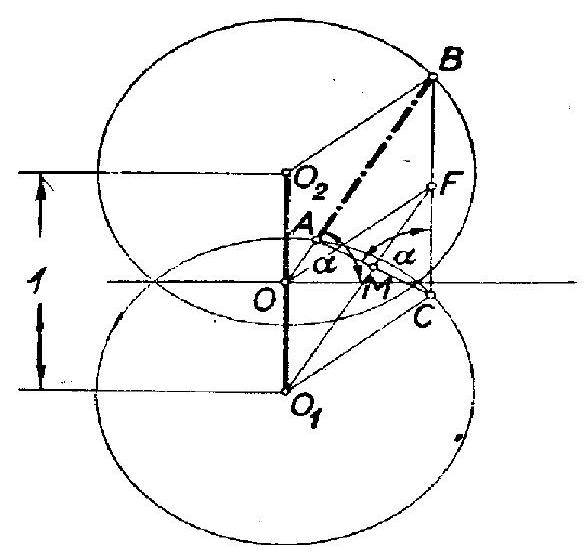
Figure 1
Since $O_{1} C = O_{2} B = r$ and $O_{1} C \para... | AB=\sin\alpha | 32,188 | <think>I. Solution: Connect point $O_{2}$ with $B$ and draw a radius $O_{1} C$ parallel to $O_{2} B$ in the other circle (Figure 1).

Figure 1
Since $O_{1} C = O_{2} B = r$ and $O_{1} C \para... | 1_31 |
Problem 8.4. The distances from a point $P$, lying inside an equilateral triangle, to its vertices are 3, 4, and 5. Find the area of the triangle. | <think>Answer: $9+\frac{25 \sqrt{3}}{4}$.
Solution. Let the vertices of the triangle be denoted by $A, B$, and $C$ such that $PA = 3$, $PB = 4$, and $PC = 5$. Construct point $C_1$ such that $ACC_1$ is an equilateral triangle and mark a point $P_1$ inside it such that $P_1A = 3$, $P_1C = 4$, and $P_1C_1 = 5$ (Fig. 1).... | 9+\frac{25\sqrt{3}}{4} | 16,657 | <think>Answer: $9+\frac{25 \sqrt{3}}{4}$.
Solution. Let the vertices of the triangle be denoted by $A, B$, and $C$ such that $PA = 3$, $PB = 4$, and $PC = 5$. Construct point $C_1$ such that $ACC_1$ is an equilateral triangle and mark a point $P_1$ inside it such that $P_1A = 3$, $P_1C = 4$, and $P_1C_1 = 5$ (Fig. 1).... | 1_32 |
Determine all pairs of natural numbers $(m, r)$ with $2014 \ge m \ge r \ge 1$ that fulfill
$\binom{2014}{m}+\binom{m}{r}=\binom{2014}{r}+\binom{2014-r}{m-r} $ | <think>1. We start with the given equation:
\[
\binom{2014}{m} + \binom{m}{r} = \binom{2014}{r} + \binom{2014-r}{m-r}
\]
2. We know that the binomial coefficient $\binom{n}{k}$ represents the number of ways to choose $k$ elements from a set of $n$ elements. Therefore, the equation can be interpreted combinato... | (i, i) \text{ for } 1 \le i \le 2014, (2014 - j, j) \text{ for } 1 \le j \le 1006, \text{ and } (2014, k) \text{ for } 1 \le k \le 2013 | 69,921 | <think>1. We start with the given equation:
\[
\binom{2014}{m} + \binom{m}{r} = \binom{2014}{r} + \binom{2014-r}{m-r}
\]
2. We know that the binomial coefficient $\binom{n}{k}$ represents the number of ways to choose $k$ elements from a set of $n$ elements. Therefore, the equation can be interpreted combinato... | 1_33 |
3 (Full score: 50 points) Solve the system of equations
$$
\left\{\begin{array}{l}
x-y+z-w=2, \\
x^{2}-y^{2}+z^{2}-w^{2}=6, \\
x^{3}-y^{3}+z^{3}-w^{3}=20, \\
x^{4}-y^{4}+z^{4}-w^{4}=66 .
\end{array}\right.
$$ | <think>Let $p=x+z, q=xz$, we have
$$
\begin{array}{l}
p^{2}=x^{2}+z^{2}+2 q, \\
p^{3}=x^{3}+z^{3}+3 p q, \\
p^{4}=x^{4}+z^{4}+4 p^{2} q-2 q^{2},
\end{array}
$$
Similarly, let $s=y+w, t=yw$, we have
$$
\begin{array}{l}
s^{2}=y^{2}+w^{2}+2 t, \\
s^{3}=y^{3}+w^{3}+3 s t \\
s^{4}=y^{4}+w^{4}+4 s^{2} t-2 t^{2}
\end{array}
... | 3,2,1,w=0;or3,0,1,w=2;or1,2,3,w=0;or1,0,3,w=2 | 87,139 | <think>Let $p=x+z, q=xz$, we have
$$
\begin{array}{l}
p^{2}=x^{2}+z^{2}+2 q, \\
p^{3}=x^{3}+z^{3}+3 p q, \\
p^{4}=x^{4}+z^{4}+4 p^{2} q-2 q^{2},
\end{array}
$$
Similarly, let $s=y+w, t=yw$, we have
$$
\begin{array}{l}
s^{2}=y^{2}+w^{2}+2 t, \\
s^{3}=y^{3}+w^{3}+3 s t \\
s^{4}=y^{4}+w^{4}+4 s^{2} t-2 t^{2}
\end{array}
... | 1_34 |
If the non-negative reals $x,y,z$ satisfy $x^2+y^2+z^2=x+y+z$. Prove that
$$\displaystyle\frac{x+1}{\sqrt{x^5+x+1}}+\frac{y+1}{\sqrt{y^5+y+1}}+\frac{z+1}{\sqrt{z^5+z+1}}\geq 3.$$
When does the equality occur?
[i]Proposed by Dorlir Ahmeti, Albania[/i] | <think>1. Given the condition \( x^2 + y^2 + z^2 = x + y + z \), we need to prove that
\[
\frac{x+1}{\sqrt{x^5 + x + 1}} + \frac{y+1}{\sqrt{y^5 + y + 1}} + \frac{z+1}{\sqrt{z^5 + z + 1}} \geq 3.
\]
2. Notice that \( x^5 + x + 1 = (x^2 + x + 1)(x^3 - x^2 + 1) \). By the AM-GM inequality, we have:
\[
(x+... | 3 | 38,721 | <think>1. Given the condition \( x^2 + y^2 + z^2 = x + y + z \), we need to prove that
\[
\frac{x+1}{\sqrt{x^5 + x + 1}} + \frac{y+1}{\sqrt{y^5 + y + 1}} + \frac{z+1}{\sqrt{z^5 + z + 1}} \geq 3.
\]
2. Notice that \( x^5 + x + 1 = (x^2 + x + 1)(x^3 - x^2 + 1) \). By the AM-GM inequality, we have:
\[
(x+... | 1_35 |
Problem 8.5.1. In the cells of a $12 \times 12$ table, natural numbers are arranged such that the following condition is met: for any number in a non-corner cell, there is an adjacent cell (by side) that contains a smaller number. What is the smallest number of different numbers that can be in the table?
(Non-corner c... | <think>Answer: 11.
Solution. First, let's provide an example with the arrangement of 11 different numbers.
| 1 | 2 | 3 | 4 | 5 | 6 | 6 | 5 | 4 | 3 | 2 | 1 |
| :---: | :---: | :---: | :---: | :---: | :---: | :---: | :---: | :---: | :---: | :---: | :---: |
| 2 | 3 | 4 | 5 | 6 | 7 | 7 | 6 | 5 | 4 | 3 | 2 |
| 3 | 4 | 5 |... | 11 | 29,311 | <think>Answer: 11.
Solution. First, let's provide an example with the arrangement of 11 different numbers.
| 1 | 2 | 3 | 4 | 5 | 6 | 6 | 5 | 4 | 3 | 2 | 1 |
| :---: | :---: | :---: | :---: | :---: | :---: | :---: | :---: | :---: | :---: | :---: | :---: |
| 2 | 3 | 4 | 5 | 6 | 7 | 7 | 6 | 5 | 4 | 3 | 2 |
| 3 | 4 | 5 |... | 1_36 |
(40 points) (1) Find all mappings $f: \mathbf{Z}_{+} \rightarrow \mathbf{Z}_{+}$, satisfying
$$
f(f(x))=9 x, f(f(f(x)))=27 x ;
$$
(2) Find all mappings $f: \mathbf{Z}_{+} \rightarrow \mathbf{Z}_{+}$, satisfying
$$
f(f(x))=9 x .
$$ | <think>(1) For any positive integer $x$,
$9 f(x)=f(f(f(x)))=27 x \Rightarrow f(x)=3 x$.
Thus, the solution is $f(x)=3 x$.
(2) Let the set
$M=\{x \mid x$ is a positive integer not divisible by 9 $\}$.
Take infinite sets $A$ and $B$ such that
$A \cap B=\varnothing, A \cup B=M$.
Take a bijection $u$ from set $A$ to set $B... | f(x)=3x | 44,883 | <think>(1) For any positive integer $x$,
$9 f(x)=f(f(f(x)))=27 x \Rightarrow f(x)=3 x$.
Thus, the solution is $f(x)=3 x$.
(2) Let the set
$M=\{x \mid x$ is a positive integer not divisible by 9 $\}$.
Take infinite sets $A$ and $B$ such that
$A \cap B=\varnothing, A \cup B=M$.
Take a bijection $u$ from set $A$ to set $B... | 1_37 |
6. On the table, there are three cones standing on their bases, touching each other. The radii of their bases are 32, 48, and 48, and the vertex angles are $\frac{\pi}{3}$, $\frac{2 \pi}{3}$, and $\frac{2 \pi}{3}$ respectively (the vertex angle of a cone is the angle between its generators in the axial section). A sphe... | <think>Answer: $13(\sqrt{3}+1)$.
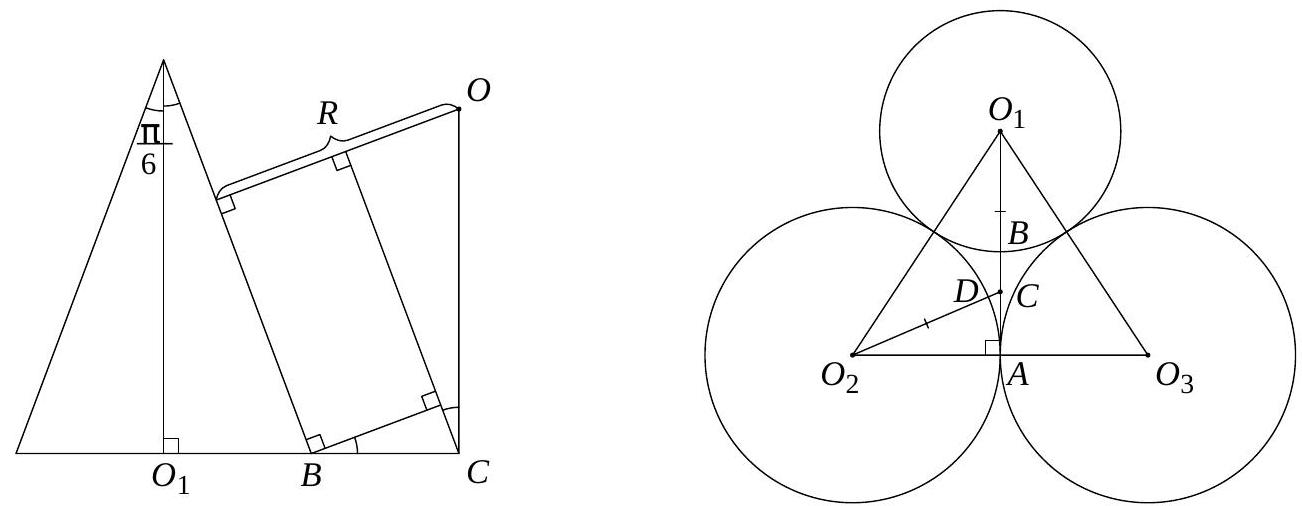
Solution. Let $O_{1}, O_{2}, O_{3}$ be the centers of the bases of the cones, $O$ be the center of the sphere, $C$ be its projection on the table, and $R$ b... | 13(\sqrt{3}+1) | 18,558 | <think>Answer: $13(\sqrt{3}+1)$.

Solution. Let $O_{1}, O_{2}, O_{3}$ be the centers of the bases of the cones, $O$ be the center of the sphere, $C$ be its projection on the table, and $R$ b... | 1_38 |
Let $ABC$ be an isosceles triangle with $AB=AC$ and incentre $I$. If $AI=3$ and the distance from $I$ to $BC$ is $2$, what is the square of length on $BC$? | <think>1. Given an isosceles triangle \(ABC\) with \(AB = AC\) and incentre \(I\). We know \(AI = 3\) and the distance from \(I\) to \(BC\) is \(2\). We need to find the square of the length of \(BC\).
2. The area of the triangle can be calculated using the formula for the area in terms of the inradius \(r\) and the s... | 80 | 34,565 | <think>1. Given an isosceles triangle \(ABC\) with \(AB = AC\) and incentre \(I\). We know \(AI = 3\) and the distance from \(I\) to \(BC\) is \(2\). We need to find the square of the length of \(BC\).
2. The area of the triangle can be calculated using the formula for the area in terms of the inradius \(r\) and the s... | 1_39 |
## Zadatak A-2.4.
Točka $P$ je polovište dužine $\overline{A B}$ duljine 2 . Neka je $T$ diralište tangente iz točke $A$ na kružnicu promjera $\overline{P B}$. Odredi duljinu $|P T|$.
| <think>## Prvo rješenje.
Neka je $O$ polovište dužine $\overline{P B}$. Iz uvjeta zadatka je jasno da je $|A P|=|B P|=1$.
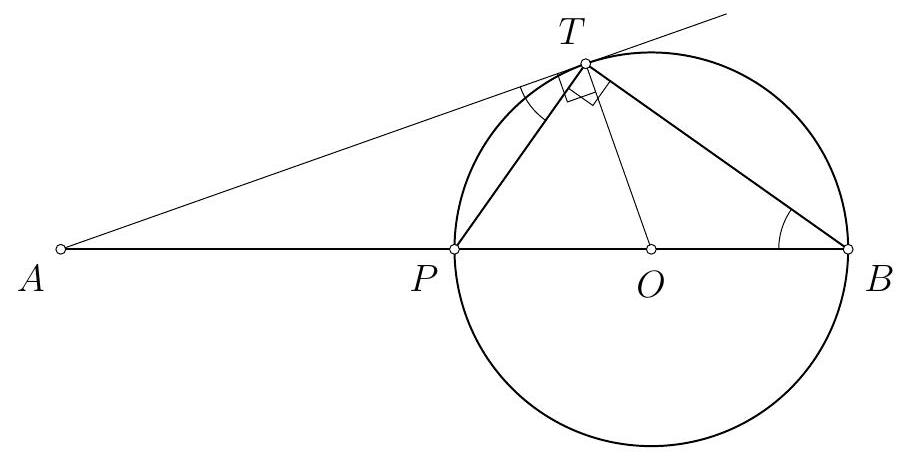
Budući da je $A T$ tangenta, vrijedi da je $\varangle A T P=\varang... | \frac{1}{\sqrt{3}} | 57,474 | <think>## Prvo rješenje.
Neka je $O$ polovište dužine $\overline{P B}$. Iz uvjeta zadatka je jasno da je $|A P|=|B P|=1$.

Budući da je $A T$ tangenta, vrijedi da je $\varangle A T P=\varang... | 1_40 |
Problem 4. Each cell of a $3 \times 3$ table is painted in one of three colors such that cells sharing a side have different colors. Among all possible such colorings, find the proportion of those in which exactly two colors are used. | <think>Answer: $1 / 41$.
Solution. The central cell can be painted in any of the three colors, let's call this color $a$. Each of the four cells that share a side with the central one can be painted in any of the two remaining colors. Let the cell above the central one be painted in color $b$. The third color we will ... | \frac{1}{41} | 79,756 | <think>Answer: $1 / 41$.
Solution. The central cell can be painted in any of the three colors, let's call this color $a$. Each of the four cells that share a side with the central one can be painted in any of the two remaining colors. Let the cell above the central one be painted in color $b$. The third color we will ... | 1_41 |
Find all $k>0$ such that there exists a function $f : [0,1]\times[0,1] \to [0,1]$ satisfying the following conditions:
$f(f(x,y),z)=f(x,f(y,z))$;
$f(x,y) = f(y,x)$;
$f(x,1)=x$;
$f(zx,zy) = z^{k}f(x,y)$, for any $x,y,z \in [0,1]$ | <think>1. **Given Conditions:**
- \( f(f(x,y),z) = f(x,f(y,z)) \)
- \( f(x,y) = f(y,x) \)
- \( f(x,1) = x \)
- \( f(zx,zy) = z^k f(x,y) \) for any \( x, y, z \in [0,1] \)
2. **Analyzing the conditions:**
- From \( f(x,1) = x \), we know that \( f(1,1) = 1 \).
- Let \( P(x,y) \) denote the assertion \... | k = 1, 2 | 62,868 | <think>1. **Given Conditions:**
- \( f(f(x,y),z) = f(x,f(y,z)) \)
- \( f(x,y) = f(y,x) \)
- \( f(x,1) = x \)
- \( f(zx,zy) = z^k f(x,y) \) for any \( x, y, z \in [0,1] \)
2. **Analyzing the conditions:**
- From \( f(x,1) = x \), we know that \( f(1,1) = 1 \).
- Let \( P(x,y) \) denote the assertion \... | 1_42 |
4. Solve the system $\left\{\begin{array}{l}3 x \geq 2 y+16 \\ x^{4}+2 x^{2} y^{2}+y^{4}+25-26 x^{2}-26 y^{2}=72 x y .\end{array}\right.$ | <think>Answer. $(6 ; 1)$.
Solution. Transform the equation of the system (add $36 x^{2}+36 y^{2}$ to both sides):
$$
\begin{gathered}
\left(x^{2}+y^{2}\right)^{2}+25+10 x^{2}+10 y^{2}=36 x^{2}+36 y^{2}+72 x y \Leftrightarrow\left(x^{2}+y^{2}+5\right)^{2}=(6 x+6 y)^{2} \Leftrightarrow \\
\Leftrightarrow\left[\begin{ar... | (6;1) | 78,183 | <think>Answer. $(6 ; 1)$.
Solution. Transform the equation of the system (add $36 x^{2}+36 y^{2}$ to both sides):
$$
\begin{gathered}
\left(x^{2}+y^{2}\right)^{2}+25+10 x^{2}+10 y^{2}=36 x^{2}+36 y^{2}+72 x y \Leftrightarrow\left(x^{2}+y^{2}+5\right)^{2}=(6 x+6 y)^{2} \Leftrightarrow \\
\Leftrightarrow\left[\begin{ar... | 1_43 |
End of preview. Expand in Data Studio
README.md exists but content is empty.
- Downloads last month
- 33