

question stringlengths 12 1.6k | answer stringlengths 0 2.23k | openr1_source stringclasses 8
values | id stringlengths 3 36 ⌀ | dataset stringclasses 2
values | choices sequencelengths 1 1 |
|---|---|---|---|---|---|
The sum of the first $n$ terms of an arithmetic sequence $\{a_n\}$ is $S_n$. Given that $a_5=8$ and $S_3=6$, the value of $S_{10}-S_{7}$ is ( ).
A: $24$
B: $48$
C: $60$
D: $72$ | Let the first term of the arithmetic sequence be $a_1$, and the common difference be $d$.
Since $a_5=8$ and $S_3=6$,
we have $\begin{cases} a_1+4d=8 \\ a_1+a_1+d+a_1+2d=6 \end{cases}$
Thus, $\begin{cases} a_1=0 \\ d=2 \end{cases}$
Therefore, $S_{10}-S_{7}=a_8+a_9+a_{10}=3a_1+24d=48$
Hence, the correct answer ... | cn_k12 | b6f9fe90-0d21-5ec1-93cd-a99f91e2ab0d | open-r1/OpenR1-Math-220k | [
""
] |
Given the coordinates of the foci are (0, -4) and (0, 4), and the ellipse passes through the point (0, -6), the equation of the ellipse is ( )
A: $$\frac {x^{2}}{36} + \frac {y^{2}}{20} = 1$$
B: $$\frac {x^{2}}{20} + \frac {y^{2}}{36} = 1$$
C: $$\frac {x^{2}}{36} + \frac {y^{2}}{16} = 1$$
D: $$\frac {x^{2}}{16... | Given the coordinates of the foci are (0, -4) and (0, 4), and it passes through the point (0, -6),
we can determine that in the ellipse, $c=4$ and $a=6$. Therefore, $b= \sqrt {a^{2}-c^{2}} = \sqrt {20}$,
The equation of the sought ellipse is: $$\frac {x^{2}}{20} + \frac {y^{2}}{36} = 1.$$
Hence, the correct optio... | cn_k12 | 48236b60-8416-5293-a9a0-d5f8d51b1042 | open-r1/OpenR1-Math-220k | [
""
] |
Let $[t]$ denote the greatest integer $\leq t$ where $t \geq 0$ and $S = \{(x,y): (x-T)^2 + y^2 \leq T^2 \text{ where } T = t - [t]\}$. Then we have
$\textbf{(A)}\ \text{the point } (0,0) \text{ does not belong to } S \text{ for any } t \qquad$
$\textbf{(B)}\ 0 \leq \text{Area } S \leq \pi \text{ for all } t \qquad$
$... | The region $S$ is a circle radius $T$ and center $(T,0)$. Since $T = t-[t]$, $0 \le T < 1$. That means the area of the circle is less than $\pi$, and since the region can also be just a dot (achieved when $t$ is integer), the answer is $\boxed{\textbf{(B)}}$. | amc_aime | 5a38f8d7-78c5-5db0-8e22-2c2131716eee | open-r1/OpenR1-Math-220k | [
""
] |
4. [4] Let $P$ be a fourth degree polynomial, with derivative $P^{\prime}$, such that $P(1)=P(3)=P(5)=P^{\prime}(7)=0$. Find the real number $x \neq 1,3,5$ such that $P(x)=0$. | Answer: $\frac{89}{11}$
Solution: Observe that 7 is not a root of $P$. If $r_{1}, r_{2}, r_{3}, r_{4}$ are the roots of $P$, then $\frac{P^{\prime}(7)}{P(7)}=$ $\sum_{i} \frac{1}{7-r_{i}}=0$. Thus $r_{4}=7-\left(\sum_{i \neq 4} \frac{1}{7-r_{i}}\right)^{-1}=7+\left(\frac{1}{6}+\frac{1}{4}+\frac{1}{2}\right)^{-1}=7+12 /... | olympiads | d8f7efab-681f-5715-88b0-8f2e50d2a83d | open-r1/OpenR1-Math-220k | [
""
] |
1. On an island, there live only knights, who always tell the truth, and liars, who always lie. One fine day, 30 islanders sat around a round table. Each of them can see everyone except themselves and their neighbors. Each person in turn said the phrase: "All I see are liars." How many liars were sitting at the table? | Answer: 28.
Solution. Not all of those sitting at the table are liars (otherwise they would all be telling the truth). Therefore, there is at least one knight sitting at the table. Everyone he sees is a liar. Let's determine who his neighbors are. Both of them cannot be liars (otherwise they would be telling the truth... | olympiads | 3690589f-702a-5179-917a-43096704926a | open-r1/OpenR1-Math-220k | [
""
] |
A Baranya IC overtakes a freight train traveling on a parallel track, then they pass each other in the opposite direction. The ratio of the IC's speed to the freight train's speed is the same as the ratio of the time it takes to overtake to the time it takes to pass each other. How many times faster is the IC than the ... | Solution. Let the speed of the IC be $u \mathrm{~km} / \mathrm{h}$ and the speed of the freight train be $v \mathrm{~km} / \mathrm{h}$. Let the length of the IC be $x \mathrm{~km}$, and the length of the freight train be $y \mathrm{~km}$. When the IC overtakes the freight train, in the reference frame fixed to the frei... | olympiads | 69b0433d-a289-5b55-a2e9-1fd8b0a6e8ed | open-r1/OpenR1-Math-220k | [
""
] |
The slope of the tangent line to the function $f(x)=x^{3}-x^{2}+x+1$ at the point $(1,2)$ is ( ).
A: $\dfrac {1}{2}$
B: $1$
C: $2$
D: $3$ | According to the problem, we have $y'=3x^{2}-2x+1$.
Therefore, the slope of the tangent line to $f(x)=x^{3}-x^{2}+x+1$ at the point $(1,2)$ is equal to $2$.
Hence, the correct choice is $\boxed{C}$.
To find the slope of the tangent line, we only need to first use the derivative to find the value of the derivative fu... | cn_k12 | f796507d-f1d3-55f5-91b7-c57fe39be619 | open-r1/OpenR1-Math-220k | [
""
] |
Calculate in terms of $n$ the following sum:
$$
\sum_{k \equiv 1[4]}\binom{n}{k}
$$ | Fix $n>0$, we define the 4 sums as follows:
$$
S_{i}=\sum_{k \equiv i[4]}\binom{n}{k} \quad i \in\{0,1,2,3\}
$$
Now we will use the formula $(1+x)^{n}=\sum\binom{n}{k} x^{k}$ with $x=1,-1$ and $i$.
$$
\begin{aligned}
S_{0}+S_{1}+S_{2}+S_{3} & =2^{n} \\
S_{0}-S_{1}+S_{2}-S_{3} & =0 \\
S_{0}-S_{2} & =\operatorname{Re}... | olympiads | bc372075-d61f-5de3-b1c1-4c3ef2f517a9 | open-r1/OpenR1-Math-220k | [
""
] |
A swimming pool contains 300 m3 of water. Now, the drain is opened to drain water at a rate of 25 m3 per hour.
(1) Write the function relationship between the remaining water volume $Q$ (in m3) and the drainage time $t$ (in hours), and the range of values for the independent variable;
(2) How many hours does it tak... | **Answer:**
(1) The relationship between the remaining water volume and the original water volume minus the drained volume can be expressed as:
$Q = 300 - 25t$;
(2) When $Q = 150$ m3,
$150 = 300 - 25t$,
Solving for $t$ gives $t = 6$.
Answer: It takes $\boxed{6}$ hours of drainage for the pool to have 150 m... | cn_k12 | b93306c8-99d7-5913-bda5-dd7dadac15ab | open-r1/OpenR1-Math-220k | [
""
] |
4A. Determine the angles in a triangle where the height and the median drawn from the same vertex divide the angle at that vertex into three equal parts. | Solution. Let $ABC$ be a triangle such that the altitude $CH$ and the median $CT$ divide the angle at vertex $C$ into three equal parts. $\triangle AHC \cong \triangle CHT$ because $CH$ is common, $\measuredangle AHC=\measuredangle CHT=90^{\circ}$, and from the condition of the problem, $\measuredangle ACH=$ $\measured... | olympiads | 2f0f66d3-ffbc-5d8a-9045-27b49b43d4ff | open-r1/OpenR1-Math-220k | [
""
] |
Example 2. Study the maximum and minimum values of the function $\mathrm{y}=\frac{1}{\mathrm{x}(1-\mathrm{x})}$ on $(0,1)$.
| Given $x \in (0,1)$, therefore $x>0, 1-x>0$.
When $x \rightarrow +0$, $1-x \rightarrow 1, x(1-x) \rightarrow +0$,
When $x \rightarrow 1-0$, $1-x \rightarrow +0, x(1-x) \rightarrow +0$,
Therefore, $y(+0)=y(1-0)=+\infty$. From (v),
it is known that $y$ has only a minimum value on $(0,1)$. Also, $y' = \frac{2x-1}{x^2(1-x... | cn_contest | 91b265ae-23ce-5407-a93f-0270fad212ec | open-r1/OpenR1-Math-220k | [
""
] |
There are 285 sweets in the bowl. If 49 of the sweets are red and 59 of the sweets are green, how many of the sweets are neither red nor green? | There are 49 + 59 = <<49+59=108>>108 red or green sweets in the bowl
There are 285 - 108 = <<285-108=177>>177 sweets that are neither red nor green
#### 177 | null | null | openai/gsm8k | [
""
] |
1. Solve the equation $3 \cdot 9^{x}+2 \cdot 3^{x}=1$. | Solution: $3 \cdot 9^{x}+2 \cdot 3^{x}=1,3 \cdot\left(3^{x}\right)^{2}+2 \cdot 3^{x}-1=0,3^{x}=\frac{-2 \pm \sqrt{4+12}}{6}=\left[\begin{array}{l}\frac{1}{3}, \\ -1-\text { not valid }\end{array} \quad x=-1\right.$.
Answer: $x=-1$ | olympiads | 08d4138d-7f5d-5b45-a884-c7a36853096c | open-r1/OpenR1-Math-220k | [
""
] |
In the arithmetic sequence $\{a_n\}$, $S_n$ represents the sum of the first $n$ terms of the sequence $\{a_n\}$, and it is given that $S_9 = a_4 + a_5 + a_6 + 66$. Find the value of $a_2 + a_8$. | Given that $S_9 = a_4 + a_5 + a_6 + 66$,
we have $S_9 = \frac{9(a_1 + a_9)}{2} = 9a_5$,
thus $9a_5 = 3a_5 + 66$,
solving this gives $a_5 = 11$.
Therefore, $a_2 + a_8 = 2a_5 = 22$.
Hence, the answer is $\boxed{22}$.
This problem can be solved by using the general term formula and sum formula of an arithmetic... | cn_k12 | af6a0a1c-ba57-541f-9124-4f7fc4458216 | open-r1/OpenR1-Math-220k | [
""
] |
1. The range of the function $y=\sin x\left(\frac{\pi}{6} \leqslant x \leqslant \frac{2 \pi}{3}\right)$ is | 1. $\left[\frac{1}{2}, 1\right]$. According to the graph of $y=\sin x$, the range can be obtained as $\left[\frac{1}{2}, 1\right]$. | olympiads | 1634a0cc-ebad-5e0d-a9c3-079bcf0c092b | open-r1/OpenR1-Math-220k | [
""
] |
Given the sets $A=\{x\mid -2\leq x\leq 5\}$ and $B=\{x\mid m+1\leq x\leq 2m-1\}$, if $B \subseteq A$, determine the range of real numbers $m$. | To find the range for the real number $m$, we need to identify the conditions under which the set $B$ is a subset of $A$. We consider two cases: when $B$ is empty, and when $B$ is not empty.
Case 1: If $B = \emptyset$, then $m+1$ must be greater than $2m-1$. Simplifying this inequality, we have:
$$m+1 > 2m-1,$$
which ... | cn_k12 | 6429f538-0da9-5b4e-af58-d7c94c0742e6 | open-r1/OpenR1-Math-220k | [
""
] |
A clock has an hour, minute, and second hand, all of length $1$. Let $T$ be the triangle formed by the ends of these hands. A time of day is chosen uniformly at random. What is the expected value of the area of $T$?
[i]Proposed by Dylan Toh[/i] | 1. **Understanding the Problem:**
We need to find the expected value of the area of the triangle $T$ formed by the ends of the hour, minute, and second hands of a clock. Each hand has a length of $1$.
2. **Reformulating the Problem:**
The problem can be reformulated as finding the expected area of a triangle who... | aops_forum | e4fa5035-2295-5dea-b8bc-296fe70c2a7a | open-r1/OpenR1-Math-220k | [
""
] |
Example 3 In the Cartesian coordinate system $x O y$, given two points $M(-1,2)$ and $N(1,4)$, point $P$ moves on the $x$-axis. When $\angle M P N$ takes the maximum value, find the x-coordinate of point $P$.
(2004 National High School Mathematics Competition Problem) | Solution 1: Let $P\left(x_{0}, 0\right)$, and let $\theta$ be the angle from line $N P$ to line $M P$,
then when $x_{0} \neq \pm 1$, $k_{P \mathrm{M}}=\frac{2}{-1-x_{0}}, k_{P \mathrm{~V}}=\frac{4}{1-x_{0}}$,
Thus,
$$
\tan \theta=\frac{\frac{2}{-1-x_{0}}-\frac{4}{1-x_{0}}}{1+\frac{8}{x_{0}^{2}-1}}=\frac{2 x_{0}+6}{x_{... | olympiads | 455f1d83-08e3-5255-8d79-4fd8287432fb | open-r1/OpenR1-Math-220k | [
""
] |
The central angles of the white and red sectors on a spinner are $120^{\circ}$ and $240^{\circ}$, respectively. If the spinner is spun freely twice, the probability of landing on the white sector once and the red sector once is ______. | To solve this problem, we first need to understand the probabilities of landing on each sector for a single spin. The spinner has two sectors: white and red, with central angles of $120^{\circ}$ and $240^{\circ}$, respectively.
1. The probability of landing on the white sector in one spin is calculated by dividing th... | cn_k12 | 94657766-6210-50e6-b64e-5fb4d2b4d033 | open-r1/OpenR1-Math-220k | [
""
] |
The domain of the function $y= \sqrt {1-x}+ \frac {1}{x+1}$ is $(\quad \quad)$.
A: $(-∞,-1)∪(1,+∞)$
B: $(-1,1)$
C: $(-∞,-1)∪(-1,1]$
D: $(-∞,-1)∪(-1,1)$ | The function $y= \sqrt {1-x}+ \frac {1}{x+1}$ is meaningful only if $1-x \geqslant 0$ and $x+1 \neq 0$.
Solving these inequalities gives us $x \leqslant 1$ and $x \neq -1$.
Therefore, the correct answer is option C: $(-∞,-1)∪(-1,1]$.
To find the domain of the function, we need to solve the inequalities that make the f... | cn_k12 | b1871554-859a-5983-be27-417d73b3e173 | open-r1/OpenR1-Math-220k | [
""
] |
Given an ellipse $\frac{x^{2}}{49}+ \frac{y^{2}}{24}=1$ with a point $P$ on it such that the lines connecting $P$ to the ellipse's two foci $F\_1$ and $F\_2$ are perpendicular to each other.
(1) Calculate the eccentricity of the ellipse;
(2) Calculate the area of the triangle $PF\_1F\_2$. | (1) From the given equation, we have $a^2=49$ and $b^2=24$, which implies $a=7$ and $b=2\sqrt{6}$. The distance $c$ between the foci can be determined using the relation $c^2 = a^2 - b^2 = 49 - 24 = 25$, so $c=5$. Thus, the eccentricity of the ellipse is $e = \frac{c}{a} = \boxed{\frac{5}{7}}$.
(2) From the definition... | cn_k12 | 48f4bcda-184a-50b1-b4b0-8cc5d2361014 | open-r1/OpenR1-Math-220k | [
""
] |
Task 9. Find the largest negative root $x_{0}$ of the equation $\frac{\sin x}{1+\cos x}=2-\operatorname{ctg} x$. In the answer, write $x_{0} \cdot \frac{3}{\pi}$. | Answer: $-3.5$
Problem 10. A group of 30 people collected cranberries in the forest. Each of them collected 2, 3, 4, or 5 buckets of cranberries, totaling 93 buckets. Moreover, the number of people who collected 3 buckets was more than those who collected 5 buckets and less than those who collected 4 buckets. Addition... | olympiads | 04b532f3-326d-5255-bb31-ee0bca8626dc | open-r1/OpenR1-Math-220k | [
""
] |
G7.1 If the two distinct roots of the equation $a x^{2}-m x+1996=0$ are primes, find the value of $a$. | Let the roots be $\alpha, \beta \cdot \alpha+\beta=\frac{m}{a}, \alpha \beta=\frac{1996}{a}$ $1996=4 \times 499$ and 499 is a prime
$$
\therefore a=1,2,4,499,998 \text { or } 1996
$$
When $a=1, \alpha \beta=1996$, which cannot be expressed as a product of two primes $\therefore$ rejected
When $a=2, \alpha \beta=998 ; ... | olympiads | 2a9a8cb2-33f5-500b-a81b-c2a6bc4e989f | open-r1/OpenR1-Math-220k | [
""
] |
A1. The function is given by $f(x)=-2(x+3)^{2}+2$. Which statement is correct?
(A) The function is decreasing everywhere.
(B) The vertex is at the point $T(3,2)$.
(C) The function has no real zeros.
(D) The graph is a parabola that is symmetric with respect to the line $x=-3$.
(E) None of the given statements is c... | A1. From the function's record, we see that its graph is a parabola with the vertex $T(-3,2)$ and is symmetric with respect to the line $x=-3$. | olympiads | a5a1fbe4-5fe6-54ad-81af-d207cd112cf7 | open-r1/OpenR1-Math-220k | [
""
] |
The derivative of the function $y=\sin x \cdot \cos x$ is ( )
A: $\cos x \cdot \sin x$
B: $\cos^2x+\sin^2x$
C: $2\cos x \cdot \sin x$
D: $\cos^2x-\sin^2x$ | **Analysis**
This question tests the rules of differentiation and the basic formulas of derivatives, and it is a basic question.
The solution can be found by applying the rules of differentiation and the basic formulas of derivatives.
Solution: $y'=\cos^2x-\sin^2x$,
Therefore, the correct answer is $\boxed{D}$. | cn_k12 | 7ec91864-5c27-58af-beb4-fa10577f5d77 | open-r1/OpenR1-Math-220k | [
""
] |
Compute: $$\frac {5}{ \sqrt {2}}$$ - $$\sqrt { \frac {1}{2}}$$ = _______ . | Solution: The original expression equals $$\frac {5 \sqrt {2}}{2}$$ - $$\frac { \sqrt {2}}{2}$$
= 2 $$\sqrt {2}$$ .
Hence, the answer is $\boxed{2 \sqrt {2}}$ .
First, simplify each radical to its simplest form, then combine them.
This problem tests the mixed operations of radicals: first, simplify each radical to ... | cn_k12 | b88c23d4-9663-52d3-b802-4a9102973e7e | open-r1/OpenR1-Math-220k | [
""
] |
11. Which of the following statements is false?
A 12 is a multiple of 2
B 123 is a multiple of 3
C 1234 is a multiple of 4
D 12345 is a multiple of 5
E 123456 is a multiple of 6 | 11. C A number is divisible by 4 if and only if its last two digits are divisible by 4 . Since 34 is not divisible by 4 , we deduce that 1234 is not a multiple of 4 . Of the other options, 12 is even and so is a multiple of 2; the sum of the digits of 123 is 6 , which is a multiple of 3 , so 123 is a multiple of $3 ; 1... | olympiads | 7e28e7eb-0ff8-51a6-808d-c4f665dc146e | open-r1/OpenR1-Math-220k | [
""
] |
Given $\cos \left(\frac{\pi }{4}+x\right)=\frac{3}{5}$, $\frac{17}{12}\pi < x < \frac{7}{4}\pi $, the value of $\frac{\sin 2x+2\sin^2 x}{1-\tan x}$ is __________. | **Analysis**
This problem tests the simplification and evaluation of trigonometric functions. The key to solving the problem is to first use the trigonometric formulas to find $\cos x$, and then to find $\sin x$ and $\tan x$, from which the answer can be calculated.
**Solution**
Given $\frac{17}{12}\pi < x < \frac{7... | cn_k12 | b75f3ba0-7b6f-5f41-af18-1e1ae6f8cb69 | open-r1/OpenR1-Math-220k | [
""
] |
Given that $a$, $b$, $c$ are the sides opposite to angles $A$, $B$, $C$ respectively in $\triangle ABC$, with $a=2$ and $(2+b)(\sin A-\sin B)=(c-b)\sin C$
(1) Find the measure of angle $A$;
(2) Find the maximum area of $\triangle ABC$. | (1) In $\triangle ABC$, we have $a=2$ and $(2+b)(\sin A-\sin B)=(c-b)\sin C$.
By using the Law of Sines, we get $(2+b)(a-b)=(c-b)c$, which simplifies to $b^{2}+c^{2}-bc=4$, or $b^{2}+c^{2}-4=bc$.
Thus, $\cos A= \frac{b^{2}+c^{2}-a^{2}}{2bc}= \frac{bc}{2bc}= \frac{1}{2}$, and so $A= \frac{\pi}{3}$.
(2) From $b^{2}+c^{2... | cn_k12 | 016587ee-21e4-539e-95dc-79fa0efc9f75 | open-r1/OpenR1-Math-220k | [
""
] |
3. As shown in Figure 1, given a cube $A B C D$ $A_{1} B_{1} C_{1} D_{1}$, draw a line $l$ through vertex $A_{1}$ in space such that $l$ forms an angle of $60^{\circ}$ with both lines $A C$ and $B C_{1}$. How many such lines $l$ can be drawn?
(A) 4
(B) 3
(C) 2
(D) 1 | 3. (B).
It is easy to know that the angle formed by the skew lines $A C$ and $B C_{1}$ is $60^{\circ}$, so this problem is equivalent to:
Given that the angle formed by the skew lines $a$ and $b$ is $60^{\circ}$, how many lines pass through a fixed point $P$ in space and form an angle of $60^{\circ}$ with both $a$ an... | cn_contest | 7e4f31a2-6842-548a-bc32-a91262fe46aa | open-r1/OpenR1-Math-220k | [
""
] |
## 81. Math Puzzle $2 / 72$
On a wooden roll with a diameter of $10 \mathrm{~cm}$, a long paper strip is tightly wound and together with the wooden roll forms a cylinder with a diameter of $30 \mathrm{~cm}$.
How long is the wound paper strip approximately, if the paper is $0.1 \mathrm{~mm}$ thick, no air gap was left... | The wrapped paper represents a hollow cylinder with a wall thickness of $10 \mathrm{~cm}$; thus, $\frac{100}{0.1}=1000$ layers are wound up.
The layers have an average length of $r_{\text {Middle }} \cdot 2 \pi=\frac{5+15}{2} \cdot 2 \pi=20 \pi \mathrm{cm}$.
The total wound length is $L=1000 \cdot 20 \pi \approx 628 ... | olympiads | 3c16ac9d-9cda-510b-970c-ae4f16d16665 | open-r1/OpenR1-Math-220k | [
""
] |
5. Let $\alpha \in\left(0, \frac{\pi}{2}\right)$, then the minimum value of $\frac{\sin ^{3} \alpha}{\cos \alpha}+\frac{\cos ^{3} \alpha}{\sin \alpha}$ is | 5. 1 .
Let $t=\sin \alpha \cos \alpha$, then $t=\frac{1}{2} \sin 2 \alpha \in\left(0, \frac{1}{2}\right]$, so
$$
\frac{\sin ^{3} \alpha}{\cos \alpha}+\frac{\cos ^{3} \alpha}{\sin \alpha}=\frac{\sin ^{4} \alpha+\cos ^{4} \alpha}{\sin \alpha \cos \alpha}=\frac{1-2(\sin \alpha \cos \alpha)^{2}}{\sin \alpha \cos \alpha}=\... | olympiads | ca770515-c2ba-5fb2-943b-0f2593641b9f | open-r1/OpenR1-Math-220k | [
""
] |
If $a > 0, a \neq 1$, then the graph of the function $y = a^{x-1} + 2$ must pass through the point $\_\_\_\_\_\_\_\_\_.$ | This problem tests our understanding of the properties and graph of an exponential function. Since $a^0 = 1$, we can set $x - 1 = 0$ to find the value of $x$, and then find the corresponding value of $y$.
Steps:
1. Given that $a^0 = 1$, we set $x - 1 = 0$.
2. Solving for $x$ yields $x = 1$.
3. Substitute $x = 1$ into ... | cn_k12 | 8243a6ad-1371-5d82-8850-efe95655b914 | open-r1/OpenR1-Math-220k | [
""
] |
11. Given that the internal angles $A, B, C$ of $\triangle ABC$ have opposite sides $a, b, c$ respectively, and $\sqrt{3} b \cos \frac{A+B}{2}=c \sin B$.
(1) Find the size of $\angle C$;
(2) If $a+b=\sqrt{3} c$, find $\sin A$. | (1) $\sqrt{3} \sin B \cos \frac{A+B}{2}=\sin C \sin B \Rightarrow \sqrt{3} \sin \frac{C}{2}=\sin C \Rightarrow \cos \frac{C}{2}=\frac{\sqrt{3}}{2}$,
so $\frac{C}{2}=30^{\circ} \Rightarrow C=60^{\circ}$.
$$
\begin{array}{l}
\text { (2) } \sin A+\sin B=\sqrt{3} \sin C=\frac{3}{2} \Rightarrow \sin A+\sin \left(120^{\circ... | olympiads | 84f224e8-719b-5b42-a410-27816014bdd3 | open-r1/OpenR1-Math-220k | [
""
] |
Let the function $f(x)=|x+a+1|+|x-\frac{4}{a}|$, where $(a > 0)$.
(Ⅰ) Prove that $f(x) \geqslant 5$;
(Ⅱ) If $f(1) < 6$ holds, find the range of the real number $a$. | Solution:
(Ⅰ) To prove: $f(x)=|x+a+1|+|x- \frac{4}{a}|\geqslant |\left(x+a+1\right)-\left(x- \frac{4}{a}\right)|=|a+1+ \frac{4}{a}|$.
Since $a > 0$, we have $|a+1+ \frac{4}{a}|=a+ \frac{4}{a}+1\geqslant 2 \sqrt{a\cdot \frac{4}{a}}+1=5$,
Equality holds if and only if $a=2$,
Therefore, $f(x) \geqslant 5$ holds;
(Ⅱ... | cn_k12 | d556b5ba-313b-5159-b6b7-7f85d7d03faa | open-r1/OpenR1-Math-220k | [
""
] |
Given that the function $f(x)= \frac {-2^{x}+a}{2^{x}+1}$ defined on the domain $\mathbb{R}$ is an odd function.
(1) Find the value of $a$;
(2) Determine and prove the monotonicity of the function on the domain $\mathbb{R}$;
(3) If the inequality $f(t^{2}-2t)+f(2t^{2}-k) < 0$ holds for any $t∈\mathbb{R}$, find the r... | (1) From the problem, we have $f(0)= \frac {-1+a}{2}=0$.
Hence, $a=1$, and $f(x)= \frac {1-2^{x}}{1+2^{x}}$.
Upon verification, $f(x)$ is indeed an odd function, so $a=1$.
(2) The function $f(x)$ is decreasing on the domain $\mathbb{R}$.
Proof: For any $x_1, x_2 \in \mathbb{R}$ such that $x_1 0$.
Then, $f(x_2)-f(... | cn_k12 | 400aee68-5ecb-5d0a-a0bc-f977e9b5a6b2 | open-r1/OpenR1-Math-220k | [
""
] |
5. Given the function
$$
y=a^{x+3}-2(a>0, a \neq 1)
$$
the graph always passes through a fixed point $A$. If point $A$ lies on the line
$$
\frac{x}{m}+\frac{y}{n}+1=0(m, n>0)
$$
then the minimum value of $3 m+n$ is | 5. 16 .
Note that the function
$$
y=a^{x+3}-2(a>0, a \neq 1)
$$
always passes through the fixed point $(-3,-1)$.
So point $A(-3,-1)$.
Then $-\frac{3}{m}-\frac{1}{n}+1=0 \Rightarrow 1=\frac{3}{m}+\frac{1}{n}$.
Thus, $3 m+n=(3 m+n)\left(\frac{3}{m}+\frac{1}{n}\right)$
$$
=10+\frac{3 n}{m}+\frac{3 m}{n} \geqslant 16 \te... | cn_contest | 569a8047-faa3-5e3f-858e-34e93b9ab96f | open-r1/OpenR1-Math-220k | [
""
] |
2. Let positive integers $m, n$ satisfy
$$
m(n-m)=-11 n+8 \text {. }
$$
Then the sum of all possible values of $m-n$ is $\qquad$ | 2. 18 .
From the problem, we have
$$
n=\frac{m^{2}+8}{m+11}=m-11+\frac{129}{m+11} \in \mathbf{Z}_{+} \text {. }
$$
Then $(m+11) \mid 129$
$$
\Rightarrow m+11=1,3,43,129 \text {. }
$$
Also, $m \in \mathbf{Z}_{+}$, checking we find that when $m=32,118$, the corresponding $n$ is a positive integer.
$$
\text { Hence }(m... | cn_contest | 4f264020-26ef-5938-979d-51c3110cfa1a | open-r1/OpenR1-Math-220k | [
""
] |
For a circle defined by the equation $x^{2} + y^{2} + 2x - 4y + 1 = 0$, find the range of values for $ab$ if the circle is symmetric with respect to the line $2ax - by - 2 = 0$ (where $a, b \in \mathbb{R}$). | Since the circle $x^{2} + y^{2} + 2x - 4y + 1 = 0$ is symmetric with respect to the line $2ax - by - 2 = 0$, the line must pass through the center of the circle, which is $(-1,2)$.
Therefore, the line equation $2ax - by - 2 = 0$ should be satisfied by substituting the coordinates of the center:
$$
2a(-1) - b(2) - 2 = ... | cn_k12 | 8a317c5f-e93d-5b6a-aee5-c119457c55d7 | open-r1/OpenR1-Math-220k | [
""
] |
Which of the following calculations is correct?
A: $x^{5}+x^{3}=x^{8}$
B: $x^{5}-x^{3}=x^{2}$
C: $x^{5}\cdot x^{3}=x^{8}$
D: $(-3x)^{3}=-9x^{3}$ | Let's analyze each option step by step:
**Option A: $x^{5}+x^{3}=x^{8}$**
- We know that when adding or subtracting polynomials, we can only combine like terms. Since $x^{5}$ and $x^{3}$ are not like terms, they cannot be simply added to result in $x^{8}$. Therefore, option A is incorrect.
**Option B: $x^{5}-x^{3}=x... | cn_k12 | f82a146c-6a62-5227-9bf3-6caf7f0ee6d3 | open-r1/OpenR1-Math-220k | [
""
] |
Given the set $I = \{x \mid 1 < x < 5, x \in \mathbb{N}\}$ and set $A = \{2, 3\}$, calculate $C_{I} \setminus A$. | First, we identify the elements of the set $I$ by considering the condition $1 < x < 5$ where $x$ must be a natural number. Therefore, the set $I$ consists of the numbers just greater than 1 and less than 5, which gives us $I = \{2, 3, 4\}$.
Next, we have the set $A = \{2, 3\}$. We are asked to find the set difference... | cn_k12 | 6672be34-a00d-531c-ad3e-22969a19e885 | open-r1/OpenR1-Math-220k | [
""
] |
15.7. If $A B C D E F$ is a regular hexagon with each side of length 6 units, what is the area of $\triangle A C E$ ? | 15.7. $27 \sqrt{3}$ square units
Note that $\triangle A C E$ is equilateral. Each interior angle of $A B C D E F$ measures $\frac{1}{6}(6-2)\left(180^{\circ}\right)=120^{\circ}$. Using a property of a $30^{\circ}-60^{\circ}-90^{\circ}$ triangle, we have
$$
\frac{1}{2} A C=\frac{\sqrt{3}}{2} \cdot 6 \quad \text { or } \... | olympiads | 07a4a38e-0750-50ae-93fa-7c03068f706e | open-r1/OpenR1-Math-220k | [
""
] |
A tetrad in the process of meiosis is ( )
A: Four chromatids of a pair of homologous chromosomes when paired
B: Four chromosomes that are paired with each other
C: Four chromosomes of the same size and shape
D: Four chromatids of two chromosomes | **Answer:** During the first division of meiosis, homologous chromosomes undergo synapsis, and a pair of synapsed homologous chromosomes contains four chromatids, which is called a tetrad. Therefore, a tetrad refers to the four chromatids of each pair of homologous chromosomes that are paired and synapsed during the pr... | cn_k12 | 1a5e0fbb-0a4c-5687-ae68-93750b9d9c7b | open-r1/OpenR1-Math-220k | [
""
] |
## Task Condition
Find the angle between the planes:
$x+2 y+2 z-3=0$
$2 x-y+2 z+5=0$ | ## Solution
The dihedral angle between planes is equal to the angle between their normal vectors. The normal vectors of the given planes are:
$\overrightarrow{n_{1}}=\{1 ; 2 ; 2\}$
$\overrightarrow{n_{2}}=\{2 ;-1 ; 2\}$
The angle $\phi$ between the planes is determined by the formula:
$$
\begin{aligned}
& \cos \ph... | olympiads | 0e79d789-81fe-56f3-baf0-19a7e7ad3554 | open-r1/OpenR1-Math-220k | [
""
] |
Variation 1. (Guangzhou, 2009 $\in \boldsymbol{R}$, and $a+b+c=2, a^{2}+2 b^{2}+3 c^{2}=4$, then the range of values for $a$ is $\qquad$ . | According to the problem, we have: $b+c=2-a, 2 b^{2}+3 c^{2}=4-$ $a^{2}$. By the Cauchy-Schwarz inequality, we get: $4-a^{2}=2 b^{2}+3 c^{2}=\frac{b^{2}}{1 / 2}+\frac{c^{2}}{1 / 3}$ $\geqslant \frac{(b+c)^{2}}{1 / 2+1 / 3}=\frac{6}{5}(2-a)^{2}$, so $5\left(4-a^{2}\right) \geqslant 6(2-$ $a)^{2}$,
Simplifying, we get: ... | inequalities | f4ccb9a4-aab5-5ff1-ae01-04ac1a595b45 | open-r1/OpenR1-Math-220k | [
""
] |
4B. A parabolic bridge needs to be built over a river that is $30 \mathrm{~m}$ wide, with pillars spaced $5 \mathrm{~m}$ apart. The height of the central pillar is $7.5 \mathrm{~m}$.
What are the heights of the other pillars? | Solution. We place the bridge in a coordinate system as shown in the diagram. Then the equation of the parabola is $y=a x^{2}+b$ and since it passes through the points $(0 ; 7.5)$ and $(15,0)$, we get $b=7.5$ and $a=-\frac{1}{30}$. The heights of the other pillars are
^{2}-28 \cdot 9^{\sqrt{x}}+3=0 ; 9^{\sqrt{x}}=\frac{14 \pm 13}{9}$.
1) $9^{\sqrt{x}}=\frac{1}{9}$, no solutions; 2) $9^{\sqrt{x}}=3, \sqrt{x}=\frac{1}{2}, x=\frac{... | olympiads | 0430f8ab-58df-5263-add5-02c51e92f5d3 | open-r1/OpenR1-Math-220k | [
""
] |
Sarah decided to pull weeds from her garden. On Tuesday she pulled 25 weeds. The next day she pulled three times the number of weeds she did the day before. On Thursday her allergies bothered her and she could only pull up one-fifth of the weeds she pulled on the day before. Finally, on Friday it rained for half the da... | On Wednesday she pulled 25*3=<<25*3=75>>75 weeds
On Thursday she pulled 75/5=<<75/5=15>>15 weeds
On Friday she pulled 15-10=<<15-10=5>>5 weeds
In total she pulled 25+75+15+5=<<25+75+15+5=120>>120 weeds
#### 120 | null | null | openai/gsm8k | [
""
] |
2. Given the functions $y=2 \cos \pi x(0 \leqslant x \leqslant 2)$ and $y=2(x \in$ $R$ ) whose graphs enclose a closed plane figure. Then the area of this figure is $\qquad$ . | 2. As shown in the figure, by symmetry, the area of $CDE$ = the area of $AOD$ + the area of $BCF$, which means the shaded area is equal to the area of square $OABF$, so the answer is 4. | cn_contest | 776637bf-7934-5147-9220-e35e3fe739ef | open-r1/OpenR1-Math-220k | [
""
] |
During one day, there are 4 boat trips through the lake. The boat can take up to 12 people during one trip. How many people can the boat transport in 2 days? | During each boat trip, there can be 12 people onboard, so during 4 boat trips, there can be 4 * 12 = <<4*12=48>>48 people in total.
During two days the boat can transport a total of 48 * 2 = <<48*2=96>>96 people.
#### 96 | null | null | openai/gsm8k | [
""
] |
16.2.17 $\star \star$ Find the smallest decimal natural number $n$, such that its square starts with the digits 19 and ends with the digits 89. | Obviously, the unit digit of $n$ is 3 or 7. Among the two-digit numbers with unit digits of 3 or 7, only 17, $33, 67, 83$ have squares whose last two digits are 89. Therefore, the last two digits of $n$ are $17, 33, 67, 83$. 1989 is not a perfect square, so $n^{2}$ must be at least a five-digit number. If $n^{2}$ is a ... | olympiads | 8654f2c7-2b1e-5d92-9da4-010d1a7d37c7 | open-r1/OpenR1-Math-220k | [
""
] |
In the Cartesian coordinate system $xOy$, with $O$ as the pole and the positive $x$-axis as the polar axis, a polar coordinate system is established. The polar equation of curve $C_1$ is $$\rho\cos(\theta- \frac {\pi}{3})=1$$, $P$ is the intersection point of $C_1$ and the $x$-axis. It is known that the parametric equa... | Solution:
(I) The polar equation of curve $C_1$ is $$\rho\cos(\theta- \frac {\pi}{3})=1$$,
Expanding it, we get: $$\rho\left( \frac {1}{2}\cos\theta+ \frac { \sqrt {3}}{2}\sin\theta\right)=1$$,
Converting to Cartesian coordinate equation: $x+ \sqrt {3}y-2=0$.
(II) From the equation: $x+ \sqrt {3}y-2=0$, let $y=... | cn_k12 | 28ae1695-d41b-554a-afbe-93a422699038 | open-r1/OpenR1-Math-220k | [
""
] |
$\frac{16+8}{4-2}=$
$\text{(A)}\ 4 \qquad \text{(B)}\ 8 \qquad \text{(C)}\ 12 \qquad \text{(D)}\ 16 \qquad \text{(E)}\ 20$ | \begin{align*} \frac{16+8}{4-2} &= \frac{24}{2} \\ &= 12\rightarrow \boxed{\text{C}}. \end{align*} | amc_aime | b7062683-3e7b-5380-93e1-7ac586ef1cc7 | open-r1/OpenR1-Math-220k | [
""
] |
Calculate $7-\left(-5\right)+\left(-7\right)-\left(+3\right)$, the correct expression after removing the parentheses is:
A: $7-5+7+3$
B: $7+5-7-3$
C: $7-5+7-3$
D: $7-5-7+3$ | To solve the problem, we start by removing the parentheses and paying attention to the signs:
1. The term $-\left(-5\right)$ becomes $+5$ because a double negative results in a positive.
2. The term $+\left(-7\right)$ becomes $-7$ because adding a negative is the same as subtracting.
3. The term $-\left(+3\right)$ sim... | cn_k12 | 483d9cda-419e-5d61-b3bf-1b47dc21ec42 | open-r1/OpenR1-Math-220k | [
""
] |
3. 11088 is $110\%$ of the containers in December compared to November. This means that in November, $11088: 1.10=10080$ containers were manufactured, which is $105\%$ compared to October. This means that in October, $10080: 1.05=9600$ containers were manufactured, which is $120\%$ compared to September. Therefore, in ... | Answer: in September 8000, in October 9600, in November 10080 containers. | olympiads | 456c6175-194a-5245-971c-a3cec2205032 | open-r1/OpenR1-Math-220k | [
""
] |
3. If at least one of A's height or weight is greater than B's, then A is said to be no less than B. Among 100 young men, if someone is no less than the other 99, he is called a great young man. Then, the maximum number of great young men among 100 young men could be ( ).
(A) 1
(B) 2
(C) 50
(D) $100 \uparrow$ | 3. (D).
Take 100 young men as a special case, where their heights and weights are all different, and the tallest is also the lightest, the second tallest is also the second lightest, $\cdots$, the $k$-th tallest is also the $k$-th lightest $(k=1,2, \cdots, 100)$. Clearly, these 100 young men are all excellent young me... | cn_contest | a438113c-ab59-5824-8e3e-656889366fe8 | open-r1/OpenR1-Math-220k | [
""
] |
In △ABC, the sides opposite to angles A, B, C are a, b, c, respectively, and $$\sqrt {3}$$asinC=c+ccosA.
(1) Find the measure of angle A;
(2) If a=2$$\sqrt {3}$$, the area of △ABC is $$\sqrt {3}$$, find the perimeter of △ABC. | (This question is worth 12 points)
Solution: (1) By the sine law, we have $$\sqrt {3}sinAsinC=sinC+sinCcosA$$,
Since C∈(0,π),
So sinC≠0,
So $$\sqrt {3}sinA=1+cosA$$;...(2 points)
So $$sin(A- \frac {π}{6})= \frac {1}{2}$$;...(4 points)
Since $$A- \frac {π}{6}∈(- \frac {π}{6}, \frac {5π}{6})$$,
So $$A- \frac {π}{6}= \fr... | cn_k12 | 39cf258a-edba-5253-94bc-4967c17f1efa | open-r1/OpenR1-Math-220k | [
""
] |
1. (6 points) Calculate: $30 \% \div 1 \frac{2}{5} \times\left(\frac{1}{3}+\frac{1}{7}\right)=$ | 1. (6 points) Calculate: $30 \% \div 1 \frac{2}{5} \times\left(\frac{1}{3}+\frac{1}{7}\right)=-\frac{5}{49}$.
【Solution】Solution:
$$
\begin{array}{l}
30 \% \div 1 \frac{2}{5} \times\left(\frac{1}{3}+\frac{1}{7}\right), \\
=30 \% \div 1 \frac{2}{5} \times \frac{10}{21}, \\
=\frac{3}{14} \times \frac{10}{21}, \\
=\frac{5... | olympiads | f5671149-ebc0-5d91-9574-7c115403d2f8 | open-r1/OpenR1-Math-220k | [
""
] |
Given variables $x,y$ satisfy the system of inequalities:
\[
\begin{cases}
& x-1\geqslant 0 \\
& x-y+1\leqslant 0 \\
& x+y-4\leqslant 0 \\
\end{cases}
\]
Find the minimum value of $\dfrac{x}{y+1}$. | **Analysis**
This problem examines a linear programming issue. By the constraints, we can sketch the feasible region. Combining this with the objective function, which can be seen as the reciprocal of the slope of the line formed by points in the feasible region and $(-1,0)$, we can thus determine the extremum.
**Sol... | cn_k12 | 347749f2-d6da-5de7-b8e3-a0c839fc2ba7 | open-r1/OpenR1-Math-220k | [
""
] |
A4. The quadratic equation is $3 x^{2}+6 x-m=0$. If one solution of the equation is $x=-3$, then $m$ is equal to:
(A) -13
(B) -9
(C) 3
(D) 6
(E) 9 | A4. Considering $x=-3$ we get: $3 \cdot(-3)^{2}+6 \cdot(-3)-m=0$, from which the solution $m=9$ follows. | olympiads | 9c1b84e6-6b8b-5f94-af92-5bd19a9d8499 | open-r1/OpenR1-Math-220k | [
""
] |
Let $P$ units be the increase in circumference of a circle resulting from an increase in $\pi$ units in the diameter. Then $P$ equals:
$\text{(A) } \frac{1}{\pi}\quad\text{(B) } \pi\quad\text{(C) } \frac{\pi^2}{2}\quad\text{(D) } \pi^2\quad\text{(E) } 2\pi$ | Let $d$ be the diameter of the original circle. If $d$ is increased by $\pi$, then the new circumference is $\pi d + \pi^2$. The difference in circumference is therefore $\pi d + \pi^2 - \pi d = \pi^2$
Therefore, the answer is $\fbox{D}$
Solution by VivekA | amc_aime | 58ade15f-5f0e-5135-a853-404624200f06 | open-r1/OpenR1-Math-220k | [
""
] |
In the geometric sequence $\{a\_n\}$, the common ratio $q > 0$, and $S\_n$ denotes the sum of its first $n$ terms. Given that $S\_2=3$ and $S\_4=15$, find:
1. $a\_n$;
2. Let $T\_n$ be the sum of the first $n$ terms of the sequence $\{S\_n\}$, find $T\_n$. | 1. If $q=1$, then $S\_4=2S\_2$, which contradicts the given information. Therefore, $q≠1$.
\begin{cases} S\_2= \frac{a\_1(1-q^{2})}{1-q}=3 \ S\_4= \frac{a\_1(1-q^{4})}{1-q}=15 \end{cases}
Since $q > 0$, solving the system of equations yields:
\begin{cases} a\_1=1 \ q=2 \end{cases}
Hence, $a\_n=2^{n-1}$.
2. From part 1... | cn_k12 | 828dcb4a-caf6-554e-bd89-29e6f16a75d2 | open-r1/OpenR1-Math-220k | [
""
] |
Given $f(x) = (1-2x)^8$, $g(x) = (1+x)^9(1-2x)^8$.
(1) Find the coefficient of the $x^3$ term in the expansion of $f(x)$.
(2) Find the coefficient of the $x^2$ term in the expansion of $g(x)$. | (1) Let the term we are looking for be $T_{r+1} = \binom{8}{r}(-2x)^r = (-1)^r\binom{8}{r}2^rx^r$. Now, for $r=3$,
$\therefore T_4 = (-1)^3\binom{8}{3}2^3x^3 = -448x^3$.
So, the coefficient of the $x^3$ term is $\boxed{-448}$.
(2) For $g(x) = (1+x)^9(1-2x)^8$,
the $x^2$ term can arise in three scenarios: taking ... | cn_k12 | 74b2f109-dd4e-5564-823e-0eef79a232af | open-r1/OpenR1-Math-220k | [
""
] |
4. The last two digits of the integer $\left[\frac{10^{93}}{10^{31}+3}\right]$ are $\qquad$ (write the tens digit first, followed by the units digit; where $[x]$ denotes the greatest integer not exceeding $x$). | 4.
$$
\begin{aligned}
{\left[\frac{10^{93}}{10^{31}+3}\right] } & =\left[\frac{\left(10^{31}\right)^{3}+3^{3}-3^{3}}{10^{31}+3}\right] \\
& =\left(10^{31}\right)^{2}-3 \times 10^{31}+3^{2}-1 \\
& =10^{31}\left(10^{31}-3\right)+8 .
\end{aligned}
$$
So its last two digits are 08. | olympiads | 971adb83-6d61-5f8b-a736-1fb21a47df0c | open-r1/OpenR1-Math-220k | [
""
] |
Let the variables $x$ and $y$ satisfy $|x| + |y| \leq 1$. The maximum value of $x + 2y$ is \_\_\_\_\_\_\_\_. | Construct the feasible region as a square, with the four vertices being $(1, 0)$, $(0, 1)$, $(-1, 0)$, and $(0, -1)$. Then, $z = x + 2y$ reaches its maximum value of $2$ at the point $(0, 1)$.
Thus, the maximum value of $x + 2y$ is $\boxed{2}$. | cn_k12 | 00168592-5121-5aaa-b4ca-eedee1bfb42c | open-r1/OpenR1-Math-220k | [
""
] |
For a positive integer $n$, if there exist positive integers $a$ and $b$ such that $n = a + b + ab$, then $n$ is called a "good number". For example, $3 = 1 + 1 + 1 \times 1$, so $3$ is a "good number". Then, among the first 20 positive integers from 1 to 20, there are ( ) "good numbers".
A: 8
B: 10
C: 12
D: 13 | From $n = a + b + ab$, we get
$n + 1 = (a + 1)(b + 1)$.
Therefore, as long as $n + 1$ is a composite number, $n$ is a "good number".
The "good numbers" within 20 are: $3, 5, 7, 8, 9, 11, 13, 14, 15, 17, 19, 20$;
Hence, the correct choice is $\boxed{\text{C}}$. | cn_k12 | ae4245d3-0653-5a12-8a0e-ee47f07e6b74 | open-r1/OpenR1-Math-220k | [
""
] |
1. Shooting at a target, with each shot the athlete scored only eight, nine, or ten points (all these points were scored at least once). Making more than 11 shots, in total he scored 100 points. How many 8-point shots did the athlete make? | Solution. $8 x+9 y+10 z=100, x, y, z \in \mathbb{N} \Rightarrow 8(x+y+z)<100$
$$
\begin{gathered}
\Rightarrow 11<x+y+z<\frac{100}{8}=12.5 \Rightarrow x+y+z=12 \\
\Rightarrow\left\{\begin{array} { c }
{ x + y + z = 1 2 } \\
{ 8 x + 9 y + 1 0 z = 1 0 0 }
\end{array} \Rightarrow \left\{\begin{array} { c }
{ x + y + z =... | olympiads | cf026784-f77b-527b-8681-1edc611a5908 | open-r1/OpenR1-Math-220k | [
""
] |
Given that the function $f(x)$ on $\mathbb{R}$ satisfies $f(x) = 2f(4-x) - 2x^2 + 5x$, the equation of the tangent line to the curve $y=f(x)$ at the point $(2, f(2))$ is ( )
A: $y=-x+4$
B: $y=x+4$
C: $y=-x+4$
D: $y=-2x+2$ | Let $x=2$, we get $f(2) = 2f(2) + 2$, which gives $f(2) = -2$.
Differentiating the function $f(x)$, we obtain $f'(x) = -2f'(4-x) - 4x + 5$.
Therefore, $f'(2) = -2f'(2) - 3$, which gives $f'(2) = -1$.
From this, we can determine that the slope $k$ of the tangent line to the curve $y=f(x)$ at the point $(2, f(2))$ is ... | cn_k12 | 4b3ee83f-f3da-5484-b3e2-c5bac6296a12 | open-r1/OpenR1-Math-220k | [
""
] |
## Task 2 - 030522
In a state-owned enterprise, a certain machine part was produced daily in a quantity of 12 pieces until the end of June. Through the socialist competition, it became possible to produce 2 more pieces daily.
a) How many machine parts of this type are now produced monthly - 26 working days?
b) How m... | a) With 26 working days in a month, and 14 pieces produced each day, this results in: $26 \cdot 14$ pieces $=364$ pieces for the entire month.
b) A half year consists of 6 months. Each day (26 days per month), 2 more pieces are produced than the plan specifies.
Thus, this results in: 6 months $\cdot 26$ days per mont... | olympiads | dcff2645-3c67-5158-a021-675fc09708c3 | open-r1/OpenR1-Math-220k | [
""
] |
The area of the enclosed shape formed by the line $y=4x$ and the curve $y=x^3$ in the first quadrant is \_\_\_\_\_\_. | First, according to the problem, draw the figure to find that the upper limit of integration is 2, and the lower limit is 0.
The area of the shape enclosed by the curve $y=x^3$ and the line $y=4x$ in the first quadrant is given by the integral $\int_{0}^{2} (4x-x^3) \, dx$,
and $\int_{0}^{2} (4x-x^3) \, dx = \left(... | cn_k12 | dd0b82c1-c554-558a-b0cd-c260b3b5a989 | open-r1/OpenR1-Math-220k | [
""
] |
There are two piles of apples. After moving 2 apples from the first pile to the second pile, the number of apples in the second pile is exactly twice the number of apples in the first pile. If the first pile originally had $a$ apples, then the second pile originally had $\_\_\_$ apples. | **Analysis:** Based on the statement "after moving 2 apples from the first pile to the second pile," we can write an algebraic expression for the first pile as $a-2$. Let's assume the second pile originally had $b$ apples. Then, according to "the number of apples in the second pile is exactly twice the number of apples... | cn_k12 | 7c4f0b79-565f-509b-9f53-beb93e0e3ccc | open-r1/OpenR1-Math-220k | [
""
] |
If $a$ and $b$ are opposite numbers, and $c$ and $d$ are reciprocal numbers, and the absolute value of $m$ is $1$, find $\left(a+b\right)cd-2009m=\_\_\_\_\_\_$. | Given the conditions:
1. $a$ and $b$ are opposite numbers, which means $a = -b$. Therefore, $a + b = 0$.
2. $c$ and $d$ are reciprocal numbers, implying $c = \frac{1}{d}$ or $d = \frac{1}{c}$. Thus, $cd = 1$.
3. The absolute value of $m$ is $1$, indicating $m = 1$ or $m = -1$.
Let's analyze the expression $\left(a+b\... | cn_k12 | ad6d2a8c-1952-59eb-a733-ad2642ed2c21 | open-r1/OpenR1-Math-220k | [
""
] |
5. Solve the inequality $\frac{2 x^{2}-6 x+5}{x^{2}-4 x+3}<1$.
# | # Solution:
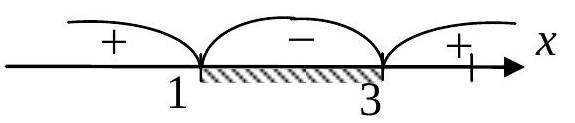
$$
\frac{2 x^{2}-6 x+5}{x^{2}-4 x+3}<1, \frac{2 x^{2}-6 x+5-x^{2}+4 x-3}{(x-1)(x-3)}<0, \frac{2 x^{2}-2 x+2}{(x-1)(x-3)}<0
$$
Answer: $(1 ; 3)$. | olympiads | 2ab1fe89-8468-5fc7-bf2f-08ca7a55e0cd | open-r1/OpenR1-Math-220k | [
""
] |
Given that the origin of the coordinate system is O, and the perpendicular line to the line 2mx - (4m + n)y + 2n = 0 (where m and n are not simultaneously zero) passes through point P(2, 6) with foot of the perpendicular M, find the range of values for |OM|. | From the given line equation 2mx - (4m + n)y + 2n = 0, we can rewrite it as m(2x - 4y) - n(y - 2) = 0.
Then, we have a system of equations: $\begin{cases} 2x-4y=0 \\ y-2=0 \end{cases}$. Solving the system, we get $\begin{cases} x=2 \\ y=2 \end{cases}$. Thus, the line always passes through the point Q(4, 2).
Let's deno... | cn_k12 | 7ab5e70a-f819-5665-aa6e-bd01dbb18a0e | open-r1/OpenR1-Math-220k | [
""
] |
Given the function $y = -ax + b$ ($a \neq 0$) whose graph passes through the first, third, and fourth quadrants, the quadrant that the graph of the function $y = -ax^2 + bx$ does not pass through is ( )
A: First quadrant
B: Second quadrant
C: Third quadrant
D: Fourth quadrant | Since the graph of the linear function $y = -ax + b$ passes through the first, third, and fourth quadrants,
it follows that $-a > 0$,
thus $a 0$, is to the right of the y-axis.
Hence, the graph of the quadratic function passes through the first, second, and fourth quadrants, but not through the third quadrant. ... | cn_k12 | 4a047f3d-6f5f-5add-b9fc-fe744538d83d | open-r1/OpenR1-Math-220k | [
""
] |
There are 10 rows of 15 chairs set up for the award ceremony. The first row is reserved for the awardees while the second and third rows are for the administrators and teachers. The last two rows are then reserved for the parents and the rest of the rows are for the students. If only 4/5 of the seats reserved for the s... | There are 1 + 2 + 2 = <<1+2+2=5>>5 rows that are not reserved for the students.
Hence, 10 - 5 = <<10-5=5>>5 rows are reserved for the students.
That is equal to 5 x 15 = <<5*15=75>>75 seats.
But only 75 x 4/5 = <<75*4/5=60>>60 seats are occupied by the students.
Therefore, 75 - 60 = <<75-60=15>>15 seats can be given to... | null | null | openai/gsm8k | [
""
] |
13. [5] Find the number of real zeros of $x^{3}-x^{2}-x+2$. | Solution: Let $f(x)=x^{3}-x^{2}-x+2$, so $f^{\prime}(x)=3 x^{2}-2 x-1$. The slope is zero when $3 x^{2}-2 x-1=0$, where $x=-\frac{1}{3}$ and $x=1$. Now $f\left(\frac{1}{3}\right)>0$ and $f(1)>0$, so there are no zeros between $x=-\frac{1}{3}$ and $x=1$. Since $\lim _{x \rightarrow+\infty} f(x)>0$, there are no zeros fo... | olympiads | 88e59d93-571a-5ca0-8704-95f7945b7704 | open-r1/OpenR1-Math-220k | [
""
] |
Example 5 Let $P$ be a point inside $\triangle A B C$ such that $\angle P B C = 30^{\circ}, \angle P B A = 8^{\circ}$, and $\angle P A B = \angle P A C = 22^{\circ}$. Question: What is the measure of $\angle A P C$ in degrees? | Solve as shown in Figure 7, take
the circumcenter $D$ of $\triangle P B C$, and
connect $D P, D C, D B$.
Then $D P=D C=D B$,
$\angle P D C$
$=2 \angle P B C=60^{\circ}$.
Therefore, $\triangle D P C$ is an equilateral triangle.
Thus, $P C=D P=D B, \angle D P C=60^{\circ}$.
It is easy to see that $A B>A C$.
Therefore, we... | cn_contest | 550d0771-9e4d-5b7b-acb6-5a629b8abb62 | open-r1/OpenR1-Math-220k | [
""
] |
14. From the 20 numbers 11, 12, 13, 14, ... 30, at least ( ) numbers must be taken to ensure that there are two numbers whose sum is a multiple of ten. | 【Analysis】(11, 29) (12, 28) (13, 27) (14, 26) (15, 25) (16, 24) (17, 23) (18, 22) (19, 21) (20, 30), there are 10 drawers. By the drawer principle, selecting 11 numbers, there must be 2 numbers falling into the same drawer, and the sum of the 2 numbers in the same drawer is a multiple of ten. If taking 10 numbers, one ... | olympiads | 01d9ceae-fe18-5c81-a6b7-4e941c91cfe7 | open-r1/OpenR1-Math-220k | [
""
] |
Given that $P$ is a moving point on the parabola $y^{2}=4x$, and $Q$ is a moving point on the circle $x^{2}+(y-4)^{2}=1$, find the minimum value of the sum of the distances from point $P$ to point $Q$ and from point $P$ to the directrix of the parabola.
A: $5$
B: $8$
C: $\sqrt{17}-1$
D: $\sqrt{5}+2$ | The focus of the parabola $y^{2}=4x$ is at $F(1,0)$, and the center of the circle $x^{2}+(y-4)^{2}=1$ is at $C(0,4)$.
According to the definition of a parabola, the distance from point $P$ to the directrix is equal to the distance from point $P$ to the focus. Therefore, the sum of the distances from point $P$ to poin... | cn_k12 | bf3356f5-b38e-5a15-8952-259505093a68 | open-r1/OpenR1-Math-220k | [
""
] |
29.1. Find the three-digit number $\overline{a b c}$, if it is known that
$$
\begin{gathered}
8 a+5 b+c=100 \\
a+b+c=20
\end{gathered}
$$ | 29.1. Subtracting the second equation of the system from the first, we get
$$
7 a+4 b=80
$$
From this equality, it follows that $a$ is divisible by 4, i.e., $a=4$ or $a=8$. But $a$ cannot be equal to 4, because in this case, from the equation $7 a+4 b=80$, it would follow that $b=13$. However, this is impossible, sin... | olympiads | f70010eb-01d3-5b25-ad9d-f7c9b0c425b2 | open-r1/OpenR1-Math-220k | [
""
] |
The derivative of the function $$y= \frac {1}{2}(e^{x}+e^{-x})$$ is ( )
A: $$\frac {1}{2}(e^{x}-e^{-x})$$
B: $$\frac {1}{2}(e^{x}+e^{-x})$$
C: $e^{x}-e^{-x}$
D: $e^{x}+e^{-x}$ | Given $$y= \frac {1}{2}(e^{x}+e^{-x})$$,
then $$y' = \frac {1}{2}(e^{x}-1 \times e^{-x}) = \frac {1}{2}(e^{x}-e^{-x})$$.
Therefore, the correct option is A.
This can be derived using the derivative formula $(u+v)'=u'+v'$ and $(e^{x})'=e^{x}$ to find the derivative of the function.
This question tests the operat... | cn_k12 | eece8c9a-d1bd-50a4-851e-24eb45ce40d8 | open-r1/OpenR1-Math-220k | [
""
] |
3. The triangle $A B C$ is isosceles with $A B=B C$. The point $D$ is a point on $B C$, between $B$ and $C$, so that $A C=A D=B D$.
What is the size of angle $A B C$ ? | SolUtion
Commentary
For this solution, we use the results that
(a) 'the angles opposite the two equal sides of an isosceles triangle are equal' (base angles of an isosceles triangle),
(b) 'an exterior angle of a triangle is equal to the sum of the two opposite interior angles' (exterior angle of a triangle),
(c) 'the a... | olympiads | db1f51e8-033f-5c48-af09-10dffcd26c5a | open-r1/OpenR1-Math-220k | [
""
] |
Which of the following equations is definitely a quadratic equation in terms of $x$?
A: $(\frac{1}{x})^2+\frac{2}{x}+1=0$
B: $x\left(x+1\right)=1+x^{2}$
C: $x\left(x-1\right)=0$
D: $ax^{2}+x+1=0$ | To determine which of the given equations is definitely a quadratic equation in terms of $x$, we need to analyze each option:
**Option A**: $(\frac{1}{x})^2+\frac{2}{x}+1=0$
This equation involves terms with $x$ in the denominator, which means it is not a polynomial equation. A quadratic equation must be a polynomial... | cn_k12 | d1349b7a-006c-5b45-a2fc-679ef7aa35ef | open-r1/OpenR1-Math-220k | [
""
] |
Using the numbers 1, 2, and 3 to form a number (without repeating any digit), the largest number obtained is ( )
A: 321
B: $21^3$
C: $3^{21}$
D: $2^{31}$ | **Solution**: Given that $21^3 = (3 \times 7)^3$,
$= 27 \times 289$
Therefore, $27 \times 289 > 321$.
Thus, $321 512$, and $3^{21} = 3^6 \times 3^6 \times 3^6 \times 3^3$
$= 729 \times 729 \times 729 \times 27$;
$2^{31} = 2^9 \times 2^9 \times 2^9 \times 2^4$
$= 512 \times 512 \times 512 \times 16$,
Ther... | cn_k12 | 52d12581-f492-5220-906c-b71802a45b05 | open-r1/OpenR1-Math-220k | [
""
] |
A teacher proposes 80 problems to a student, informing that they will award five points for each problem solved correctly and deduct three points for each problem not solved or solved incorrectly. In the end, the student ends up with eight points. How many problems did he solve correctly? | Let $c$ be the number of problems solved correctly and $e$ be the sum of the number of problems solved incorrectly and problems not solved. Therefore, $c+e=80$ and $5 c-3 e$ is the number of points the student scored in the evaluation. In the present case,
$$
\left\{\begin{aligned}
c+e & =80 \\
5 c-3 e & =8
\end{align... | olympiads | ee3e311c-ed52-554a-a2d0-9637f8517c5d | open-r1/OpenR1-Math-220k | [
""
] |
The result of the absolute value of $-2$ is ___. | The absolute value of a number is the non-negative value of that number without regard to its sign. It's like asking how far a number is from zero on the number line. For any real number $x$, the absolute value function can be defined as:
$$
|x| =
\begin{cases}
x & \text{if } x \geq 0, \\
-x & \text{if } x < 0.
\end... | cn_k12 | 36e7a677-ac86-537d-b444-894bcb2dd2d8 | open-r1/OpenR1-Math-220k | [
""
] |
Given that the inverse function of \\(f(x) = 2^x\\) is \\(y = f^{-1}(x)\\), and \\(g(x) = f^{-1}(1-x) - f^{-1}(1+x)\\), then the solution set of the inequality \\(g(x) < 0\\) is. | **Analysis**
This question mainly tests the method of finding the inverse function, as well as the monotonicity and application of logarithmic functions, and the solution method for logarithmic inequalities. It is a basic question.
**Solution**
Given \\(y = f(x) = 2^x\\),
then \\(x = \log_2(y)\\),
which means th... | cn_k12 | 25acec62-7af4-589d-8be6-b934624d7f61 | open-r1/OpenR1-Math-220k | [
""
] |
6. To the question: "How many two-digit numbers are there such that the sum of their digits is 9?" - Stepa Verkhoglyadkin started listing all two-digit numbers in a row, selecting the ones he needed. Show him a shorter way to solve the problem. | 6. For two-digit numbers, except for 99, the statement is true: “If a number is divisible by 9, then the sum of its digits is 9, and vice versa.” Up to 99 inclusive, there are 11 numbers divisible by 9 (99: 9=11). However, among them, two numbers (9 and 99) are not considered in this problem, so the number of numbers s... | olympiads | ebc83d03-974d-51a3-a32b-13ef47a5ef93 | open-r1/OpenR1-Math-220k | [
""
] |
Jane and Josh wish to buy a candy. However Jane needs seven more cents to buy the candy, while John needs one more cent. They decide to buy only one candy together, but discover that they do not have enough money. How much does the candy cost? | 1. Let \( C \) be the cost of the candy in cents.
2. Let \( J \) be the amount of money Jane has in cents.
3. Let \( H \) be the amount of money John has in cents.
From the problem, we know:
- Jane needs 7 more cents to buy the candy, so \( J + 7 = C \).
- John needs 1 more cent to buy the candy, so \( H + 1 = C \).
... | aops_forum | 07b4fdc2-1bf9-5e31-9938-d4c18b67f0fc | open-r1/OpenR1-Math-220k | [
""
] |
-6. The parabola $y=x^{2}+23 x+1$ intersects the line $y=2 a x+2 a b$ at most one point. Then the maximum value of $a^{2}+b^{2}$ is ).
(A) 1
(B) $\frac{\sqrt{3}}{2}$
(C) $\frac{\sqrt{2}}{2}$
(D) 0 | 6. (A).
From $\left\{\begin{array}{l}y=x^{2}+2 b x+1, \\ y=2 a x-2 a b\end{array}\right.$ we get
$$
x^{2}+2(b-a) x+1-2 a b=0 .
$$
Since the parabola and the line have at most one intersection point,
$$
\therefore \Delta=4(b-a)^{2}-4(1-2 a b) \leqslant 0 \text {, }
$$
which means $a^{2}+b^{2} \leqslant 1$. | cn_contest | af280e20-c295-574b-b66d-ec262f4e55b8 | open-r1/OpenR1-Math-220k | [
""
] |
17. 32 students form a circle. If among any 3 adjacent students there is at least 1 girl, then the maximum number of boys is
$\qquad$people. | 21 | olympiads | cdb4be38-5919-53df-9602-51733974a20a | open-r1/OpenR1-Math-220k | [
""
] |
$17 \cdot 73$ Segment $A B$ is $p$ units long, with midpoint $M$ and perpendicular line $M R$; $M R$ is $q$ units long. An arc is drawn from $R$ with a radius equal to $\frac{1}{2} A B$, intersecting $A B$ at $T$. The roots of the following equation are $A T$ and $T B$:
(A) $x^{2}+p x+q^{2}=0$.
(B) $x^{2}-p x+q^{2}=0$.... | [Solution] By the given and the Pythagorean theorem, we have $M T=\sqrt{\left(\frac{p}{2}\right)^{2}-q^{2}}$, thus
$$
\begin{array}{l}
A T=A M+M T=\frac{p}{2}+\sqrt{\left(\frac{p}{2}\right)^{2}-q^{2}}, \\
B T=B M-M T=\frac{p}{2}-\sqrt{\left(\frac{p}{2}\right)^{2}-q^{2}} .
\end{array}
$$
It is known that $A T, B T$ are... | olympiads | 4130829c-dc4b-5df0-a14c-c0df9b61213e | open-r1/OpenR1-Math-220k | [
""
] |
9. Given $\alpha \in\left[0, \frac{\pi}{2}\right], \beta \in\left[0, \frac{\pi}{2}\right], \cos ^{2} \alpha \sin \beta+\frac{1}{\sin \beta}$, the minimum value is . $\qquad$ | 9. 1 .
Since $\cos ^{2} \alpha \sin \beta \geqslant 0, \sin \frac{1}{\beta} \geqslant 1$, thus $\cos ^{2} \alpha \sin \beta+\frac{1}{\sin \beta} \geqslant 1$, equality holds if and only if $\alpha=\beta=90^{\circ}$. | olympiads | b0fb3157-c905-5454-8e20-ebbe8ba33b97 | open-r1/OpenR1-Math-220k | [
""
] |
(1) Let $z \in \mathbf{C}$, and $\overline{z(\bar{z}+1)}=\bar{z}+1$, find $|z|$. | (Solution: $|z|=1$ ) | olympiads | 1d39751a-8923-5ff5-9573-6eb42c60a9fd | open-r1/OpenR1-Math-220k | [
""
] |
Among the following fractions, the range of values for $x$ that makes the fraction valid for all real numbers is ( )
A: $\frac{|x-1|}{x^2}$
B: $\frac{|x^2|}{|x|}$
C: $\frac{|x^4-1|}{x^2+1}$
D: $\frac{|x^2-1|}{x+1}$ | Based on the condition that a fraction is meaningful, we can deduce that $x^2+1 \neq 0$.
Therefore, the correct option is $\boxed{C}$. | cn_k12 | 84830ea2-d9cb-51cc-ac46-a00c0cabd7ff | open-r1/OpenR1-Math-220k | [
""
] |
One, (40 points) Find all prime numbers $p, q$ such that $p^{2}-p+1=q^{3}$.
| $$
\begin{array}{l}
\text { Given } q^{3}<p^{2} \Rightarrow q<p. \\
\text { Original equation } \Leftrightarrow p(p-1)=(q-1)\left(q^{2}+q+1\right) \\
\Rightarrow p \mid\left(q^{2}+q+1\right). \\
\text { Let } \frac{q^{2}+q+1}{p}=\frac{p-1}{q-1}=k .
\end{array}
$$
Then $p=k(q-1)+1$
$$
\begin{array}{l}
\Rightarrow k(q-1... | olympiads | f4a16ec6-a7b6-5a48-94d7-7a26f154d966 | open-r1/OpenR1-Math-220k | [
""
] |
Daddy decided to give his son Mojmir a monthly allowance. Mojmir received his first allowance in January. Daddy increased the allowance by 4 Kč every month. If Mojmir didn't spend any, he would have 900 Kč after the twelfth allowance before Christmas. How many Kč did Mojmir receive for his first allowance in January?
... | Let's denote the amount of Mojmír's pocket money in January in Kč as $x$. In February, Mojmír received $x+4$, in March $x+8$, in April $x+12, \ldots$, in December $x+44$. According to the problem, we know that
$$
12 x+(4+8+12+16+20+24+28+32+36+40+44)=900 .
$$
After simplification, we get:
$$
\begin{aligned}
12 x+264... | olympiads | 68e25716-9048-5474-bca9-5ad75ef7b2a0 | open-r1/OpenR1-Math-220k | [
""
] |
3. $\left(4^{-1}-3^{-1}\right)^{-1}=(\quad)$.
(A) -12 .
(B) -1 .
(C) $-\frac{1}{12}$.
(D) 1. (E) 12 . | A
Translate the text above into English, please retain the original text's line breaks and format, and output the translation result directly. | cn_contest | 9d7271ff-21a3-5327-8ecc-1866fe596976 | open-r1/OpenR1-Math-220k | [
""
] |
End of preview. Expand in Data Studio
README.md exists but content is empty.
- Downloads last month
- 13