

question stringlengths 13 7.47k | answer stringlengths 0 13.5k | openr1_source stringclasses 8
values | id stringlengths 3 36 ⌀ | dataset stringclasses 2
values | choices sequencelengths 1 1 |
|---|---|---|---|---|---|
Given $f(x) = \log_{3}(x+3)$, then $f^{-1}(2) =$ ( )
A: $\log_{3}^{5}$
B: $32$
C: $6$
D: $243$ | Let $f^{-1}(2) = a$
Then $f(a) = \log_{3}(a+3) = 2$. This means $9 = a + 3$
Therefore, $a = 6$.
Thus, $f^{-1}(2) = 6$.
Hence, the correct option is $\boxed{C}$. | cn_k12 | 6c653d05-e37d-5990-9c9d-b1add0fa9472 | open-r1/OpenR1-Math-220k | [
""
] |
3. (10 points) The sum and the quotient of two numbers are both 6, then the product of these two numbers minus the difference of these two numbers (larger minus smaller) equals ( )
A. $26 \frac{4}{7}$
B. $5 \frac{1}{7}$
C. $\frac{6}{7}$
D. $\frac{6}{49}$ | 【Analysis】According to the problem, the larger number can be called A, and the smaller number can be called B. From the problem, we know that A is 6 times B, and A plus B equals 6. Using the sum-multiple formula, we can find that B is $6 \div(6+1)=\frac{6}{7}$, and then according to the problem, we can find A, and then... | olympiads | c915bcfc-b687-57e7-af6f-fb0d9e6b55a4 | open-r1/OpenR1-Math-220k | [
""
] |
(3) The sequence $\left\{a_{n}\right\}$ has 11 terms, $a_{1}=0, a_{11}=4$, and $\left|a_{k+1}-a_{k}\right|=1$, $k=1,2, \cdots, 10$. The number of different sequences that satisfy these conditions is ( ).
(A) 100
(B) 120
(C) 140
(D) 160 | (3) B Hint: According to the problem, we have $a_{k+1}-a_{k}=1$, or $a_{k+1}-a_{k}=-1$. If there are $m$ ones, then there are $10-m$ negative ones, thus we have $4=m-(10-m)$, solving this gives $m=7$. Therefore, the number of such sequences is $\mathrm{C}_{10}^{7}=120$. | olympiads | 3700f831-9759-537e-b97b-3f75b889b5a8 | open-r1/OpenR1-Math-220k | [
""
] |
7. If the coordinates of the two foci of an ellipse are $(-1,0)$ and $(1,0)$, and the equation of a tangent line is $x+y=7$, then the eccentricity of the ellipse is $\qquad$
Translate the text above into English, please retain the original text's line breaks and format, and output the translation result directly. | 7. $\frac{1}{5}$.
Let the equation of the ellipse be $\frac{x^{2}}{a^{2}}+\frac{y^{2}}{b^{2}}=1$, where $a>b>0$. It is easy to know that $a^{2}=b^{2}+1$. The equation of the tangent line to the ellipse at the point $(a \cos t, b \sin t)$ is
$$
\frac{x \cos t}{a}+\frac{y \sin t}{b}=1 .
$$
By comparing with the given t... | olympiads | 6d457817-139d-581e-8dde-2a52cda85fba | open-r1/OpenR1-Math-220k | [
""
] |
With the changes in the market and the reduction in production costs, the price of computers decreases by $\frac{1}{3}$ every 4 years. If the price of a computer was 8100 yuan in 2000, what would its price be in 2016?
A: 3000 yuan
B: 2400 yuan
C: 1600 yuan
D: 1000 yuan | Since the price of computers decreases by $\frac{1}{3}$ every 4 years, the price in the $n^{th}$ year, $a_n$, can be calculated as $a_{1} \times (1- \frac{1}{3})^{\left[ \frac{n}{4} \right]}$.
Therefore, the price of a computer that was 8100 yuan in 2000 would be $8100 \times \left( \frac{2}{3} \right)^{4}$ in 2016, ... | cn_k12 | dc942ff6-842d-5c38-b4cc-6462dd2750a1 | open-r1/OpenR1-Math-220k | [
""
] |
15. On a long strip of paper, the numbers $1, 2, 3, \ldots, n$ are written in sequence. The long strip is cut into five segments, each containing some consecutive natural numbers (the digits of a single number are not split between different segments). We calculated the average of the numbers in these five segments, wh... | 【Answer】2014
Analysis: The average of 1 to 18 is $9.5$, the average of 19 is 19, the average of 20 to 236 is 128, the average of 237 to 453 is 345, and the average of 454 to 2014 is 1234.
Average $=[$ (first term + last term) $\times$ number of terms $\div 2]$ number of terms, so the last term can be directly calculate... | olympiads | d24a8539-bcb2-5db5-b57e-889a9b35648d | open-r1/OpenR1-Math-220k | [
""
] |
In the arithmetic sequence $\{a_n\}$, $a_2 = 6$, and the sum of its first $n$ terms is $S_n$. Each term of the geometric sequence $\{b_n\}$ is positive, $b_1 = 1$, and $b_2 + S_4 = 33$, $b_3 =S_2$.
(1) Find $a_n$ and $b_n$.
(2) Suppose the sum of the first $n$ terms of the sequence $\{c_n\}$ is $T_n$, and $c_n = 4b_n -... | (1) Let $d$ be the common difference of the arithmetic sequence $\{a_n\}$ and let $q > 0$ be the common ratio of the geometric sequence $\{b_n\}$.
Given $a_2 = 6$, $b_1 = 1$, and also $b_2 + S_4 = 33$, $b_3 = S_2$, we have:
$$a_1+ d = 6$$
$$q + 6a_1+ 6d = 33$$
$$q^2 = 2a_1 + d$$
Solving these equations concurrently, ... | cn_k12 | bd3d5863-bfd9-5482-9643-d504cbdc3f9a | open-r1/OpenR1-Math-220k | [
""
] |
In the Cartesian coordinate system $xOy$, $l$ is a line passing through the fixed point $P(4,2)$ with an inclination angle of $\alpha$. In the polar coordinate system with the origin $O$ as the pole and the positive half-axis of $x$ as the polar axis (using the same unit length), the polar equation of curve $C$ is $\rh... | Solution:
- (Ⅰ) Since line $l$ passes through the fixed point $P(4,2)$ with an inclination angle of $\alpha$,
the parametric equation of $l$ is $\begin{cases}x=4+t\cos \alpha \\ y=2+t\sin \alpha\end{cases}$ (where $t$ is the parameter).
From $\rho=4\cos \theta$, we get $\rho^{2}=4\rho\cos \theta$,
substituting $\... | cn_k12 | 1f302391-0c11-5d04-85ea-ec4fda6fdeea | open-r1/OpenR1-Math-220k | [
""
] |
The Bank of Zürich issues coins with an $H$ on one side and a $T$ on the other side. Alice has $n$ of these coins arranged in a line from left to right. She repeatedly performs the following operation: if some coin is showing its $H$ side, Alice chooses a group of consecutive coins (this group must contain at least one... | 1. **Define the Problem and Key Terms:**
- We have \( n \) coins, each showing either \( H \) (heads) or \( T \) (tails).
- Alice can flip any group of consecutive coins.
- The goal is to determine the maximum number of operations \( m(C) \) required to turn any initial configuration \( C \) into all tails.
2... | aops_forum | 8aa9069a-db0e-5e31-8fe7-4d41299273e9 | open-r1/OpenR1-Math-220k | [
""
] |
8. Let $M=\{1,2, \cdots, 2017\}$ be the set of the first 2017 positive integers. If one element is removed from $M$, and the sum of the remaining elements in $M$ is exactly a perfect square, then the removed element is $\qquad$ . | $$
1+2+\cdots+2017=\frac{2017 \cdot 2018}{2}=2017 \cdot 1009=2035153,1426^{2}=2033476 \text {, }
$$
So the removed element is $2035153-2033476=1677$. | olympiads | 5e21c578-8245-57e0-8868-2cf5f4e7a28a | open-r1/OpenR1-Math-220k | [
""
] |
Rica's group won in a dance competition. She got 3/8 of the prize money. From Rica's prize money, she spent 1/5 of it and is now left with $300. How much was the prize money that her group won? | Rica is left with 1 - 1/5 = 4/5 of her prize money which is equal to $300.
Since 4/5 is worth $300, then 1/5 is worth $300/4 = $75.
So, Rica got $75 x 5 = $375 from their prize money which is 3/8 of the total prize.
Since 3/8 is equal to $375, then 1/8 is worth $375/3 = $125.
So, the total prize money is $125 x 8 = $<<... | null | null | openai/gsm8k | [
""
] |
Example 7. What dimensions of a box (without a lid) made from a square sheet of cardboard with side $a$ will have the maximum capacity | Solution. To manufacture a box, it is necessary to cut out squares from the corners of the sheet and fold the protrusions of the resulting cross-shaped figure. Let the side of the cut-out square be denoted by $x$, then the side of the box base will be $a-2 x$. The volume of the box can be expressed by the function $V=(... | olympiads | cb0a2438-3f01-5bcb-88c3-454816034149 | open-r1/OpenR1-Math-220k | [
""
] |
Zamyatin V.
Vladimir wants to make a set of cubes of the same size and write one digit on each face of each cube so that he can use these cubes to form any 30-digit number. What is the smallest number of cubes he will need? (The digits 6 and 9 do not turn into each other when flipped.)
# | No less than 30 units, twos, ..., nines, and no less than 29 zeros. In total, no less than 50 cubes. It is not difficult to arrange no less than 30 instances of each digit on 50 cubes so that the digits on each cube do not repeat.
## Answer
50 cubes. | olympiads | d29e973d-df9c-54a3-9d41-6b169c326031 | open-r1/OpenR1-Math-220k | [
""
] |
There are $2^{10} = 1024$ possible 10-letter strings in which each letter is either an A or a B. Find the number of such strings that do not have more than 3 adjacent letters that are identical. | Let $a_{n}$ be the number of ways to form $n$-letter strings made up of As and Bs such that no more than $3$ adjacent letters are identical.
Note that, at the end of each $n$-letter string, there are $3$ possibilities for the last letter chain: it must be either $1$, $2$, or $3$ letters long. Removing this last chain w... | amc_aime | 4b302330-d692-5737-9684-c05dbb09e027 | open-r1/OpenR1-Math-220k | [
""
] |
Find $x$ in the following equation: $64(x+1)^3-27=0$. | Solve the equation:
$(x+1)^3 = \frac{27}{64}$
Therefore, $x+1 = \frac{3}{4}$
Solving for $x$, we get $x = -\frac{1}{4}$.
Thus, the solution is $x = \boxed{-\frac{1}{4}}$. | cn_k12 | 4efee869-317e-5115-b149-25995ac5da69 | open-r1/OpenR1-Math-220k | [
""
] |
Given the set $A=\{x|0<x\leq 2\}$, then there are $\boxed{2}$ integers in the set $A$. | Since $0<x\leq 2$, if $x$ is an integer, then $x=1$ or $x=2$.
Therefore, the answer is $\boxed{2}$. | cn_k12 | f2ed51ff-e79d-5624-9f92-54b3ec4d5f92 | open-r1/OpenR1-Math-220k | [
""
] |
A bank employee is filling an empty cash machine with bundles of $\$ 5.00, \$ 10.00$ and $\$ 20.00$ bills. Each bundle has 100 bills in it and the machine holds 10 bundles of each type. What amount of money is required to fill the machine?
(A) $\$ 30000$
(B) $\$ 25000$
(C) $\$ 35000$
(D) $\$ 40000$
(E) $\$ 45000$
Part... | A bank employee is filling an empty cash machine with bundles of $\$ 5.00, \$ 10.00$ and $\$ 20.00$ bills. Each bundle has 100 bills in it and the machine holds 10 bundles of each type. What amount of money is required to fill the machine?
(A) $\$ 30000$
(B) $\$ 25000$
(C) $\$ 35000$
(D) $\$ 40000$
(E) $\$ 45000$
## S... | olympiads | 5075e0a1-bd8a-55d8-9e5d-b2907d99f7a9 | open-r1/OpenR1-Math-220k | [
""
] |
For any rational numbers $x$, $y$, define the operation as follows: $x \triangle y = ax + by + cxy$, where $a$, $b$, $c$ are given numbers, and the right side of the equation involves the usual addition and multiplication of numbers. For example, when $a=1$, $b=2$, $c=3$, $1 \triangle 3 = 1 \times 1 + 2 \times 3 + 3 \t... | Since $x \triangle d = x$, we have $ax + bd + cdx = x$,
which implies $(a + cd - 1)x + bd = 0$.
Since there exists a non-zero number $d$ such that for any rational number $x \triangle d = x$, we have
\[
\begin{align*}
a + cd - 1 &= 0 \\
bd &= 0
\end{align*}
\]
From $1 \triangle 2 = 3$, we get $a + 2b + 2c = 3$.
Fr... | cn_k12 | 7e183859-15eb-5e5e-808b-aec323601434 | open-r1/OpenR1-Math-220k | [
""
] |
Given that $\sum_{k=1}^{35}\sin 5k=\tan \frac mn,$ where angles are measured in degrees, and $m_{}$ and $n_{}$ are relatively prime positive integers that satisfy $\frac mn<90,$ find $m+n.$ | Let $s = \sum_{k=1}^{35}\sin 5k = \sin 5 + \sin 10 + \ldots + \sin 175$. We could try to manipulate this sum by wrapping the terms around (since the first half is equal to the second half), but it quickly becomes apparent that this way is difficult to pull off. Instead, we look to [telescope](https://artofproblemsolvi... | amc_aime | ab518101-6e9f-5e4b-ad7a-7cf101586b6b | open-r1/OpenR1-Math-220k | [
""
] |
Given the parabola $C: y=2x^2$ and the line $l: y=kx+1$, where $O$ is the origin.
(1) Prove that $l$ and $C$ must intersect at two points;
(2) Suppose $l$ and $C$ intersect at points $A$ and $B$, and the sum of the slopes of lines $OA$ and $OB$ is 1, find the value of $k$. | (1) **Proof**: By combining the equations of the parabola $C: y=2x^2$ and the line $l: y=kx+1$, we get $2x^2-kx-1=0$.
Therefore, $\Delta=k^2+8>0$, which means $l$ and $C$ must intersect at two points.
(2) **Solution**: Let $A(x_1, y_1)$ and $B(x_2, y_2)$. Then, $\frac{y_1}{x_1} + \frac{y_2}{x_2} = 1$.
Since $y_1 = kx_... | cn_k12 | baa43032-7617-509a-94dc-69381498a05a | open-r1/OpenR1-Math-220k | [
""
] |
Given $A=a^{2}-2ab+b^{2}$, $B=a^{2}+2ab+b^{2}$, where $a\neq b$. $(1)$ Determine the sign of $A+B$ and explain the reason; $(2)$ If $ab$ are reciprocals of each other, find the value of $A-B$. | For the given problem, let's break down the solution step by step, following the rules:
### Part (1) Determine the sign of $A+B$
Given:
- $A = a^{2} - 2ab + b^{2}$
- $B = a^{2} + 2ab + b^{2}$
We need to find the sign of $A+B$:
\begin{align*}
A+B & = (a^{2} - 2ab + b^{2}) + (a^{2} + 2ab + b^{2}) \\
& = a^{2} - 2a... | cn_k12 | fa2d80fc-bb55-5829-9689-80c3294971c1 | open-r1/OpenR1-Math-220k | [
""
] |
Given that $a > b > 0$, and $a + b = 2$, find the minimum value of $\frac{2}{a + 3b} + \frac{1}{a - b}$. | Since $(a + 3b) + (a - b) = 2(a + b) = 4$,
We have $\frac{1}{4}[(a + 3b) + (a - b)] = 1$,
Hence, $\frac{2}{a + 3b} + \frac{1}{a - b}$
$= \frac{1}{4}(\frac{2}{a + 3b} + \frac{1}{a - b})[(a + 3b) + (a - b)]$
$= \frac{1}{4}[2 + \frac{2(a - b)}{a + 3b} + \frac{a + 3b}{a - b} + 1]$
Using the Arithmetic Mean-Geometric M... | cn_k12 | 11a04e27-82ac-50cf-aac0-601de949feb8 | open-r1/OpenR1-Math-220k | [
""
] |
Given that $(2x-1)^5=a_0x^5+a_1x^4+a_2x^3+a_3x^2+a_4x+a_5$, find the value of $a_2+a_3$. | According to the binomial theorem, the general term of the expansion of $(2x-1)^5$ is given by $T_{r+1}=C_5^r\cdot(2x)^{5-r}\cdot(-1)^r=(-1)^r\cdot(2)^{5-r}\cdot C_5^r\cdot x^{5-r}$.
The coefficient $a_2$ is the coefficient of the $x^3$ term in the expansion of $(2x-1)^5$. Therefore, $a_2=(-1)^2\cdot(2)^3\cdot C_5^2=8... | cn_k12 | ae234a99-7300-597a-b8cc-f03bebdc8590 | open-r1/OpenR1-Math-220k | [
""
] |
15. Express the polynomial $x^{4}+x^{3}+x^{2}+x+1$ as the difference of squares of two real-coefficient polynomials with different degrees and factorize it over the real numbers. | 15. Let $x^{4}+x^{3}+x^{2}+x+1=[f(x)]^{2}-[g(x)]^{2}$, given that $f(x)$ is a quadratic polynomial and the degree of $g(x)$ is less than 2, we can set $f(x)=x^{2}+\frac{1}{2} x+a$.
So $[g(x)]^{2}=[f(x)]^{2}-x^{4}-x^{3}-x^{2}-x-1$
$$
=\left(2 a-\frac{3}{4}\right) x^{2}+(a-1) x+\left(a^{2}-1\right)
$$
Thus, $\Delta=(a-1... | olympiads | 1ba9f3b2-d1f6-5c64-af0e-d17047c47f5f | open-r1/OpenR1-Math-220k | [
""
] |
A $k$ circle has a regular hexagon $A B C D E F$ inscribed in it. The intersection of lines $C D$ and $B F$ is point $G$, and the reflection of $G$ over $A B$ is $H$. Calculate the ratio of the lengths of the chords cut by lines $A G$ and $A H$ from $k$. | Since the hexagon is regular, the diagonal $B E$ is an axis of symmetry. The line $A F$ is the mirror image of $C D$ with respect to this axis. The intersection of the lines $F B$ and $C D$ is $G$, which is also the mirror image of $F$ with respect to $B$. The mirror image of $D$ with respect to $B$ is $D^{\prime}$, wh... | olympiads | 7e9b6418-2b6c-5b88-af57-4a203136372f | open-r1/OpenR1-Math-220k | [
""
] |
Given that the area of a sector is 2, and the central angle of the sector in radians is 4, find the perimeter of the sector. | To begin with, let's recall the formula to calculate the area of a sector of a circle:
$$ A = \frac{1}{2}r^2\theta $$
where $A$ is the area, $r$ is the radius, and $\theta$ is the central angle in radians.
From the given problem, we have $A = 2$ and $\theta = 4$ radians.
Now, we solve for $r$ using these values:
$... | cn_k12 | 0ef86365-8e36-576c-8afe-5b385fd864bc | open-r1/OpenR1-Math-220k | [
""
] |
There are 60 products numbered from 01 to 60. Now, 5 products are selected for inspection using the systematic sampling method. The sampling numbers determined are ( )
A: 5,10,15,20,25
B: 5,12,31,39,57
C: 5,17,29,41,53
D: 5,15,25,35,45 | **Analysis of the Problem:**
According to the knowledge of systematic sampling, the numbers are divided into 5 groups, each containing 12 numbers. One number is drawn from each group. The difference between the numbers drawn from two adjacent groups should be 12. Among the options, only option C meets this criterion.... | cn_k12 | 8b020a29-5419-5957-8bbf-85fe974aa44c | open-r1/OpenR1-Math-220k | [
""
] |
7. Use $m$ colors to paint the 6 edges of a regular tetrahedron, with each edge painted one color. Find the number of distinct edge-colored regular tetrahedrons. | 7. $\frac{1}{12}\left(m^{6}+3 m^{4}+8 m^{2}\right)$. | olympiads | 078f1e62-a13d-57c7-a7a7-0615376a76a0 | open-r1/OpenR1-Math-220k | [
""
] |
An archaeologist discovered three dig sites from different periods in one area. The archaeologist dated the first dig site as 352 years more recent than the second dig site. The third dig site was dated 3700 years older than the first dig site. The fourth dig site was twice as old as the third dig site. The archaeologi... | The third dig site was dated from the year 8400 / 2 = <<8400/2=4200>>4200 BC.
Thus, the first dig site was dated from the year 4200 - 3700 = <<4200-3700=500>>500 BC.
The second dig site was 352 years older, so it was dated from the year 500 + 352 = <<500+352=852>>852 BC.
#### 852 | null | null | openai/gsm8k | [
""
] |
2. Given numbers $x, y, z \in [0, \pi]$. Find the minimum value of the expression
$$
A=\cos (x-y)+\cos (y-z)+\cos (z-x)
$$ | Answer: -1.
Solution. We can assume that $x \leqslant y \leqslant z$, since the expression $A$ does not change under pairwise permutations of the variables. Notice that
$$
\cos (x-y)+\cos (z-x)=2 \cos \left(\frac{z-y}{2}\right) \cos \left(\frac{z+y}{2}-x\right)
$$
The first cosine in the right-hand side is non-negat... | olympiads | 1871275b-603a-58f6-ac31-1fce3afad10d | open-r1/OpenR1-Math-220k | [
""
] |
Example 3. As shown in Figure 3, through an internal point $P$ of $\triangle ABC$, three lines parallel to the three sides are drawn, resulting in three triangles $t_{1}, t_{2}$, and $t_{3}$ with areas 4, 9, and 49, respectively. Find the area of $\triangle ABC$.
(2nd American
Mathematical Invitational) | This example can directly apply the conclusion (4) of Theorem 2 to obtain
$$
S \triangle A B C=144
$$ | cn_contest | 3e90b08d-c37d-55ef-922c-fa1b17d9b39d | open-r1/OpenR1-Math-220k | [
""
] |
2. In $\square A B C D$, $E, F$ are the midpoints of $A B, B C$ respectively, $A F$ intersects $C E$ at $G$, $A F$ intersects $D E$ at $H$, find $A H: H G: G F$. | 2. Let the extensions of $C B$ and $D E$ intersect at $P$, and also $B P = B C, \frac{F P}{P B} = \frac{3}{2}$. For $\triangle A F B$ and the transversal lines $H E P$ and $C G E$, we have $\frac{A H}{H F} \cdot \frac{F P}{P B} \cdot \frac{B E}{E A} = \frac{A H}{H F} \cdot \frac{3}{2} \cdot \frac{1}{1} = 1$, which mean... | olympiads | 32d03cda-af19-5a50-862d-548681a6a9a4 | open-r1/OpenR1-Math-220k | [
""
] |
$AB$ is a focal chord of the parabola $y^{2}=x$, and $|AB|=4$. Find the distance from the midpoint of $AB$ to the line $x+\frac{1}{2}=0$. | From the given parabolic equation, we know that the directrix line equation is $x=-\frac{1}{4}$.
According to the definition of a parabola, the distance between the focus and any point on the parabola is equal to the distance between that point and the directrix. Therefore, the sum of the distances from the endpoints ... | cn_k12 | bbb1ddd9-f5ea-5683-8125-ad591994c12d | open-r1/OpenR1-Math-220k | [
""
] |
5 students compete for the championship in 3 sports events (each student can participate in any number of events, and each event has only one champion). The total number of different possible outcomes for the champions is ( ).
A: 15
B: 60
C: 125
D: $3^5$ | According to the problem, each championship has 5 possible winners.
Since there are 3 sports events,
the total number of different possible outcomes for the champions is $5 \times 5 \times 5 = 125$.
Therefore, the correct answer is $\boxed{C}$. | cn_k12 | 03450645-2a2f-5f60-9e38-c8530803499a | open-r1/OpenR1-Math-220k | [
""
] |
Let $\alpha$, $\beta$, and $\gamma$ be planes, and $m$, $n$, $l$ be lines. Then, to deduce that $m \perpendicular \beta$ is ( )
A: $\alpha \perpendicular \beta$, $\alpha \cap \beta = l$, $m \perpendicular l$
B: $\alpha \cap \gamma = m$, $\alpha \perpendicular \gamma$, $\beta \perpendicular \gamma$
C: $\alpha \pe... | For option A, since $\alpha \perpendicular \beta$, $\alpha \cap \beta = l$, and $m \perpendicular l$, according to the theorem for determining perpendicular planes, it lacks the condition $m \subset \alpha$, hence it is incorrect;
For option B, since $\alpha \cap \gamma = m$, $\alpha \perpendicular \gamma$, and $\bet... | cn_k12 | f4a6e8b3-fcd5-58cb-be21-e074d878ab21 | open-r1/OpenR1-Math-220k | [
""
] |
Task B-1.7. For which integers $p$ does the equation
$$
\frac{1}{(x-4)^{2}}-\frac{p-1}{16-x^{2}}=\frac{p}{(x+4)^{2}}
$$
have a unique integer solution? | ## Solution.
$$
\frac{1}{(x-4)^{2}}-\frac{p-1}{16-x^{2}}=\frac{p}{(x+4)^{2}}
$$
Given that $x \neq -4$ and $x \neq 4$, after multiplying the given equation by $(x+4)^{2}(x-4)^{2}$, we get
$$
\begin{aligned}
(x+4)^{2}+(p-1)(x+4)(x-4) & =p(x-4)^{2} \\
x^{2}+8 x+16+(p-1)\left(x^{2}-16\right) & =p\left(x^{2}-8 x+16\righ... | olympiads | fb0b1099-38ad-5a39-b3fc-e015f8457796 | open-r1/OpenR1-Math-220k | [
""
] |
The 15th question of the first test:
As shown in Figure 1, a tangent line is drawn through point $A(1,1)$ on the parabola $y=x^{2}$, intersecting the $x$-axis at point $D$ and the $y$-axis at point $B$. Point $C$ is on the parabola, and point $E$ is on line segment $A C$, satisfying $\frac{A E}{E C}=\lambda_{1}$. Point... | Solution: Since $y^{\prime}=\left.2 x\right|_{x=1}=2$, the equation of the tangent line passing through point $A$ is
$y-1=2(x-1)$, which is $y=2 x-1$.
Thus, $A(1,1), B(0,-1), D\left(-\frac{1}{2}, 0\right)$.
Therefore, $D$ is the midpoint of $A B$, and $C D$ is a median of $\triangle A B C$.
By the given conditions,
$\b... | cn_contest | 440bc7f0-7d1a-5cff-94a3-56c5c3e2113c | open-r1/OpenR1-Math-220k | [
""
] |
Let $\overrightarrow{a} = (2, -1)$, $\overrightarrow{b} = (-3, 4)$. Then, $2\overrightarrow{a} + \overrightarrow{b}$ equals to ( )
A: $(3, 4)$
B: $(1, 2)$
C: $-7$
D: $3$ | Solution: $2\overrightarrow{a} + \overrightarrow{b} = (4, -2) + (-3, 4) = (1, 2)$.
Therefore, the correct option is $\boxed{B}$.
This problem can be directly solved by substituting the coordinates and performing the calculation.
This question tests the coordinate operations of vectors and is considered a basic probl... | cn_k12 | 0bacdc5f-7757-5cf9-b597-14b93c722e98 | open-r1/OpenR1-Math-220k | [
""
] |
A clothing merchant sells two sets of clothes at the same time, with a selling price of 168 yuan per set. Calculated at cost, one set makes a 20% profit, while the other set incurs a 20% loss. Therefore, this merchant:
A: Neither makes a profit nor a loss
B: Makes a profit of 37.2 yuan
C: Makes a profit of 14 yuan
D: I... | Let's denote the cost of each set of clothes as $x$ yuan and $y$ yuan, respectively.
For the first set, $x(1+20\%)=168$, so $x=140$.
For the second set, $y(1-20\%)=168$, so $y=210$.
The profit from the first set is $168-140=28$ yuan.
The loss from the second set is $210-168=42$ yuan.
Combining both, we get $4... | cn_k12 | 7a7ed4fb-0557-54a4-9493-3084a3f42d8f | open-r1/OpenR1-Math-220k | [
""
] |
3. There are two cylinders with a volume ratio of $5: 8$. The lateral surfaces of these cylinders unfold into the same rectangle. If the length and width of this rectangle are both increased by 6, its area increases by 114. What is the area of this rectangle? $\qquad$ . | 【Answer】 40
【Analysis】Let the length and width of the rectangle be $a$ and $b$; then the volumes of the two cylinders are: $\pi\left(\frac{a}{2 \pi}\right)^{2} b$ and $\pi\left(\frac{b}{2 \pi}\right)^{2} a$, respectively. Therefore, $\pi\left(\frac{a}{2 \pi}\right)^{2} b: \pi\left(\frac{b}{2 \pi}\right)^{2} a=a: b=8: 5... | olympiads | 8c043352-2d76-51b3-823f-c37b308402b3 | open-r1/OpenR1-Math-220k | [
""
] |
Which of the following real numbers is irrational?
A: $-\sqrt{4}$
B: $\pi$
C: $-1$
D: $\frac{2}{3}$ | To determine which of the given real numbers is irrational, we evaluate each option step by step:
A: $-\sqrt{4} = -2$ is an integer. Since integers are rational numbers (they can be expressed as the ratio of two integers, in this case, $-2/1$), option A does not meet the requirement of being irrational.
B: $\pi$ is k... | cn_k12 | 9378304a-5bef-5f8e-a68a-3d21beb97384 | open-r1/OpenR1-Math-220k | [
""
] |
[ Volume of a Tetrahedron and Pyramid ]
The base of the pyramid is an isosceles right triangle with a leg length of 8. Each of the lateral edges of the pyramid is 9. Find the volume of the pyramid. | Let $D H$ be the height of the triangular pyramid $A B C D$, and $A B C$ be a right triangle with $\angle C=90^{\circ}$, $A C = B C = 8$. Since $D H$ is perpendicular to the plane $A B C$, the segments $A H, B H$, and $C H$ are the projections of the oblique lines $A D$, $B D$, and $C D$ on the plane $A B C$. According... | olympiads | 0abfd34f-a40e-5e51-8796-3863af95b878 | open-r1/OpenR1-Math-220k | [
""
] |
If $n$ is the largest positive integer with $n^{2}<2018$ and $m$ is the smallest positive integer with $2018<m^{2}$, what is $m^{2}-n^{2}$ ? | Since $\sqrt{2018} \approx 44.92$, the largest perfect square less than 2018 is $44^{2}=1936$ and the smallest perfect square greater than 2018 is $45^{2}=2025$.
Therefore, $m^{2}=2025$ and $n^{2}=1936$, which gives $m^{2}-n^{2}=2025-1936=89$.
ANSWER: 89 | olympiads | 850857f8-df8c-509d-859c-52bb1d2590ff | open-r1/OpenR1-Math-220k | [
""
] |
Given the sets $M=\{x|y=\ln(9-x^2)\}$, $N=\{y|y=2^{1-x}\}$, the intersection $M \cap N$ is ( )
A: $(0,3)$
B: $(1,3)$
C: $(-3,1)$
D: $(-\infty,3)$ | From the function $y=\ln(9-x^2)$ in set $M$, we get $9-x^2>0$,
which leads to $(x+3)(x-3)0$ in set $N$, we find that set $N=(0,+\infty)$,
Therefore, $M \cap N=(0,3)$.
Hence, the correct choice is $\boxed{\text{A}}$. | cn_k12 | 7b8f67e0-7b73-5bad-891a-3c54b868e1f2 | open-r1/OpenR1-Math-220k | [
""
] |
Let $S$ be a subset of $\{1,2,3,\dots,30\}$ with the property that no pair of distinct elements in $S$ has a sum divisible by $5$. What is the largest possible size of $S$?
$\textbf{(A)}\ 10\qquad\textbf{(B)}\ 13\qquad\textbf{(C)}\ 15\qquad\textbf{(D)}\ 16\qquad\textbf{(E)}\ 18$ | Of the integers from $1$ to $30$, there are six each of $0,1,2,3,4\ (\text{mod}\ 5)$. We can create several rules to follow for the elements in subset $S$. No element can be $1\ (\text{mod}\ 5)$ if there is an element that is $4\ (\text{mod}\ 5)$. No element can be $2\ (\text{mod}\ 5)$ if there is an element that is $3... | amc_aime | e9063795-c63a-5a90-8350-311c0605f8f3 | open-r1/OpenR1-Math-220k | [
""
] |
## Zadatak B-4.6.
Zadane su elipsa s jednadžbom $\frac{x^{2}}{9}+\frac{y^{2}}{4}=1$ i hiperbola kojoj su žarišta u tjemenima elipse na velikoj osi, a tjemena u žarištima elipse. Kolika je površina šesterokuta kojemu su vrhovi tjemena elipse na maloj osi i sjecišta zadanih krivulja?
| ## Rješenje.
Označimo s $C$ i $D$ tjemena elipse na maloj osi, a s $P, Q, R$ i $S$ točke presjeka elipse i hiperbole.
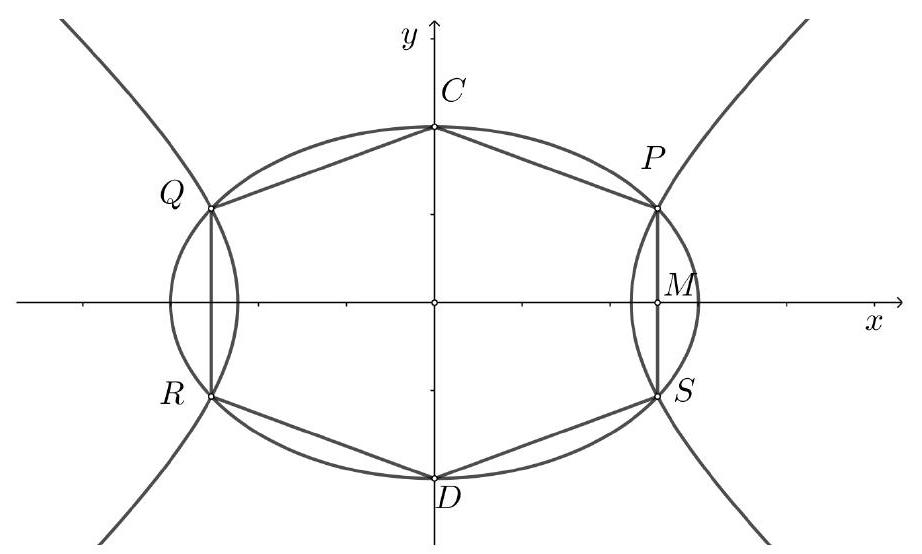
Za elipsu $\frac{x^{2}}{9}+\frac{y^{2}}{4}=1$ je $e=\sqrt{3^{2}-2^{2}}=... | olympiads | d041f080-2d39-5d70-b933-826d5e4d1e07 | open-r1/OpenR1-Math-220k | [
""
] |
Show that $M=\sqrt[3]{\sqrt{5}+2}-\sqrt[3]{\sqrt{5}-2}$ is an integer. | Let $a=\sqrt[3]{\sqrt{5}+2}$ and $b=\sqrt[3]{\sqrt{5}-2}$. Thus, $M=a-b$ and we have:
$$
M^{3}=(a-b)^{3}=a^{3}-b^{3}-3 a b(a-b)
$$
We know that $a^{3}-b^{3}=4$ and $a b=1$. Therefore, $M^{3}+3 M-4=0$, which means the number $M$ is a root of the polynomial $x^{3}+3 x-4$.
In turn, the number 1 is a root of the polynom... | olympiads | 4c81206a-e3b3-5898-8b00-e418003fabc2 | open-r1/OpenR1-Math-220k | [
""
] |
Given the sequence $\{a_n\}$ satisfies: $a_1=3$, $a_{n+1}=\frac{1}{1-a_n}$, then $a_{2020}=$
A: $3$
B: $-\frac{1}{2}$
C: $\frac{2}{3}$
D: $\frac{3}{2}$ | **Analysis**
This problem examines the recursive relationship of the sequence and the functional characteristics of the sequence. According to the problem, it is found that the sequence forms a cycle with a period of $3$, from which the result is obtained.
**Solution**
Given: $a_1=3$, $a_{n+1}= \frac{1}{1-a_n}$,
Th... | cn_k12 | f5642c47-cd2c-59e2-80be-cb90e4b33cc6 | open-r1/OpenR1-Math-220k | [
""
] |
Example 1 Given ten points in space, where no four points lie on the same plane. Connect some of the points with line segments. If the resulting figure contains no triangles and no spatial quadrilaterals, determine the maximum number of line segments that can be drawn. ${ }^{[1]}$ | Let the graph that satisfies the conditions be $G(V, E)$.
First, we prove a lemma.
Lemma In any $n(n \leqslant 5)$-order subgraph $G^{\prime}$ of graph $G(V, E)$, there can be at most five edges.
Proof It suffices to prove the case when $n=5$.
If there exists a vertex $A$ in $G^{\prime}$ with a degree of 4, then no edg... | olympiads | 700b0f1d-23d9-5ec0-9c5c-dd27fbcc47ee | open-r1/OpenR1-Math-220k | [
""
] |
9. (20 points) For which $n>1$ do there exist such distinct natural numbers $a_{1}, a_{2}, \ldots, a_{n}$ that
$$
\operatorname{LCM}\left(a_{1}, a_{2}, \ldots, a_{n}\right)=a_{1}+a_{2}+\ldots+a_{n}
$$ | Solution: Let there exist such different natural numbers $a$ and $b$ that $\operatorname{HOK}(a, b)=a+b$. Since
$$
\operatorname{HOK}(a, b) \vdots a \quad \text { and } \quad \operatorname{HOK}(a, b) \vdots b
$$
then
$$
a+b \vdots a \quad \text { and } \quad a+b \vdots b
$$
Therefore, $a \vdots b$ and $b \vdots a$,... | olympiads | 0fdc1479-9818-5d9f-aaf3-974a0f69846c | open-r1/OpenR1-Math-220k | [
""
] |
1. The maximum value $M(a)$ of the function $f(x)=\left|x^{2}-a\right|$ in the interval $[-1,1]$ has its minimum value as $\qquad$ . | $$
\text { 2.1. } \frac{1}{2} \text {. }
$$
(1) When $a \leqslant 0$, it is easy to see that $M(a)=1-a$.
(2) When $a>0$, $M(a)=\max \{a,|1-a|\}$.
When $0<a \leq \frac{1}{2}$, $M(a)=1-a$; when $a>\frac{1}{2}$, $M(a)=a$.
Therefore, $(M(a))_{\min }=\frac{1}{2}$. | cn_contest | 934cefbb-7f4e-5075-af52-4e087bda5dc9 | open-r1/OpenR1-Math-220k | [
""
] |
Given an arithmetic sequence $a_n$ with the first term being 1 and the common difference being 2. If $a_k = 7$, then the term number $k = \ $. | Since the first term of the arithmetic sequence $a_n$ is 1 and the common difference is 2, we have:
$$a_n = 1 + 2(n-1) = 2n - 1$$
Therefore, for $a_k = 7$, we get:
$$2k - 1 = 7$$
Solving for $k$, we find:
$$k = 4$$
Hence, the answer is $\boxed{4}$. | cn_k12 | 8e55cbdc-7198-5794-9cb1-b71dd08f0295 | open-r1/OpenR1-Math-220k | [
""
] |
Given $i^1 = i$, $i^2 = -1$, $i^3 = -i$, $i^4 = 1$, $i^5 = i$, it can be inferred that $i^{2016} = \_\_\_\_\_\_$. | Solution: Since $i^1 = i$, $i^2 = -1$, $i^3 = -i$, $i^4 = 1$, $i^5 = i$, it is known that the power operation of the complex unit $i$ is periodic, with a period of 4.
Therefore, $i^{2016} = i^{4} = 1$.
Hence, the answer is $\boxed{1}$.
This problem tests the basic operations of complex numbers and computational s... | cn_k12 | d66b1858-84e4-54c1-8a2e-f0a549a56935 | open-r1/OpenR1-Math-220k | [
""
] |
Given vectors $\overrightarrow{m}=({\sqrt{3},1}),\overrightarrow{n}=({cos2x,sin2x})$, and the function $f(x)=\overrightarrow{m}•\overrightarrow{n}$, then which of the following statements is true?
A: The maximum value of $f\left(x\right)$ is $2$
B: The line $x=-\frac{π}{{12}}$ is a symmetry axis of the graph of $f\le... | Given vectors $\overrightarrow{m}=({\sqrt{3},1})$ and $\overrightarrow{n}=({\cos2x,\sin2x})$, the function $f(x)=\overrightarrow{m}•\overrightarrow{n}$ can be calculated as follows:
1. Calculate the dot product of $\overrightarrow{m}$ and $\overrightarrow{n}$:
\begin{align*}
f(x) &= \overrightarrow{m}⋅\overright... | cn_k12 | 5aed691e-db40-51f9-bfc2-333d78f17b5f | open-r1/OpenR1-Math-220k | [
""
] |
Given that $f(x)$ is differentiable in the interval $(a, b)$, then $f'(x) < 0$ is a sufficient but not necessary condition for $f(x)$ to be monotonically decreasing in $(a, b)$ ( )
A: Sufficient but not necessary condition
B: Necessary but not sufficient condition
C: Necessary and sufficient condition
D: Neither suffi... | Since $f'(x) < 0$ can deduce that $f(x)$ is monotonically decreasing in $(a, b)$, but from $f(x)$ being monotonically decreasing in $(a, b)$, we cannot deduce that $f'(x) < 0$. For example, $f(x) = -x^3$ is a decreasing function in $\mathbb{R}$, but $f'(x) = -3x^2 \leq 0$. Therefore, it is a sufficient but not necessar... | cn_k12 | 6078f8f6-06ce-5d7f-8416-9b251d3d93f3 | open-r1/OpenR1-Math-220k | [
""
] |
There are 7 trucks that have 20 boxes. There are 5 trucks that have 12 boxes. Each box holds 8 containers of oil. If all of the oil is evenly redistributed onto 10 trucks, how many containers of oil will each truck have? | Boxes of oil = 7 * 20 + 5 * 12 = <<7*20+5*12=200>>200 boxes
Containers of oil = 200 boxes * 8 containers = <<200*8=1600>>1600 containers of oil
1600/10 = <<1600/10=160>>160
Each truck will carry 160 containers of oil.
#### 160 | null | null | openai/gsm8k | [
""
] |
Given a triangle $ABC$ with internal angles $A$, $B$, $C$ opposite to sides $a$, $b$, $c$ respectively, and $A=2C$.
(Ⅰ) If $\triangle ABC$ is an acute triangle, find the range of $\frac{a}{c}$.
(Ⅱ) If $b=1, c=3$, find the area of $\triangle ABC$. | Solution:
(Ⅰ) Given: $A=2C$.
By the Law of Sines, we have $\frac{a}{c}= \frac{\sin A}{\sin C}= \frac{\sin 2C}{\sin C}=2\cos C$,
Since $\triangle ABC$ is an acute triangle,
Therefore, $0 < A < \frac{\pi}{2}$, $0 < B < \frac{\pi}{2}$, $0 < C < \frac{\pi}{2}$,
Which means: $0 < 2C < \frac{\pi}{2}$, $0 < \pi-3C < \fra... | cn_k12 | ef876f07-af34-5183-b2bb-0012f1ecf95a | open-r1/OpenR1-Math-220k | [
""
] |
10. The sequence $a_{0}, a_{1}, \cdots, a_{n}$ satisfies
$$
a_{0}=\sqrt{3}, a_{n+1}=\left[a_{n}\right]+\frac{1}{\left\{a_{n}\right\}} \text {, }
$$
where, $[x]$ denotes the greatest integer not exceeding the real number $x$, and $\{x\}=x-[x]$. Then $a_{2016}=$ $\qquad$ | 10. $3024+\sqrt{3}$.
From the given, we have
$$
\begin{array}{l}
a_{0}=1+(\sqrt{3}-1), \\
a_{1}=1+\frac{1}{\sqrt{3}-1}=1+\frac{\sqrt{3}+1}{2}=2+\frac{\sqrt{3}-1}{2}, \\
a_{2}=2+\frac{2}{\sqrt{3}-1}=2+(\sqrt{3}+1)=4+(\sqrt{3}-1), \\
a_{3}=4+\frac{1}{\sqrt{3}-1}=4+\frac{\sqrt{3}+1}{2}=5+\frac{\sqrt{3}-1}{2} .
\end{array... | cn_contest | 365c1cae-9a9d-51a9-98a9-507f85c4b175 | open-r1/OpenR1-Math-220k | [
""
] |
2. As shown in Figure 1, the diagonals of
rectangle $A B C D$ intersect at point $O, A E$ bisects
$\angle B A D$ and intersects $B C$ at
point $E$. If $\angle C A E=$
$15^{\circ}$, then $\angle B O E=$ ( ).
(A) $30^{\circ}$
(B) $45^{\circ}$
(C) $60^{\circ}$
(D) $75^{\circ}$ | 2. D.
From the given conditions, we know $\angle B A E=45^{\circ}$. Thus,
$$
\angle B A O=60^{\circ}, \angle B E A=45^{\circ} \text {. }
$$
Therefore, $\triangle A B O$ is an equilateral triangle, and $\triangle A B E$ is an isosceles right triangle.
Hence, $B E=A B=B O, \angle A B O=60^{\circ}$.
Thus, $\angle O B E=... | cn_contest | adedd8ca-c0a7-569f-a832-799a8b4e50e6 | open-r1/OpenR1-Math-220k | [
""
] |
7. In the acute triangle $\triangle A B C$, it is known that $\frac{\sin A}{\sin B}+\cos C=0, \tan A=\frac{\sqrt{2}}{4}$, then $\tan B=$ | Solution: $\frac{\sqrt{2}}{2}$.
From $\frac{\sin A}{\sin B}+\cos C=0$, we have
$$
\begin{aligned}
\cos (A+B) \cdot \sin B= & \sin A=\sin ((A+B)-B)=\sin (A+B) \cos B-\cos (A+B) \sin B \\
& \Rightarrow 2 \cos (A+B) \cdot \sin B=\sin (A+B) \cdot \cos B
\end{aligned}
$$
$$
\Rightarrow \tan (A+B)=2 \tan B
$$
Also, $\tan A=... | olympiads | b3b1bbc7-dc12-5ba3-83f5-952b2d7c9dc5 | open-r1/OpenR1-Math-220k | [
""
] |
On the table there are $k \ge 3$ heaps of $1, 2, \dots , k$ stones. In the first step, we choose any three of the heaps, merge them into a single new heap, and remove $1$ stone from this new heap. Thereafter, in the $i$-th step ($i \ge 2$) we merge some three heaps containing more than $i$ stones in total and remove $i... | 1. **Initial Setup and Problem Understanding:**
We start with \( k \ge 3 \) heaps of stones, where the heaps contain \( 1, 2, \ldots, k \) stones respectively. In each step, we merge three heaps and remove a certain number of stones from the new heap. The goal is to show that the final number of stones \( p \) is a ... | aops_forum | 1e524e5c-ed03-524e-9958-b27127b7ff84 | open-r1/OpenR1-Math-220k | [
""
] |
5. (10 points) There are 10 cards on the table, numbered $1, 1, 2, 2, 3, 3, 4, 4, 5, 5$. Now, these 10 cards are shuffled and arranged in a row from left to right. Then, count the number of cards between the two 1s, the two 2s, the two 3s, the two 4s, and the two 5s. The maximum possible sum of these 5 numbers is . $\q... | 【Analysis】Place 10 cards in a row and number them from left to right as $1, 2, 3, 4, 5, 6, 7, 8, 9, 10$. The number of cards between two cards $=$ the difference in their numbers - 1. The problem can be transformed into selecting 5 numbers from these 10 to be the minuends and the other 5 to be the subtrahends. Finally,... | olympiads | acfb5159-61d8-59aa-b757-b8c68258d43f | open-r1/OpenR1-Math-220k | [
""
] |
When the sum of the first ten terms of an arithmetic progression is four times the sum of the first five terms, the ratio of the first term to the common difference is:
$\textbf{(A)}\ 1: 2 \qquad \textbf{(B)}\ 2: 1 \qquad \textbf{(C)}\ 1: 4 \qquad \textbf{(D)}\ 4: 1 \qquad \textbf{(E)}\ 1: 1$ | Let our first term be $a$ and our common difference be $d$. Thus, the first few terms of the sequence are $a$, $a + d$, $a + 2d$, ...
The sum of the first 5 terms is
\[a + (a + d) + (a + 2d) + ... + (a + 4d) = 5a + 10d\]
The sum of the first 10 terms is
\[a + (a + d) + (a + 2d) + ... + (a + 9d) = 10a + 45d\]
We are t... | amc_aime | 16687083-a632-5657-b5b6-d3f6117b9fdf | open-r1/OpenR1-Math-220k | [
""
] |
D Given that $\alpha^{2005}+\beta^{2005}$ can be expressed as a bivariate polynomial in terms of $\alpha+\beta$ and $\alpha \beta$, find the sum of the coefficients of this polynomial. (Supplied by Zhu Huawei) | Method One: In the expansion of $\alpha^{k}+\beta^{k}$, let $\alpha+\beta=1, \alpha \beta=1$, and the sum of the coefficients sought is $S_{k}$. From
$$
\begin{aligned}
& (\alpha+\beta)\left(\alpha^{k-1}+\beta^{k-1}\right) \\
= & \left(\alpha^{k}+\beta^{k}\right)+\alpha \beta\left(\alpha^{k-2}+\beta^{k-2}\right),
\end{... | olympiads | 8236d70e-6a84-5bd4-b8e1-e06a5dcd1f93 | open-r1/OpenR1-Math-220k | [
""
] |
Given a function $f\left(x\right)=\left\{\begin{array}{l}{\log_2}x & (x>0)\\{3^x} & (x\leq0)\end{array}\right.$, then the value of $f[f(\frac{1}{4})]$ is ____. | To solve for $f[f(\frac{1}{4})]$, we first need to determine the value of $f\left(\frac{1}{4}\right)$.
Step 1: Calculate $f\left(\frac{1}{4}\right)$
Since $\frac{1}{4} > 0$, we use the definition of $f(x)$ for $x > 0$, which is $f(x) = \log_2 x$.
\[f\left(\frac{1}{4}\right) = \log_2\left(\frac{1}{4}\right) = \log_2\le... | cn_k12 | de4292b7-00fa-53cf-9a22-a1577a75e052 | open-r1/OpenR1-Math-220k | [
""
] |
In convex quadrilateral $ABCD$, $\angle ADC = 90^\circ + \angle BAC$. Given that $AB = BC = 17$, and $CD = 16$, what is the maximum possible area of the quadrilateral?
[i]Proposed by Thomas Lam[/i] | 1. **Identify the given information and the goal:**
- We have a convex quadrilateral \(ABCD\) with \(\angle ADC = 90^\circ + \angle BAC\).
- Given side lengths: \(AB = BC = 17\) and \(CD = 16\).
- We need to find the maximum possible area of the quadrilateral.
2. **Analyze the condition \(\angle ADC = 90^\cir... | aops_forum | 72f59ea4-df9c-5962-8915-f0ef16c2335b | open-r1/OpenR1-Math-220k | [
""
] |
Calculate the result of $(2a^2)^3$.
A: $2a^5$
B: $2a^6$
C: $6a^6$
D: $8a^6$ | We have $(2a^2)^3 = 2^3 \cdot a^{6} = 8a^6$. Therefore, the correct answer is $\boxed{\text{D}}$. | cn_k12 | 7bb1a2fb-ca70-50c7-a8bb-4e219adeea1c | open-r1/OpenR1-Math-220k | [
""
] |
Given $\sin \left(x+ \frac {\pi}{12}\right)= \frac {1}{3}$, then the value of $\cos \left(x+ \frac {7\pi}{12}\right)$ is ( ).
A: $ \frac {1}{3}$
B: $- \frac {1}{3}$
C: $- \frac {2 \sqrt {2}}{3}$
D: $ \frac {2 \sqrt {2}}{3}$ | Since $\sin \left(x+ \frac {\pi}{12}\right)= \frac {1}{3}$, it follows that $\cos \left(x+ \frac {7\pi}{12}\right)=\cos \left[ \frac {\pi}{2}+(x+ \frac {\pi}{12})\right]=-\sin \left(x+ \frac {\pi}{12}\right)=- \frac {1}{3}$.
Therefore, the correct answer is $\boxed{\text{B}}$.
This can be derived using the trigonom... | cn_k12 | 9a63baa5-b113-5f11-b8e6-fde7c0f8b6c2 | open-r1/OpenR1-Math-220k | [
""
] |
"Through equivalent transformation, unfamiliar becomes familiar, and unknown becomes known" is the basic way of thinking in solving problems in mathematics. For example, to solve the equation $x-\sqrt{x}=0$, one can use this way of thinking by letting $\sqrt{x}=y$, transforming the original equation into $y^{2}-y=0$, a... | For the equation $x-2\sqrt{x}+1=0$:
1. **Substitution**: Let $y=\sqrt{x}$. This transforms the original equation into $y^2 - 2y + 1 = 0$.
2. **Solve the New Equation**: We solve the quadratic equation $y^2 - 2y + 1 = 0$.
- This can be factored as $(y-1)^2 = 0$.
- Solving for $y$ gives $y = 1$.
3. **Check**: We c... | cn_k12 | d5e4d0fd-bc72-5b55-ba0c-91c86d65a1eb | open-r1/OpenR1-Math-220k | [
""
] |
20 -90 The ratio of the area of a square inscribed in a semicircle to the area of a square inscribed in a full circle is
(A) $1: 2$.
(B) $2: 3$.
(C) $2: 5$.
(D) $3: 4$.
(E) $3: 5$.
(2nd American High School Mathematics Examination, 1951) | [Solution] Let the side length of the square inscribed in the semicircle be $x$, the side length of the square inscribed in the circle be $y$, and the radius of the circle be $R$.
From $x^{2}+\left(\frac{x}{2}\right)^{2}=R^{2}$, we get $x^{2}=\frac{4}{5} R^{2}$.
Also, $y=\sqrt{2} R$, so $y^{2}=2 R^{2}$.
Therefore, $x^{... | olympiads | 63499cdb-c6cd-5c2f-a23e-54fe37eb405f | open-r1/OpenR1-Math-220k | [
""
] |
17 Given that $a+\frac{1}{a+1}=b+\frac{1}{b-1}-2$ and $a-b+2 \neq 0$, find the value of $a b-a+b$. | 17 Answer: (2)
Let $x=a+1, y=b-1(x-y \neq 0)$, then $x-1+\frac{1}{x}=y+1+\frac{1}{y}-2 \Rightarrow x+\frac{1}{x}=y+\frac{1}{y}$ $\Rightarrow(x-y)\left(1-\frac{1}{x y}\right)=0 \Rightarrow x y=1 \Rightarrow a b-a+b=2$. | olympiads | a5d66625-565a-5635-b6b8-f37094c8e715 | open-r1/OpenR1-Math-220k | [
""
] |
If the radius of circle $C$ is $5$, the center of the circle is on the $x$-axis, and it is tangent to the line $x=3$, then the equation of circle $C$ is __________. | **Analysis**
This question examines the standard equation of a circle. Assume the coordinates of the center of the circle are $C(a,0)$. We can obtain $|a-3|=5$, solve for the value of $a$, and substitute it into the standard equation of the circle to get the answer.
**Solution**
Let the coordinates of the center of ... | cn_k12 | 76cee1a9-9b49-51b8-ad60-01aa618f2b2b | open-r1/OpenR1-Math-220k | [
""
] |
Given triangle $ABC$, where angles $A$, $B$, $C$ correspond to sides $a$, $b$, $c$ respectively, and $a\sin A + c\sin C - b\sin B = \sqrt{2}a\sin C$.
(1) Find the measure of angle $B$;
(2) Let vector $\overrightarrow{m} = (\cos A, \cos 2A)$, and $\overrightarrow{n} = (12, -5)$, with side length $a = 4$. When $\overri... | (I) Using the given information and the Law of Sines, we have $a^2 + c^2 - b^2 = \sqrt{2}ac$.
Then, $\cos B = \frac{a^2 + c^2 - b^2}{2ac} = \frac{\sqrt{2}}{2}$. Since $0 < B < \pi$, we have $B = \frac{\pi}{4}$.
(II) We know that $\overrightarrow{m} \cdot \overrightarrow{n} = 12\cos A - 5\cos 2A = 12\cos A - 10\cos^2 ... | cn_k12 | 44464308-9c84-5d45-bf3a-6f651be621e5 | open-r1/OpenR1-Math-220k | [
""
] |
1. Compare the fractions $f_{1}=\frac{a+125^{725}}{a+625^{544}}$ and $f_{2}=\frac{b+121^{1007}}{b+343^{671}}$, where $a$ and $b$ are natural numbers. | Solution: $f_{1}=\frac{a+125^{725}}{a+625^{544}}=\frac{a+\left(5^{3}\right)^{725}}{a+\left(5^{4}\right)^{544}}=\frac{a+5^{2175}}{a+5^{2176}}$
- since $5^{2175}<5^{2176}$, we obtain that $a+5^{2175}<a+5^{2176}$, thus $f_{1}<1$.
For $f_{2}=\frac{b+11^{2014}}{b+7^{2013}}$:
- since $11^{2014}>7^{2013}$, we obtain that $... | olympiads | 0dbd4cf5-e1bd-55c4-87d2-f694b996f83c | open-r1/OpenR1-Math-220k | [
""
] |
Example 23 Find the polynomial $f(x)$ that satisfies $f\left(x^{n}+1\right)=f^{n}(x)+1$.
untranslated text remains the same as requested. | $$
\begin{array}{l}
\text { Analysis: If } f(0)=0, \text { then } f(x)=x . \\
\quad \text { Let } f(x)=a_{m} x^{m}+a_{m-1} x^{m-1}+\cdots+a_{0}, a_{0} \neq \\
0, \varepsilon=e^{\frac{2 \pi i}{n}}, \\
\quad \text { then } f^{n}(\varepsilon x)=f\left((\varepsilon x)^{n}+1\right)-1=f\left(x^{n}+1\right) \\
-1=f^{n}(x),
\e... | olympiads | 5708b10d-a848-57db-beb9-adb2dcc60af1 | open-r1/OpenR1-Math-220k | [
""
] |
Example 3. Find the mass and coordinates of the center of gravity of the arc of the astroid $x=10 \cos ^{3} t, y=10 \sin ^{3} t, 0 \leqslant t \leqslant \frac{\pi}{2}$, if its density $\rho=1$. | Solution. First, we determine the element of arc length $d l=\sqrt{x^{\prime 2}+y^{\prime 2}} d t . \quad$ We have $\quad x^{\prime}=-30 \cos ^{2} t \sin t, \quad y^{\prime}=30 \sin ^{2} t \cos t$, $d l=30 \sqrt{\cos ^{4} t \sin ^{2} t+\sin ^{4} t \cos ^{2} t} d t=30 \sin t \cos t d t=15 \sin 2 t d t$.
Next, we sequen... | olympiads | aa050c18-b456-5c78-ab12-f6866d7ad9c6 | open-r1/OpenR1-Math-220k | [
""
] |
Express $\log _{x y} z$ as a function of $\log _{x} z$ and $\log _{y} z$. | Preliminary remark. The question can only be examined in the case where the given logarithms are defined, in other words, for the base of the given logarithms, it holds that $x>0, x \neq 1$, and $y>0, y \neq 1$;
for the base of the sought logarithm, in addition to the above, it holds that $x y \neq 1$;
for the sought... | olympiads | 6db52402-be27-5053-a728-10f39f3d9b7f | open-r1/OpenR1-Math-220k | [
""
] |
3. On a wooden ruler, three marks are made: 0, 7, and 11 centimeters. How can you measure a segment of (a) 8 cm; (b) 5 cm using it? | $\Delta$ Using divisions by 7 and 11, it is easy to measure 4 centimeters. Doing this twice, we get a segment of 8 centimeters. Measuring 5 centimeters is a bit more complicated: knowing how to measure 8 and 7, we can measure 1 centimeter. Doing this 5 times, we get 5 centimeters. $\triangleleft$
We can do it differen... | olympiads | 21b096c3-9fc0-5035-a3bd-dba2d00790c0 | open-r1/OpenR1-Math-220k | [
""
] |
One, (50 points) The incenter of $\triangle A B C$ is $I$, and the incircle touches sides $A B$ and $A C$ at points $M$ and $N$, respectively. The extensions of $B I$ and $C I$ intersect $M N$ at points $K$ and $L$, respectively. Prove that the circumcircle of $\triangle I L K$ is tangent to the incircle of $\triangle ... | Let $(B C, C A, A B)=(a, b, c),(\angle C A B, \angle A B C, \angle B C A)=(\alpha, \beta, \gamma)$.
First, we prove the lemma: The circumradius $r_{1}$ of $\triangle I L K$ is $r_{1}=\frac{a}{2} \tan \frac{a}{2}$.
Let $B L \cap C K=D$.
Since $\angle I K L=\angle B K L=\angle A M K-\angle A B K=\frac{\pi-\alpha}{2}-\fra... | olympiads | 1e1dbebd-7be1-5e5a-a019-2bf9210d7711 | open-r1/OpenR1-Math-220k | [
""
] |
Let an incident light ray travel along the line $y=2x+1$ towards the line $y=x$. After being reflected by the line $y=x$, the equation of the line on which the reflected light ray lies is ( )
A: $x-2y-1=0$
B: $x-2y+1=0$
C: $3x-2y+1=0$
D: $x+2y+3=0$ | A
Omitted
Therefore, the correct answer is $\boxed{\text{A}}$. | cn_k12 | 4752724a-189c-5fce-ac07-add8ded9384a | open-r1/OpenR1-Math-220k | [
""
] |
+ Find all positive integers $n$ such that there exist $k \in \mathbf{N}^{*}, k \geqslant 2$ and positive rational numbers $a_{1}, a_{2}, \cdots, a_{k}$, satisfying
$$
a_{1}+a_{2}+\cdots+a_{k}=a_{1} \cdots a_{k}=n .
$$ | The solution is $n=4$ or $n \geqslant 6$.
By the AM-GM inequality, we have
$$
n^{\frac{1}{k}}=\sqrt[k]{a_{1} \cdots a_{k}} \leqslant \frac{a_{1}+\cdots+a_{k}}{k}=\frac{n}{k} .
$$
Therefore, $n \geqslant k^{k-1}=k^{1+\frac{1}{k-1}}$.
If $k \geqslant 3$, we have the following:
$$
\begin{array}{l}
k=3 \text {, } n \geqsl... | olympiads | dc7e2dbb-e402-55d0-bc34-c590ff961e82 | open-r1/OpenR1-Math-220k | [
""
] |
1・32 Given $2 x-3 y-z=0, \quad x+3 y-14 z=0, z \neq 0$, then the value of $\frac{x^{2}+3 x y}{y^{2}+z^{2}}$ is
(A) 7.
(B) 2.
(C) 0.
(D) $-\frac{20}{17}$.
(E) -2.
(15th American High School Mathematics Examination, 1964) | [Solution] From the given, we have $2 x-3 y=z, x+3 y=14 z$,
solving these gives $\quad x=5 z, y=3 z$.
$$
\therefore \quad \frac{x^{2}+3 x y}{y^{2}+z^{2}}=\frac{x(x+3 y)}{y^{2}+z^{2}}=\frac{5 z \cdot 14 z}{9 z^{2}+z^{2}}=\frac{70 z^{2}}{10 z^{2}}=7 \text {. }
$$
Therefore, the answer is (A). | olympiads | 2fbcbc2b-42e8-5b4a-8183-6f1a790378ea | open-r1/OpenR1-Math-220k | [
""
] |
6. Calculate: $\arctan \frac{1}{3}+\arctan \frac{1}{5}+\arcsin \frac{1}{\sqrt{50}}+\arcsin \frac{1}{\sqrt{65}}$ $=$ . $\qquad$ | 6. $\frac{\pi}{4}$.
Consider the complex numbers:
$$
z_{1}=3+\mathrm{i}, z_{2}=5+\mathrm{i}, z_{3}=7+\mathrm{i}, z_{4}=8+\mathrm{i} \text {. }
$$
It is easy to see that,
$$
\begin{array}{l}
\arg z_{1}=\arctan \frac{1}{3}, \arg z_{2}=\arctan \frac{1}{5}, \\
\arg z_{3}=\arcsin \frac{1}{\sqrt{50}}, \arg z_{4}=\arcsin \f... | olympiads | a496ad37-1e5a-5326-bb17-34f55130c3be | open-r1/OpenR1-Math-220k | [
""
] |
The product of the sum and the difference of two natural numbers is 1996. What is the sum of these two numbers? | Let the two natural numbers be $a$ and $b$. According to the problem, we have
$$(a+b)(a-b)=1996,$$
and the parity of $(a+b)$ and $(a-b)$ is the same.
Therefore, $1996=998 \times 2$.
Since $(a+b) > (a-b)$, we have
$$a+b=998.$$
Thus, the answer to this problem is $\boxed{998}$. | cn_k12 | d021465a-422f-575a-bce3-19cda99d913e | open-r1/OpenR1-Math-220k | [
""
] |
3. A row contains 2015 positive numbers. The product of all the numbers is 2015, and the product of any three consecutive numbers is 1. What is the 1008th number in the sequence?
# | # Solution
From the additional condition, it follows that if the sequence is divided into blocks of 3 numbers "end-to-end," moving simultaneously from left and right towards each other, the 336th block from the left and the 336th block from the right will overlap on the middle number. Let's denote this number as $C$.
... | olympiads | cf40172d-41ec-5fc3-a9ed-352a75016c05 | open-r1/OpenR1-Math-220k | [
""
] |
6. For a natural number $n$, $G(n)$ denotes the number of natural numbers $m$ for which $m+n$ divides $m n$. Find $G\left(10^{\mathrm{k}}\right)$. | Answer: $G\left(10^{k}\right)=2 k^{2}+2 k$.
Sketch of the solution. Since $m n=n(m+n)-n^{2}$, if $m+n$ divides $m n$, then $m+n$ divides $n^{2}$. Therefore, $G(n)$ is equal to the number of divisors of $n^{2}$ that are greater than $n$. For each divisor $d > n$ of $n^{2}$, we can associate a divisor $n^{2} / d < n$, w... | olympiads | 6f883ddd-23b6-5d2d-a542-f9c91e83c4d9 | open-r1/OpenR1-Math-220k | [
""
] |
7. (10 points) Two wheels rotate, meshed with each other, around fixed axes passing through the centers of wheels $A$ and $B$. The radii of the wheels differ by a factor of three. The smaller wheel makes 30 revolutions per minute. Determine how many seconds the larger wheel spends on one revolution?

The distances traveled by these points differ by three times.
The small wheel spends on one revolution: $t_{\text {small }}=\frac{1 \text { min }}{30 \text { revolutions }}=\frac{60 s}{30 \text { revolutions }}=2 s... | olympiads | 1c1dd0c5-08ce-59f7-b12f-4275c9d41efb | open-r1/OpenR1-Math-220k | [
""
] |
Given a sequence $\{a_n\}$, where $a_1=1$, insert 1 number between $a_1$ and $a_2$, 2 numbers between $a_2$ and $a_3$, 3 numbers between $a_3$ and $a_4$, ..., $n$ numbers between $a_n$ and $a_{n+1}$. All the inserted numbers and the original sequence $\{a_n\}$ form a new positive arithmetic sequence $\{b_n\}$.
(1) If ... | (1) Let $d$ denote the common difference of $\{b_n\}$. According to the problem, the first few terms of $\{b_n\}$ are:
$b_1=a_1=1$, $b_2$, $b_3=a_2$, $b_4$, $b_5$, $b_6=a_3$, $b_7$, $b_8$, $b_9$, $b_{10}=a_4=19$.
$a_4$ is the $10^{\text{th}}$ term of $\{b_n\}$, so $b_{10}=b_1+9d$. Thus, $d=2$. Since $b_1=1$, the gene... | cn_k12 | 3fbd0355-7d0e-505a-9fd1-df744214dde3 | open-r1/OpenR1-Math-220k | [
""
] |
2、There are 12 points on a circle, only one of which is a red point, and the rest are black points. Choose any 3 points as vertices, the difference between triangles with a red point and triangles without a red point is
| 【Analysis】There are $C_{11}^{3}=165$ without red dots, and $C_{11}^{2}=55$ with red dots, differing by 110. | olympiads | 0bfb149e-ba27-5855-b13f-7da28b1f938b | open-r1/OpenR1-Math-220k | [
""
] |
Let's calculate the value of the expression under a) and simplify the expression under b) as much as possible;
a) $\left(1-\cos 15^{\circ}\right)\left(1+\sin 75^{\circ}\right)+\cos 75^{\circ} \cos 15^{\circ} \operatorname{cotg} 15^{\circ}$
b) $\sin \left(45^{\circ}-\alpha\right)-\cos \left(30^{\circ}+\alpha\right)+\sin... | Sure, here is the translation:
---
When calculating the two expressions, we use the relationships between the trigonometric functions of complementary angles.
$$
\text { a) } \begin{gathered}
\left(1-\cos 15^{\circ}\right)\left(1+\sin 75^{\circ}\right)+\cos 75^{\circ} \cos 15^{\circ} \operatorname{cotg} 15^{\circ}= ... | olympiads | 9fa6e28a-d37e-5c1f-b5c8-406d7cdd3572 | open-r1/OpenR1-Math-220k | [
""
] |
In the Shanghai college entrance examination reform plan, every high school student is required to choose 3 subjects from the following 6 subjects for level examination: the science subjects include Physics, Chemistry, and Biology, and the humanities subjects include Politics, History, and Geography. If student Xiao Wa... | To solve for the number of combinations, we break the problem down into two cases:
- **Case 1**: Choosing two science subjects and one humanities subject.
Since there are 3 science subjects and 3 humanities subjects, the number of combinations in this case can be calculated by the formula for combinations (denoted as ... | cn_k12 | 05fc6cb8-a4d3-503a-9cf4-f65a2807a876 | open-r1/OpenR1-Math-220k | [
""
] |
Given the function f(x) = x(e^x + 1) - a(e^x - 1),
1. Find the value of the real number a if the slope of the tangent line to the curve y = f(x) at the point (1, f(1)) is 1.
2. Find the range of values for the real number a such that f(x) > 0 is always true when x ∈ (0, +∞). | 1. The derivative of the function is f'(x) = xe^x + e^x + 1 - ae^x. Given that f'(1) = e + e + 1 - ae = 1, we solve for a and get $\boxed{a = 2}$.
2. We have f'(x) = e^x + 1 + xe^x - ae^x. Let g(x) = e^x + 1 + xe^x - ae^x, then g'(x) = (x + 2 - a)e^x. Let h(x) = x + 2 - a.
It's clear that f(0) = 0 and f'(0) = 2 - ... | cn_k12 | 63ff2dbe-5f9a-5ec1-af31-a60c74d3ffa3 | open-r1/OpenR1-Math-220k | [
""
] |
Given the function $y=a+8\ln x$ ($x\in[\frac{1}{e},e]$), there exists a point $P$ on its graph. There also exists a point $Q$ on the graph of the function $y=-x^2-2$. Points $P$ and $Q$ are symmetric about the $x$-axis. Determine the range of values for $a$ ($\,\,$).
A: $[6-8\ln2,e^2-6]$
B: $[6-8\ln2,e^2-6]$
C: $[10+\f... | According to the problem, $a+8\ln x=x^2+2$ has a solution in $[\frac{1}{e},e]$, which means $a=x^2+2-8\ln x$ has a solution in $[\frac{1}{e},e]$.
Let $g(x)=x^2+2-8\ln x$. Then, $g'(x)=2x-\frac{8}{x}=\frac{2x^2-8}{x}=0$. When $x\in[\frac{1}{e},e]$, $x=2$.
$g(2)=6-8\ln2$, $g(\frac{1}{e})=10+\frac{1}{e^2}$, $g(e)=e^2-6$... | cn_k12 | 50c9ed50-5eae-596a-b25c-3a07353dadcb | open-r1/OpenR1-Math-220k | [
""
] |
3. The equation $x^{2}+a x+8=0$ has two distinct roots $x_{1}$ and $x_{2}$; in this case,
$$
x_{1}-\frac{64}{17 x_{2}^{3}}=x_{2}-\frac{64}{17 x_{1}^{3}}
$$
Find all possible values of $a$. | Answer: $a= \pm 12$.
Solution. For the equation to have roots, its discriminant must be positive, hence $a^{2}-32>0$. Under this condition, by Vieta's theorem, $x_{1}+x_{2}=-a, x_{1} x_{2}=8$. Then $x_{1}^{2}+$ $x_{1} x_{2}+x_{2}^{2}=\left(x_{1}+x_{2}\right)^{2}-x_{1} x_{2}=a^{2}-8$.
Transform the given equality:
$$... | olympiads | f6388a84-d831-5631-a383-2953377cc3c1 | open-r1/OpenR1-Math-220k | [
""
] |
In a studio audience of 100 people, 40% of these people have an envelope taped underneath their chairs. 20% of these people will have "You Won" in their envelope, the rest will have empty envelopes. How many people will win a prize? | 40% of the 100 studio audience will have an envelope under their chair so .40*100 = <<100*.40=40>>40 people will find an envelope
20% of these 40 people will find a "You Won" notice so only .20*40 = <<.20*40=8>>8 people will win
#### 8 | null | null | openai/gsm8k | [
""
] |
Problem 4. The sum of all sides of two squares is $96 \mathrm{~cm}$. If the side of one square is three times larger than the side of the other square, then calculate the lengths of the sides of the two squares. | Solution. First method. Since the side of the larger square is three times larger than the side of the smaller square, the sum of one side of both squares is four times larger than the side of the smaller square. However, a square has four sides, so the sum of the sides of both squares is $4 \cdot 4=16$ times larger th... | olympiads | 093b8a04-c4c2-5f56-b4f6-e976cd2a1f59 | open-r1/OpenR1-Math-220k | [
""
] |
Given a geometric sequence $\left\{a_n\right\}$ where all terms are positive, and $a_1$, $\frac{1}{2} a_3$, $2a_2$ form an arithmetic sequence, then $\frac{a_9+a_{10}}{a_7+a_8} =$ ?
A: $1+ \sqrt{2}$
B: $1- \sqrt{2}$
C: $3+2 \sqrt{2}$
D: $3-2 \sqrt{2}$ | **Analysis**
This problem examines the properties of arithmetic and geometric sequences. First, by using the property of the arithmetic mean, we know that $2\times\left( \frac{1}{2}a_3\right)=a_1+2a_2$. Then, by expressing this in the form of the common ratio formula, we get $q^2=1+2q$, from which we can find $q$ and ... | cn_k12 | 6bd9040f-304d-5354-8464-088cb0bd84c2 | open-r1/OpenR1-Math-220k | [
""
] |
Given a sequence $\{a_n\}$ with the sum of the first $n$ terms $S_n=n^2+n$, and a sequence $\{b_n\}$ satisfying $b_n= \sqrt{2^{a_n}}$.
$(1)$ Find the general formula for the sequence $\{b_n\}$;
$(2)$ Let $C_n=a_nb_n$, find the sum of the first $n$ terms of the sequence $\{c_n\}$, denoted as $T_n$. | Solution:
$(1)$ From $S_n=n^2+n$, when $n=1$, we have $a_1=S_1=2$;
When $n \geqslant 2$, $a_n=S_n-S_{n-1}=2n$,
Since $a_1=2$ also satisfies $a_n=2n$, thus $a_n=2n$ ($n\in\mathbb{N}^*$).
From $b_n= \sqrt{2^{a_n}}$, we get $b_n= \sqrt{2^{a_n}}=2^n$ ($n\in\mathbb{N}^*$).
$(2)$ From $(1)$, we have $c_n=a_nb_n=2n\cdot2... | cn_k12 | bb096917-7a06-5c0a-99f6-8f90e711f3af | open-r1/OpenR1-Math-220k | [
""
] |
1. In the set of real numbers, solve the system of equations
$$
\left\{\begin{array}{l}
\log _{y-x^{3}}\left(x^{3}+y\right)=2^{y-x^{3}} \\
\frac{1}{9} \log _{x^{3}+y}\left(y-x^{3}\right)=6^{x^{3}-y}
\end{array}\right.
$$ | Solution. From the definition of the logarithmic function, it follows that $y-x^{3}>0$, $y-x^{3} \neq 1$, $x^{3}+y>0$, and $x^{3}+y \neq 1$. Furthermore, if we use that $\log _{b} a=\frac{1}{\log _{a} b}$, the given system is equivalent to the system:
$$
\left\{\begin{array}{l}
2^{y-x^{3}} \log _{y+x^{3}}\left(y-x^{3}... | olympiads | b888a5d2-d992-5f3d-9720-370ac6d89410 | open-r1/OpenR1-Math-220k | [
""
] |
B1. A bag contains two regularly shaped (cubic) dice which are identical in size. One die has the number 2 on every side. The other die has the numbers 2 on three sides and number 4 on each side opposite to one that has number 2. You pick up a die and look at one side of it, observing the number 2. What is the probabil... | Solution: There are 9 different sides we could be looking at: either side of the first dice, or 3 sides of the second dice. In 6 of those possibilities (i.e. for each side of the first dice), the other side is also a 2 , so the probability is $\frac{6}{9}=\frac{2}{3}$.
Answer: $2 / 3$. | olympiads | ec8a444f-c95d-5e7e-a31b-a31f0519c1df | open-r1/OpenR1-Math-220k | [
""
] |
End of preview. Expand in Data Studio
README.md exists but content is empty.
- Downloads last month
- 15