

MaLViL: Multi-axis Low-rank Vision-LSTM for Medical Image Segmentation
Paper • 2608.17635 • Published



Official pretrained weights for MaLViL (MLMI Workshop, MICCAI 2026), a 2D segmentation network that keeps Vision-LSTM in every decoder stage, for abdominal CT, breast ultrasound and dermoscopy images.
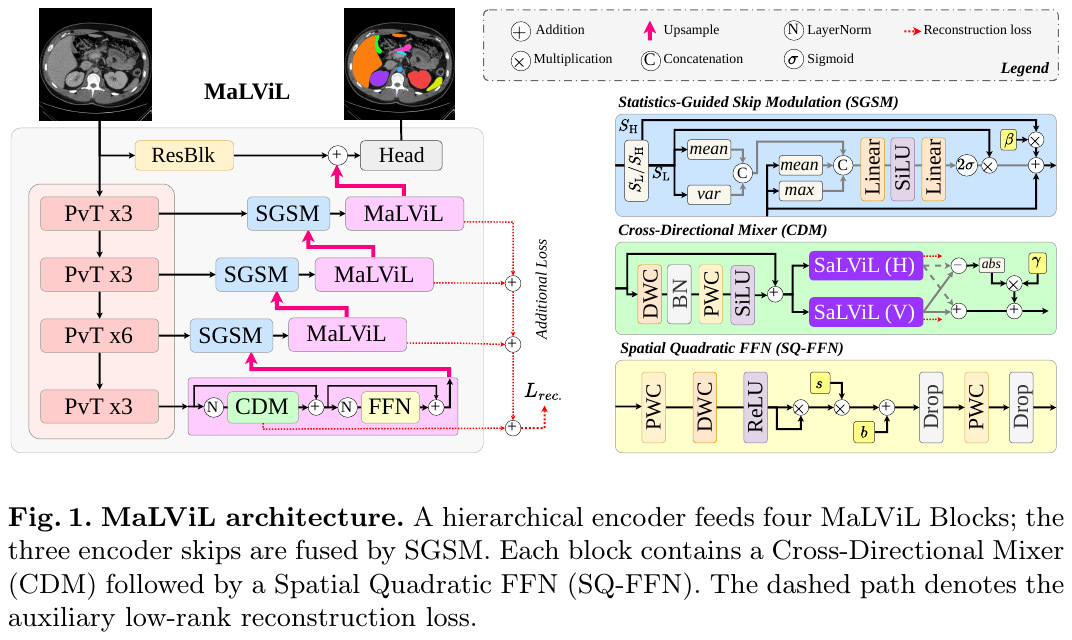
You do not need to clone anything. PyTorch Hub fetches the model code from GitHub, and the weights are downloaded from this repository.
pip install torch torchvision "timm>=1.0.15" einops "numpy<2" scipy SimpleITK huggingface_hub
The predictor applies the training preprocessing and returns a mask with the size of your input.
import torch

# Skin lesion (dermoscopy image)
skin = torch.hub.load("xmindflow/MaLViL", "predictor", dataset="isic2018", trust_repo=True)
mask = skin.predict("lesion.jpg")            # (H, W): 0 = background, 1 = lesion

# Abdominal CT (NIfTI volume, processed slice by slice)
ct = torch.hub.load("xmindflow/MaLViL", "predictor", dataset="synapse", trust_repo=True)
mask = ct.predict("abdomen_ct.nii.gz")       # (D, H, W)
print(ct.classes)                            # label names, index = label value
predict accepts a file path (.png, .jpg, .npy, .nii, .nii.gz), a PIL image or a NumPy array. It runs on the GPU if one is available.
model = torch.hub.load("xmindflow/MaLViL", "malvil", dataset="synapse", trust_repo=True)
x = torch.randn(1, 1, 224, 224)              # one preprocessed slice
with torch.no_grad():
    (logits,), rec_error = model(x)          # logits: (1, 9, 224, 224)
pred = logits.argmax(dim=1)
malvil_custom returns an untrained network with an ImageNet PVTv2-B2 encoder, for your own training loop. The network is built for one input size, a multiple of 32.
net = torch.hub.load("xmindflow/MaLViL", "malvil_custom", in_chs=3, n_classes=4, img_size=224, trust_repo=True)
(logits,), rec_error = net(images)
loss = criterion(logits, labels) + 0.01 * rec_error
The repository also has a ready training and evaluation script that takes a folder of images and masks.
dataset |
Task | Input | Labels | File |
|---|---|---|---|---|
synapse |
Abdominal CT, 8 organs | 1 × 224 × 224 | 0 background, 1 aorta, 2 gallbladder, 3 left kidney, 4 right kidney, 5 liver, 6 pancreas, 7 spleen, 8 stomach | malvil-synapse.pth |
busi |
Breast ultrasound | 1 × 256 × 256 | 0 background, 1 lesion | malvil-busi.pth |
ham10000 |
Skin lesion | 3 × 224 × 224 | 0 background, 1 lesion | malvil-ham10000.pth |
ph2 |
Skin lesion | 3 × 224 × 224 | 0 background, 1 lesion | malvil-ph2.pth |
isic2017 |
Skin lesion | 3 × 224 × 224 | 0 background, 1 lesion | malvil-isic2017.pth |
isic2018 |
Skin lesion | 3 × 224 × 224 | 0 background, 1 lesion | malvil-isic2018.pth |
Each file is a plain PyTorch state_dict (about 150 MB). The network has size-dependent parameters, so BUSI weights only load at 256 and the others only at 224.
The predictor does this for you. If you call the model directly, prepare inputs the same way:
Predictions are resized back to the input size with nearest-neighbor interpolation.
These are retrained checkpoints, so they differ slightly from the tables in the paper. Each row was measured with scripts/main.sh DATASET TEST from the repository. All use AdamW and a learning rate of 1e-4.
| Dataset | Input | Epochs | Batch size | Seed | Loss | Dice | Acc | IoU |
|---|---|---|---|---|---|---|---|---|
| PH² | 224 | 150 | 8 | 2222 | dice+ce | 95.78 | 97.54 | 92.06 |
| HAM10000 | 224 | 20 | 16 | 1234 | dice+ce | 95.15 | 97.51 | 91.40 |
| ISIC 2017 | 224 | 40 | 8 | 1234 | dice+ce | 92.13 | 97.14 | 86.22 |
| ISIC 2018 | 224 | 40 | 8 | 1234 | dice+ce | 91.08 | 96.53 | 84.92 |
| BUSI | 256 | 50 | 8 | 1234 | dice+ce | 82.38 | 96.92 | 74.33 |
| Synapse | 224 | 350 | 8 | 42 | boundary | 85.68 (HD95 17.01) |
hf download afshinbigboy/MaLViL --include "*.pth" --local-dir weights
or in Python:
from huggingface_hub import hf_hub_download
path = hf_hub_download(repo_id="afshinbigboy/MaLViL", filename="malvil-synapse.pth")
These models are for research only. They are not a medical device and must not be used for diagnosis or treatment decisions. Each model was trained on a single public dataset and may perform poorly on images from other scanners, protocols or populations.
The code and weights are released under the MIT license. The training datasets have their own terms (for example, HAM10000 is CC BY-NC 4.0), so please also respect the license of each dataset.
If you use MaLViL, please cite:
@inproceedings{bozorgpour2026malvil,
  title         = {{MaLViL}: Multi-axis Low-rank Vision-{LSTM} for Medical Image Segmentation},
  author        = {Bozorgpour, Afshin and Ghorbani Kolahi, Sina and Heidari, Moein and Hacihaliloglu, Ilker and Merhof, Dorit},
  booktitle     = {Medical Image Computing and Computer Assisted Intervention -- MICCAI 2026 Workshops and Challenges (MLMI)},
  series        = {Lecture Notes in Computer Science},
  volume        = {17272},
  publisher     = {Springer Nature Switzerland},
  year          = {2026},
  eprint        = {2608.17635},
  archivePrefix = {arXiv},
  primaryClass  = {cs.CV}
}