


Ar2Can: An Architect and an Artist Leveraging a Canvas for Multi-Human Generation
Paper • 2511.22690 • Published • 1
Ar2Can is a two-stage LoRA adapter pipeline for multi-reference face composition in multi-human image generation. It uses two adapters: an Architect (on FLUX.1-schnell) for scene layout, and an Artist (on FLUX.1-Kontext-dev) for identity-preserving rendering.


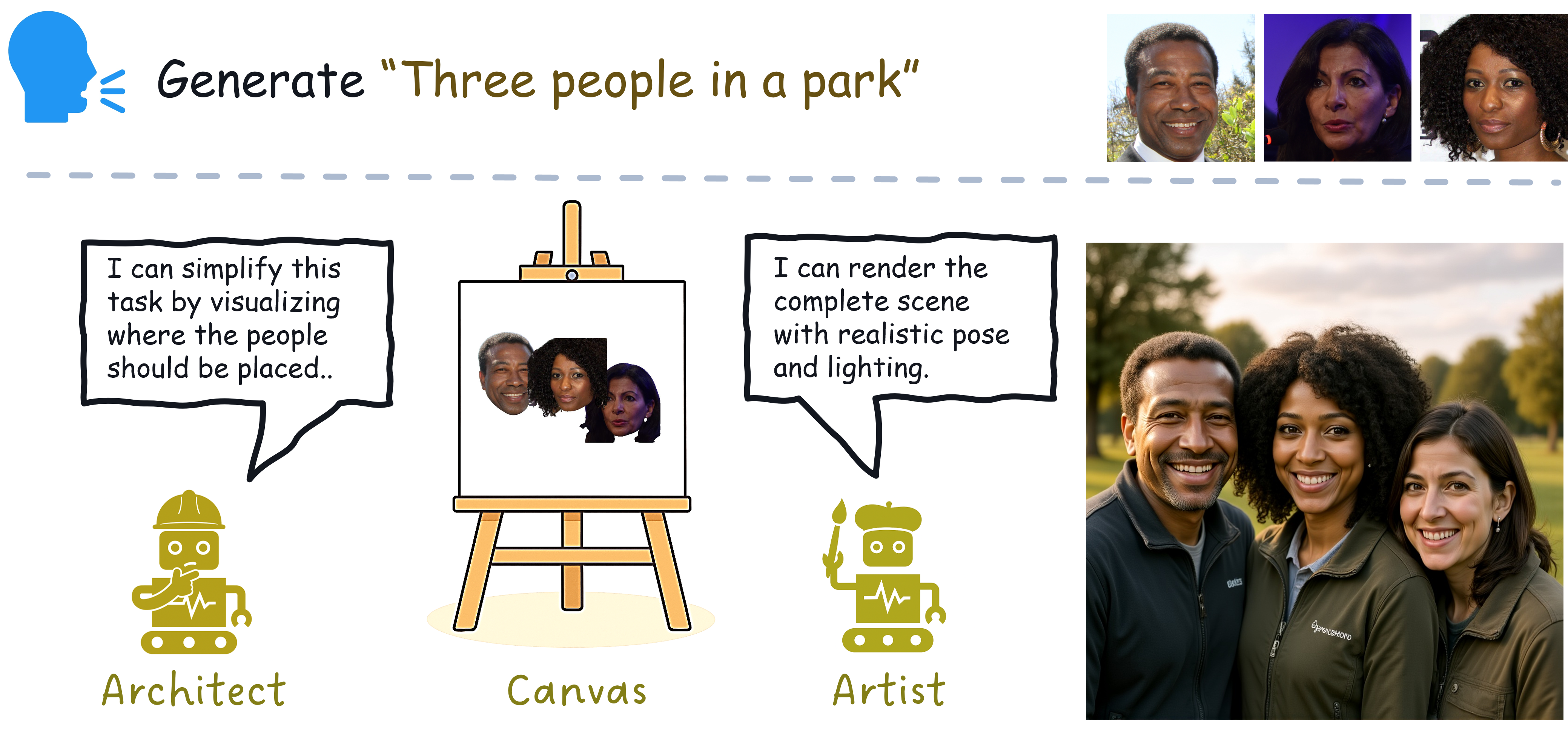
Despite recent advances in personalized image generation, existing models consistently fail to produce reliable multi-human scenes, often merging or losing facial identity. We present Ar2Can, a novel two-stage framework that disentangles spatial planning from identity rendering for multi-human generation. The Architect predicts structured layouts, specifying where each person should appear. The Artist then synthesizes photorealistic images, guided by a spatially-grounded face matching reward that combines Hungarian spatial alignment with identity similarity. This approach ensures faces are rendered at correct locations and faithfully preserve reference identities. We develop two Architect variants, seamlessly integrated with our diffusion-based Artist model. This is optimized via Group Relative Policy Optimization (GRPO) using compositional rewards for count accuracy, image quality, and identity matching. Evaluated on the MultiHuman-Testbench, Ar2Can achieves substantial improvements in both count accuracy and identity preservation, while maintaining high perceptual quality. Notably, our method achieves these results using primarily synthetic data, without requiring real multi-human images.
This repo contains two LoRA adapters in separate subdirectories:
| Adapter | Subdirectory | Base model | Purpose |
|---|---|---|---|
| Architect | architect/ |
black-forest-labs/FLUX.1-schnell |
Generates scene layout / probe image |
| Artist | artist/ |
black-forest-labs/FLUX.1-Kontext-dev |
Renders final identity-preserving composition |
Both adapters share the same LoRA configuration:
| Field | Value |
|---|---|
| Adapter type | LoRA (PEFT) |
| LoRA rank (r) | 64 |
| LoRA alpha | 128 |
| Dropout | 0.0 |
| Weight init | Gaussian |
Architect target modules: attn.to_q, attn.to_k, attn.to_v, attn.to_out.0, attn.to_add_out, attn.add_q_proj, attn.add_k_proj, attn.add_v_proj, ff.net.0.proj, ff.net.2, ff_context.net.0.proj, ff_context.net.2
Artist target modules: attn.to_q, attn.to_k, attn.to_v, attn.to_out.0, attn.to_add_out, attn.add_q_proj, attn.add_k_proj, attn.add_v_proj, ff.net.0.proj, ff.net.2, ff_context.net.0.proj, ff_context.net.2, proj_mlp
Clone the repo — weights are pulled automatically from HuggingFace on first run:
git clone https://github.com/Qualcomm-AI-research/ar2can.git
cd ar2can
Run inference:
python infer.py \
  --faces faces/person_1.webp faces/person_2.webp faces/person_3.webp \
  --prompt "Three people standing side-by-side in a winter landscape, 8K, ultra-realistic, preserve exact facial identity."
Or launch the Gradio demo:
python app.py
# open http://localhost:7865
If you prefer locally downloaded weights (e.g. from GitHub Releases), place them at loras/architect/adapter_model.safetensors and loras/artist/adapter_model.safetensors — the code will use the local copies automatically.
Two people on a sunny beach, ultra-realistic, 8K, preserve exact facial identity.
Three people standing side-by-side in a winter landscape, realistic light rendering, preserve exact facial identity.
Four people in a city plaza at midday, high fidelity, preserve exact facial identity.
Ar2Can is trained with Flow-GRPO, a flow-matching adaptation of Group Relative Policy Optimization (GRPO):
@inproceedings{borse2026ar2can,
  title={Ar2can: An architect and an artist leveraging a canvas for multi-human generation},
  author={Borse, Shubhankar and Pham, Phuc and Farhadzadeh, Farzad and Choi, Seokeon and Nguyen, Phong and Tran, Anh and Yun, Sungrack and Hayat, Munawar and Porikli, Fatih},
  booktitle={Proceedings of the IEEE/CVF Conference on Computer Vision and Pattern Recognition},
  pages={550--560},
  year={2026}
}
Disclaimer: The model weights released here are not identical to the model reported in the paper. They are provided for research and demonstration purposes only. Performance may vary from the results reported in the paper.
The Architect LoRA weights are derived from FLUX.1-schnell, which is released under the Apache 2.0 License.
The Artist LoRA weights are derived from FLUX.1-Kontext-dev, which is released under a Non-commercial License. Any use of the Artist LoRA weights must comply with those Non-commercial License terms.
Copyright (c) Qualcomm Technologies, Inc. and/or its subsidiaries.
Base model
black-forest-labs/FLUX.1-Kontext-dev