

SAMBA: Toward an EEG Foundation Model via Differential Mamba and Coordinate-Driven Spatial Embedding
Paper • 2511.18571 • Published
EEG representation models. Project website · Code · Paper
SAMBA was developed during my 2025 internship at Emotiv. The original checkpoints are no longer available, so we retrained both models. SAMBA-100s follows the original training method with a rebuilt TUAB pipeline and validation split. SAMBA-2s adds HBN, Muse, and DICE to the Emotiv data for greater electrode-layout diversity.
Both models use 128 Hz EEG. The names indicate the pretraining window; the encoders support other input lengths and channel layouts.
| SAMBA-2s | SAMBA-100s | |
|---|---|---|
| Window | 2 s, 256 samples | 100 s, 12,800 samples |
| Data | Emotiv¹, HBN, Muse, DICE | TUAB |
| Pretraining channels | 4, 14, 19, 129 | 16 bipolar |
| Parameters | 1.06M | 1.06M |
¹ Alpha, Attention, Crowdsource, DriverDistraction, and STEW.
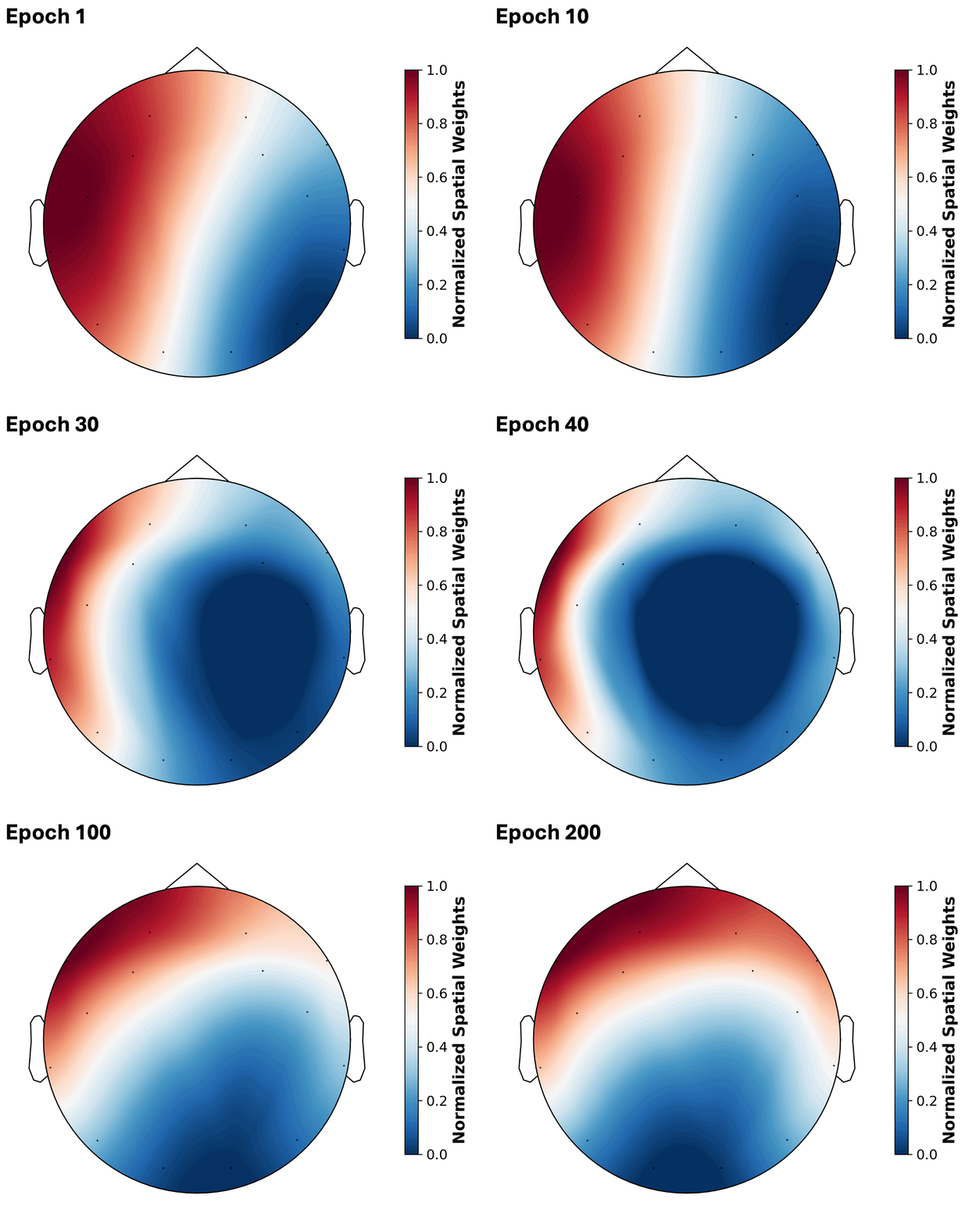
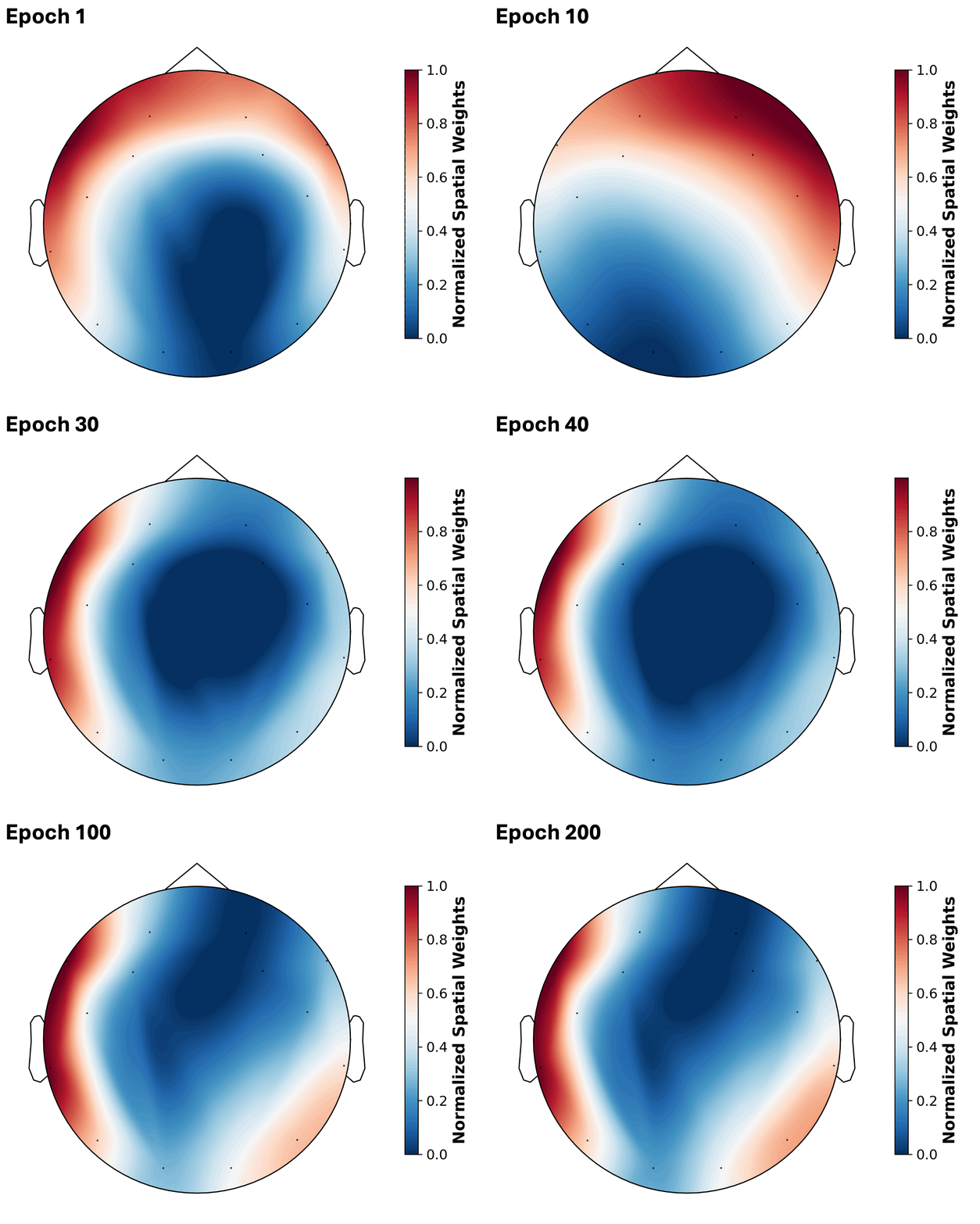
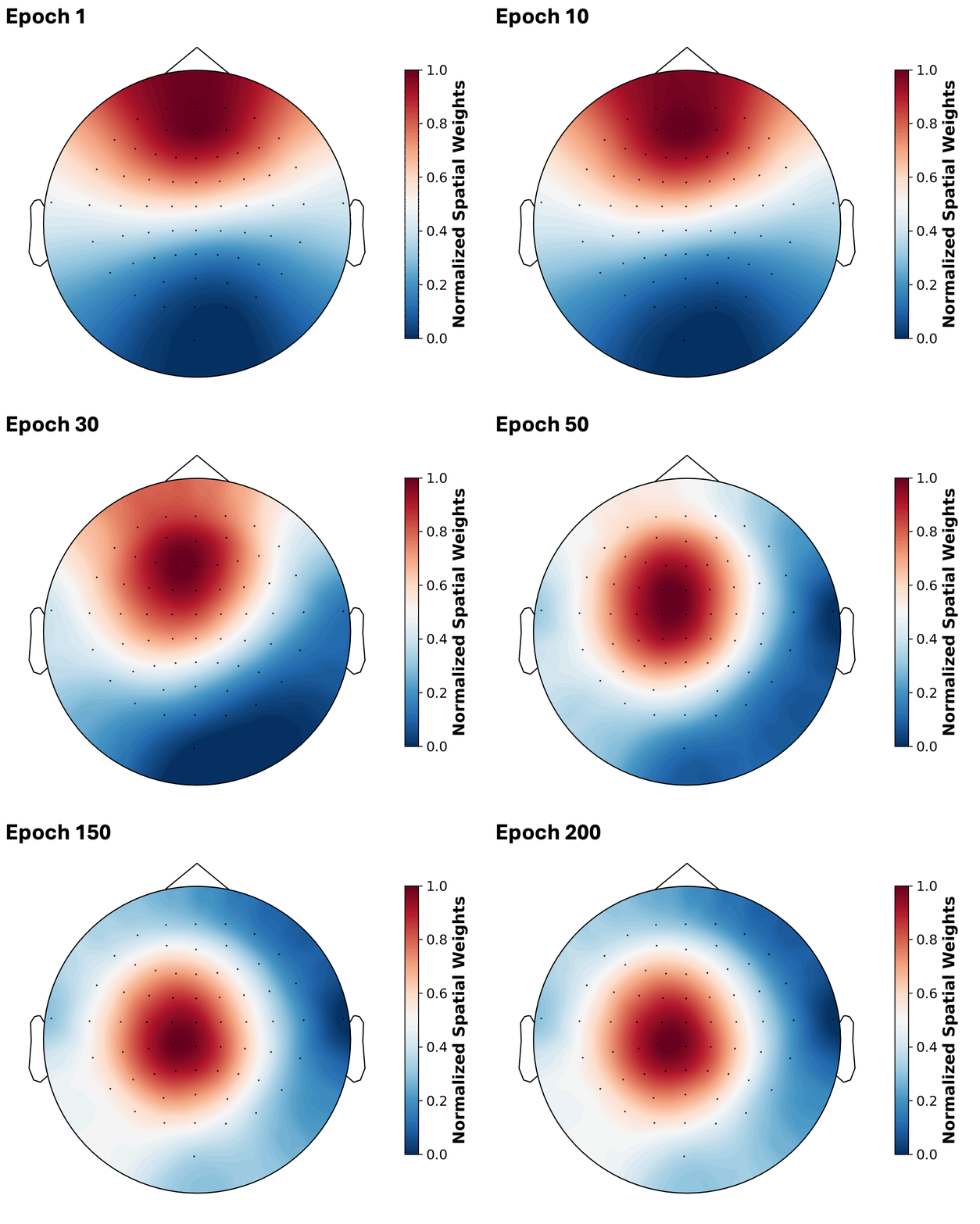
SAMBA uses electrode coordinates to learn how to combine EEG channels. These maps show how the spatial weights change during training.
| Eyes open vs. closed | Driver distraction | Motor imagery |
|---|---|---|
 |
 |
 |
Requires a compatible CUDA system.
git clone https://github.com/Jiazhen-Hong/SAMBA.git
cd SAMBA
pip install -e '.[mamba,hub]'
from pathlib import Path
import torch
from huggingface_hub import snapshot_download
from samba_eeg import SambaModel

variant = "SAMBA-2s"  # or "SAMBA-100s"
folder = snapshot_download(
    "Jay1208/SAMBA",
    allow_patterns=[f"{variant}/*"],
)
model = SambaModel.from_pretrained(Path(folder) / variant).cuda().eval()
Prepare EEG at 128 Hz:
signals: [batch, channels, samples].positions: [channels, 3] or [batch, channels, 3], matching the channel order and the coordinate units and frame in config.json.signals = signals.to(device="cuda", dtype=torch.float32)
positions = positions.to(device="cuda", dtype=torch.float32)
# Skip if already normalized.
scale = torch.quantile(signals.abs(), 0.95, dim=-1, keepdim=True)
signals = signals / scale.clamp_min(1e-8)
with torch.inference_mode():
features = model.encode(signals, positions)
pooled_features = features.mean(dim=1)
features has shape [batch, floor(samples / 8), 128]. Use the pooled features for linear probing, or fine-tune the encoder.
@article{hong2026samba,
  title={SAMBA: Toward an EEG Foundation Model via Differential Mamba and Coordinate-Driven Spatial Embedding},
  author={Hong, Jiazhen and Mackellar, Geoffrey and Ghane, Soheila},
  journal={arXiv preprint arXiv:2511.18571},
  year={2026}
}