

Index-Translate
Collection
Index‐Translate: A Multilingual Translation Model Family
From text & vision to speech, bring meaning across languages • 44 items • Updated • 31
🌐 Online demo ·  GitHub · 📚 Technical report · 🤗 Hugging Face collection ·
  ModelScope collection
Index-Echo-S2ST-2B translates a Chinese, Japanese, or English speech clip into another language and generates speech conditioned on the source speaker's voice. It combines a frozen Index-Echo-S2TT-2B-family backbone, a learned Hidden2CV mapper, and CosyVoice3 speech generation in one self-contained package and Python process.
The release supports twelve directions: Chinese → English/Spanish/Japanese/Korean, Japanese → English/Spanish/Korean/Chinese, and English → Chinese/Spanish/Japanese/Korean. The caller specifies the target language; the package infers the source language from its source transcript. 2B denotes the speech translator's decoder size, rather than the total size of all packaged components.
This v4.1 package supersedes the initial six-direction release: it adds Japanese source input, Korean target output, and Japanese → Chinese, and its mapper is tuned with one round of rejection-sampling fine-tuning (RFT) on top of distillation.
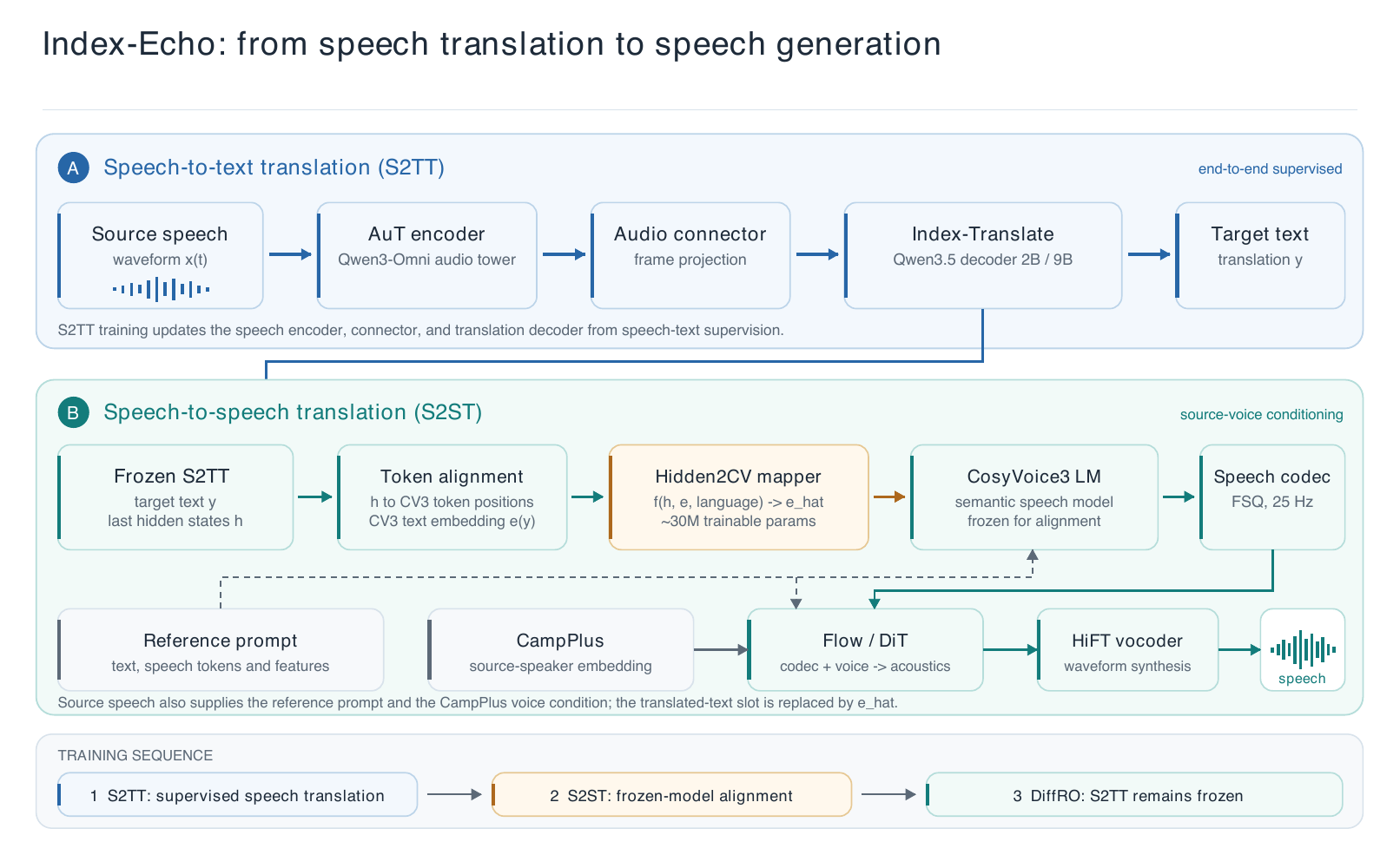
The report's lower path extends S2TT to S2ST: the frozen speech translator supplies its final hidden states to Hidden2CV, which connects to CosyVoice3 speech generation. Source audio supplies the reference prompt and CampPlus speaker embedding for voice conditioning. The S2TT backbone remains frozen throughout S2ST training.
The technical report initializes S2ST from the trained Index-Echo S2TT model, whose Qwen3-Omni AuT audio encoder and connector feed an Index-Translate decoder. The speech-generation path uses a roughly 26M-parameter Hidden2CV mapper to connect the translator's final hidden states to the CosyVoice3 semantic layer.
Training first distills the mapper with both the S2TT backbone and speech generator frozen, then applies a round of rejection-sampling fine-tuning (RFT): best-of-G samples are drawn from the distilled mapper's own synthesis pool, scored, and replayed with ground-truth anchoring. The S2TT backbone remains frozen throughout. At inference, source audio supplies the reference prompt and CampPlus speaker embedding for voice conditioning. Voice similarity varies with the source, target language, and synthesis result.
The translator in this package is the EXP-59 checkpoint, whose continued pre-training adds Japanese-source speech understanding on top of the released S2TT recipe; a 40/40 probe set passes for both genuine English and Japanese source audio.
Download the complete model package before importing its local modeling_dubbing.py:
pip install -U huggingface_hub
hf download IndexTeam/Index-Echo-S2ST-2B --local-dir ./Index-Echo-S2ST-2B
cd Index-Echo-S2ST-2B
The release documents the following tested dependency pins. Use CUDA-compatible PyTorch wheels; the +cu129 builds require a wheel source that provides that CUDA build. System ffmpeg must be on PATH.
pip install torch==2.11.0+cu129 torchaudio==2.11.0+cu129 transformers==5.6.0 \
    tokenizers==0.22.2 librosa==1.0.0 onnxruntime==1.30.0 wetext==0.0.4 \
    kaldifst==1.8.0 conformer==0.3.2 hydra-core==1.3.7 HyperPyYAML==1.2.3 \
    lightning==2.6.6 x-transformers==2.11.24 einx==0.4.3 frozendict==2.4.7 \
    pyworld==0.3.5 soundfile==0.13.1 modelscope==1.37.1 safetensors==0.7.0 \
    numpy==2.4.6 openai-whisper==20250625
openai-whisper is used only for the package's ASR-based evaluation/self-check. The Japanese frontend (pyopenjtalk==0.4.1, including its dictionary, and pykakasi==2.3.0) is vendored under code/ja_ext/; the pipeline adds it to the import path automatically. All components run in one Python environment and process.
The package automatically applies two CosyVoice3 compatibility patches for Transformers 5.6 in code/tts/pipeline.py: keeping the CosyVoice3 LLM in fp32, and providing the full visible attention mask during autoregressive decoding. Keep the bundled code and dependency pins together.
Run this from the downloaded package directory, with input clips available at the indicated paths:
from modeling_dubbing import DubbingBridgeModel

model = DubbingBridgeModel.from_pretrained('.', device='cuda')

# Chinese source: four supported targets.
wav, sr = model.dub('input_zh.wav', lang='en', out_wav='dub_en.wav')
model.dub('input_zh.wav', lang='ko', out_wav='dub_ko.wav')

# Japanese source: four supported targets, including Chinese.
model.dub('input_ja.wav', lang='zh', out_wav='dub_zh.wav')
model.dub('input_ja.wav', lang='en', out_wav='dub_en2.wav')

# English source: four supported targets.
model.dub('input_en.wav', lang='ja', out_wav='dub_ja.wav')
model.dub('input_en.wav', lang='es', out_wav='dub_es.wav')

wav, sr, info = model.dub('input_ja.wav', lang='en', return_info=True)
print(sr)               # 24000 Hz
print(info['src_lang']) # Detected source language: 'zh', 'ja', or 'en'
print(info['tgt_raw'])  # Model translation, before the speech frontend's normalization.
print(info['tgt_cv'])   # Speech-frontend text; Japanese uses a katakana representation.
lang always means the target language: en, es, ja, ko, or zh. The source language is detected from the transcript of the source audio: a transcript containing kana is treated as Japanese, one containing CJK ideographs as Chinese, and otherwise English; it is not a general language identifier. Source and target must differ; zh→zh and en→en raise an error. The waveform is a float32 tensor of shape (1, T) at 24 kHz. out_wav saves it to a file. With return_info=True, the third return value includes the transcript, translation, source language, and synthesis diagnostics.
English-source input must be genuine English speech: heavily accented synthetic English (for example, TTS English read with a Chinese accent) can make the translator's transcript collapse into kana. That is a translator hearing boundary, not a mapper fault.
At the lower pipeline layer, extract(audio_path, lang) returns the translated text and aligned hidden states separately from synthesis. See the S2ST inference guide for the dub.py wrapper, and the video pipeline for segmentation and video timeline alignment.
| Stage or setting | Released default |
|---|---|
| Transcription and translation | Greedy, temperature=0.0 / do_sample=False |
| Transcription/translation budget | max_new_tokens=1024 |
| Speech mode | h2cv (the only supported mode in this package) |
| Speech-token budget | max_tokens=1500; actual cap min(20 * m, 1500), where m is aligned target-text token count |
| Minimum speech length | 2 * m tokens before stop tokens are allowed |
| Speech sampling | sampling=25; release notes describe ras_sampling, top-k 25 / top-p 0.8 |
| Speech-generation seed | 42 |
| Synthesis speed | 1.0 |
| Output sample rate | 24000 Hz |
| CosyVoice3 execution | stream=False, load_trt=False, load_vllm=False, fp16=False; LLM kept in fp32 |
| Chunked orchestration | Disabled (chunk=False) |
Greedy transcription/translation does not make speech synthesis greedy. The public DubbingBridgeModel.dub wrapper does not expose a seed argument; seed changes are available through the lower-level pipeline's dub/synth APIs. Sampling may vary between calls even with the default seed, as documented in the release notes.
The public wrapper and lower pipeline expose different controls.
| Interface | Parameter | Default | Behavior |
|---|---|---|---|
from_pretrained |
model_dir |
Required | Local directory containing the full package |
from_pretrained |
device |
cuda |
CUDA device for the loaded components |
from_pretrained |
mode |
None → config default h2cv |
Sets the default speech mode |
Public dub |
audio_path |
Required | Chinese, Japanese, or English source clip |
Public dub |
lang |
en |
Target language: en, es, ja, ko, zh; must differ from detected source |
Public dub |
out_wav |
None |
Save path; None creates a temporary WAV |
Public dub |
mode |
None → loaded default |
Only h2cv is accepted |
Public dub |
chunk |
False |
True is unsupported in this release |
Public dub |
return_info |
False |
Adds transcript, translation, and synthesis diagnostics to the return value |
Pipeline extract |
lang |
en |
Target language for transcription/translation and alignment |
Pipeline extract |
max_new_tokens |
1024 |
Transcription/translation output budget |
Pipeline synth |
out_wav |
None |
Optional output save path |
Pipeline synth |
max_tokens |
1500 |
Upper bound on generated speech tokens |
Pipeline synth |
seed |
42 |
Seed set before speech-token generation and acoustic synthesis |
Pipeline synth |
prompt_wav |
None |
Uses the source audio unless a reference clip is supplied |
Pipeline synth |
prompt_text |
None |
Uses the source transcript unless reference text is supplied |
For explicit text/speech budgets or seed control, use the lower pipeline after loading model as above:
pipe = model._pipe
ext = pipe.extract('input_zh.wav', lang='en', max_new_tokens=1024)
wav, info = pipe.synth(ext, out_wav='dub_en.wav', max_tokens=1500, seed=42)
The lower pipeline's dub(..., **kw) forwards synthesis options such as seed and max_tokens; changing the translation budget requires calling extract separately. Sampling argument 25 and synthesis speed 1.0 are fixed in the released pipeline code, not keyword arguments of the public wrapper. Translation stops at tokenizer EOS or <|im_end|>; speech generation uses CosyVoice3's defined stop tokens and the length limits above. The script does not explicitly override other text-generation knobs such as top_p, top_k, or repetition penalties.
Content fidelity is measured per direction by reading the synthesized speech back with whisper-large-v3 and comparing it against the translator's own target text: WER for English and Spanish targets, CER for Japanese, Korean, and Chinese targets (median, n=200 per axis; held-out cohorts excluded from mapper training). This caliber measures acoustic fidelity and controllability of the speech-generation path — the reference translation is produced by this chain's own speech translator, so it is not an independent translation-quality benchmark. These are different metrics and test sets; do not compare values directly across target languages.
| Direction | Median | Direction | Median | |
|---|---|---|---|---|
| zh→en | 0.036 WER | ja→zh | 0.050 CER | |
| zh→es | 0.062 WER | en→zh | 0.000 CER | |
| zh→ja | 0.059 CER | en→es | 0.111 WER | |
| zh→ko | 0.020 CER | en→ja | 0.000 CER | |
| ja→en | 0.037 WER | en→ko | 0.000 CER | |
| ja→es | 0.051 WER | ja→ko | 0.020 CER |
Against the distilled (pre-RFT) mapper, the RFT round improves the 22-axis paired macro trim-10 mean from 0.0683 to 0.0612 (−10.4%), with three directions significantly better (zh→ko, ja→zh, en→ko) and no direction significantly regressed under per-utterance paired testing. Compared with the initial six-direction release on the same cohort, all six shared directions are significantly better (note the reference translations favor this chain, so treat that comparison as directional evidence). Full numbers are recorded in config.json under eval_s2_metrics.
| File or directory | Purpose |
|---|---|
config.json, modeling_dubbing.py |
Component configuration and DubbingBridgeModel interface |
stlm_llm/ |
Qwen3.5-family translator decoder and tokenizer (EXP-59) |
stlm_ckpt/ |
Trained audio encoder/connector checkpoint |
stlm_omni/ |
Qwen3-Omni configuration and AuT source components |
cosyvoice3/ |
CosyVoice3 LLM, flow, HiFT, and ONNX assets |
bridge/ |
mapper.safetensors, mapper_config.json (5 language slots), and mapper_best_5slot.pt checkpoint archive |
code/bridge/ko_norm.py |
Korean text normalization (character-level; ASCII digits to Korean number words) |
wetext_en_tn/, wetext_repo/ |
Offline text-normalization assets |
code/tts/, code/stlm/, code/bridge/ |
Dubbing, speech translation, and mapper implementation |
code/ja_ext/, code/cosyvoice_repo/ |
Vendored Japanese frontend and CosyVoice inference code |
samples/, verify_export.py |
Input clips, reference dubs, and export/self-check assets |
The loader prefers safetensors for the translator, mapper, and CosyVoice3 components, with original-format fallback. The export records version v4.1.0-ml-s2full12-v4rft-stlm59 (2026-10-12), translator EXP-59 iter14535, and mapper h2cv_ml_s2_full12_v4/mapper_best_5slot (distilled, then one RFT round). Keep bundled assets together for offline loading. Use materialized copies (cp -rL or an appropriate rsync configuration) when copying training-side packages whose weight files are hard links.
| Direction | Translator text used for alignment | Speech-frontend text | Hidden-state alignment |
|---|---|---|---|
| zh→en | Normalized English | Same normalized text | Character-overlap mean pooling |
| zh→es | Normalized Spanish | Same normalized text | Character-overlap mean pooling |
| zh→ja | Original mixed-script Japanese | Katakana frontend representation | Word mapping to original text, then pooling |
| zh→ko | Original translation | Normalized Korean (character-level) | Coordinate remap to original text, then pooling |
| ja→* | Same per-target rules as zh source | ||
| en→zh | Original translation | Wetext-normalized Chinese | Character-overlap mean pooling |
| en→es | Original translation | Normalized Spanish | Character-overlap mean pooling |
| en→ja | Original mixed-script Japanese | Katakana frontend representation | Word mapping to original text, then pooling |
| en→ko | Original translation | Normalized Korean (character-level) | Coordinate remap to original text, then pooling |
The source transcript is the first nonempty line and the translation is the last nonempty line of translator output. The mapper's language-slot list is ['en', 'es', 'ja', 'ko', 'zh'] with indices en=0, es=1, ja=2, ko=3, zh=4; the loader asserts this mapping. Do not reorder it when modifying or converting the package. (The 5-slot mapper is a numerically exact trim of the 13-slot training mapper — forward outputs match with max abs diff 0.0.)
chunk=True raises NotImplementedError in this release.kernel size > input size). For production Japanese output, use zh→ja or en→ja.zh→zh and en→en are unsupported (extract raises an error); for dubbing in the source language, use the source audio directly.tgt_raw and tgt_cv when fidelity is important.| Family | Task | Released sizes |
|---|---|---|
| Index-Translate | Text translation and translation instructions across 150 languages | 2B, 9B, 35B-A3B (preview) |
| Index-Echo S2TT | Speech-to-text translation and subtitles | 2B, 9B |
| Index-Echo S2ST | Speech-to-speech translation with source-voice conditioning | 2B, 9B |
| Index-Homura | Translation with a target syllable count | 2B, 9B |
| Index-NativeLong | Native long-document translation; released as Index-Nailong | 2B, 9B |
The text foundation's 150-language coverage does not describe the released speech interfaces. Use the task-specific directions documented above.
@techreport{indextranslate2026,
  author={Tianjiao Li and Mengran Yu and Chenyu Shi and Lusheng Zhang and
          Qisi Chen and Yanshan Zhou and Ji Qi and Jingying Liu and
          Yuang Feng and Ziang Cui and Tianxing Yan},
  title={Index-Translate: A Multilingual Translation Model Family --- Text, Speech, Controlled Dubbing, and Long-Document Translation},
  institution={Index LLM Team},
  year={2026},
  month={September}
}
Apache-2.0. Questions and feedback are welcome through GitHub Issues.