

 |
MK-SH-Va 260M visual decision model: calibrated probabilities, a choice, and a refusal below the gate |
A decision model of about 260M parameters that answers typed questions over a described state and an image: given an image (a document page or a mobile or desktop screenshot), a state, a question and a list of options, it returns calibrated probabilities, a choice, and an explicit abstention when confidence is insufficient. One single tower reads pixels and text in the same pass; each option is marked inline and scored by a shared head. Its differentiating capability is measured abstention: a decision threshold whose selective risk was validated on held-out data with exact Clopper-Pearson bounds, under criteria frozen before any measurement.
27-second film; every number in it is measured (real model outputs, E41 accuracy, E42 risk bounds).
The published weights are the E41 seed-42 checkpoint (model.safetensors,
sha256 4fc57530…, exported from best.pt sha256 e4b4f6f5…, best step
2,000), trained with the E39 recipe plus real CC-BY data (CORD train
receipts, GUI-Odyssey task_split train episodes). Seed 43 (30f2eb42…) was
trained and evaluated the same way and is reported alongside as the
replication; it is not part of this upload. Calibration and the abstention
policy were added afterwards in experiment E42, fitted on dedicated
calibration splits without touching a single weight. inference-policy.json
carries the full policy for this checkpoint: the temperature, the gate, and
the response semantics.
Interactive demo: Gjusev/MK-SH-V-demo (Gradio, CPU). Four real cases decide in one click: a screenshot it answers, receipts it refuses. Code, criteria and per-case results: github.com/Gjusev/mk-sh-v.
What it is for
Each case names the measured capability it rests on, and where that measurement stops.
- Decisions over screenshots and document pages. "Does this screenshot show the goal as completed", document type and form state, urgency of a ticket shown on screen. Rests on real-image accuracy 0.765/0.742 on 2,586 held-out cases (CORD receipts + GUI-Odyssey screenshots, E41): on GUI-Odyssey task completion the 260M model reaches 0.826/0.783 against 0.731 for a zero-shot ~4B comparator and 0.472 for an OCR pipeline. Bound: two decision families mapped from those sources into binary questions in EN/ES/DE with our templates; on CORD receipt thresholds the model (0.550/0.602) stays below a deterministic rules baseline (0.594) and the large comparator (0.972).
- Calibrated probabilities with a safety valve. Temperature T and gate τ fitted on calibration splits disjoint from every reported set (E42): on the held-out synthetic test, both checkpoints keep over 86 % coverage with a 95 % Clopper-Pearson upper bound on selective risk of 3.23 % and 3.43 % (budget 5 %). Suited to decision queues where refusals go to human review. Bound: that guarantee is protocol- and distribution-specific (our synthetic families). On real screenshots the gate currently keeps 98 % of cases while 17 to 21 % of kept answers are wrong; on real receipts it abstains from almost everything (coverage 2 to 12 %). No abstention claim is made beyond the evaluated protocol.
- Mixed text and visual decision queues. Text competence is retained through replay-mixing: 1.000/1.000 on the MK-SH-1 numeric order set (testC, MK-SH-1 itself 0.979) and 0.810/0.830 on the routing task set (MK-SH-1 0.800). Bound: descriptive only; the shipped policy was fitted on the visual calibration split, and task-set selective risk is 16 to 18 %.
- A methodological template. Six experiments (E37 to E42) with criteria frozen and committed before each measurement, per-case outputs for every number, episode-grouped statistics, and published failure modes. Bound: one architecture, two real sources, 260M scale; not claimed beyond what the campaign measured.
Measured capability

Real images, held-out 2,586 cases (labels from each source's ground truth; details and provenance in the training repo):
| Arm | Params | Real overall | CORD thresholds | GUI task done | Regime |
|---|---|---|---|---|---|
| MK-SH-V s42 | 260M | 0.765 | 0.550 | 0.826 | task-trained |
| MK-SH-V s43 | 260M | 0.742 | 0.602 | 0.783 | task-trained |
| jev-vlm-4b | ~4B | 0.785 | 0.972 | 0.731 | zero-shot |
| OCR → MK-SH-1 | ~25M | 0.475 | 0.486 | 0.472 | task-trained |
| Same model, synthetic-only training | 260M | 0.471 | 0.394 | 0.493 | task-trained |
Moving from synthetic-only training to +10k real CC-BY rows (disjoint splits) changed real accuracy by +29.4 pp (CI95 [+25.9, +32.9], seed 42) and +27.2 pp ([+23.3, +31.3], seed 43), paired by episode. Overall the two seeds are statistically close to the ~15× larger zero-shot comparator (Δ CI95 [−5.4, +1.2] pp seed 42), which may have seen the evaluation sources in pretraining; unverifiable from its card.
Synthetic held-out test (own generator, 7 families, 4,200 cases): 0.908/0.909, a declared −2.5 pp versus the synthetic-only model, concentrated in field_threshold and form_complete (real-data number formats compete with the synthetic EUR convention); the other five families are at ceiling. French test 0.874/0.884.
Calibration & abstention (experiment E42)

Protocol, frozen before any measurement: T fitted by NLL on
cal_temperature (3,150 synthetic calibration cases); τ chosen on a
separate cal_policy split (3,150) as the smallest grid value whose
Clopper-Pearson 95 % upper bound on selective risk stays within the 5 %
budget; held-out sets reported with exact two-sided CP intervals, budget on
the upper end. Unlike an in-sample policy, every reported number below is
out-of-sample for both T and τ.
On our held-out synthetic evaluation, both 260M checkpoints achieved over 86 % coverage while maintaining a 95 % Clopper-Pearson upper confidence bound on selective risk below 5 %.
Two real cases through these weights and this policy:
| Input | Question | Calibrated probabilities | Output |
|---|---|---|---|
 |
Does the screenshot show the goal as completed? | true 0.999, false 0.001 | choice: true |
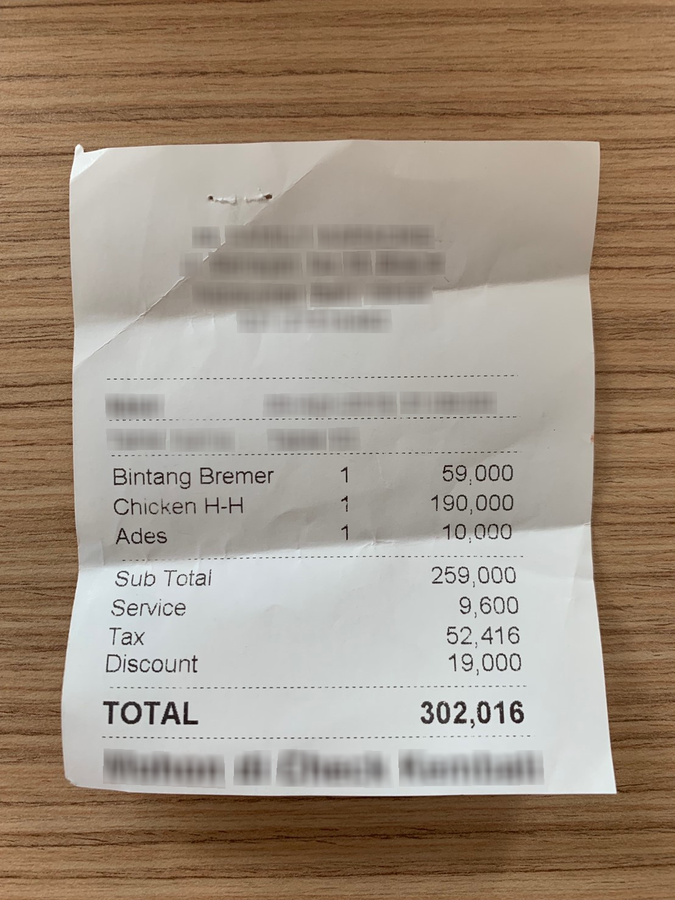 |
Is the total on this document at least 45.662 IDR? | false 0.507, true 0.493 | choice: null, below_validated_threshold |
The receipt's total is 302.016 IDR, so the right answer is true: the model leaned to false by a hair and the gate refused instead of answering wrong. On real receipts that refusal is the norm today (table below): honest, not yet useful there.
| Set | n | Coverage | Selective risk | 95 % interval | Budget |
|---|---|---|---|---|---|
| s42 synthetic test (non-FR) | 4,200 | 0.861 | 2.65 % | 2.2 to 3.2 % | held |
| s43 synthetic test (non-FR) | 4,200 | 0.864 | 2.84 % | 2.3 to 3.4 % | held |
| s42 synthetic test FR | 1,400 | 0.834 | 5.66 % | 4.4 to 7.1 % | point only |
| s43 synthetic test FR | 1,400 | 0.841 | 5.78 % | 4.5 to 7.3 % | point only |
| s42 real GUI | 2,010 | 0.983 | 16.7 % | 15.1 to 18.4 % | missed |
| s43 real GUI | 2,010 | 0.983 | 21.3 % | 19.5 to 23.1 % | missed |
| s42 real CORD | 576 | 0.023 | 38.5 % | 13.9 to 68.4 % | missed |
| s43 real CORD | 576 | 0.123 | 23.9 % | 14.6 to 35.5 % | missed |
| s42/s43 text testC | 48 | 1.000 | 0 % | 0 to 7.4 % | n too small |
| s42/s43 text task | 300 | 0.990 | 16.5 to 18.2 % | 12.5 to 23.1 % | missed |
T = 1.5455 (s42) and 1.2929 (s43), τ = 0.55 both; the full risk/coverage
curves per set and family are in the training repo (runs/e42-calib/,
deterministically regenerable). ECE after T: synthetic test 0.011/0.006,
real GUI 0.10/0.16, real overall 0.10/0.14. The confidence signal that
works on the synthetic distribution does not yet separate right from wrong
on real images: that is the campaign's declared open problem, not a hidden
one.
Usage
pip install "mksh-v @ git+https://github.com/Gjusev/mk-sh-v"
import json, torch
from PIL import Image
from huggingface_hub import hf_hub_download
from safetensors.torch import load_file
from mokka_decisions.contracts import DecisionCase, Option
from mksh_v.arch_a1v import NeoMMEMarkerScorer, forward_a1v

repo = "Gjusev/MK-SH-V"
policy = json.load(open(hf_hub_download(repo, "inference-policy.json")))
T = policy["temperature"]["value"]        # fitted on cal_temperature (E42)
tau = policy["abstention"]["threshold"]   # fitted on cal_policy (E42), CP-upper rule

model = NeoMMEMarkerScorer()              # Hcompany/NeoMME-260M backbone, marker head
model.ensure_markers(32)
model.load_state_dict(load_file(hf_hub_download(repo, "model.safetensors")), strict=True)
model.eval()

case = DecisionCase(
    id="q1", group_id="q1", source="me", language="en", domain="screens",
    state="Goal: print orders_nov.csv for the records",
    question="Does the screenshot show the goal as completed?",
    options=(Option(id="false", description="No"), Option(id="true", description="Yes")))
enc = model.encode_cases([case], max_state_tokens=700, max_option_tokens=96)
batch = model.build_batch(enc, [Image.open("screenshot.png").convert("RGB")], "cpu", max_side=1024)
with torch.inference_mode():
    probs = (forward_a1v(model, batch) / T).softmax(-1)[0].tolist()   # calibrated
top = max(range(len(probs)), key=probs.__getitem__)
choice = case.options[top].id if probs[top] >= tau else None   # None = below_validated_threshold
About one second per decision on a laptop CPU.
Architecture
NeoMMEMarkerScorer: single NeoMME-260M tower (Hcompany, Apache-2.0),
fine-tuned with a marker head. Sequence layout per case:
<doc> image-patch-grid state <eos> question [O0] option_0 [O1] option_1 …;
each option is marked by a learned inline marker token, the shared head
scores every marker in one pass, and the softmax runs over the valid
options only. It is not a chat model and generates no text.
Training / calibration provenance
Weights: E41 seeds 42/43, initialised from the E37 C3 checkpoint (sha
verified), 2,000 steps, effective batch 32, every 4th microbatch E35 text
replay and one slot of 4 real images (CORD train receipts; GUI-Odyssey
task_split train episodes), longest side 1,024 px, dev-half + real-dev
selection. Calibration + policy: experiment E42 (criteria frozen before
measurement; τ chosen by the CP-upper rule adopted from E40's evidence
before any E41 calibration output existed). Full record:
github.com/Gjusev/mk-sh-v
(docs/E37…E42 criteria, docs/status.md, per-case files under runs/).
Limitations (declared)
- Abstention is validated on the synthetic protocol only; on real images the gate either keeps confident errors (GUI) or refuses nearly everything (CORD). Per-domain thresholds or an OOD signal are open work.
- CORD receipt thresholds remain below the rules baseline; threshold questions over IDR-formatted totals are the largest accuracy gap.
- The real evaluation set (E38c) informed the error analysis that motivated the training data; it was never trained or tuned on, and all selection used separate dev splits. Disclosed for completeness.
- Single global temperature per checkpoint; text-set probabilities inherit a policy fitted on the visual calibration split (reported descriptively).
- 48-case text set cannot certify a ≤5 % CP upper bound even at zero errors.
Attribution
- Backbone: NeoMME-260M (Hcompany), Apache-2.0, fine-tuned by this project.
- Training data: CORD v2 train (Park et al. 2019, NAVER Clova, CC BY 4.0); GUI-Odyssey task_split train (Lu et al. 2024, OpenGVLab, CC BY 4.0); evaluation counterparts from the same sources' held-out splits. Original bytes, no re-encoding; labels derived from each source's ground truth with rules committed before generation.
- Text replay mix and comparators: this project's MK-SH-1 (Apache-2.0); jev-vlm-4b (used zero-shot for evaluation only).
License
Apache-2.0 (code and trained weights of this export). CC-BY-4.0 sources
keep their attribution obligations, documented in
THIRD_PARTY_NOTICES.md.
Model tree for Gjusev/MK-SH-V
Base model
Hcompany/NeoMME-260M