
YAML Metadata Warning:empty or missing yaml metadata in repo card
Check out the documentation for more information.
dexgarmentlab-dual-dynamics-gps
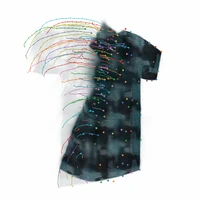
GPSDynamicsModel — graph-based (GNN + Transformer) dynamics model for
variable-vertex cloth meshes, two-gripper. Given the 3 previous mesh
frames and a per-hand 3D gripper action, predicts the next 5 mesh frames via
DDPM diffusion, using each cloth's own rest state and topology (no global
template).
- Task data: DexGarmentLab bimanual garment demos (
dexgarmentlab_dual_gps2048_clean.h5, Cloth-splatters/dexgarmentlab-dual-meshes-clean) - Formulation: DDPM diffusion (
scaled_linear, 1000 steps, Min-SNR-gamma 5.0) - Max grippers: 2
- Cross-attention mode: parallel
- Max vertices per mesh: 2048
- Best validation loss: 6.656742061750265e-05 m^2 position MSE (checkpoint in
model/ischeckpoint-best) - Training run:
demos2h_dyn_gps_ddpm_2026-08-21_17-27-35_776086(full config inconfig.yml)
Recipe
lr 5e-4 cosine over an explicit 160k-step horizon, warmup 500, batch 32,
history_noise_std 1e-4. The cosine horizon is not cosmetic: a constant
lr 1e-3 run on the predecessor dataset reached 4.89e-4 around step 155k and
then diverged to ~1e-2 by 200k. Best validation landed at step 155k of 160k
with the LR already annealed to ~0, so the horizon — not the model — was the
binding constraint; a longer run would likely still gain.
Structured history corruption (history_rigid_std / history_smooth_std) is
deliberately not used: A/B'd against a matched control it lost on both
ground-truth-bootstrapped (3.48 vs 2.94 cm) and state-estimator-fed (4.91 vs
4.20 cm) histories.
Two-hand action convention
max_grippers: 2. The action is one token stream per hand, with a learned
gripper-ID embedding and per-gripper grasped-flag node channels. A trajectory
that moves only one hand parks the other and flags it in the recording's
hand_active attribute; the loader masks that slot out of both gripper_mask
and the translation-centering centroid, so it behaves exactly like a padded
slot.
This matters when reading the source data: the recording also carries legacy
single-gripper gripper_pos / actuated_vertices fields, but on a two-handed
trajectory those are a lossy back-compat projection — the legacy point is a
virtual gripper between the hands, ~14 cm from the vertices it nominally
drives (the real per-hand positions sit 3-4 cm away), and the legacy mask
covers only ~85 of the ~153 vertices the two hands actually hold. Use
gripper_pos_2h / actuated_vertices_2h, as ClothDynamicsVariableDataset
and ClothDynamicsGraphDataset now do.
Evaluation
scripts/benchmark_dynamics_accuracy.py, validation split (24 held-out
garments — the split is by garment, baked into the dataset file, so no
trajectory of a validation cloth is ever seen in training), 50 denoising
steps, one trajectory per cloth for the rollout:
| model | one-shot (5 frames) | rollout mean | rollout end |
|---|---|---|---|
-dynamics-gps (DDPM) |
1.25 cm | 1.86 cm | 3.00 cm |
-dynamics-gps-flow |
1.24 cm | 1.84 cm | 3.10 cm |
-dynamics-gns |
0.52 cm | 3.75 cm | 5.72 cm |
The two diffusion models are within noise of each other on both metrics. GNS is 2.4x better one step ahead and ~2x worse over the horizon — it is the accurate one-step predictor and the fastest to drift.
- Downloads last month
- -