

ColPali: Efficient Document Retrieval with Vision Language Models
Paper • 2407.01449 • Published • 51
ColPali is a model based on a novel model architecture and training strategy based on Vision Language Models (VLMs) to efficiently index documents from their visual features. It is a PaliGemma-3B extension that generates ColBERT- style multi-vector representations of text and images. It was introduced in the paper ColPali: Efficient Document Retrieval with Vision Language Models and first released in this repository
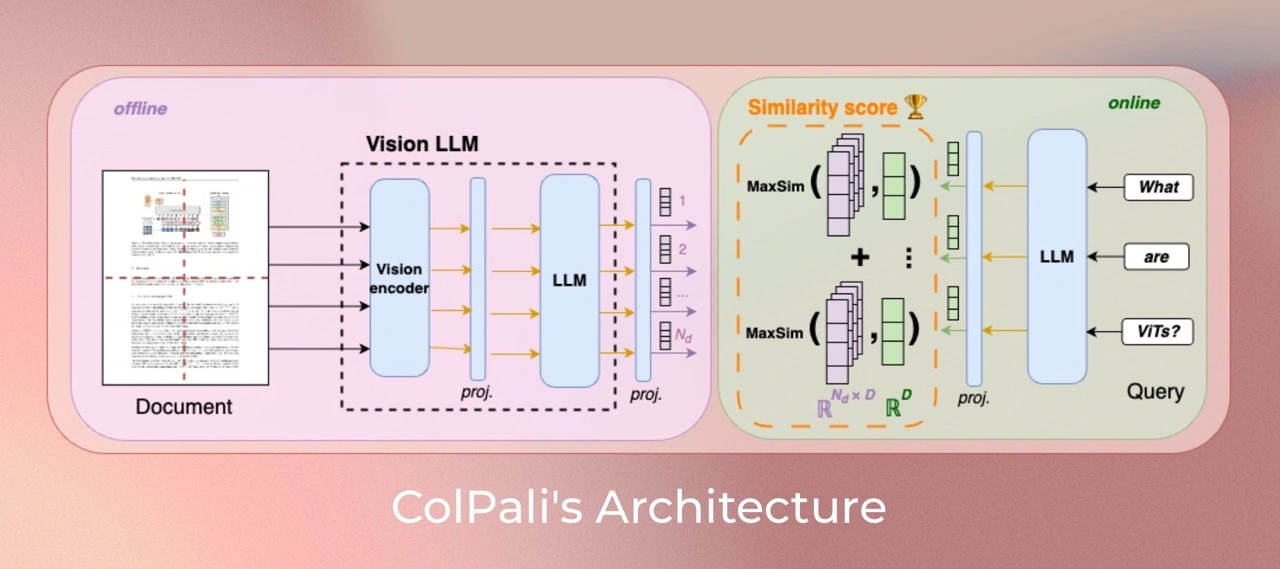
This model is built iteratively starting from an off-the-shelf SigLIP model. We finetuned it to create BiSigLIP and fed the patch-embeddings output by SigLIP to an LLM, PaliGemma-3B to create BiPali.
One benefit of inputting image patch embeddings through a language model is that they are natively mapped to a latent space similar to textual input (query). This enables leveraging the ColBERT strategy to compute interactions between text tokens and image patches, which enables a step-change improvement in performance compared to BiPali.
Our training dataset of 127,460 query-page pairs is comprised of train sets of openly available academic datasets (63%) and a synthetic dataset made up of pages from web-crawled PDF documents and augmented with VLM-generated (Claude-3 Sonnet) pseudo-questions (37%). Our training set is fully English by design, enabling us to study zero-shot generalization to non-English languages. We explicitly verify no multi-page PDF document is used both ViDoRe and in the train set to prevent evaluation contamination. A validation set is created with 2% of the samples to tune hyperparameters.
Note: Multilingual data is present in the pretraining corpus of the language model (Gemma-2B) and potentially occurs during PaliGemma-3B's multimodal training.
All models are trained for 1 epoch on the train set. Unless specified otherwise, we train models in bfloat16 format, use low-rank adapters (LoRA)
with alpha=32 and r=32 on the transformer layers from the language model,
as well as the final randomly initialized projection layer, and use a paged_adamw_8bit optimizer.
We train on an 8 GPU setup with data parallelism, a learning rate of 5e-5 with linear decay with 2.5% warmup steps, and a batch size of 32.
ColPali can be used as a multi-vector (ColBERT-style late interaction) retriever directly with Sentence Transformers via the MultiVectorEncoder.
Support for ColPali relies on the
MultiVectorEncoder, which has not yet been included in a stable Sentence Transformers release as of writing. Until it is, install Sentence Transformers from source:pip install "sentence-transformers[image] @ git+https://github.com/huggingface/sentence-transformers.git" peft
from sentence_transformers import MultiVectorEncoder

# trust_remote_code=True lets Sentence Transformers load the LoRA adapter onto its PaliGemma base
model = MultiVectorEncoder("tomaarsen/colpali-st", trust_remote_code=True)

queries = [
    "What is the variable represented on the y-axis of the graph?",
    "Total outlay is maximum in which year?",
]
images = [
    "https://huggingface.co/tomaarsen/colpali-st/resolve/main/assets/doc1.jpg",
    "https://huggingface.co/tomaarsen/colpali-st/resolve/main/assets/doc2.jpg",
    "https://huggingface.co/tomaarsen/colpali-st/resolve/main/assets/doc3.jpg",
    "https://huggingface.co/tomaarsen/colpali-st/resolve/main/assets/doc4.jpg",
]

# Queries are text (the visual prompt + query augmentation buffer are applied automatically),
# documents are page images.
query_embeddings = model.encode_query(queries, convert_to_tensor=True)
document_embeddings = model.encode_document(images, convert_to_tensor=True)
print(f"Query 0 shape:    {tuple(query_embeddings[0].shape)}")
print(f"Document 0 shape: {tuple(document_embeddings[0].shape)}")
# Query 0 shape:    (25, 128)
# Document 0 shape: (1031, 128)

# MaxSim late-interaction scoring (rows = queries, columns = images)
scores = model.similarity(query_embeddings, document_embeddings)
print(scores)
# tensor([[18.2500, 17.7500, 14.8750, 14.5625],
#         [ 9.1875, 13.4375,  9.3125, 10.9375]], dtype=torch.bfloat16)
For best performance, newer models are available (vidore/colpali-v1.2)
# This model checkpoint is compatible with version 0.1.1, but not more recent versions of the inference lib
pip install colpali_engine==0.1.1
import torch
import typer
from torch.utils.data import DataLoader
from tqdm import tqdm
from transformers import AutoProcessor
from PIL import Image

from colpali_engine.models.paligemma_colbert_architecture import ColPali
from colpali_engine.trainer.retrieval_evaluator import CustomEvaluator
from colpali_engine.utils.colpali_processing_utils import process_images, process_queries
from colpali_engine.utils.image_from_page_utils import load_from_dataset


def main() -> None:
    """Example script to run inference with ColPali"""

    # Load model
    model_name = "vidore/colpali"
    model = ColPali.from_pretrained("vidore/colpaligemma-3b-mix-448-base", torch_dtype=torch.bfloat16, device_map="cuda").eval()
    model.load_adapter(model_name)
    processor = AutoProcessor.from_pretrained(model_name)

    # select images -> load_from_pdf(<pdf_path>),  load_from_image_urls(["<url_1>"]), load_from_dataset(<path>)
    images = load_from_dataset("vidore/docvqa_test_subsampled")
    queries = ["From which university does James V. Fiorca come ?", "Who is the japanese prime minister?"]

    # run inference - docs
    dataloader = DataLoader(
        images,
        batch_size=4,
        shuffle=False,
        collate_fn=lambda x: process_images(processor, x),
    )
    ds = []
    for batch_doc in tqdm(dataloader):
        with torch.no_grad():
            batch_doc = {k: v.to(model.device) for k, v in batch_doc.items()}
            embeddings_doc = model(**batch_doc)
        ds.extend(list(torch.unbind(embeddings_doc.to("cpu"))))

    # run inference - queries
    dataloader = DataLoader(
        queries,
        batch_size=4,
        shuffle=False,
        collate_fn=lambda x: process_queries(processor, x, Image.new("RGB", (448, 448), (255, 255, 255))),
    )

    qs = []
    for batch_query in dataloader:
        with torch.no_grad():
            batch_query = {k: v.to(model.device) for k, v in batch_query.items()}
            embeddings_query = model(**batch_query)
        qs.extend(list(torch.unbind(embeddings_query.to("cpu"))))

    # run evaluation
    retriever_evaluator = CustomEvaluator(is_multi_vector=True)
    scores = retriever_evaluator.evaluate(qs, ds)
    print(scores.argmax(axis=1))


if __name__ == "__main__":
    typer.run(main)
ColPali's vision language backbone model (PaliGemma) is under gemma license as specified in its model card. The adapters attached to the model are under MIT license.
If you use any datasets or models from this organization in your research, please cite the original dataset as follows:
@misc{faysse2024colpaliefficientdocumentretrieval,
  title={ColPali: Efficient Document Retrieval with Vision Language Models},
  author={Manuel Faysse and Hugues Sibille and Tony Wu and Bilel Omrani and Gautier Viaud and Céline Hudelot and Pierre Colombo},
  year={2024},
  eprint={2407.01449},
  archivePrefix={arXiv},
  primaryClass={cs.IR},
  url={https://arxiv.org/abs/2407.01449},
}
Base model
google/paligemma-3b-mix-448