

The dataset viewer is not available for this split.
Error code:   StreamingRowsError
Exception:    TypeError
Message:      Couldn't cast array of type
struct<speaker: string, turn: string, other_turn: list<item: string>, gender: string, age: string, emotion: string, speech event: list<item: string>, 这段数据是在什么环境: string, 隐私安全标识: list<item: null>>
to
{'speaker': Value('string'), 'turn': Value('string'), 'other_turn': List(Value('string')), 'gender': Value('string'), 'age': Value('string'), 'emotion': Value('string'), 'speech event': List(Value('string')), '这段数据是在什么环境': Value('string')}
Traceback:    Traceback (most recent call last):
                File "/src/services/worker/src/worker/utils.py", line 99, in get_rows_or_raise
                  return get_rows(
                         ^^^^^^^^^
                File "/src/libs/libcommon/src/libcommon/utils.py", line 272, in decorator
                  return func(*args, **kwargs)
                         ^^^^^^^^^^^^^^^^^^^^^
                File "/src/services/worker/src/worker/utils.py", line 77, in get_rows
                  rows_plus_one = list(itertools.islice(ds, rows_max_number + 1))
                                  ^^^^^^^^^^^^^^^^^^^^^^^^^^^^^^^^^^^^^^^^^^^^^^^
                File "/usr/local/lib/python3.12/site-packages/datasets/iterable_dataset.py", line 2815, in __iter__
                  for key, example in ex_iterable:
                                      ^^^^^^^^^^^
                File "/usr/local/lib/python3.12/site-packages/datasets/iterable_dataset.py", line 2352, in __iter__
                  for key, pa_table in self._iter_arrow():
                                       ^^^^^^^^^^^^^^^^^^
                File "/usr/local/lib/python3.12/site-packages/datasets/iterable_dataset.py", line 2377, in _iter_arrow
                  for key, pa_table in self.ex_iterable._iter_arrow():
                                       ^^^^^^^^^^^^^^^^^^^^^^^^^^^^^^
                File "/usr/local/lib/python3.12/site-packages/datasets/iterable_dataset.py", line 536, in _iter_arrow
                  for key, pa_table in iterator:
                                       ^^^^^^^^
                File "/usr/local/lib/python3.12/site-packages/datasets/iterable_dataset.py", line 419, in _iter_arrow
                  for key, pa_table in self.generate_tables_fn(**gen_kwags):
                                       ^^^^^^^^^^^^^^^^^^^^^^^^^^^^^^^^^^^^
                File "/usr/local/lib/python3.12/site-packages/datasets/packaged_modules/json/json.py", line 310, in _generate_tables
                  self._cast_table(pa_table, json_field_paths=json_field_paths),
                  ^^^^^^^^^^^^^^^^^^^^^^^^^^^^^^^^^^^^^^^^^^^^^^^^^^^^^^^^^^^^^
                File "/usr/local/lib/python3.12/site-packages/datasets/packaged_modules/json/json.py", line 130, in _cast_table
                  pa_table = table_cast(pa_table, self.info.features.arrow_schema)
                             ^^^^^^^^^^^^^^^^^^^^^^^^^^^^^^^^^^^^^^^^^^^^^^^^^^^^^
                File "/usr/local/lib/python3.12/site-packages/datasets/table.py", line 2369, in table_cast
                  return cast_table_to_schema(table, schema)
                         ^^^^^^^^^^^^^^^^^^^^^^^^^^^^^^^^^^^
                File "/usr/local/lib/python3.12/site-packages/datasets/table.py", line 2303, in cast_table_to_schema
                  cast_array_to_feature(
                File "/usr/local/lib/python3.12/site-packages/datasets/table.py", line 1852, in wrapper
                  return pa.chunked_array([func(chunk, *args, **kwargs) for chunk in array.chunks])
                                           ^^^^^^^^^^^^^^^^^^^^^^^^^^^^
                File "/usr/local/lib/python3.12/site-packages/datasets/table.py", line 2109, in cast_array_to_feature
                  casted_array_values = _c(array.values, feature.feature)
                                        ^^^^^^^^^^^^^^^^^^^^^^^^^^^^^^^^^
                File "/usr/local/lib/python3.12/site-packages/datasets/table.py", line 1854, in wrapper
                  return func(array, *args, **kwargs)
                         ^^^^^^^^^^^^^^^^^^^^^^^^^^^^
                File "/usr/local/lib/python3.12/site-packages/datasets/table.py", line 2059, in cast_array_to_feature
                  _c(array.field(name) if name in array_fields else null_array, subfeature)
                File "/usr/local/lib/python3.12/site-packages/datasets/table.py", line 1854, in wrapper
                  return func(array, *args, **kwargs)
                         ^^^^^^^^^^^^^^^^^^^^^^^^^^^^
                File "/usr/local/lib/python3.12/site-packages/datasets/table.py", line 2149, in cast_array_to_feature
                  raise TypeError(f"Couldn't cast array of type\n{_short_str(array.type)}\nto\n{_short_str(feature)}")
              TypeError: Couldn't cast array of type
              struct<speaker: string, turn: string, other_turn: list<item: string>, gender: string, age: string, emotion: string, speech event: list<item: string>, 这段数据是在什么环境: string, 隐私安全标识: list<item: null>>
              to
              {'speaker': Value('string'), 'turn': Value('string'), 'other_turn': List(Value('string')), 'gender': Value('string'), 'age': Value('string'), 'emotion': Value('string'), 'speech event': List(Value('string')), '这段数据是在什么环境': Value('string')}
Need help to make the dataset viewer work? Make sure to review how to configure the dataset viewer, and open a discussion for direct support.

SmoothConv
SmoothConv is a high-quality Chinese multi-channel conversational speech dataset with expert human annotations, developed by ASLP@NPU and QualiaLabs as part of the SmoothConv–DuplexConv corpus family.



Companion dataset: DuplexConv on HuggingFace (2,000 hours, LLM-assisted annotation). SmoothConv and DuplexConv are constructed from the same underlying conversational sources. SmoothConv provides high-fidelity human annotations for benchmarking and supervised training; DuplexConv offers large-scale annotations for Speech LLM pre-training and data-driven modeling.
Dataset Overview
SmoothConv contains 100 hours of naturally occurring multi-party Chinese conversations recorded in multi-channel environments across Tutoring and Social Chat scenarios. Unlike corpora dominated by read speech or scripted interactions, it captures realistic conversational dynamics, including overlapping speech, backchannels, interruptions, pauses, and turn transitions.
The dataset is manually annotated by trained experts and provides fine-grained conversational labels, making it suitable for turn-taking modeling, overlap and interruption detection, full-duplex spoken dialogue systems, conversational speech understanding, and Speech LLM research.
| Metric | Value |
|---|---|
| Total Duration | 100.53 hours |
| Audio Files | 2,503 |
| Mean Duration | 144.59 sec |
| Duration Range | 60.0 – 634.7 sec |
| Language | Chinese (zh) |
| Domains | Tutoring, Social Chat |
| Annotation | Expert human annotation |
Domains & Directory Layout
After download, each conversation is stored under a top-level folder whose name indicates the scenario. Match the folder prefix to the domain:
| Scenario | Folder prefix | Example |
|---|---|---|
| Tutoring | starts with edu or Edu |
Edu_20240101_001/ |
| Social Chat | starts with none_Edu |
none_Edu_20240101_001/ |
Within each folder you will find paired multi-channel audio (.wav) and annotation (.json) files. The same naming convention applies to both SmoothConv and DuplexConv.
Dataset Statistics
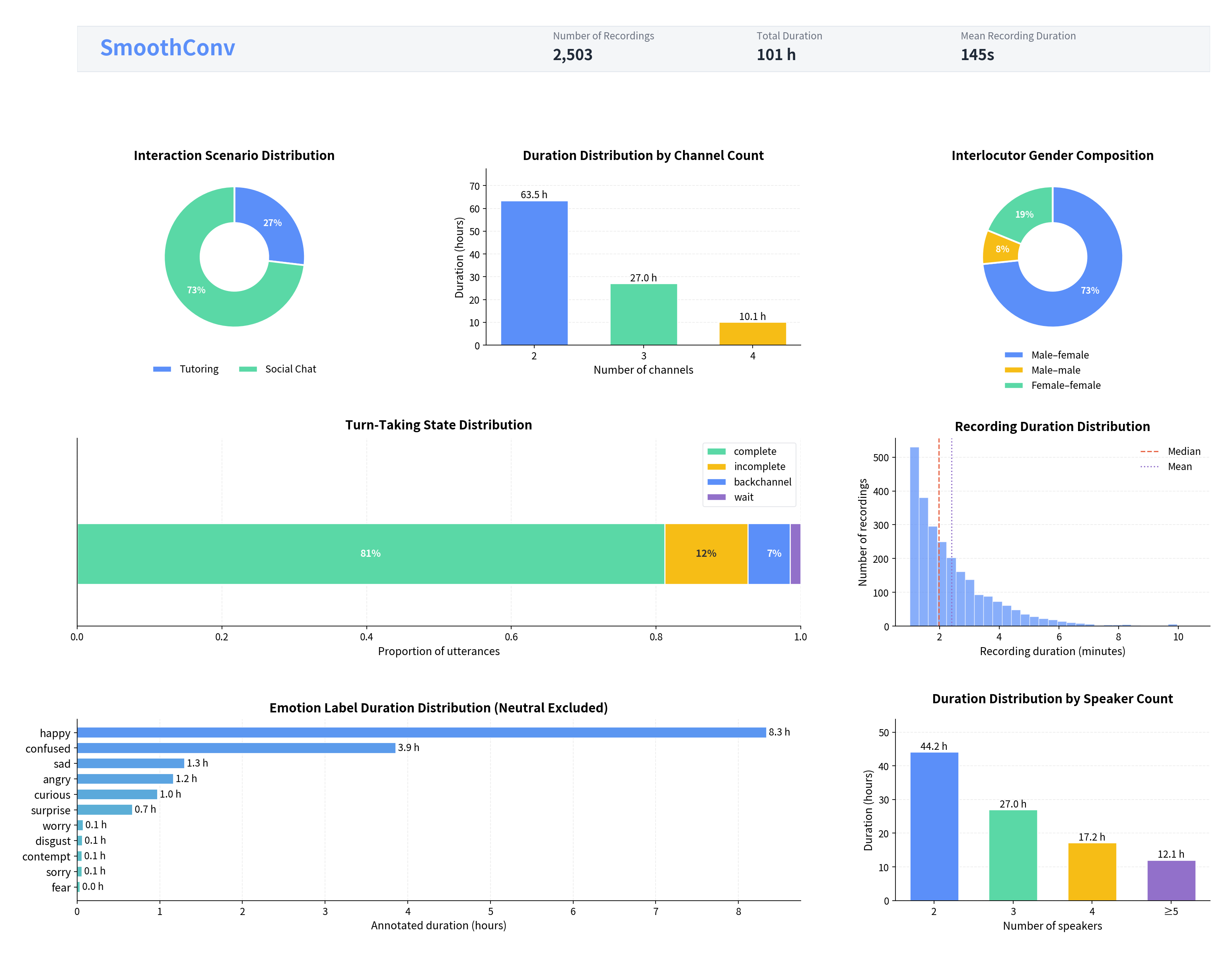
Turn-taking labels include complete, incomplete, backchannel, and wait.
Supported Tasks
- Turn-taking modeling
- Overlap and interruption detection
- Full-duplex spoken dialogue systems
- Conversational speech understanding
- Speech Language Models (Speech LLMs)
Annotation Format
Each audio file is paired with a JSON annotation file. The top-level object contains an instances list; each element describes one annotated segment.
Top-level structure
| Field | Type | Description |
|---|---|---|
instances |
list |
List of annotated segments in the conversation |
instances[i] — per-segment annotation
| Field | Type | Description |
|---|---|---|
id |
str |
Unique segment identifier (UUID) |
channelIndex |
int |
Audio channel index (0-based) |
start |
float |
Segment start time in seconds |
end |
float |
Segment end time in seconds |
text |
str |
Human-annotated transcript; inline tags mark events (e.g. <pause>, <噪声>, <unclear>) |
attributes |
dict |
Speaker, turn, paralinguistic, and scene attributes (see below) |
instances[i].attributes
| Field | Type | Description |
|---|---|---|
speaker |
str |
Speaker ID (e.g. A1, B1); unknown if unidentifiable |
turn |
str |
Turn-taking state: complete, incomplete, backchannel, wait |
other_turn |
list (optional) |
Co-occurring interaction cues, e.g. pause, unknown turn |
gender |
str |
Speaker gender |
age |
str |
Speaker age group (e.g. adult, child) |
emotion |
str |
Emotion label for the segment |
speech event |
list |
Paralinguistic / non-speech events (e.g. nonespeech event, echo, shouting) |
这段数据是在什么环境 |
str |
Scene / environment description |
Example segment
{
  "id": "0d0687e7-b2e5-4b91-834b-f3e8988e7a4a",
  "channelIndex": 0,
  "start": 0.702,
  "end": 5.146,
  "attributes": {
    "speaker": "A1",
    "turn": "complete",
    "gender": "male",
    "age": "adult",
    "emotion": "neutral",
    "speech event": ["nonespeech event"],
    "这段数据是在什么环境": "unknown"
  },
  "text": "春风花草香迟日江山丽日出江花红胜火"
}
Usage
import json
from datasets import load_dataset

ds = load_dataset("qualialabsAI/SmoothConv")

# Load annotation for a sample
with open("path/to/annotation.json", "r", encoding="utf-8") as f:
    anno = json.load(f)

for seg in anno["instances"]:
    print(seg["channelIndex"], seg["start"], seg["end"], seg["text"])
Ethics Statement
- Informed consent. Conversations were recorded with the knowledge and consent of participants. Personal identifiers have been removed or anonymized prior to release.
- Privacy protection. For academic and research use only. Do not attempt to re-identify speakers or reconstruct private information.
- Intended use. Research on spoken dialogue, turn-taking, and speech understanding—not for unauthorized surveillance, impersonation, or deceptive content generation.
- Limitations & bias. Human annotations may contain errors; account for domain and demographic bias in experiments.
- Responsible use. Report suspected misuse to jimz@qualialabs.ai.
License
Citation
@article{wang2026duoconv,
  title   = {DuoConv: Large-Scale Chinese Full-Duplex Speech Datasets for Conversational AI},
  author  = {Chengyou Wang and Chunjiang He and Zhou Zhu and Lei Xie},
  journal = {arXiv preprint arXiv:0000.00000},
  year    = {2026},
  note    = {Placeholder; paper forthcoming}
}
Contact
- Downloads last month
- 1,727