
Jev System One Model: How Typed AI Decisions Work in Software




Most AI software is built around a model that writes. It generates a reply, a summary, a plan, or a block of code. But many production systems do not need another paragraph. They need a small judgment that can be consumed immediately: Which queue should receive this ticket? Is the request urgent? Should a tool call pause for approval? Which model should handle the next step?
The Jev System One model is designed for that decision layer. Instead of asking a language model to explain a conclusion and then parsing the explanation, an application sends a piece of state and a set of typed questions. Jev returns bounded answers, probabilities, and confidence signals that code can use for routing, scoring, guardrails, and review.
This is a different interface for AI, not simply a shorter chat completion. State and typed questions become structured signals; application policy and final action remain in your code. This guide explains the model, its three primitives, its relationship with generative LLMs, and the checks required before production.
Table of contents
- What is the Jev System One model?
- Why software needs a decision model
- How state, questions, and answers fit together
- The three Jev decision primitives
- Jev versus a generative LLM
- A practical System One workflow
- Using probability and confidence safely
- Production architecture and implementation patterns
- When Jev is not the right tool
- Frequently asked questions
What is the Jev System One model?
On the Jev model overview, Jev is presented as a probabilistic model that software can use directly. The core idea is to make the output contract part of the request. You define the state that should be evaluated and describe the exact decision or decisions the application needs.
The result is not intended to be a conversational transcript. Jev is built for a known answer space: a set of categories, an ordered scale, or a yes/no judgment. The output can include a selected choice, a probability distribution, a score, a confidence value, or a yes probability, depending on the question type.
That boundary is important. A generative model is rewarded for producing useful language across many possible tasks. A System One model is useful when the system needs a narrow, inspectable signal many times. The application can make the final decision with ordinary code, deterministic policy, permissions, and human review.
The term “System One” should therefore be read as an architectural role. It is a model for the fast judgment inside a larger system, not a claim that every workflow should be reduced to one classification call. A useful Jev integration leaves open-ended writing and reasoning with the model that is good at those jobs, then uses Jev where a bounded decision must control the next branch.
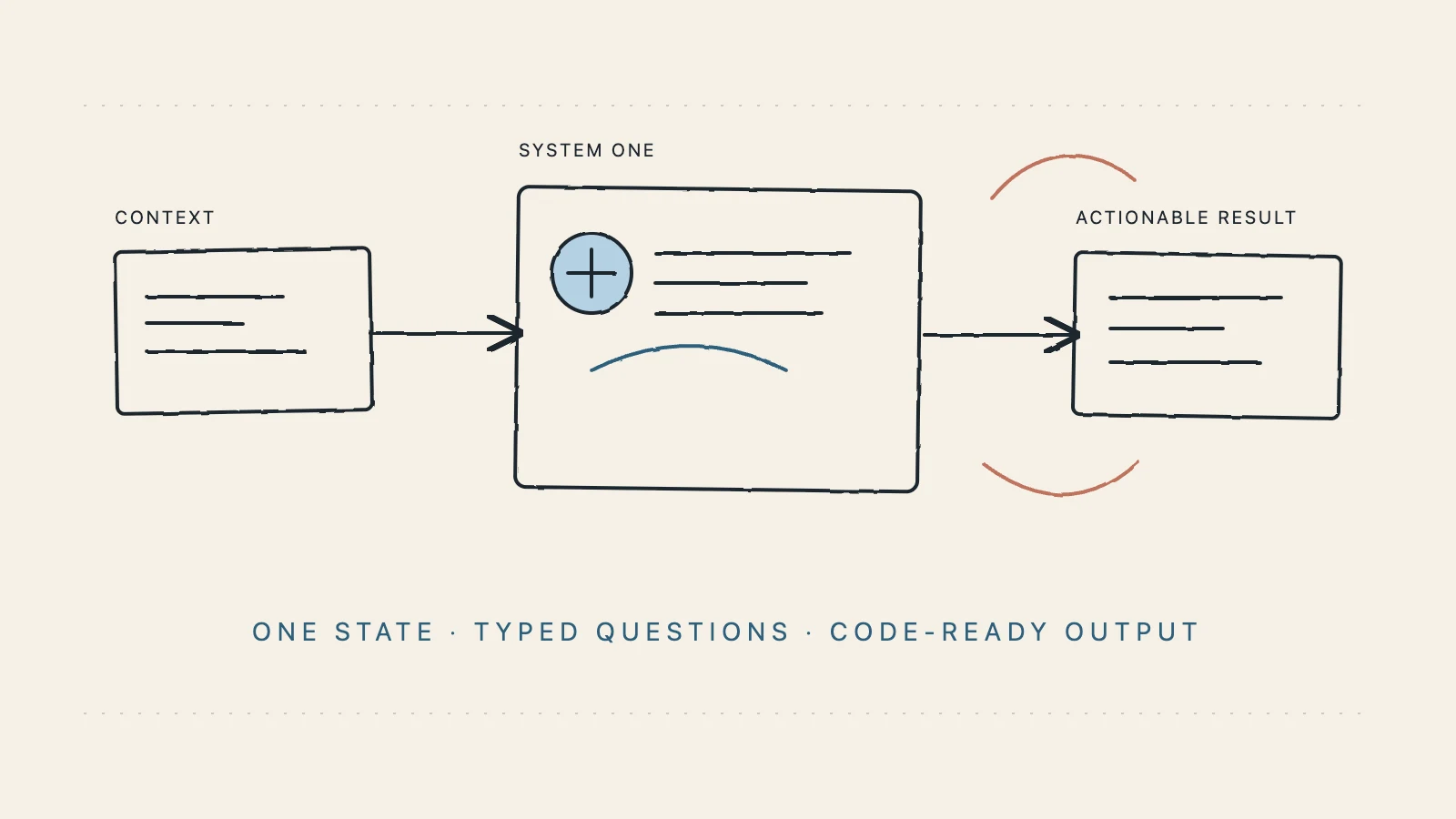
A System One decision layer turns one shared state into several observable signals that application code can act on.
The short definition
The Jev System One model is a decision-oriented AI interface:
- Input: text, a JSON object, or an array of text that describes the current state.
- Questions: typed Choice, Score, or Noul questions with a clear scope.
- Output: answers keyed by your question IDs, with probability and confidence fields where applicable.
- Control: your code decides thresholds, authorization, retries, routing, and the final action.
The public Jev documentation currently describes the jev-latest model and the POST https://thejevai.com/v1/systemone endpoint. API fields and model versions can change, so treat the live Jev developer documentation as the source of truth when implementing a client.
Why software needs a decision model
“The model produced JSON” does not yet mean “the application can safely act.” A decision model makes the semantic contract explicit while your code retains thresholds, permissions, fallbacks, tools, queues, and final actions.
How state, questions, and answers fit together
The Jev request model has a simple shape: one state can be evaluated against multiple questions. The state is shared context. Questions are the decisions. The response mirrors the question IDs so the application can connect a result to a known branch.

The useful unit is not a long prompt; it is shared state plus several small, named decisions.
State is the context, not the policy
State can be a short string such as a customer message or incident alert, or a JSON object combining a ticket, customer tier, policy fields, and other facts needed for one decision.
The application should send the smallest useful state. Remove secrets, unnecessary personal data, payment details, and unrelated retrieval results before making the request. More context is not automatically better; irrelevant fields can make a narrow question less clear and harder to evaluate.
The current website documentation lists text, JSON objects, and arrays of text as supported input forms. It also states that images, audio, and video are not direct inputs at this time. If a product begins with a screenshot or recording, preprocess it with the appropriate transcription, OCR, or vision service and pass only the decision-relevant representation to Jev.
Questions are the program interface
A good question describes one judgment, one output shape, and one reason the answer matters. Compare these two designs:
Broad: Analyze this ticket and decide what the support team should do.

Atomic:
- Which approved team should handle this ticket?
- How urgent is it on a three-level rubric?
- Does it require human review before any action?
The atomic version is easier to test. Each result has a different threshold and can drive a different branch. It is also easier to explain to an operator: the route came from the team answer, the queue priority came from urgency, and the approval requirement came from needs_human.
The three Jev decision primitives
Jev’s three basic question types map cleanly to common software control flow. Choosing the right primitive is more important than making the question sound clever.
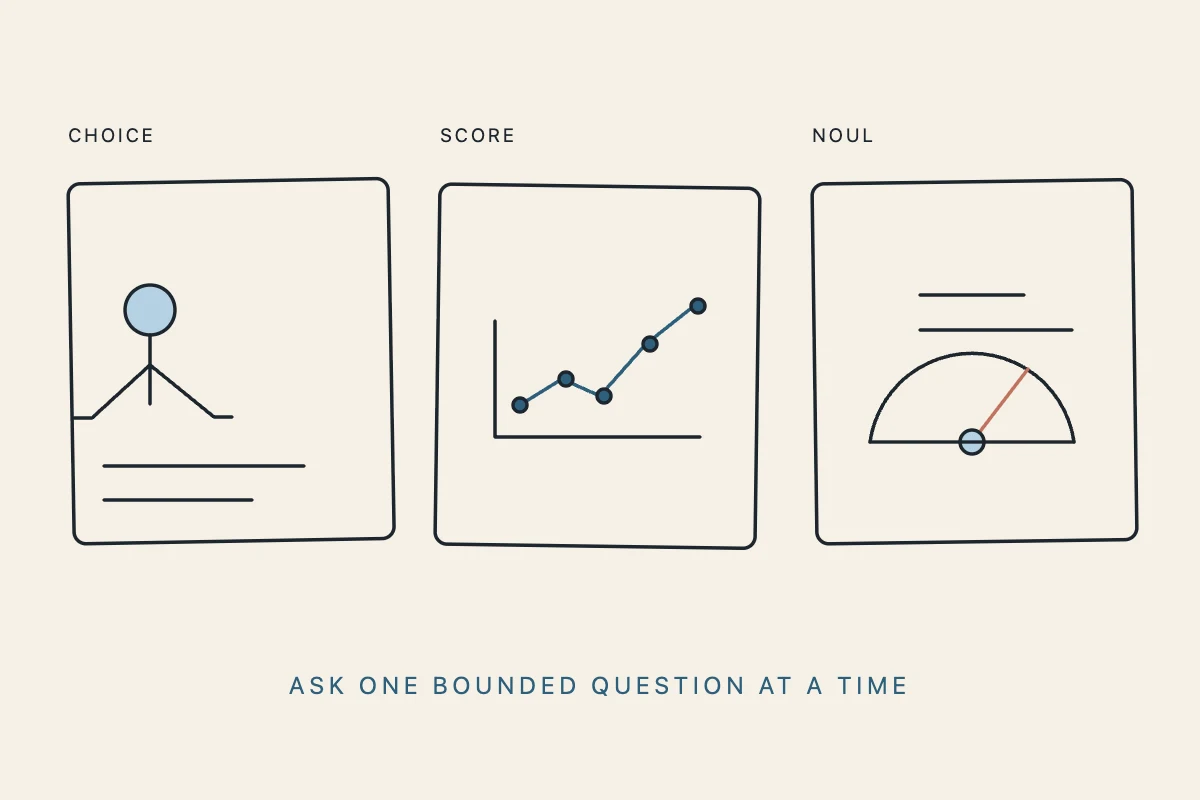
Typed questions give each decision a defined answer boundary: select, rate, or judge whether a statement is true.
Choice: select from approved options
Use Choice when the result should be one item from a defined set, such as a support team, content class, model tier, workflow, or specialist agent.
The answer space should contain the options your application can actually handle. Include other, unknown, or none_of_the_above when forcing a match would be worse than asking for review.
The selected option is useful, but the distribution is often more useful: a 0.86 result with a clear second place may be handled differently from a 0.51 result with three nearly equal candidates.
Score: rate against an ordered rubric
Use Score when the options have an order: low to high risk, calm to urgent, incomplete to complete, or simple to complex. A good Score rubric gives each level a concrete meaning and an operational consequence.
For example, a ticket-urgency rubric can define low as no active outage, medium as a blocked workflow that should be handled today, and high as production impact, data risk, or a time-critical business event.
The result can include a probability-weighted score, a legend, per-level probabilities, and confidence. That lets a queue rank work while preserving the evidence behind the ranking. Evaluate it against labelled examples before treating it as an operational measurement.
Noul: judge whether a statement is true
Use Noul for a yes/no judgment such as:
- Does this request need a person before execution?
- Is the customer explicitly asking for a refund?
- Is the proposed tool call destructive?
- Is the evidence sufficient to publish this claim?
Noul returns a number between 0 and 1 representing the probability that the answer is yes. The official documentation distinguishes this yes probability from the confidence field returned by Choice and Score. That distinction matters when designing thresholds: a Noul result is already the signal for a binary branch, while Choice and Score expose a distribution over alternatives.
Jev versus a generative LLM
Jev is not a replacement for every LLM. It is better understood as a complementary decision component. A generative model is usually the right choice when the output is a paragraph, a code patch, a creative concept, a multi-step explanation, or a plan that must be composed from open-ended reasoning.
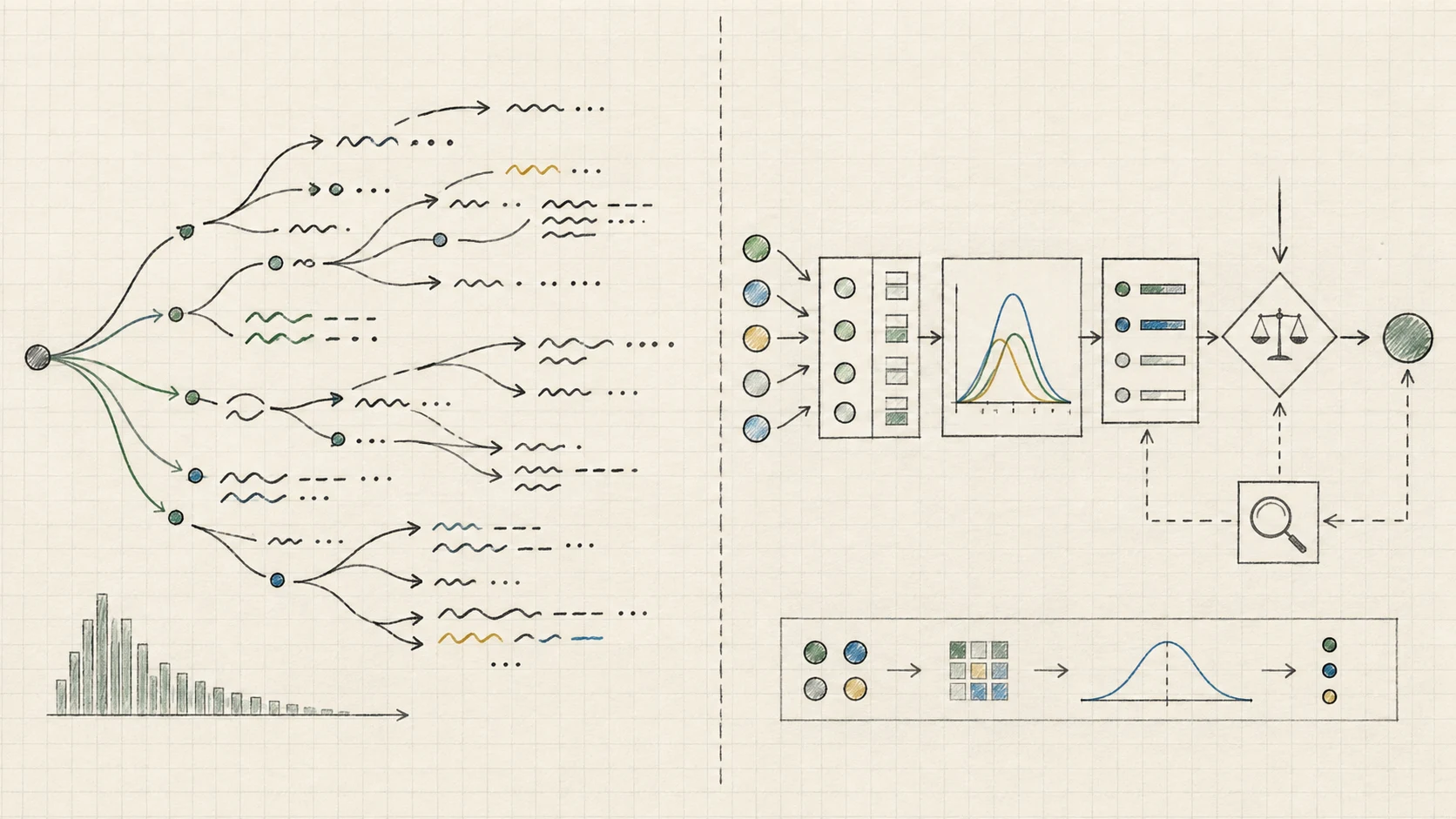
A practical architecture keeps open-ended generation with an LLM and moves bounded control signals into a decision layer.
| Question | Jev System One model | Generative LLM |
|---|---|---|
| Primary job | Make bounded decisions for software | Generate language, code, or open-ended reasoning |
| Interface | State plus typed questions | Prompt plus context |
| Output | Choice, score, yes probability, probabilities, confidence | Text or developer-defined structured content |
| Best fit | Routing, triage, scoring, guardrails | Writing, explanation, synthesis, planning |
| Uncertainty | Exposed as probabilities and confidence signals | Usually requires extra prompting or evaluation |
| Application role | A control signal inside a workflow | The main generation or reasoning engine |
The practical question is not “Which model is smarter?” It is “Which part of the workflow needs what kind of output?” A support agent may use an LLM to draft a reply and Jev to decide the department, urgency, and human-review requirement. A coding agent may use a generative model to write a patch and Jev to check whether the task is complete enough to report or whether a risky tool call needs approval.
If you want a broader engineering comparison, read Jev AI vs. LLMs. The useful boundary is the same: Jev judges a defined question; your application and another model can compose, explain, or execute the result.
A practical System One workflow
The safest way to adopt the Jev System One model is to start with one low-risk, measurable decision. Do not begin by moving an entire agent into a new orchestration pattern.
1. Choose a decision with an observable outcome
Good starting points include ticket routing, content tagging, queue priority, model routing, and a read-only safety check. Write down what “correct” means before calling the API. If operators cannot agree on the labels or rubric, the problem is not ready for a decision model.
2. Define the answer contract
Name the question ID, select Choice, Score, or Noul, and describe the criteria. The question should tell the model how to distinguish answers, while the application code should own what happens after an answer is returned.
3. Validate it in the Playground
The Jev Playground is useful for testing a real state and inspecting the request and response shape before writing integration code. Use representative examples, borderline cases, and known failures. A model that works on obvious examples may still be unsafe near the threshold.
4. Move the request behind your server
The API key belongs in a server-side environment variable. The browser should call your backend, not expose the Jev key. Your service should validate input length, strip sensitive fields, apply timeouts, handle non-success responses, and log enough metadata to reproduce a decision without storing more personal data than necessary.
An abbreviated request sends model: "jev-latest", a state object, and a questions map containing named Choice or Noul entries. The route and review questions can read the same ticket state, while their answers return under the IDs your service chose.
Always follow the live API reference for the exact fields, model name, error codes, and retry behavior. The example demonstrates the shape of the integration, not a promise that every optional field will remain unchanged.
5. Add policy after the model response
Do not call route() immediately after reading choice. First enforce authorization, validate the response, check whether the action is high impact, compare the signal with a versioned threshold, and choose an automatic, fallback, or human-review path. The decision model supplies a signal; policy determines whether it is sufficient for the side effect.
Using probability and confidence safely
Probabilities and confidence are valuable because they expose more than a single label. They are not the same as accuracy, and they are not a guarantee that the business decision is correct.

Confidence should change system behavior: clear low-risk cases can move automatically, while ambiguous or consequential cases need another path.
Set thresholds by risk
A read-only tag can tolerate a lower threshold than a payment, deletion, access change, or customer-facing promise. Start conservatively and measure false positives and false negatives on your own labelled data.
One useful operating policy is:
- High signal, low risk: automate and sample results for monitoring.
- Medium signal or medium risk: ask for confirmation, enrich the state, or run a second check.
- Low signal or high risk: stop, request clarification, or send to a person.
There is no universal threshold. A threshold is a business decision that should be versioned alongside the question definition and evaluated when the model or data distribution changes.
Measure calibration, not just accuracy
For a Choice question, track whether cases at a stated probability are correct at roughly that rate. For a Noul question, measure how often a high yes probability is actually true under your chosen definition. For a Score question, compare rankings and severity bands with operator labels.
Also record coverage: how often the system acts automatically versus falls back. A cautious model that routes only 20% of cases may be more useful than an overconfident model that acts on 95% with expensive mistakes. The right balance depends on the cost of review and the cost of an incorrect action.
Production architecture and implementation patterns
The Jev System One model is easiest to maintain when it stays small and composable. The application should make the call at a stable boundary, validate the response, and return a typed internal signal to the rest of the system.

Keep validation, authorization, policy, execution, and auditability in the application around the model.
Pattern 1: confidence-gated model routing
Use Choice to select from an allowlist of model tiers. If Jev selects a fast model with strong confidence, send the request there. If the distribution is ambiguous, use a stronger model or ask a human. The allowlist, budget, and permissions remain deterministic configuration; Jev does not get to invent a model name.
Pattern 2: pre-tool safety gate
Before a tool call, use Noul to judge whether the proposed action needs approval. Combine that result with static policy: destructive database operations, payments, credential changes, and data export may always require human confirmation. A probabilistic check can add semantic context, but it cannot weaken a hard rule.
These patterns share one rule: the decision stays bounded, and the final action stays in the host application.
When Jev is not the right tool
A decision model is powerful partly because it does less. Use a generative model for long explanations, polished emails, code patches, novel plans, and open-ended answer spaces; use deterministic code for rules that do not need semantic interpretation. Validate Jev with domain data for safety, access, money, privacy, or legal decisions, and use modality-specific services for visual or audio input.
Frequently asked questions
Is the Jev System One model a chatbot?
No. Jev is designed to return decisions that software can consume. It can sit beside a chatbot or agent, but its primary output is a bounded answer such as a choice, score, or yes probability rather than a conversational paragraph.
Does a high confidence value mean the result is correct?
No. Confidence is a signal that should be calibrated against your data. Treat it as an input to policy, not as permission to bypass authorization, deterministic rules, or human review.
Final takeaway
The Jev System One model is best understood as a missing layer between unstructured application state and deterministic software action. It does not try to write everything, own your permissions, or replace your product logic. It makes focused decisions visible as typed values and probability signals.
That makes the design question simple: find the if statement in your system that currently depends on a paragraph, a brittle parser, or an unmeasured guess. Define its answer space, ask one good question, and let your application decide what to do with the result.

